













Maine’s 2025 abortion report was published in June 2025. The report indicates that abortions increased from 2024 to 2025.
The data published by the state doesn’t include the total number of abortions obtained by Maine residents out of state or the number of self-managed abortions on women outside of the healthcare system. The report also does not contain the number of mail-order abortions obtained by Maine residents and prescribed by licensed providers in Maine or in other states. In a separate section, the Charlotte Lozier Institute (CLI) will describe data provided by both the Guttmacher Institute’s Monthly Abortion Provision Study (MAPS) and the Society of Family Planning’s (SFP) #WeCount project detailing the number of mail-order abortions obtained by Maine residents from in and out-of-state prescribers. In the past, the MAPS published estimates on the annual number of the state’s residents who traveled out of state to obtain an abortion. However, the 2025 estimates on out-of-state travel totals have not been released. Guttmacher’s abortion estimates include the number of abortions obtained at brick-and-mortar facilities and those provided via telehealth and virtual providers in the United States.
Maine’s statute code defines abortion as “the intentional interruption of a pregnancy by the application of external agents, whether chemical or physical or by the ingestion of chemical agents with an intention other than to produce a live birth or to remove a dead fetus” (22 M.R.S. §1598).
In Maine, abortion is widely available throughout pregnancy because of the state’s ineffective gestational limit at viability. While the language of the law limits abortion after viability, the law contains a broad health (life and health of the mother) exception that doesn’t differentiate between physical and mental health, which effectively allows abortion throughout pregnancy for nearly any reason (22 M.R.S. §1598).
Statistics and Changes in Maine Abortions, 2024-2025

The report does not include information on Planned Parenthood’s Maine abortion market share.
Abortion Totals and Trends
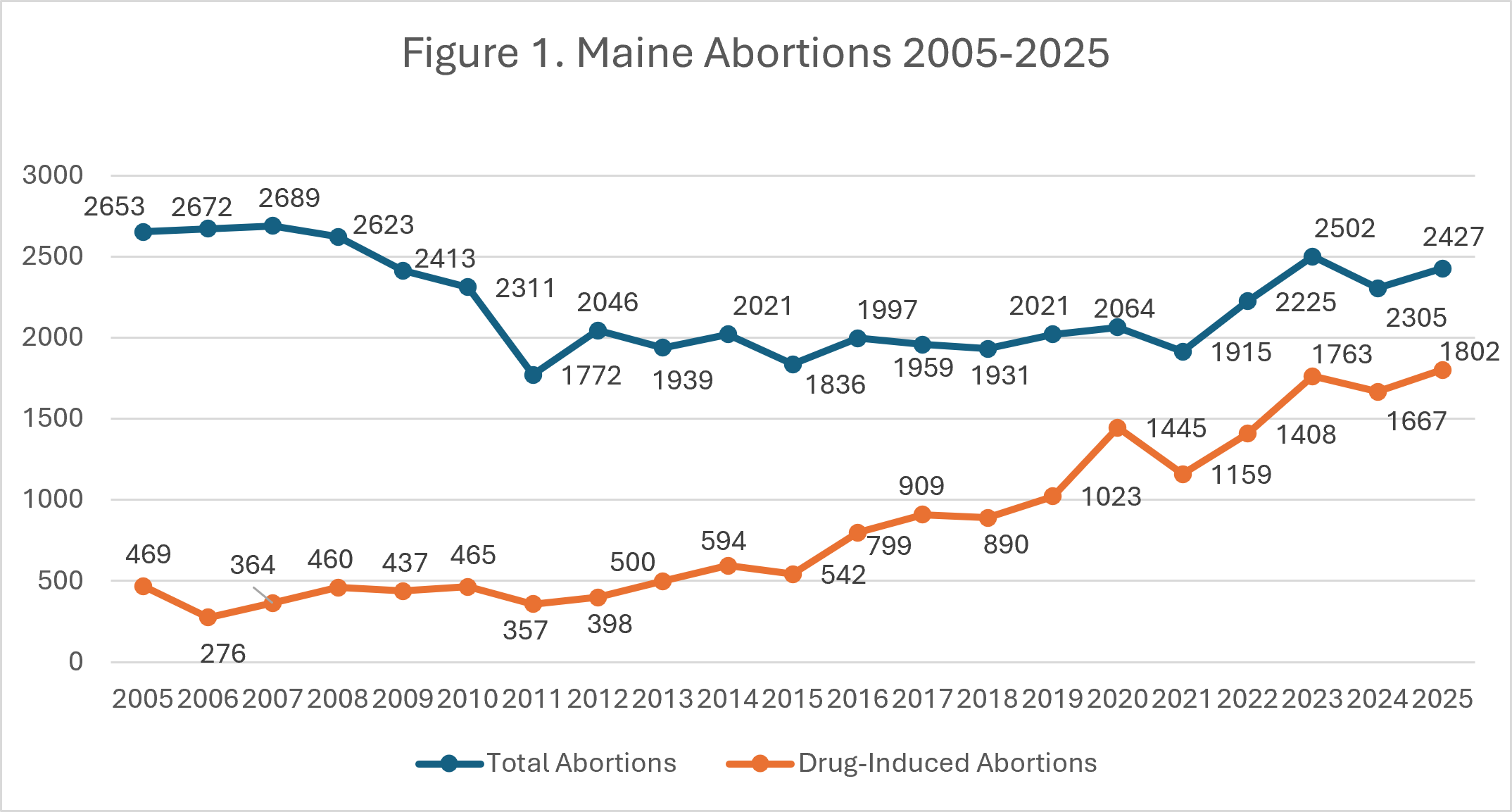
There were 2,427 abortions reported in Maine in 2025, an increase of 5% from the 2,305 reported in 2024. Drug-induced abortions increased by 8% from 1,667 in 2024 to 1,802 in 2025 (Fig. 1). CLI estimates that Maine’s abortion rate in 2025 was 9.7 abortions per 1,000 women ages 15 to 44, an increase of 5% from 2024’s abortion rate of 9.2 (Fig. 2).1 As of July 2026, 11 states have released 2025 data and three have shown an increase in abortions from 2024.
State Report Summary
Ninety-three percent of abortions reported in Maine in 2025 were performed on state residents, and 7% on non-residents. New Hampshire had the greatest number of nonresident women (115) obtain abortions in Maine, followed by Massachusetts (16), Florida (7), and New York (6). Compared to 2024, both the resident and nonresident abortion totals increased in Maine in 2025.
Ten percent of the abortions were performed on girls under the age of 20, including 3% on girls under the age of 18. Fifty-two percent were performed on women in their twenties, with 25% on women ages 20 to 24 and 27% on women ages 25 to 29. Thirty-three percent of Maine abortions were performed on women in their thirties and 4% on women aged 40 or older.
In 2025, drug-induced abortions made up 74% of the abortions reported in Maine. Nineteen percent of the abortions were performed using suction curettage and 5% using a dilation and evacuation procedure. Two percent of abortions were performed via sharp curettage. The number of sharp curettage abortions significantly increased from three abortions in 2023, to 14 in 2024, to 41 in 2025.
Seventy-eight percent of the abortions were performed earlier than nine weeks of gestation, 11% between nine and 10 weeks, and 5% between 11 and 12 weeks. Three percent were performed from 13 to 15 weeks and 2% from 16 to 19 weeks. Thirty-one abortions were reported at 20 weeks of gestation or later, 14 more than in 2024. The number of abortions at nearly every gestational week increased from 2024 to 2025 except those occurring between nine and 10 weeks.
Breakdown of Abortion Providers in Maine2
| # of brick-and-mortar locations | 24 |
| # of independent centers | 19 |
| # of Planned Parenthood centers | 4 |
| # of hospitals/doctors’ offices that perform abortions | 1 |
| # of abortion drug providers | 24 |
| # of abortion drug-only providers | 21 |
| # of surgical and abortion drug providers | 3 |
| Latest gestational age that a center performs surgical abortion | Through 20 weeks |
These abortion provider totals were current as of July 17, 2026. This does not reflect the breakdown of providers available in Maine during the period that Maine’s abortion report covers (2025).
Guttmacher Data3
Guttmacher estimated that in 2025, 2,750 abortions occurred in Maine, versus the state’s reported total of 2,427. To see the differences in Guttmacher’s Maine estimates and the state’s reported totals, see below:

Additionally, in 2025, #WeCount estimated that 3,010 abortions occurred in Maine.4 SFP estimated that 2,230 abortions were obtained in person, while 610 were obtained via virtual-only organizations who ship mail-order abortion drugs within or into the state and 170 abortions were obtained via hybrid brick-and-mortar telehealth organizations. In 2024, the Maine Department of Health and Human Services told CLI via email that they do not collect the number of telehealth abortions to include in their abortion totals. This could explain why Guttmacher’s and #WeCount’s abortion estimates for Maine are much higher than the state’s reported total.
State Ranking
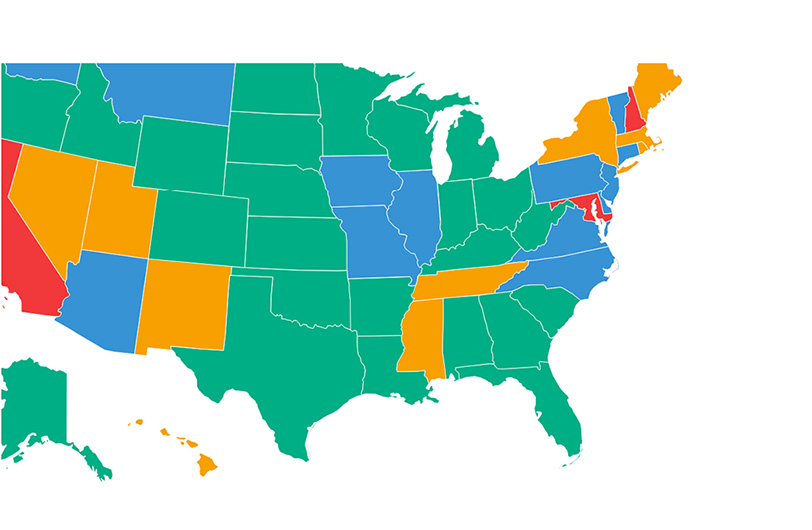
In 2024, CLI published a paper reevaluating state abortion reporting across the country, with Maine ranked at 35th best. As CLI has previously recommended, Maine could expand and strengthen the reporting requirements eliminated by H.P. 1044 and also require the reporting of complications caused by abortion, as many other states do.
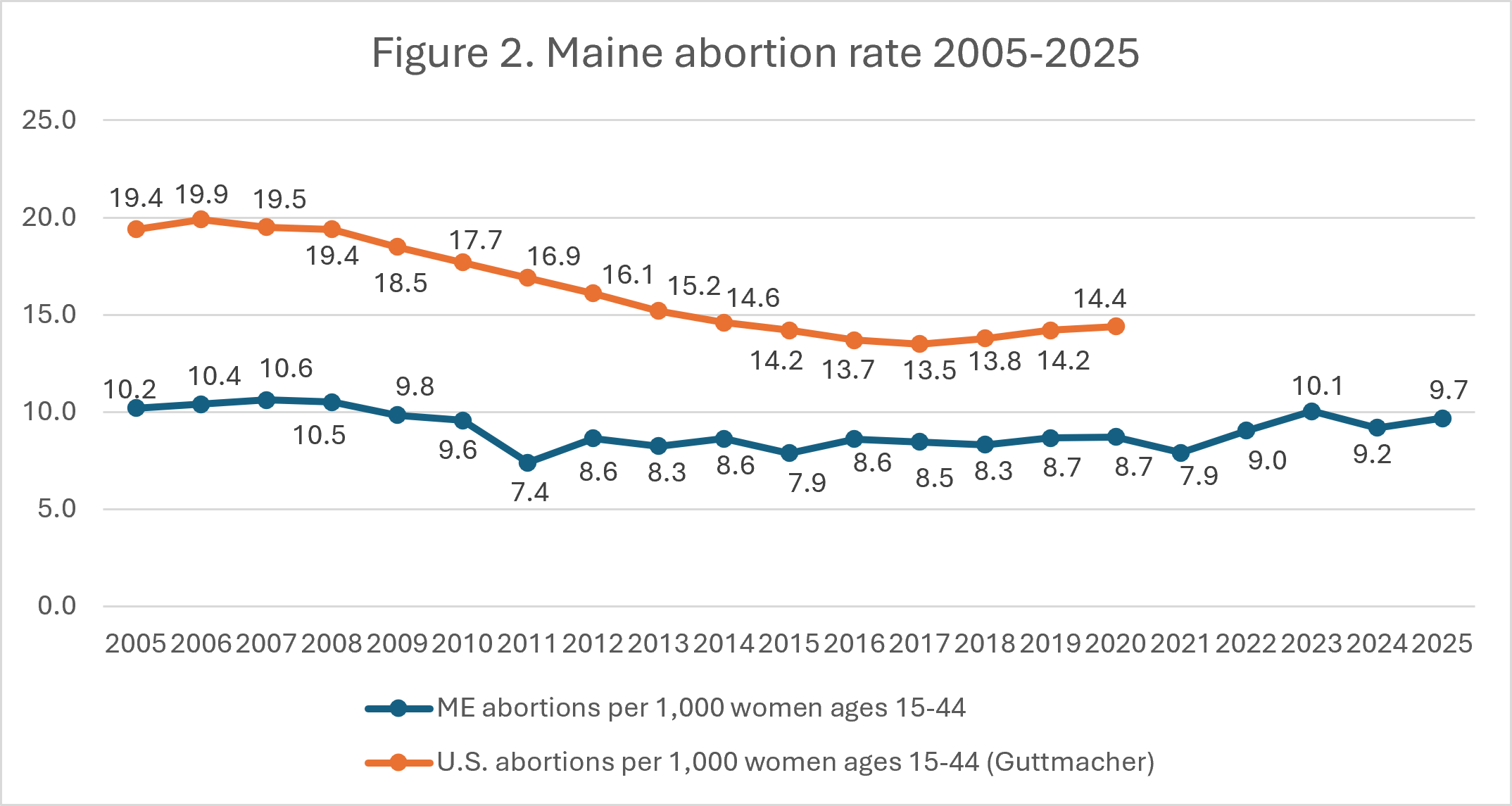
- National rates were calculated by the Guttmacher Institute. Maine rates were calculated by CLI using the following formula: (total number of abortions performed in Maine ÷ number of resident women ages 15-44 [based on most recent population estimates]) x 1,000. Rates may differ slightly from previous CLI articles due to revised population estimates. Population estimates were obtained from the CDC WONDER database. Estimates for 2005-2009 are intercensal estimates of the July 1 resident population. Estimates for 2010-2019 are Vintage 2020 postcensal estimates of the July 1 resident population. Estimates for 2020-2025 are Vintage 2024 postcensal estimates of the July 1 resident population. Estimates were produced by the U.S. Census Bureau and the National Center for Health Statistics. Rates for 2025 were calculated using the Vintage 2024 postcensal estimates because 2025 population estimates have not yet been released by the CDC.
- Provider totals do not include hospitals or physician offices not listed in databases that compile abortion provider locations in different states, but do include Planned Parenthood locations, independent abortion centers, and hospitals/doctors’ offices included in databases like Abortion Finder and INeedAnA. This information was up to date as of July 17, 2026.
- The Guttmacher Institute notes that their monthly abortion totals by state are estimates and that each state’s estimate is within a range of uncertainty. Guttmacher’s data can be found in the CSV folder here(Summary_Table_Annual_2023_2024_2025). This information was updated as of July 17, 2026.
- #WeCount’s data can be found hereby downloading the “Report data tables [.xlsx]” document. The #WeCount report specifies that the numbers included in their tables for abortions performed under shield laws only represent the number of women to whom abortion drugs were sent, not the number of drug-induced abortions that resulted from the mailed drugs. However, because #WeCount’s data is the only source of data that delineates the number of abortions by mode of provision (in-person, telehealth/mail order, and/or abortion drugs obtained under shield laws), their data is the best available. This information was updated as of July 17, 2026.
Click here to view reporting from:2024202320222021201920182017