











Nebraska’s 2025 abortion report was published on July 1, 2026, on the electronic dashboard of the state’s Department of Health and Human Services. The data shows that reported abortions increased in the Cornhusker state.
The data published by the state does not include the total number of abortions obtained by Nebraska residents out of state or the number of self-managed abortions on women outside of the healthcare system. The report also does not contain the number of mail-order abortions obtained by Nebraska residents prescribed by licensed abortion providers in other states. In a separate section, CLI will describe data provided by both the Guttmacher Institute’s Monthly Abortion Provision Study (MAPS) and the Society of Family Planning’s (SFP) #WeCount project detailing the number of mail-order abortions obtained by Indiana residents from out of state prescribers. In the past, the MAPS published estimates on the annual number of a state’s residents who traveled out of state to obtain an abortion. However, the 2025 estimates on out-of-state travel totals have not been released. Guttmacher’s abortion estimates include the number of abortions obtained at brick-and-mortar facilities and those provided via telehealth and virtual providers in the United States.
Nebraska law defines abortion as “the prescription or use of any instrument, device, medicine, drug, or substance to or upon a woman known to be pregnant with the specific intent of terminating the life of her preborn child” (§71-6914). According to the same law , abortion is not the removal of an ectopic pregnancy or an already deceased unborn child, nor is it an act done with the intention to save the life or preserve the health of the unborn child.
In Nebraska, abortion is prohibited after 11 weeks of gestation except in the cases of a medical emergency or a pregnancy resulting from sexual assault or incest (§71-6915).
Statistics and Changes in Nebraska Abortions, 2024-2025

The report does not include information on Planned Parenthood’s Nebraska abortion market share.
Abortion Totals and Trends
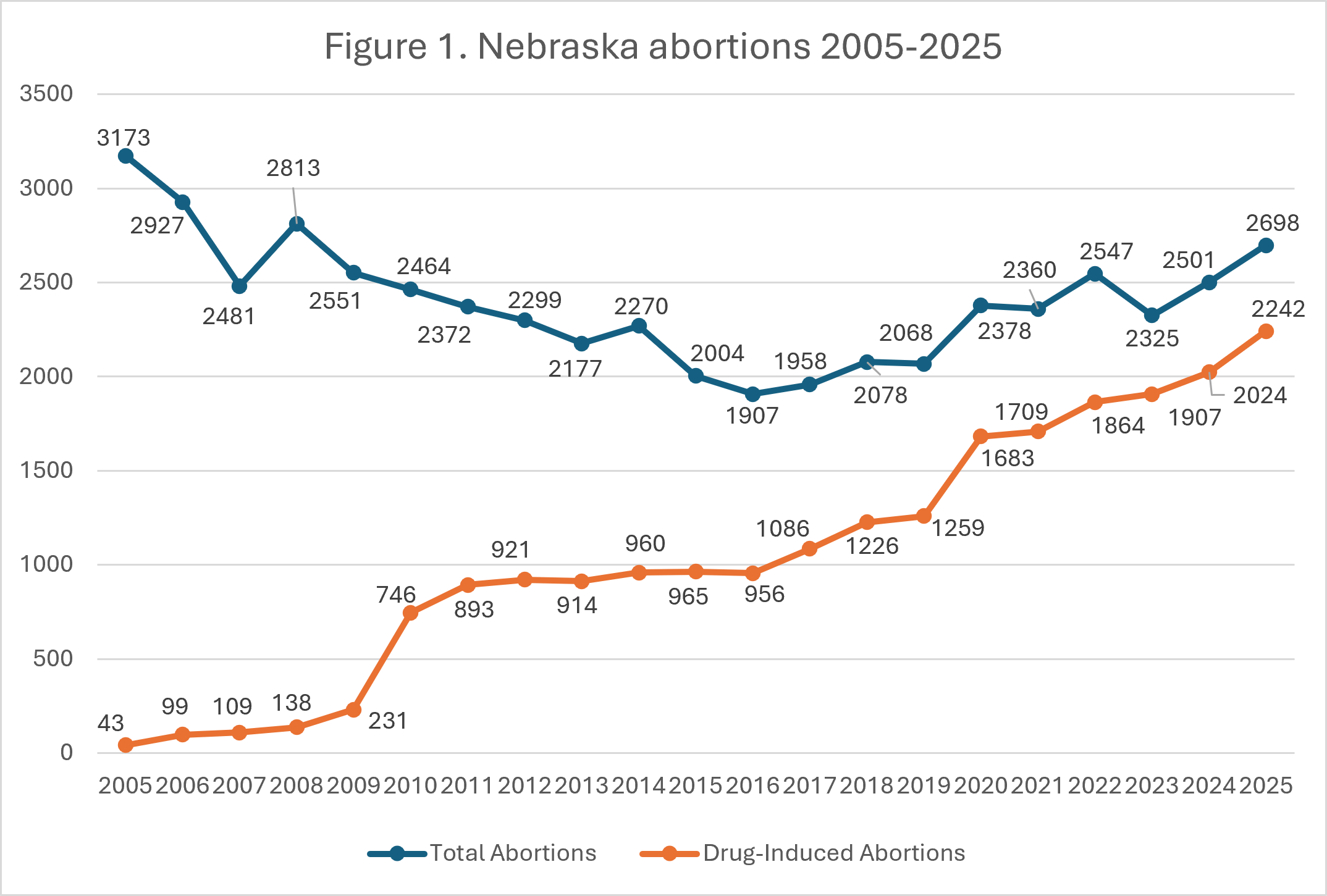
In 2025, there were 2,698 abortions reported in Nebraska, an increase of 8% from 2,501 reported the previous year. Drug-induced abortions increased by 11% from 2,024 in 2024 to 2,242 in 2025, making up 83% of all abortions in the state (Fig. 1). Nebraska’s abortion rate increased by 8% to 6.8 abortions per 1,000 women of childbearing age, according to CLI (Fig. 2).1 As of July 2026, 11 states have released 2025 abortion statistics, and three states reported that abortions increased from 2024.
State Report Summary
In 2025, 73% of the abortions reported in Nebraska were performed on state residents, while 27% were performed on women from other states. The number of abortions performed on state residents decreased by 4% from 2024 to 2025, while the number of abortions performed on non-residents increased by 63%. The biggest percentage (24%) of abortions performed on women from other states were performed on Iowa women. The number of Iowa women who obtained abortions in Nebraska increased by 77% from 2024 to 2025, rising from 358 to 635. Sixty-six abortions were performed on South Dakota women, seven on Texas women, and three on Missouri women. A handful of abortions in Nebraska in 2025 were performed on women from Alabama, Colorado, Florida, Georgia, Kansas, Louisiana, Mississippi, Montana, Ohio, Oklahoma, Pennsylvania, Tennessee, and Wisconsin.
Twelve percent of Nebraska abortions were performed on girls younger than 20, and 55% were obtained by women in their twenties. Thirty percent of Nebraska abortions were performed on women in their thirties, and 4% on women ages 40 and older.
In 2025, 43% of the abortions were performed on non-Hispanic white women, and 21% on non-Hispanic black women. Two percent were performed on non-Hispanic American Indian women, and 4% on non-Hispanic Asian/Pacific Islander women. Twenty abortions were performed on non-Hispanic, multi-racial women. Twenty-four percent were performed on Hispanic women and race was not reported for 5% of the abortions. Nebraska’s black abortion rate of 24.9 abortions per 1,000 women of childbearing age was nearly six times higher than the white abortion rate of 4.2.
A majority of abortions were performed on women whose highest level of education was a high-school diploma (53%). Twenty-one percent of abortions were performed on women who had attended some college, while 14% were performed on women with a college degree. Eleven percent of abortions were performed on women who had not graduated high school, while educational status was not reported for 1% of the abortions.
Sixty-eight percent of the abortions were performed on women who had been pregnant before. Thirty-three percent of the abortions were performed on women who had previously had an abortion, with 21% on women with one prior abortion and 12% on women with more than one. Forty-one percent of women who obtained abortions in Nebraska had zero previous live births, while 23% had one previous live birth. Thirty-six percent had two or more previous live births. Eighty-three percent of the abortions were performed on unmarried women, and 13% on married or separated women. Marital status was not reported for 3% of the abortions.
Two dilation and evacuation (dismemberment) abortions and zero dilation and extraction abortions (the procedure used in partial-birth abortion) occurred in 2025. The majority of abortions reported in Nebraska (83%) were drug-induced. Seventeen percent of the abortions were conducted via suction curettage. One sharp curettage abortion was performed.
In 2025, 37% of the state’s reported abortions occurred at six weeks of gestation or less. Thirty-five percent were performed on women between seven and eight weeks of gestation, while 22% were performed between nine and 10 weeks of gestation. Six percent of the state’s reported abortions were performed between 11 and 12 weeks of gestation, and two abortions were performed between 13 and 14 weeks. One abortion was performed at 15 weeks of gestation or later.
The postfertilization age (PFA) was determined for all but two abortions. For the 2,696 abortions that had a determined PFA, the PFA was determined by ultrasound in 83% of the cases, abdominal ultrasound in 17% of the cases, and another, unknown method for one abortion.
The 2025 Nebraska report states that 10 doctors performed abortions in the state that year.
Women undergoing abortions in Nebraska are asked to share their reasons for seeking abortion, and each woman may provide multiple reasons. In 2025, 4% of women declined to answer. Six percent of all women getting abortions were seeking an abortion due to contraceptive failure, and 4% did not use contraception. Eighty percent of abortions were performed for socioeconomic reasons and 17% were performed due to the woman’s mental health. Seven percent were performed due to physical health concerns. Twenty-three abortions were performed to preserve the life of the mother, 15 due to sexual assault, and 10 because of the presence of a fetal anomaly. Thirty-six abortions occurred because of an unspecified “emergency situation.”
Seventy-six percent of the unborn babies killed by abortion were less than 60 millimeters long (approximately 2.4 inches), while a suppressed number were 60 millimeters or longer. Twenty-four percent of the babies couldn’t be measured. Sixteen percent of the babies weighed less than 100 grams, and four babies weighed 100 grams or more. Eighty-four percent could not be measured.
In 2025, parental consent for abortion was obtained for 79 minors.
There were six abortion-related complications in 2025 while 15 were reported in 2024.2 There were three cases of retained products of conception, one cervical laceration, and two other unspecified complications.
Abortions Performed by County of Occurrence
In 2025, Nebraska abortions occurred in three counties: Douglas County, where a Planned Parenthood is located; Lancaster County, where no known abortion centers are open; and Sarpy County where an abortion center once owned by the deceased late-term abortionist, Leroy Carhart, is located and remains open. Below is a breakdown of the number of abortions in Nebraska by county.
| # of Abortions, 2025 | % of Abortions, 2025 | |
| Douglas County | 2,236 | 83% |
| Lancaster | 5 | 0.2% |
| Sarpy | 457 | 17% |
| Total | 2,698 | NA |
As previously noted, the Planned Parenthood location in Lincoln, Nebraska (Lancaster County), stopped performing abortions. The location remains open.
Abortions Performed by County of Occurrence
In 2025, the counties (other than the category labeled “other county” in the state’s abortion report) with the five highest counts of resident women who obtained abortions in Nebraska included:
- Douglas (NE)- 1,040 abortions
- Lancaster (NE)- 328
- Polk (IA)- 235
- Sarpy (NE)- 180
- Woodbury (IA)- 99
Given this data and the county of occurrence data, more nonresidents (1,196) than residents obtained abortions in Douglas County and 277 of the 457 abortions (61%) occurring in Sarpy were obtained by nonresidents.
Breakdown of Abortion Providers in Nebraska3
| # of brick-and-mortar locations | 2 |
| # of independent centers | 1 |
| # of Planned Parenthood centers | 1 |
| # of hospitals/doctors’ offices that perform abortions | 0 |
| # of abortion drug providers | 2 |
| # of abortion drug-only providers | 1 |
| # of surgical and abortion drug providers | 1 |
| Latest gestational age that a center performs surgical abortion | Through 11 weeks |
These abortion provider totals were current as of July 2026.
Guttmacher Data4
In 2025, Guttmacher estimated that 3,910 abortions occurred in Nebraska, while the state reported 2,698,a total 45% lower than Guttmacher’s estimate. To see the differences in Guttmacher’s Nebraska estimates and the state’s reported totals, see below:

A possible explanation for the discrepancy between the state’s reported total of abortions occurring in the state and Guttmacher’s estimate is that Nebraska’s total did not include abortions performed using abortion drugs mailed into the state, which Guttmacher’s estimate does. Under state law, telehealth abortions (abortion drugs being sent through the mail within or from outside of the state) are illegal (Neb. R.R.S. §28-335). However, Guttmacher tracks the number of abortion drugs sent into Nebraska from states where abortionists are legally exempted under the state’s shield law and includes these abortions in its total estimate. If one looks at data provided by SFP’s #WeCount project, 2,780 in-person abortions were performed in Nebraska in 2025. This figure is very similar to the number reported by the state. However, #WeCount also reports that 1,210 abortion drug regimens were mailed into Nebraska from abortionists in states with shield laws, meaning that they estimated a total of 3,990 abortions occurred in the state in 2025.5 The discrepancy between the state’s reported total and Guttmacher (1,212) as well as the discrepancy between the state’s reported total and #WeCount’s (1,292) can almost be exclusively explained by Guttmacher’s and #WeCount’s inclusion in their estimates of abortion drugs mailed into Nebrasak , and the state’s lack of doing so.
State Ranking
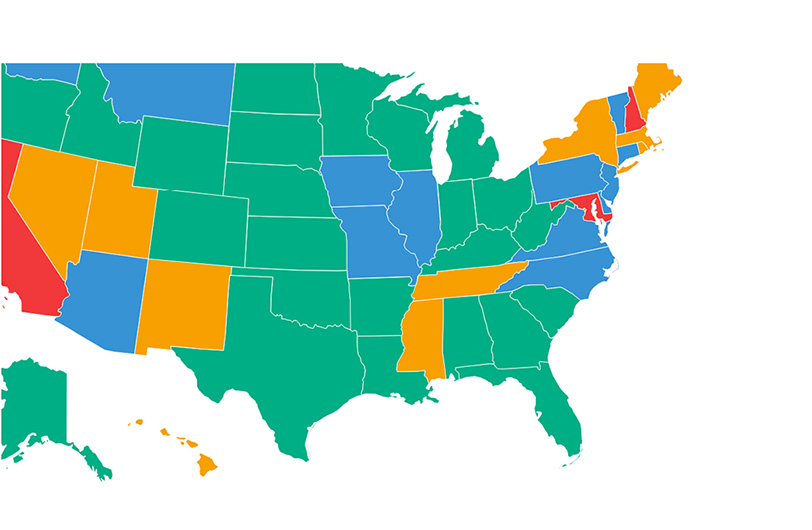
In CLI’s updated 2024 evaluation of abortion reporting across the country, Nebraska’s reporting was ranked as tied for 4th best. To enhance its abortion reporting, Nebraska could improve its abortion complication data collection and reporting as well as specify if drug-induced abortions were performed in office or via the mail. Furthermore, the state could report the number of abortions by facility.
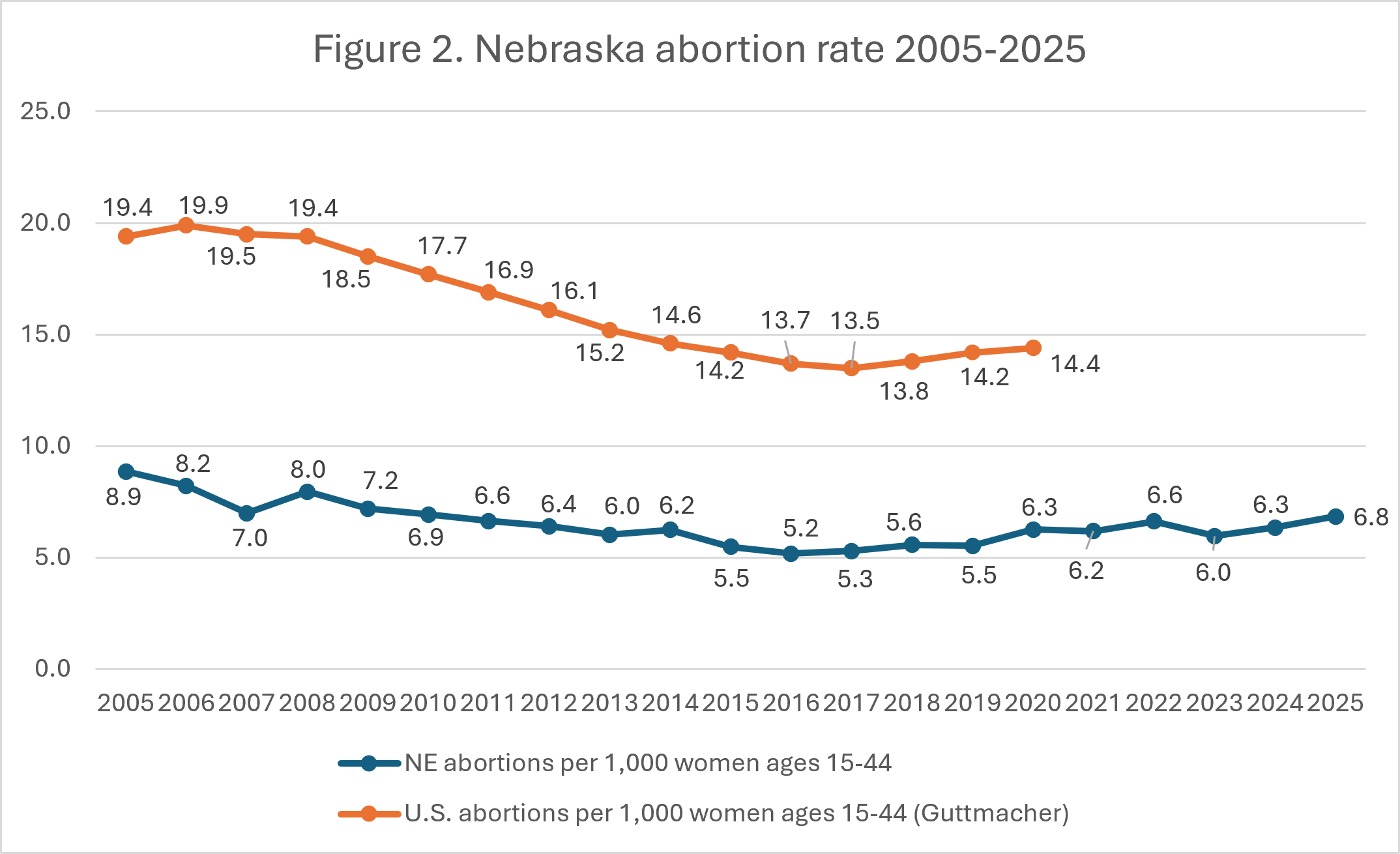
- National rates were calculated by the Guttmacher Institute. Nebraska rates were calculated by CLI using the following formula: (total number of abortions performed in Nebraska ÷ number of resident women ages 15-44 [based on most recent population estimates]) x 1,000. Rates may differ slightly from previous CLI articles due to revised population estimates. Population estimates were obtained from the CDC WONDER database. Estimates for 2005-2009 are intercensal estimates of the July 1 resident population. Estimates for 2010-2019 are Vintage 2020 postcensal estimates of the July 1 resident population. Estimates for 2020-2025 are Vintage 2024 postcensal estimates of the July 1 resident population. Estimates were produced by the U.S. Census Bureau and the National Center for Health Statistics. Rates for 2025 were calculated using the Vintage 2024 postcensal estimates because 2025 population estimates have not yet been released by the CDC.
- Statistics on abortion complications reported here represent a minimal number of deaths and complications as this data is collected in a non-systematic and non-verifiable way. As such, this data cannot be used to calculate either an accurate abortion mortality rate or an accurate abortion complication rate for the state.
- Provider totals do not include hospitals or physician offices not listed in databases that compile abortion provider locations in different states, but do include Planned Parenthood locations, independent abortion centers, and hospitals/doctors’ offices included in databases like Abortion Finder and I Need An A. This information was up to date as of July 17, 2026.
- The Guttmacher Institute notes that their monthly abortion totals by state are estimates and that each state’s estimate is within a range of uncertainty. Guttmacher’s data can be found in the CSV folder here(Summary_Table_Annual_2023_2024_2025). This information is updated as of July 17, 2026.
- #WeCount’s data can be found hereby downloading the “Report data tables [.xlsx]” document. The #WeCount report specifies that the numbers included in their tables for abortions performed under shield laws only represent the number of women to whom abortion drugs were sent, not the number of drug-induced abortions that resulted from the mailed drugs. However, because #WeCount’s data is the only source of data that delineates the number of abortions by mode of provision (in-person, telehealth/mail order, and/or abortion drugs obtained under shield laws), their data is the best available. This information was updated as of July 17, 2026.
Click here to view reporting from:2024320232022202120202019201820172016