





Search Icon
close-panel

Charlotte Lozier Institute

Phone: 202-223-8073
Fax: 571-312-0544

2776 S. Arlington Mill Dr.
#803
Arlington, VA 22206

Get Notifications

Sign up to receive email updates from Charlotte Lozier Institute.

This field is for validation purposes and should be left unchanged.

close-panel

Become A Defender of Life

Your donation helps us continue to provide world-class research in defense of life.

DONATE

Charlotte Lozier Institute

Phone: 202-223-8073
Fax: 571-312-0544

2776 S. Arlington Mill Dr.
#803
Arlington, VA 22206

Future Eggs and Sperm

Dive Deeper
Did you know that all a woman’s eggs formed before she was born?

In fact, she had more egg cells as a fetus than at any other point in her life. All oocytes form before birth. Interestingly, a female fetus will have produced over 7 million oocytes by five months gestation,1 but many of these are selectively eliminated so that she only has 600,000 to 800,000 oocytes when she is born. By puberty, only about 40,000 eggs remain.  During a woman’s reproductive lifetime, she will ovulate less than 500 eggs.2

How are eggs formed?

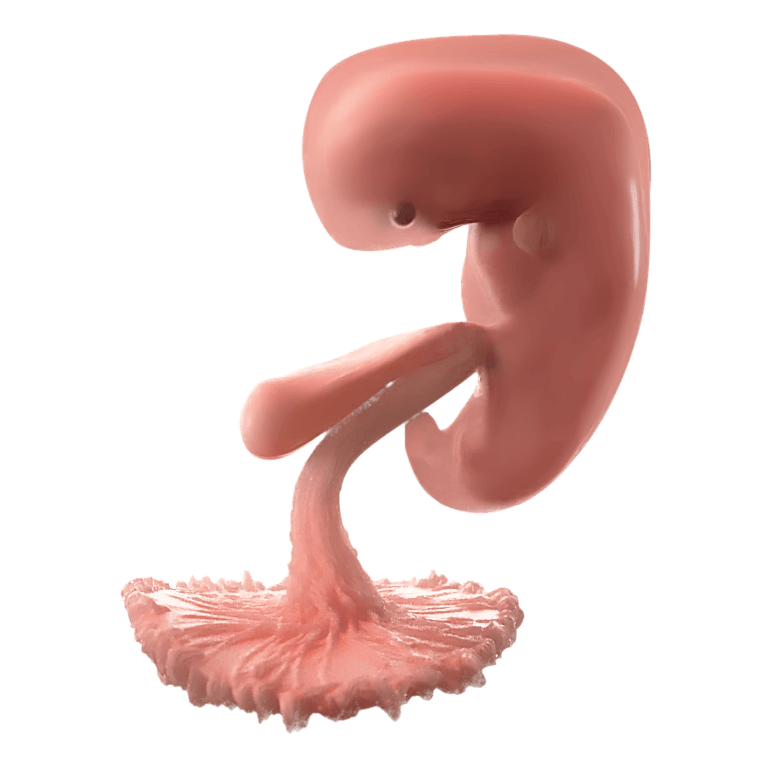
Both the egg cells in a female, and the sperm-producing cells in a male come from primordial germ cells that originate in the yolk sac. During week 7, approximately 300 to 1300 primordial germ cells migrate from the yolk sac through the developing umbilical cord into the developing gonads which will become the ovaries or testes.3 4 These cells will provide the entire pool of future egg and sperm cells.

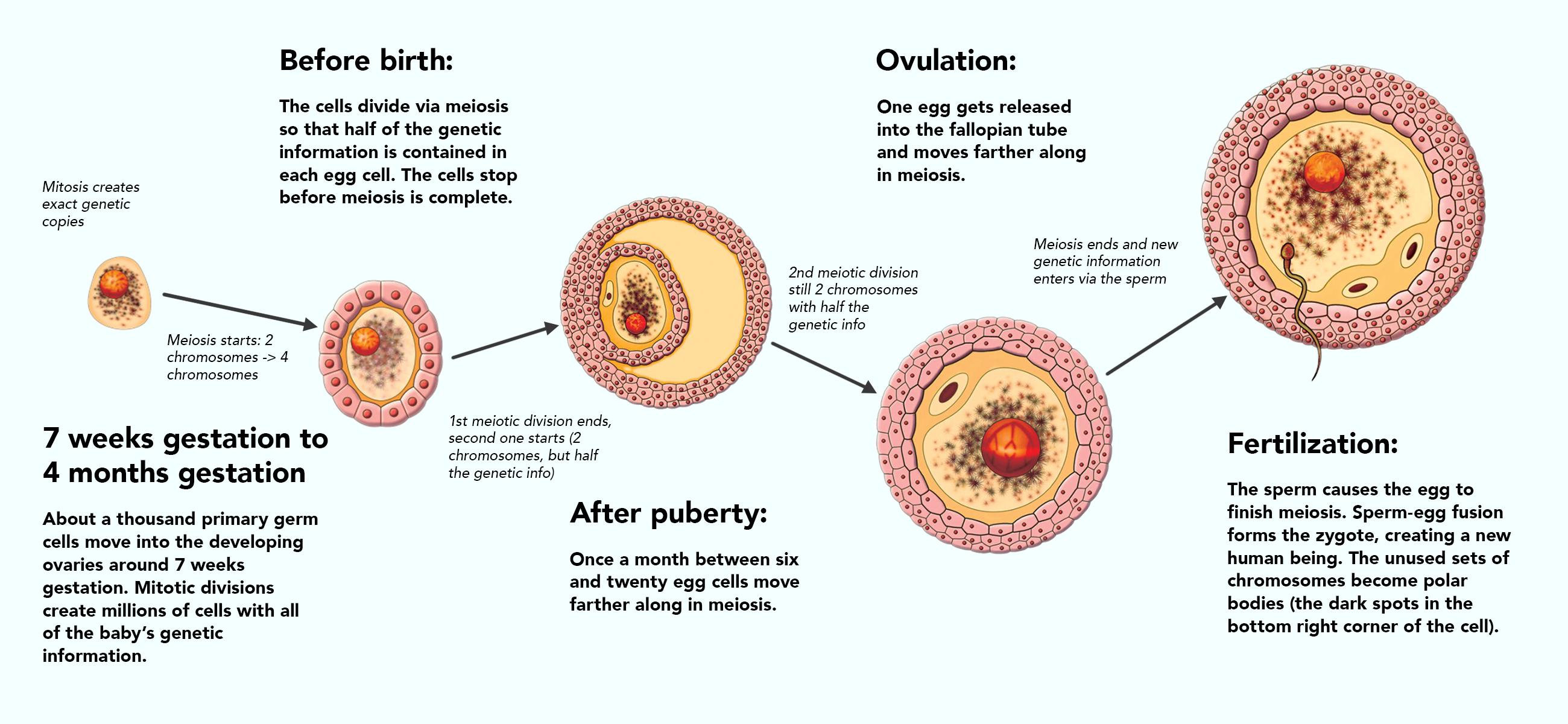
The picture below shows how eggs form in a process known as oogenesis. In females, the primordial germ cells continue dividing via mitosis. During mitosis, cells make an exact copy of their genetic information. In fact, there are special mechanisms to make sure that there are no copying mistakes in the primordial germ cells when the DNA replicates.5 These cells are diploid, having a full set of 46 chromosomes.6

This diagram depicts oogenesis. Oogenesis is the process by which a primary germ cell becomes an egg that can be released during ovulation and fertilized. Each primary oocyte undergoes meiosis so that only half of the genetic information from the mother gets passed to her child. (Image Credit: Science Source)

By four months, the primordial germ cells start dividing to create egg cells. Egg cells will undergo two rounds of cell division known as “meiosis,” where the genetic information within the cell will be reduced to half of the normal amount. Primordial germ cells begin the first round of meiosis and then pause half-way in a stage of the process known as “prophase,” where they will remain until puberty. During prophase, genetic information is exchanged between the chromosomes originating from the woman’s mother and her father, producing chromosomes with unique combinations of genetic information that will be inherited by her children. This process is called “crossing over.” These cells, called primary oocytes, can remain in prophase for more than 40 years. The prophase step only finishes when the cell matures at the start of a woman’s menstrual cycle. 7 8

When do eggs finish maturing?

At puberty, each month, between 15 and 20 primary oocytes begin to mature. The maturing cells complete the first round of meiosis, eliminating half of their original DNA in a small structure known as a polar body. This makes them haploid, with 23 single chromosomes. The egg cells are now known as secondary oocytes. They contain 23 pairs of chromosomes, but because of the exchange of genetic information during prophase of meiosis I, each chromosome of the pair contains a new arrangement of information.  If the oocyte is fertilized, the child will have its own unique genome.9

Each month, one secondary oocyte typically gets released into the fallopian tube during ovulation.  If more than one oocyte matures and is released, a woman can become pregnant with fraternal (non-identical) twins.  After ovulation, the secondary oocyte remains in a stage of the second meiotic cycle known as metaphase. The second meiotic cycle (meiosis II) is only completed after the oocyte is fertilized.  Sperm-egg fusion at fertilization produces the one-cell human embryo, or zygote, with a unique genome that is different from either parent.10

When does sperm form?

In males, the primordial germ cells lie dormant until puberty. After sexual maturity, these primordial cells, now called spermatogonia stem cells, are capable of two main functions:

  1. dividing to create clones and replace themselves
  2. dividing to form sperm cells.

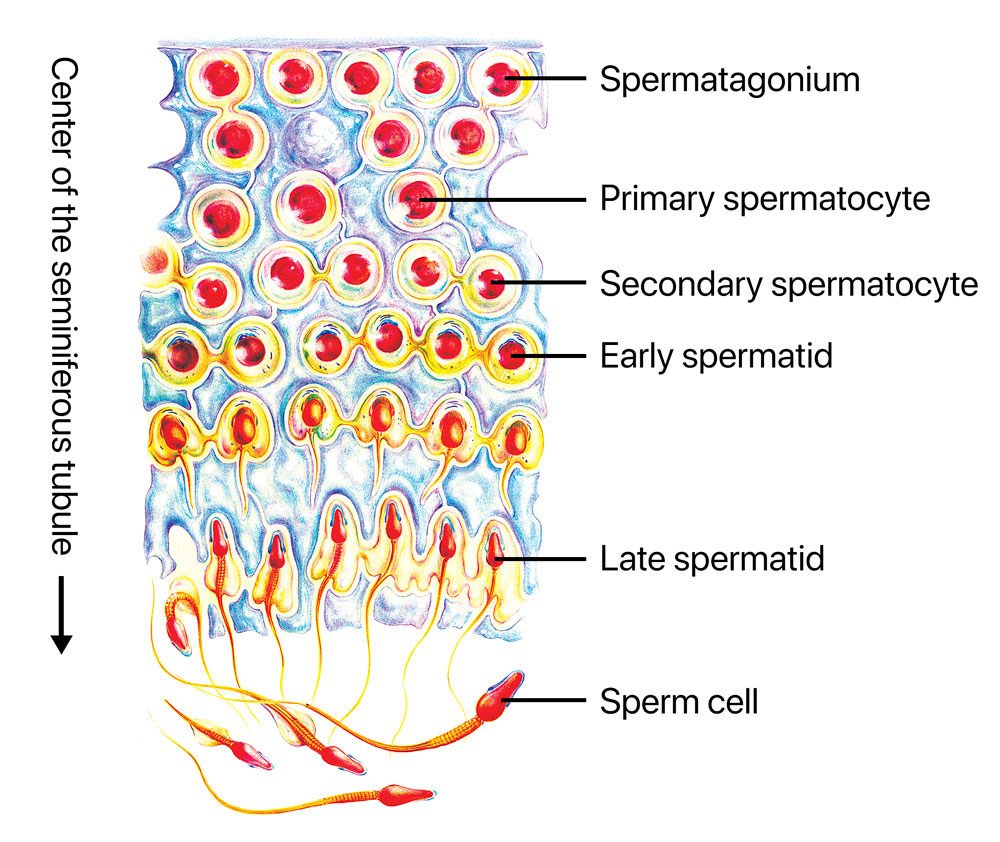
Spermatogonia divide via meiosis to form sperm cells. Meiosis creates new haploid cells with half of the original number of chromosomes. The young sperm cells then get a cap, called the acrosome, which helps the sperm penetrate the egg. They also form a tail to help propel the sperm toward the egg. The process of growing one sperm takes about 74 days. Roughly 300 million sperm are generated each day.11 Making sperm is highly inefficient; about 75% of germ cells are lost during development and roughly half of the remaining sperm are malformed. This leaves only about 12% of sperm capable of contributing to reproduction.12

Sperm developing in the seminiferous tubule. As the sperm reaches the center of the tubule, it is more fully mature. (Image Credit: Science Source)
having 46 chromosomes
46 chromosomes are reduced to 23
having 23 chromosomes
sperm-egg fusion
sperm-egg fusion
unique one-celled human
having 23 chromosomes