











South Carolina’s 2024 abortion report was released on June 30, 2025, revealing that abortions reported in the state decreased significantly. The data published by the state does not include the total number of abortions obtained by South Carolina residents out of state or the number of self-managed abortions performed by women outside of the healthcare system. It is also unlikely that the report contains the total number of mail-order abortion drugs obtained by South Carolina residents prescribed by licensed abortion providers in other states (under shield laws), as telehealth abortions are prohibited under South Carolina law. In a separate section, Charlotte Lozier Institute (CLI) will describe data provided by the Guttmacher Institute’s Monthly Abortion Provision Study that details the number of abortions obtained by South Carolina women in other states. Guttmacher’s abortion estimates include the number of abortions obtained at brick-and-mortar facilities and those provided via telehealth and virtual providers in states where such abortions are still legal. CLI will also describe data from the Society of Family Planning’s #WeCount project that details the number of abortion drugs mailed to South Carolina women under other states’ shield laws.
South Carolina’s statute code defines abortion as:
The act of using or prescribing any instrument, medicine, drug, or any other substance, device, or means with the intent to terminate the clinically diagnosable pregnancy of a woman with knowledge that the termination by those means will, with reasonable likelihood, cause the death of the unborn child. Such use, prescription, or means is not an abortion if done with the intent to save the life or preserve the health of the unborn child, or to remove a dead unborn child (§44-41-610).
In South Carolina, abortion is prohibited after an unborn child’s heartbeat is detected (often around six weeks of gestation) (§44-41-630-640, 660, 680). The exceptions to this law include medical emergencies that threaten the life or physical health of the mother, fatal fetal anomalies, and cases of rape and incest (up to 12 weeks of gestation).
Statistics and Changes in South Carolina Abortions, 2023-2024

Abortion Totals and Trends
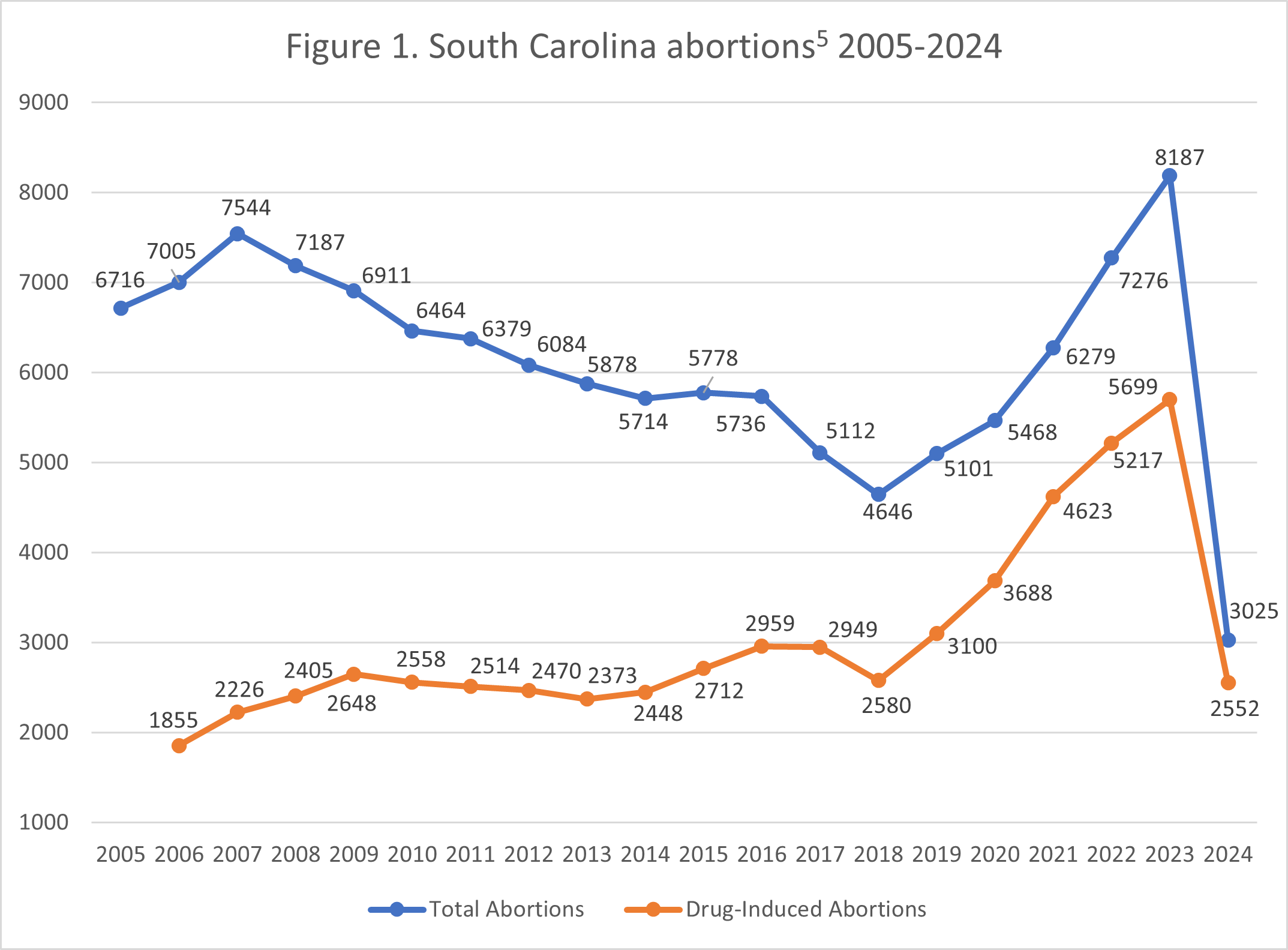
In 2024, there were 3,025 abortions reported in South Carolina, down 63% from the previous year. Drug-induced abortions, which made up 84% of reported abortions, decreased by 55% from 5,699 in 2023 to 2,552 in 2024 (Fig. 1). CLI estimates that South Carolina’s abortion rate was 2.9 abortions per 1,000 women of childbearing age, a decrease of 63% from the previous year (Fig. 2).1 As of July 2025, nine states have released 2024 abortion statistics, two of which showed that abortions had decreased from 2023.
State Report Summary
Ninety-two percent of abortions occurring in South Carolina were performed on South Carolina residents, while 8% were performed on out-of-state women. For the second year in a row, South Carolina published abortion totals by month, showing that March had the highest monthly abortion total (310) and December had the lowest (193).
The number of abortions performed on girls under the age of 15 and girls between the ages of 15 and 16 was suppressed because the respective totals for those categories were under five abortions. Seven percent of the abortions were obtained by girls ages 17 to 19, while 27% were obtained by women ages 20 to 24. Twenty-six percent of abortions were performed on women ages 25 to 29, while 22% were obtained by women ages 30 to 34, and 16% by women ages 35 and older. In total, 25 abortions by maternal age were suppressed (.08%).
Eighty-four percent of South Carolina abortions were drug-induced. Six percent were manual vacuum aspiration abortions, and 5% were performed using dilation and curettage. Three percent of the abortions were performed using electrical vacuum aspiration procedures, and 1% were dilation and evacuation abortions. The number of abortions performed by combined induction and dilation and evacuation procedures, induction with prostaglandin procedures, other induction procedures, and other unknown procedures was individually suppressed but added up to a total of seven abortions.
No abortions used intra-fetal injections to kill the unborn baby.
Ninety-seven percent of abortions reported in the state were performed at six weeks of gestation or less. Two percent were performed between seven and 13 weeks, while 18 abortions were performed between 14 and 19 weeks. Six abortions occurred between 20 and 23 weeks of gestation. A heartbeat was not detected for 99% of the abortions reported in the state, while 1% (39 abortions) were performed after a fetal heartbeat was detected. Of the 39 abortions performed after a fetal heartbeat was detected, 14 were performed between seven and 13 weeks of gestation, 18 between 14 and 19 weeks, and seven were performed at gestational ages that were suppressed. Of the 2,986 abortions performed before a heartbeat was detected, 99% were performed at six weeks or less while 41 abortions were performed between seven and 13 weeks.
For the abortions performed at 12 weeks or less and after a heartbeat was detected, five were performed because of a medical emergency, while the numbers performed because of a fatal fetal anomaly or in the cases of rape and incest were suppressed. The total for the two latter categories, however, added up to six abortions. For the 28 abortions performed after 12 weeks, five were performed because of medical emergency, 21 because of fatal fetal anomalies, and two for suppressed reasons.
In the 36 cases where an abortion was performed due to a medical emergency, 28 of the abortion procedures utilized a method that provided the best opportunity for the unborn child to survive, while eight did not. In the eight cases where the method used did not provide the best opportunity for the unborn child to survive, providers specified the basis for utilizing such a procedure in all eight cases.
Abortion Centers in South Carolina
Planned Parenthood performed forty-six percent of South Carolina’s abortions. Planned Parenthood’s Columbia center performed 29% percent of South Carolina’s abortions while 17% were performed by the Planned Parenthood Charleston location. Fifty-two percent of the abortions reported by the state were performed by the state’s sole independent abortion center, Greeneville Women’s Clinic. Forty-seven abortions were performed by hospitals (within the Prisma Health system, Novant Health system, and Spartanburg Medical Center) and independent doctors’ offices.
Guttmacher Data2
In 2024, Guttmacher estimated that 6,940 abortions occurred in South Carolina, while the state reported 3,025. According to Guttmacher’s 2024 travel and residence data, 6,000 South Carolina residents and 680 nonresidents (Georgia women) obtained abortions (with the residence of 260 women being unknown) in South Carolina, while the state reported 2,768 and 257 abortions obtained by residents and nonresidents in South Carolina, respectively. Additionally, Guttmacher estimated that 8,540 South Carolina women traveled out of state to obtain an abortion.3 To see the number of abortions obtained by South Carolina women in various states, see the following table:
| States Traveled to by South Carolina Women | # of Abortions Obtained by Non-Resident Women in South Carolina, 2024 |
| North Carolina | 6,600 |
| Georgia | 870 |
| Virginia | 820 |
| D.C. | 140 |
| Florida | 110 |
| Total | 8,540 |
A possible explanation of the discrepancy between the state’s reported total of abortions occurring in the state (3,025 abortions) and Guttmacher’s reported total (6,940) is that South Carolina did not capture abortion drugs mailed into the state. Under state law, telehealth abortions (abortion drugs being sent through the mail within or from outside of the state) are illegal (§40-47-37 [C][6]). However, Guttmacher tracks the number of abortion drugs sent into South Carolina from states where abortionists are legally exempted under their state’s shield law and includes these abortions in its total estimate. This means that abortionists in states with such laws can ship abortion drugs into pro-life states. If one looks at data provided by another pro-abortion initiative, the Society for Family Planning’s #WeCount project, 3,010 in-person abortions were performed in South Carolina in 2024. This figure is very similar to the number reported by the state. However, #WeCount also reports that 3,890 South Carolina women were mailed abortion drugs from abortionists in shielding states.4 When one adds the in-person and mail-order abortion totals together (6,900), the figure is very close to the figure reported by Guttmacher (6,940). Guttmacher’s total also includes abortions performed under shield laws in South Carolina, but it doesn’t delineate that data by mode of provision (in-person or via shield law/telehealth). In conclusion, it is likely that the 3,025-figure reported by the state only includes those abortions performed in person and reported to the state by the performing brick-and-mortar facilities.
State Ranking
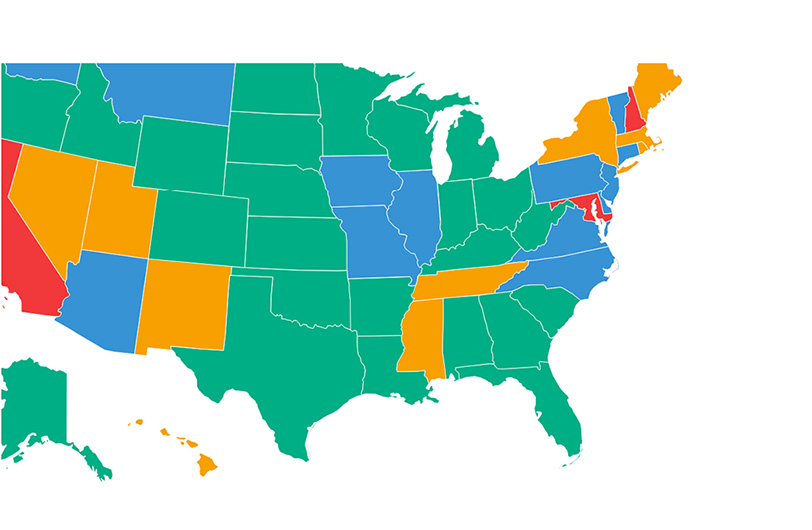
In 2024, CLI reanalyzed abortion reporting across the 50 states, New York City, and D.C., and South Carolina was tied for 23rd best. To strengthen its reporting, South Carolina could report the race, level of education, and marital status of all women undergoing abortions in the state. The state could also collect and report information on complications resulting from abortion.
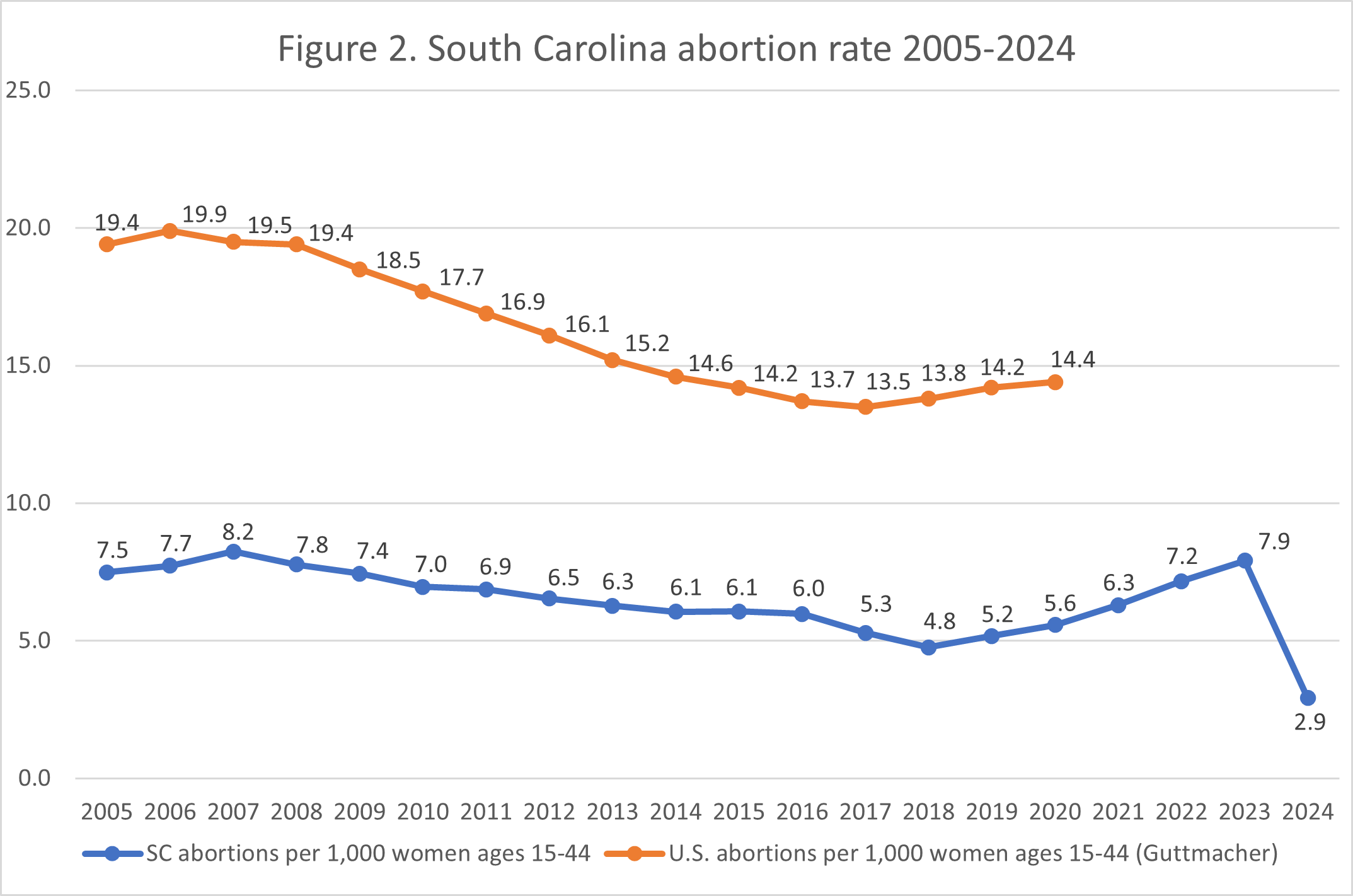
- National rates were calculated by the Guttmacher Institute. South Carolina rates were calculated by CLI using the following formula: (total number of abortions performed in South Carolina ÷ number of resident women ages 15-44 [based on most recent population estimates]) x 1,000. Rates may differ slightly from previous CLI articles due to revised population estimates. Population estimates were obtained from the CDC WONDER database. Estimates for 2005-2009 are intercensal estimates of the July 1 resident population. Estimates for 2010-2019 are Vintage 2020 postcensal estimates of the July 1 resident population. Estimates for 2020-2024 are Vintage 2023 postcensal estimates of the July 1 resident population. Estimates were produced by the U.S. Census Bureau and the National Center for Health Statistics. Rates for 2024 were calculated using the Vintage 2023 postcensal estimates because 2024 population estimates have not yet been released by the CDC.
- The Guttmacher Institute notes that their monthly abortion totals by states are estimates and that each state’s estimate is within a range of uncertainty. Guttmacher also notes that their estimates do not reflect self-managed abortions or those obtained by women in states with total abortion bans under shield laws. This information is updated as of July 1, 2025.
- Guttmacher’s travel and residence data can be found here (State_Abortion_Travel_2024.csv).
- #WeCount’s data can be found here by downloading the “Report data tables [.xlsx]” document. The #WeCount report specifies that the numbers included in their tables for abortions performed under shield laws only represent the number of women whom abortion drugs were sent to, not the number of drug-induced abortions that were a result of the mailed drugs. However, because #WeCount’s data is the only source of data that delineates the number of abortions by mode of provision in-person, telehealth/mail order, and/or abortion drugs obtained under shield laws) their data is the best available.
- Abortion totals prior to 2017 are from the CDC. South Carolina did not report its drug-induced abortion total to the CDC in 2005.
Click here to view reporting from:202520232022202120202019201820172016