


Search Icon
close-panel

Charlotte Lozier Institute

Phone: 202-223-8073
Fax: 571-312-0544

2776 S. Arlington Mill Dr.
#803
Arlington, VA 22206

Get Notifications

Sign up to receive email updates from Charlotte Lozier Institute.

This field is for validation purposes and should be left unchanged.

close-panel

Become A Defender of Life

Your donation helps us continue to provide world-class research in defense of life.

DONATE

Charlotte Lozier Institute

Phone: 202-223-8073
Fax: 571-312-0544

2776 S. Arlington Mill Dr.
#803
Arlington, VA 22206

Lung formation

Dive Deeper
How do the preborn baby's lungs form?

The respiratory system begins forming around 22 days after conception, during week 5 of pregnancy. The lungs develop from a small bud that comes from both the endoderm and mesoderm. The endoderm gives rise to specialized cells of the larynx, trachea, bronchi, and alveoli. The cartilaginous, muscular, and connective tissues of the lung will arise from the mesoderm.1 Mature lungs have more than 40 different types of cells derived from this early tissue.2

Lungs don’t just magically pop into place—they grow step by step to get ready for that very first breath! 
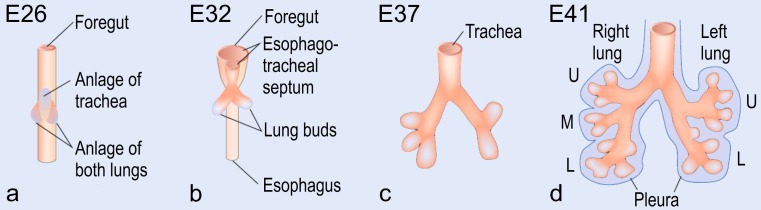
Diagram showing embryonic lung development at stages E26 (trachea and lung anlages), E32 (lung buds, esophagus, esophago-tracheal septum), E37 (branched bronchi), and E41 (right and left lungs with lobes and pleura).
Early human lung development from 26 to 41 days after conception. The lung buds form in front of the gut tube and start branching to establish bronchi and the 5 major lobes of the lungs.3 (Image Credit: Cell & Tissue Research)

There are 5 important steps in lung formation.

  1. The Lung Buds (Embryonic Stage; 6-9 weeks)
    Around 26 days after conception, or the end of gestational week 5, two tiny lung buds grow in front of the digestive tract.4 In week 6, these lung buds fuse with the developing trachea. By 7 weeks, the major airways, called bronchi, have grown. These bronchi divide into three major lobes on the right and two major lobes on the left by the end of week 7.5
  2. Branching Out (Pseudoglandular Stage; 7-19 weeks)
    Next, those bronchi start branching out like a tree, making tiny tubes called bronchioles that will eventually carry air. This continues for about 12 weeks until the airways have branched about 20 times. Blood vessels follow the bronchioles, preparing to carry oxygenated blood after birth. At this point in development, the structure of the lungs is being meticulously formed but the baby does not need to use it yet—not until she is born and takes her first breath.6
  3. Making Air Sacs (Canalicular Stage; 18-28 weeks)
    Between weeks 18 and 28, the tips of the airways start forming little air sacs called terminal sacs, shaped like clusters of grapes. These sacs will subdivide into alveoli , which will one day fill with air that the baby inhales. Blood vessels grow closely around the alveoli preparing to exchange oxygen and carbon dioxide. About 10% of the gas exchange surface area in the lungs comes from terminal sacs.7 Fetal breathing movements push amniotic fluid into and out of the developing lungs. At the end of the bronchioles, the moving amniotic fluid helps inflate the tips into terminal sacs. Mechanical forces from the fetal breathing movements also help lung cells differentiate into type I and type II pneumocytes. Type I pneumocytes trade gases with blood cells while type II pneumocytes produce surfactant and create new cells in the adult lungs.8 By 22 weeks, special lung cells begin producing surfactant, a slippery substance that keeps the alveoli from collapsing or getting stuck together.9 When a baby is at risk of being born prematurely, doctors will give medicine to boost surfactant production —supporting the baby’s breathing after delivery.10
  4. Getting Ready to Breathe (Saccular Stage; 26 weeks – birth)
    From about week 26 to birth, the air sacs enlarge and divide over and over to produce more alveoli, significantly expanding the gas-exchange surface area.11 In fact, the fetus’s lung volume increases four-fold between 29 weeks and birth. Although surfactant production begins early, the fetus produces increasing amounts as pregnancy progresses.12
  5. Final Touches (Alveolar Stage; 38 weeks gestation to 21 years)
    After birth, the lungs continue an extraordinary period of growth. Newborns begin life with about 150 million alveoli—roughly half the adult number.13 14 In fact, about 95% of alveoli form after birth,15 as existing air sacs divide to create new walls—accounting for roughly 90% of the lung’s gas exchange surface area.16 Most of this growth happens in the first six months,17 but continues through childhood and even into early adulthood—up to around 21 years of age.18
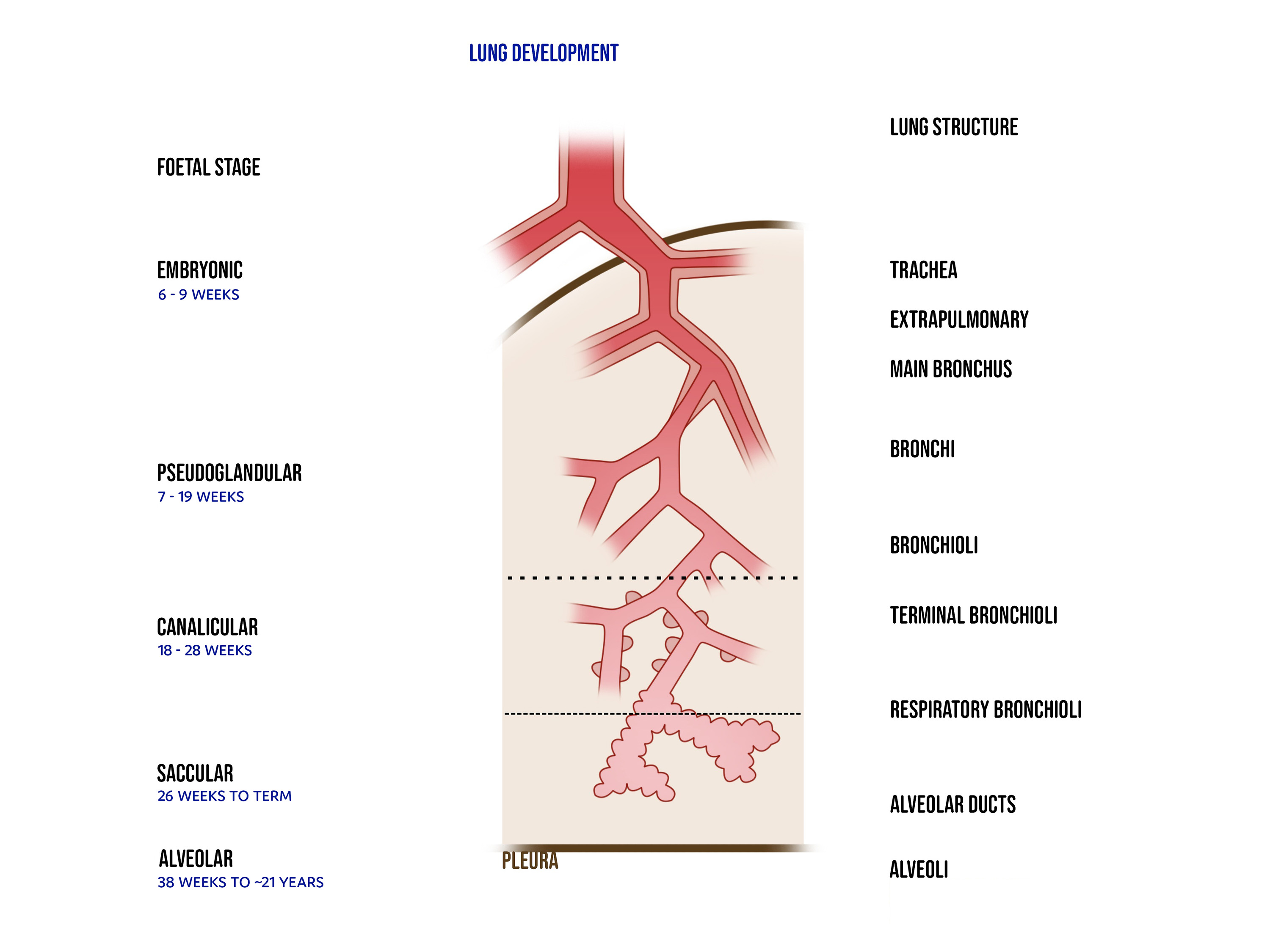
Diagram illustrating lung formation and development stages (embryonic, pseudoglandular, canalicular, saccular, and alveolar) alongside labeled lung structures—trachea, bronchi, bronchioles, and alveoli—with a sectional lung graphic.
Illustration of the stages of lung development. The lungs start developing around six weeks gestation. The lungs become progressively more branched and more able to exchange gases with the blood, so that the full-term newborn baby can breathe unaided. At birth, the baby will have developed about 150 million alveoli, about half of that seen in adults.19 (Image Credit: Science Source)
Smoking during pregnancy

Smoking before or during pregnancy can harm both mother and baby in many ways. It raises the risk of abnormal bleeding, stillbirth, poor growth, low birth weight, premature birth, and damage to the baby’s developing lungs and brain. Secondhand smoke is harmful too, both during pregnancy and after birth, and increases the risk of Sudden Infant Death Syndrome (SIDS). The best time to quit is before pregnancy, but stopping at any point can still make a real difference. Quitting helps protect the mother’s health and gives the baby a safer, healthier start in life.20

Sperm-egg fusion
Sperm-egg fusion
Sperm-egg fusion