












Florida publishes some of its abortion reporting tables on the state’s Agency for Health Care Administration (AHCA) website. The full report was provided to the Charlotte Lozier Institute (CLI) in February 2026. The data provided to CLI showed that brick-and-mortar abortions reported in the state decreased significantly from 2024 to 2025.
The data published by the state does not include the number of abortions obtained by Florida residents out of state or the number of self-managed abortions performed by women outside of the healthcare system. The report also does not contain the total number of mail-order abortion drugs obtained by Florida residents prescribed by licensed abortion providers in other states.
In a separate section, CLI will describe data provided by both the Guttmacher Institute’s Monthly Abortion Provision Study (MAPS) and the Society of Family Planning’s (SFP) #WeCount project detailing the number of mail-order abortions obtained by Florida’s residents from out of state prescribers. In the past, the MAPS published estimates on the annual number of states’ residents who traveled out of state to obtain an abortion. However, 2025 estimates on out-of-state travel totals have not been released. Guttmacher’s abortion estimates include the number of abortions obtained at brick-and-mortar facilities and those provided via telehealth and virtual providers in the United States.
Florida’s statute code defines abortion as “the termination of human pregnancy with an intention other than to produce a live birth or to remove a dead fetus.”
The state’s six-week law, which prohibited abortions after six weeks of gestation, originally signed into law in 2023. The law went into effect on May 1, 2024 and remains in effect. Exceptions to the state’s six-week law include:
- Cases where a continued pregnancy threatens the mother’s life or could result in imminent and substantial physical impairment of a major bodily function and/or;
- Cases where the pregnancy has not progressed to the third trimester and it is determined by two physicians that the unborn child has a fatal fetal anomaly and/or;
- Cases in which the pregnancy is a result of rape, incest, or human trafficking and the gestational age of the fetus is not more than 15 weeks’ gestation.
Statistics and Changes in Florida Abortions, 2024-2025
The report does not include information on Planned Parenthood’s Florida abortion market share.
Abortions Totals and Trends
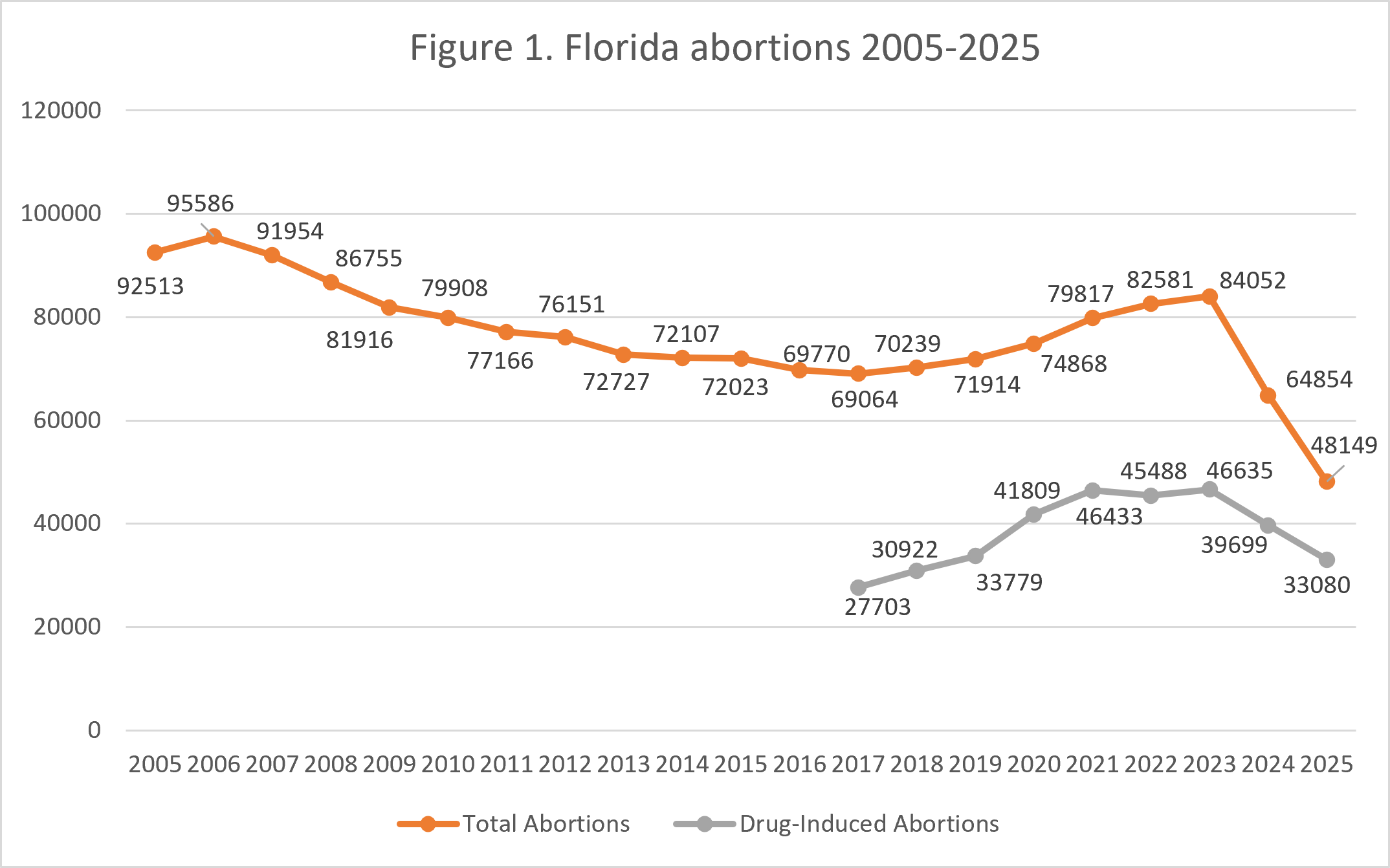
In 2025, 48,149 abortions were reported, a decrease of 26% from the previous year. Of the 48,149 abortions performed in 2025, 33,080 were drug-induced, amounting to 69% of the total (Fig. 1). The total amount of drug-induced abortions decreased by 17% from 2024. CLI estimates that Florida’s 2025 abortion rate was 11.2 abortions per 1,000 women ages 15 to 44, down 26% from 2024 (Fig. 2).1 As of July 2026, 11 states have released 2025 reports. Since CLI put together its original estimate, the Florida Department of Health issued a corrected total of 48,150 abortions performed in 2025. This report uses 48,149 as the total since CLI had already put together its estimates, and a difference of one abortion does not result in a significant difference in percentages.
There were 219 abortions performed at 15 weeks or later in Florida in 2025, down 61% from 2024.
State Report Summary
Ninety-seven percent of Florida abortions were performed on state residents in 2025, while 3% were performed on women from other states. The number of abortions performed on nonresidents in Florida decreased by 62% from 2024 to 2025. This marks a further decrease from the 50% decrease in abortions performed on nonresidents from 2023 to 2024. A possible explanation for these drastic changes is that, in 2023, Florida had a much more permissive abortion law compared to the surrounding states where the majority of nonresident women obtaining abortions in Florida traveled from (Georgia, Alabama, Louisiana, Texas, and Mississippi). In May 2024, the state’s six-week law went into effect, and Florida’s abortion law became as restrictive as Georgia’s.
Six percent of Florida abortions were performed on girls under the age of 20, 24% were performed on women ages 20 to 24, and 28% on women ages 25 to 29. Thirty-six percent of Florida abortions were performed on women in their thirties, and 5% were performed on women ages 40 and older. Seventy-five abortions were performed on women of unknown maternal age. Fifty-two percent of the abortions were performed on white women and 32% on black women. CLI estimates that Florida’s black abortion rate was 17.7 abortions per 1,000 women of childbearing age, which was more than two times the white abortion rate of 8.1. Eight percent of the abortions were performed on women of other races and another 8% on women of unknown races. Thirty-six percent of Florida abortions were performed on Hispanic women, 57% on non-Hispanic women, and 7% on women of unknown ethnicity.
Ten percent of the abortions were performed on married women and 72% on unmarried women, while 18% were obtained by women whose marital status was not reported. Forty-three percent of abortions were performed on women with no previous live births, 25% on women with one prior live birth, and 32% on women with two or more previous live births. Sixty-one percent of the women undergoing abortions reported zero prior abortions, while 22% reported one prior abortion and 18% more than one. Sixty-nine percent of the abortions in Florida in 2025 were drug-induced. Twenty-seven percent were curettage procedures, and one abortion was performed via hysterectomy/hysterotomy. Four percent of the abortions were performed using a different or unreported method.
The change in legislation in 2023 which went into effect partway through 2024 impacted the gestational ages at which abortions were performed between 2024 and 2025. See the table below:
| # of Abortions, 2025 | % of Total Abortions, 2025 | # of Abortions, 2024 | % of Total Abortions, 2024 | |
| ≤ 6 weeks of gestation | 47,321 | 98.3% | 43,690 | 67.4% |
| 7-8 | 405 | 0.8% | 11,118 | 17.1% |
| 9-10 | 85 | 0.2% | 5,557 | 8.6% |
| 11-12 | 39 | 0.1% | 2,240 | 3.5% |
| 13-14 | 80 | 0.2% | 1,687 | 2.6% |
| 15-17 | 92 | 0.2% | 425 | 0.7% |
| 18-20 | 65 | 0.1% | 75 | 0.1% |
| 21+ | 62 | 0.1% | 62 | 0.1% |
| Unknown | 0 | 0% | 0 | 0% |
| Total | 48,149 | NA | 64,854 | NA |
As seen from the table, due to legal changes, the number and percentage of abortions performed at six weeks or earlier increased from 2024 to 2025, but the number of abortions performed at seven weeks or later significantly decreased by 96%. Ninety-eight percent of abortions occurred at six weeks of gestation or earlier in 2025, while 2% occurred at seven weeks or later, compared to 67% being performed at six weeks or before in 2024 and 44% being performed at seven weeks or later.
Twelve babies were reported to have been born alive during abortion procedures in Florida in 2025, while six were reported to have been born alive in 2024. The report does not indicate the gestational age of the babies or what happened to them after they were born.
Seventy-two percent of Florida abortions were reported as “elective,” 24% were performed for social or economic reasons, and 2% were performed for the mother’s emotional or psychological health. In contrast, only 1% were performed for the mother’s physical health, and less than 1% because the unborn baby had a health condition (0.4% for a “serious abnormality” and 0.4% for a “fatal abnormality”). There were 106 abortions (0.2%) performed because of risk to the mother’s life, 64 (0.1%) due to rape, and three due to incest.
Abortion Clinic Annual Report
In accordance with Section 390.012 (8) of the Florida Statute Code, AHCA must submit a report to the President of the Senate and Speaker of the House of Representatives recapping all regulatory actions related to abortion centers taken by the agency over that year. AHCA’s 2025 report reveals key statistics about abortion centers operating in the state:
- There were 49 licensed abortion clinics (excluding licensed hospitals and physicians’ offices) in 16 counties. Forty-two of the 49 clinics were licensed as first- and second-trimester abortion centers, while seven were licensed as first-trimester only. Miami-Dade County had the highest number of first-and second-trimester abortion clinics, with six in Miami, three in Hialeah, and one in Miami Gardens.
- Licensed abortion centers submitted 100% of the required induced termination of pregnancy reports.
- The agency conducted 179 on-site inspections, including follow-up visits— a 7% increase from 2024, when the agency conducted 167 inspections. There were 43 licensure applications and 138 complaint inspections.
- There were 52 abortion clinic applications, including 23 renewal applications and 22 change applications (including two requests to terminate a license).
- AHCA initiated 15 administrative actions in response to two late ITOP submissions, six changes during the licensure period on late applications, and seven late licensure renewal submissions.
“Deficient practice” was found during 10 licensure inspections and 11 complaint investigations. There were five cases of centers that failed to ensure they had current medications for emergency use, five that did not ensure the completion of client notices, three performing second trimester abortions that failed to meet physical plant requirements, and two that had citations related to their inspection requests or reports. A few other examples of deficient practice include one instance each of:
- Failure to dispose of fetal remains in a sanitary manner;
- Failure to meet all background screening requirements;
- An administrative fine for an unclassified violation
While Florida does not report abortion complications with the rest of its annual abortion statistics, data for any incident resulting in serious injury to a patient or viable fetus during a second-trimester abortion is recorded in the annual Regulatory Actions report. In 2025, one second-trimester center submitted one report with a total of two injuries: hemorrhage/excessive bleeding and another unknown injury that required specialized medical attention. The individual required hospitalization for follow-up care.
The Regulatory Actions Report also breaks down the number of abortions performed by the type of provider. However, this report seems to have been prepared before the state finalized its abortion totals, as the total number of abortions in the Regulatory report was 44,206 versus 48,149 (48,150 in the corrected total) reported by the state. In 2025, 99% of abortions documented by the Regulatory report were performed at abortion centers, 1% at physicians’ offices, and 0.3% at hospitals. Unlike 2024, the 2025 Regulatory report did not break down how many physician’s offices and hospitals reported performing abortions.
Guttmacher and #WeCount Data2
In 2025, Guttmacher estimated that 66,420 abortions occurred in Florida, while the state reported 48,149. To see the differences in Guttmacher’s Ohio estimates and the state’s reported totals, see below:

SFP’s #WeCount project publishes their own estimates which break down Florida’s abortion totals by mode of provision. In 2025, #WeCount estimated that 68,090 abortions occurred in Florida. SFP estimated that 46,990 of those abortions were obtained in person and 21,100 were obtained via mail-order drugs.3
A possible explanation for the discrepancies in the AHCA-reported data and Guttmacher’s and #WeCount’s estimates is that the state does not collect data on telehealth (mail-order) abortions, while Guttmacher’s and #WeCount’s estimates include both the number of brick-and-mortar abortions and the number of mail-order abortions obtained by women in the state.
State Ranking
In 2024, CLI published a paper reevaluating abortion reporting across the country, and Florida was tied for 23rd best. Florida could continue to improve its abortion reporting by providing more information about the babies who survive abortions and information on all complications that occur, not just those that occur during the second trimester and beyond. The Regulatory report could also break down how many physician’s offices and hospitals perform abortions as it has in the past.
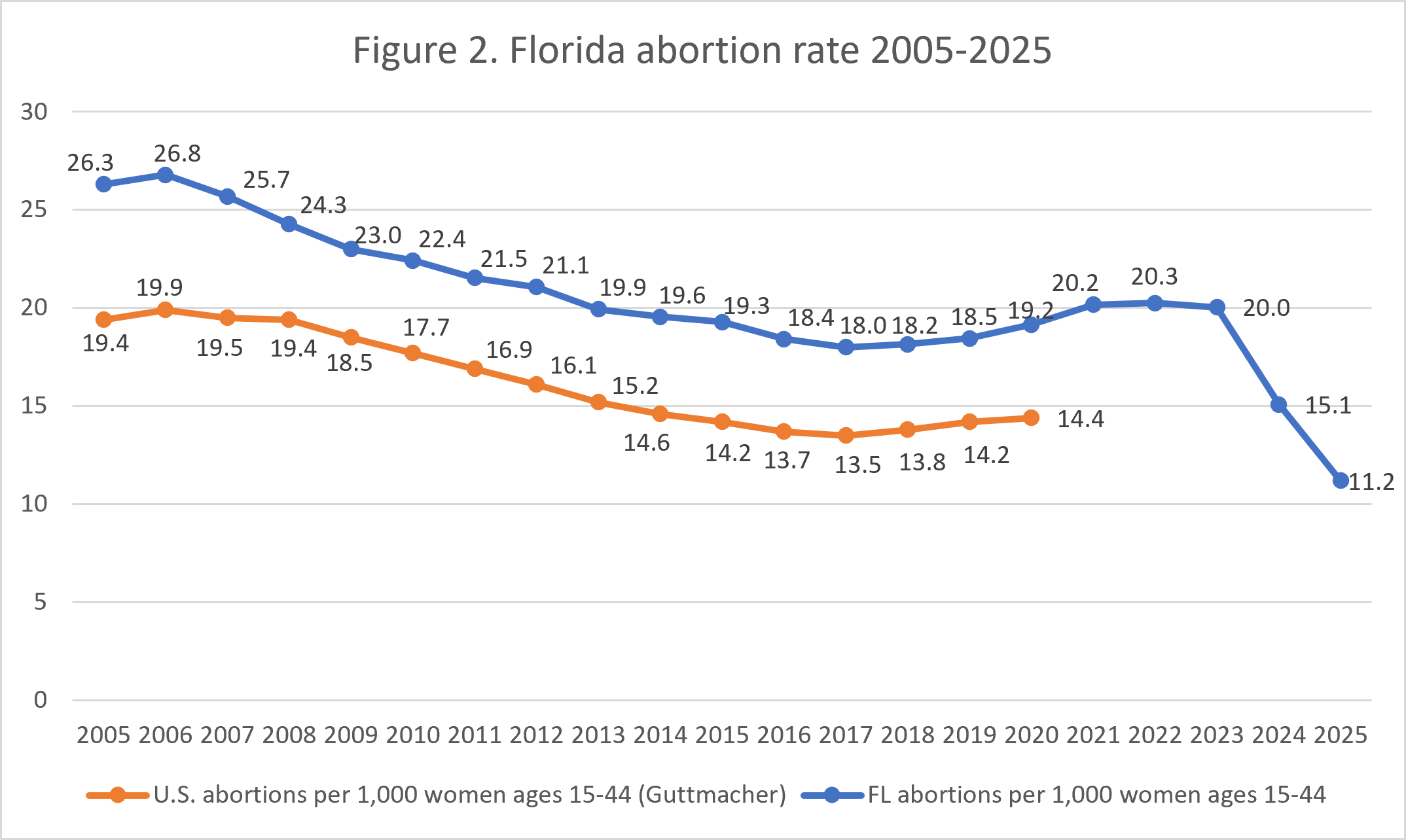
- National rates were calculated by the Guttmacher Institute. Florida rates were calculated by CLI using the following formula: (total number of abortions performed in Florida ÷ number of resident women ages 15-44 [based on most recent population estimates]) x 1,000. Rates may differ slightly from previous CLI articles due to revised population estimates. Population estimates were obtained from the CDC WONDER database. Estimates for 2005-2009 are intercensal estimates of the July 1 resident population. Estimates for 2010-2019 are Vintage 2020 postcensal estimates of the July 1 resident population. Estimates for 2020-2025 are Vintage 2024 postcensal estimates of the July 1 resident population. Estimates were produced by the U.S. Census Bureau and the National Center for Health Statistics. Rates for 2025 were calculated using the Vintage 2024 postcensal estimates because 2025 population estimates have not yet been released by the CDC.
- The Guttmacher Institute notes that their monthly abortion totals by states are estimates and that each state’s estimate is within a range of uncertainty. Guttmacher’s data can be found in the CSV folder here (Summary_Table_Annual_2023_2024_2025). This information is updated as of July 17, 2026.
- #WeCount’s data can be found here by downloading the “Report data tables [.xlsx]” document. The #WeCount report specifies that the numbers included in their tables for abortions performed under shield laws only represent the number of women to whom abortion drugs were sent, not the number of drug-induced abortions that resulted from the mailed drugs. However, because #WeCount’s data is the only source of data that delineates the number of abortions by mode of provision (in-person, telehealth/mail order, and/or abortion drugs obtained under shield laws), their data is the best available. This information is updated as of July 17, 2026.
Click here to view reporting from:20242023202220212020201920182017