












Indiana’s 2025 quarterly abortion reports were published by the Indiana Department of Health (IDOH) throughout the year and into early 2026. The state’s annual 2025 abortion report, an aggregate of the 2025 quarterly reports, was published in April 2026. These reports showed that in 2025, brick-and-mortar abortions in Indiana decreased from 2024.
The data published by the state does not include the number of abortions obtained by Indiana residents out of state or the number of self-managed abortions on women outside of the healthcare system. The report also does not contain the number of mail-order abortions obtained by Indiana residents prescribed by licensed abortion providers in other states. In a separate section, CLI will describe data provided by both the Guttmacher Institute’s Monthly Abortion Provision Study (MAPS) and the Society of Family Planning’s (SFP) #WeCount project detailing the number of mail-order abortions obtained by Indiana residents from out of state prescribers. In the past, the MAPS published estimates on the annual number of states’ residents who traveled out of state to obtain an abortion. However, 2025 estimates on out-of-state travel totals have not been released. Guttmacher’s abortion estimates include the number of abortions obtained at brick-and-mortar facilities and those provided via telehealth and virtual providers in the United States.
Indiana’s statute code defines abortion as “the termination of human pregnancy with an intention other than to produce a live birth or to remove a dead fetus. The term includes abortions by surgical procedures and by abortion drugs” (IC 16-18-2-1). In Indiana, abortion is prohibited except in limited cases (IC 16-34-2-1):
- Where the fetus is diagnosed with a lethal fetal anomaly within 22 weeks gestation or before viability, whichever one is earlier
- Of rape and incest, within the first 12 weeks gestation
- Where a doctor determines abortion is necessary to save the mother’s life or physical health (can occur anytime throughout pregnancy)
On March 5, 2026, a Marion County judge ruled that the state’s abortion law violated the constitutional rights of those (the plaintiffs, anonymous plaintiffs and the Hoosier Jews for Choice) who believed that the right to an abortion is a religious belief and the state’s Religious Freedom Restoration Act. As a result of this ruling, this law has been prohibited from being enforced against those who argue their religious freedom requires access to an abortion. It is unclear how a ruling with such undefined parameters allows the state to enforce its abortion law at all. The state’s attorney general is appealing the decision, and the case is now at the Indiana Court of Appeals.
Abortion Totals and Trends
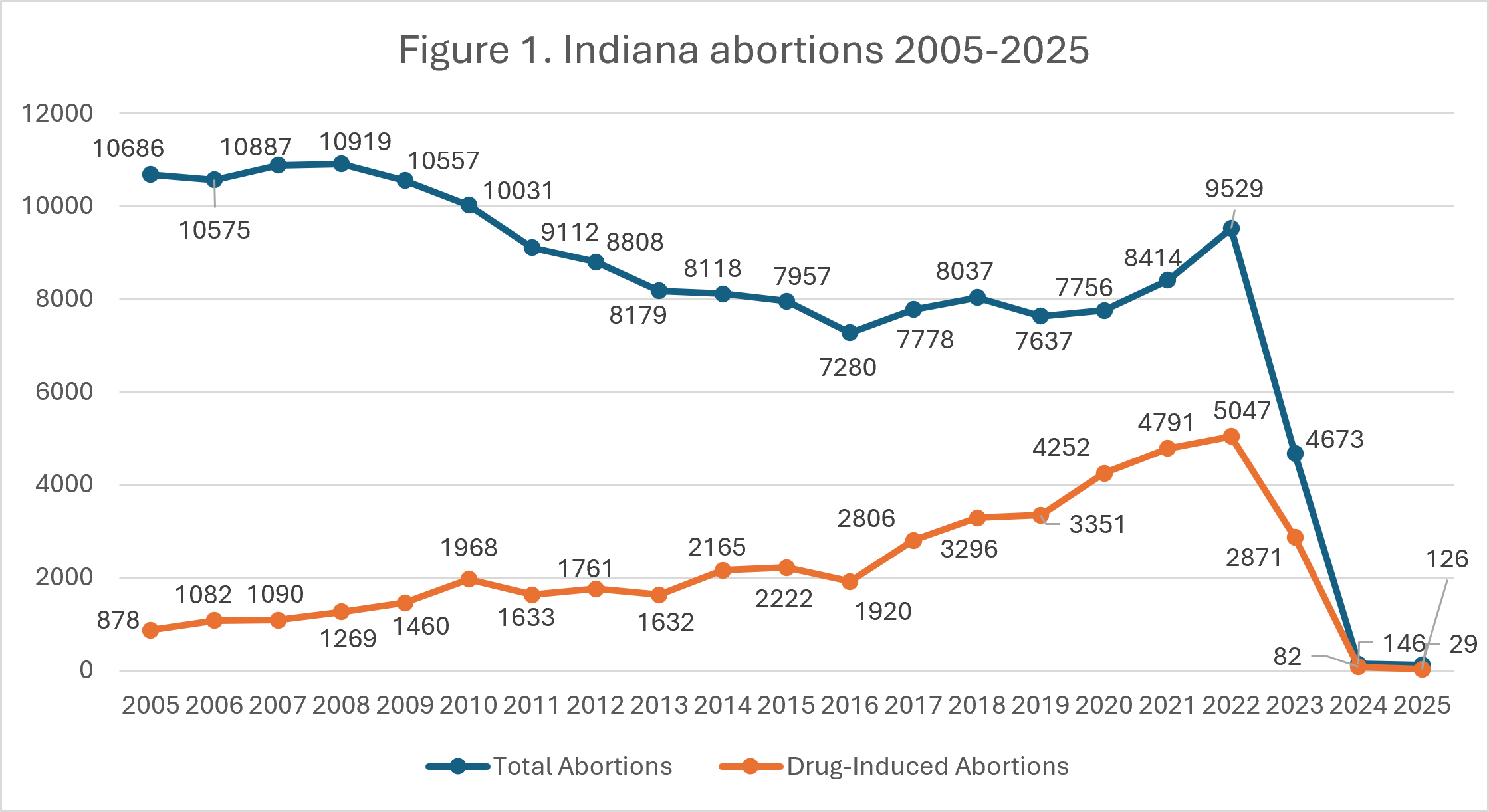
In 2025, there were 126 abortions reported in Indiana, compared to the 146 performed in 2024. Abortions performed in Indiana decreased by 97% from 2023 to 2025. Drug-induced abortions decreased by 99% during that time frame, and composed 23% of the 2025 total, as opposed to 61% in 2023 (Fig. 1). CLI estimates that Indiana’s 2025 abortion rate was 0.09 abortions per 1,000 women ages 15 to 44, a decrease of 97% from 2023 (Fig. 2).1 As of July 2026, 11 states have released 2025 abortion statistics.
State Report Summary
In 2025, 96% of the abortions reported in Indiana were performed on state residents. Five abortions were performed on non-residents. Two abortions were performed on girls under the age of 16, while 17% were performed on girls between the ages of 16 and 24. Just over half (53%) were performed on women ages 25 to 34, and 29% were performed on women between the ages of 35 and 44. Of the two abortions performed on girls under the age of 16, both were properly reported, according to state law, within three days to Indiana Department of Children’s Services, while one of the two was properly reported to the IDOH within three days. For the 124 abortions performed on girls over the age 16, 75 were reported to the IDOH within 30 days in accordance with state law, while 49 were not.
Seventy-one percent of Indiana abortions were performed on white women, and 20% on black women. Six abortions were performed on Asian women and one abortion on a Pacific Islander/Native Hawaiian woman. One abortion was performed on a woman of multiple races, and one abortion was performed on a woman of another, unspecified race. Race was unknown for three abortions. Eighty-seven percent of Indiana abortions were obtained by non-Hispanic women, while 10% were obtained by Hispanic women. Two percent of the abortions in the state were performed on women of unknown ethnicity.
Forty-nine percent of the abortions reported in Indiana were obtained by unmarried women and 51% by married women. Thirty-seven percent of Indiana abortions were performed on women with no living children, 29% on women with one child, and 35% on women with two or more children. Ninety-six percent of the abortions were obtained by women with no previous abortions, compared to 4% on women with one prior abortion. Thirty-seven percent of the abortions were performed on women who had previously had a miscarriage.
Seventy-six percent of the abortions reported in Indiana were surgically induced. Surgically induced abortions include suction curettage abortions, menstrual aspiration abortions, dilation and evacuation abortions, intracardiac injections, and other procedures, although the reports did not include the percentage of abortions performed by each procedure type. Since quarter three of 2025, the IDOH has counted intracardiac injections as surgical procedures which explains why the percentage of surgical abortions for 2025 is higher than previous years. Under a quarter (23%) of the abortions were drug-induced, and one abortion was performed by another, nonsurgical procedure.
Fifty-one percent of abortions performed in the state in 2025 were performed between 14 and 20 weeks of gestation. Twenty-two percent were performed at 21 weeks of gestation or later. Other data provided by the state noted that zero abortions were performed after 20 weeks of post-fertilization age (approximately 22 weeks of gestation). Fourteen percent were performed between nine and 13 weeks of gestation, while 13% were performed at eight weeks of gestation or earlier.
All 126 abortions performed in the state in 2025 were performed at hospitals, as all were performed under the exceptions to the state’s life-at-conception law. All freestanding abortion centers in the state closed in August 2023. Riley Health Maternity Tower performed 52% of Indiana abortions in 2025, while the Sidney and Lois Eskenazi Hospital performed 36%. Six other hospitals performed the remainder of the state’s abortions in 2025. Ninety-four percent of Indiana’s abortions were performed in Marion County, while 3% were performed in Allen County, and 2% each in Knox and Warrick Counties.
Additional Information Reported in 2025 Quarterly Reports
Two babies were reported to have been born alive during an abortion in 2025. Sixty percent of abortions were performed because the unborn child had a lethal fetal anomaly, and 40% were performed because the mother’s life or physical health was at risk. Six abortions were performed due to rape or incest. Two percent were performed because the mother’s life was at risk and the unborn child had a lethal fetal anomaly while one abortion was performed because the mother’s physical health was at risk and the unborn child had a lethal fetal anomaly. Some of the fetal diagnoses reported to the state included anencephaly, a congenital heart malformation, hydrocephalus, Trisomy 13, and Trisomy 18.
Abortion Complications2
The most frequently reported complication was incomplete abortion (retained tissue), with 37 cases reported. There were 15 cases of vaginal bleeding, 11 infections, and six failed abortions. There was one other, uncategorized complication and one case each of psychological complications, pelvic inflammatory disease, and a cervical laceration.
Women were admitted to the hospital in 17 cases, 34 complications resulted in surgical intervention, eight complications required blood transfusions, and 17 complications were treated with medication. In seven cases, other treatment was used, and an unknown treatment was utilized one time. Overall, 91% of the complication reports noted that the initial abortion provider was not the one who treated the woman’s complication(s).
The 2025 complication reports included information on the facilities where the patient presented with complications and the number of reports by the facility performing the abortion. Eleven of the seventeen facilities that treated women for abortion-related complications reported zero abortions in Indiana in 2025. Eleven of the 58 complication reports regarded abortions that were performed outside of Indiana (six in Illinois facilities, three in Michigan facilities, and two in independent centers in unknown states). Six complication reports regarded abortions performed in Indiana, while 39 complication reports resulted from abortions that were performed at unknown locations. Two complication reports resulted from abortions performed at women’s homes in unknown locations.
Fifty-five percent of the reports were completed for women aged 25 to 34, while 33% were for girls between the ages of 16 and 24. Seven reports were for women between the ages of 35 and 44. Thirty-four percent of the complication reports were for abortions performed on African American women, and 37% were for white women. There was one report for multi-racial women, three for Asian women, and seven for women of other, unspecified races. Race was not reported in six of the complication reports. Sixty-six percent of the complication reports were for abortions performed on non-Hispanic women, while 12% were for Hispanic women. Ethnicity was not reported in 13 of the complication reports.
Thirty-one percent of the complication reports resulted from surgical abortions, while 64% resulted from drug-induced abortions although there were only 29 drug-induced abortions compared to 96 surgical abortions.
Four of the complication reports involved mail-order abortions, 25 did not, and it was undisclosed whether 29 of the complication reports involved mail-order abortions.
Guttmacher and We Count Data3
Guttmacher estimated that 4,380 abortions occurred in Indiana, versus the state’s reported total of 126 (124 in-person abortions and two mail-order abortions). Guttmacher’s estimate includes only mail-order abortions obtained by Indiana residents, in Indiana, from out-of-state prescribers. SFP’s #WeCount project publishes their own estimates that break down states’ abortion totals by mode of provision. In 2025, #WeCount estimated that 5,130 abortions occurred in Indiana. SFP estimated that 160 abortions were obtained in-person, while 4,970 abortions were obtained via mail-order abortion drugs.
State Ranking
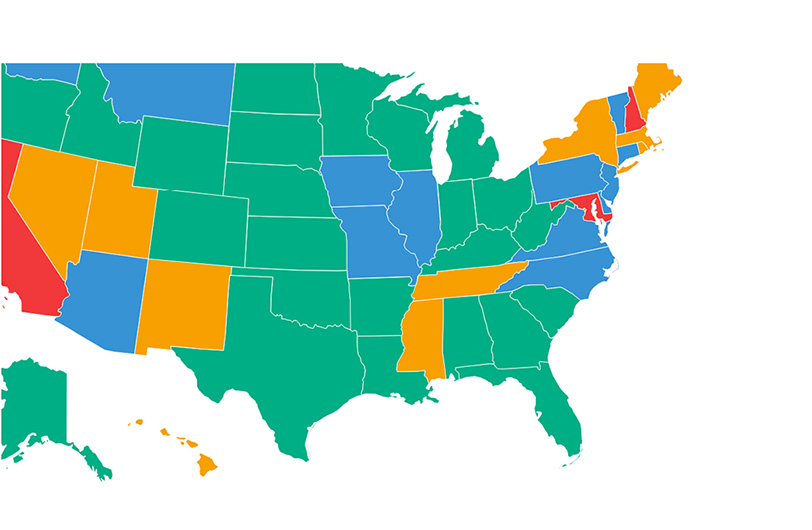
In CLI’s 2024 reevaluation of states’ abortion reporting requirements, Indiana was tied for fourth best. Since CLI’s original evaluation of abortion reporting requirements in 2016, Indiana has vastly improved their abortion reporting. Because the state has prohibited most brick-and-mortar abortions from being performed in the state, and many of the state’s reporting requirements cover topics associated with the abortions that are still performed, the only area of data collection left to improve upon (the mailing of abortion drugs into the state) may not be feasible given the legal landscape of other states’ shield laws.
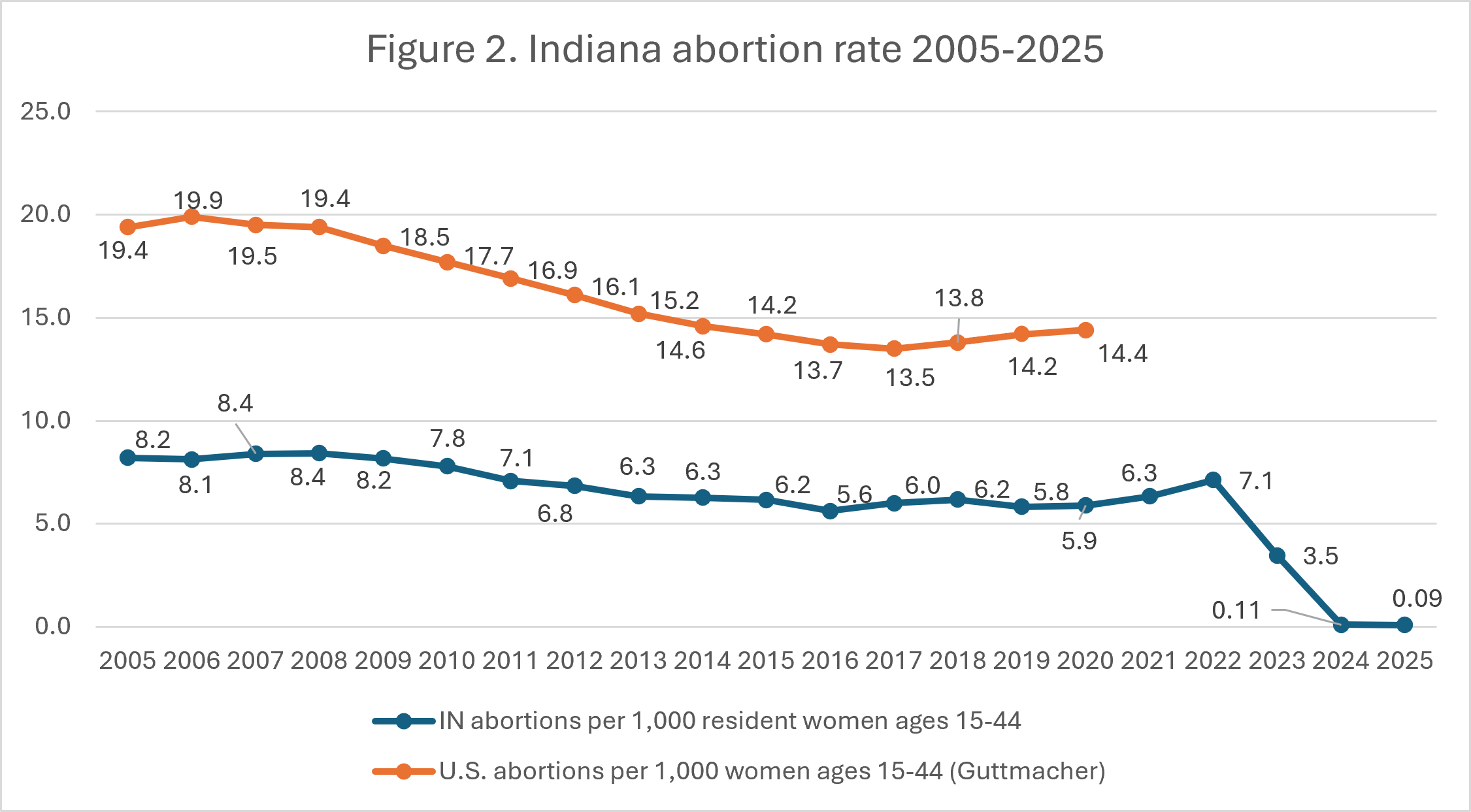
- National rates were calculated by the Guttmacher Institute. Indiana rates were calculated by CLI using the following formula: (total number of abortions performed in Indiana ÷ number of resident women ages 15-44 [based on most recent population estimates]) x 1,000. Rates may differ slightly from previous CLI articles due to revised population estimates. Population estimates were obtained from the CDC WONDER database. Estimates for 2005-2009 are intercensal estimates of the July 1 resident population. Estimates for 2010-2019 are Vintage 2020 postcensal estimates of the July 1 resident population. Estimates for 2020-2025 are Vintage 2024 postcensal estimates of the July 1 resident population. Estimates were produced by the U.S. Census Bureau and the National Center for Health Statistics. Rates for 2025 were calculated using the Vintage 2024 postcensal estimates because 2025 population estimates have not yet been released by the CDC.
- Statistics on abortion complications reported here represent a minimal number of deaths and complications, as this data is collected in a non-systematic and non-verifiable way. As such, this data cannot be used to calculate either an accurate abortion mortality rate or an accurate abortion complication rate for the state.
- The Guttmacher Institute notes that their monthly abortion totals by state are estimates and that each state’s estimate is within a range of uncertainty. Guttmacher’s data can be found in the CSV folder here(Summary_Table_Annual_2023_2024_2025). This information is updated as of July 17, 2026. #WeCount’s data can be found here by downloading the “Report data tables [.xlsx]” document. The #WeCount report specifies that the numbers included in their tables for abortions performed under shield laws only represent the number of women to whom abortion drugs were sent, not the number of drug-induced abortions that resulted from the mailed drugs. However, because #WeCount’s data is the only source of data that delineates the number of abortions by mode of provision (in-person, telehealth/mail order, and/or abortion drugs obtained under shield laws), their data is the best available. This information is updated as of July 17, 2026.
Click here to view reporting from:20242023202220212020201920182017