











Abortion Law in America Today: Confronting Infringements on Pro-life Laws


This is Issue 41 of the American Reports Series.
In Dobbs v. Jackson Women’s Health Organization, the U.S. Supreme Court held: “The Constitution does not prohibit the citizens of each State from regulating or prohibiting abortion.”[i],[ii]A law regulating abortion is constitutional “if there is a rational basis on which the legislature could have thought that [the law] would serve legitimate state interests.”[iii] Currently, 19 states have gestation-based abortion limits[iv] in effect that restrict abortion with limited exceptions throughout or for most of pregnancy.[v] Although most brick-and-mortar abortion clinics in these states have closed,[vi] the reported numbers of abortions in many of these states have increased, with women traveling out of state for abortions or receiving abortion drugs by mail.
The Society of Family Planning (SFP) collects data directly from abortion providers[vii] within the formal healthcare system.[viii] According to the SFP, there were 18,790 more abortions in 2024 than in 2020[ix] in the 13 states that limited abortion throughout pregnancy in 2024.[x] Nearly 52% of women in these states who had abortions in 2024 traveled out of state. Abortion-inducing drugs were prescribed under shield laws for the remaining 48%. The SFP defines “providing abortions under shield laws” as “mailing medication abortion pills to people in states with telehealth restrictions, 6-week bans, or total bans.”[xi] In other words, of the abortions that were obtained in 2024 by women living in states that limit abortion throughout pregnancy, nearly half still occurred in-state. These women used drugs that were prescribed and shipped by out-of-state abortion providers in contravention of state law.[xii] (For a table more fully elaborating on data related to abortions in states with laws in effect in 2024 that limit abortion throughout pregnancy, see Exhibit A in the Appendix.)
Clearly, these numbers are concerning for lawmakers and citizens in pro-life states and raise significant legal questions. The first section of this paper addresses out-of-state travel for abortion, specifically focusing on efforts by state and federal lawmakers to prevent non-parental adults from transporting minors across state lines for abortions. Section II covers federal regulations of abortion-inducing drugs; how abortion drug prescribers violate these regulations; violations of state pro-life laws by abortion drug prescribers; pro-life state responses; and why a federal solution is necessary.
I. Out-of-state travel for abortions
The number of women traveling from pro-life states to obtain abortions is tragic; however, the U.S. Supreme Court is unlikely to uphold a law that prevents a citizen of one state from traveling to another for an abortion. In his concurrence in Dobbs v. Jackson Women’s Health Organization, Justice Brett Kavanaugh wrote, “[M]ay a State bar a resident of that State from traveling to another State to obtain an abortion? In my view, the answer is no based on the constitutional right to interstate travel.”[xiii] Likewise, the court is unlikely to uphold a law that prevents women who obtain abortion-inducing drugs while out-of-state from using the drugs within the state.
The U.S. Supreme Court is more likely to uphold a law that prevents non-parents from taking minors across state lines for abortions.[xiv] Thirty-eight states have laws—with varying effectiveness—requiring parental consent or notification before a minor can get an abortion.[xv] When a minor living in a state with such a law travels to a state that does not require parental notification or consent, the abortion provider in that state is unlikely to notify her parents or seek their consent. This increases the risks that sex traffickers will transport victims across state lines for abortions, avoiding detection by law enforcement, and that non-parents will drive victims of statutory rape or coercion across state lines for abortions without parental consent or notification. Four states—Idaho, Tennessee, Missouri, and Indiana—have enacted laws to address this concern. Unsurprisingly, abortion advocates have challenged each of these laws, and one of these cases could be appealed all the way to the U.S. Supreme Court.
Missouri
A 2005 Missouri law states that no person may “intentionally cause, aid, or assist a minor to obtain an abortion without … [parental] consent,” and that it is not “a defense … that the abortion was performed or induced pursuant to consent to the abortion given in a manner that is otherwise lawful in the state or place where the abortion was performed or induced.”[xvi] In State of Missouri v. Planned Parenthood, the state is seeking an injunction to stop Planned Parenthood from violating Missouri’s parental consent law by directly or indirectly helping minors obtain abortions out-of-state.[xvii] Planned Parenthood staff were allegedly caught on video admitting that Planned Parenthood “removes minors from school using altered doctors’ notes, transports them into Kansas for abortions, and then quickly returns them—all to avoid parents finding out.”[xviii] In April 2025, the trial court denied Planned Parenthood’s motion to dismiss, allowing the case to proceed.[xix]
Indiana
A similar law in Indiana was partially enjoined by a federal judge in May 2024. The 2017 law states: “A person may not knowingly or intentionally aid or assist an unemancipated pregnant minor in obtaining an abortion without the consent required” by Indiana law.[xx] Planned Parenthood, which informs clients, “including unemancipated minors, that they have the option to receive abortion services in states other than Indiana” and informs minors that other states have “less restrictive parental bypass and notification requirements for unemancipated minor patients,” sued to enjoin the law.[xxi] The court held: “Providing unemancipated pregnant minors who have not complied with Indiana’s parental consent requirements truthful information regarding out-of-state options for legally obtaining an abortion and providing medical referrals and/or contacting out-of-state providers on behalf of such minors seeking to obtain abortion services that are legal in those states is … not inducing criminal activity.”[xxii] Because “the aid-or-assist statute as applied to Plaintiff directly regulates pure speech,” the court permanently enjoined the state from enforcing the law in these circumstances.[xxiii] However, the “permanent injunctive relief extends no further” than the speech described in the decision.[xxiv] The state appealed to the Seventh Circuit.
Idaho
In 2023, Idaho enacted a prohibition on abortion trafficking: “An adult who, with the intent to conceal an abortion from the parents or guardian of a pregnant, unemancipated minor, either procures an abortion … or obtains an abortion-inducing drug for the pregnant minor to use for an abortion by recruiting, harboring, or transporting the pregnant minor within this state commits the crime of abortion trafficking.” The law applies even when “the abortion provider or the abortion-inducing drug provider is located in another state.”[xxv] The Ninth Circuit Court of Appeals affirmed a district court’s injunction of the law in part, holding that “the statute’s provision on ‘recruiting’ violates the First Amendment by prohibiting ‘a substantial amount of protected speech relative to its plainly legitimate sweep.’”[xxvi]
However, the Ninth Circuit reversed the lower court “insofar as the ‘recruiting’ provision is severable from the other statutory provisions, including the prohibition of ‘harboring and transporting,’ which do not violate Challengers’ First Amendment rights.”[xxvii] Further, the court concluded “that the statute is neither void for vagueness nor facially in violation of the First Amendment rights of association.”[xxviii] In other words, the Ninth Circuit held that the state may criminalize “‘harboring or transporting’ a minor to ‘procure an abortion’ ‘with the intent to conceal [the abortion] from the parents or guardian’ of the minor—an intelligible crime that reaches the problems the legislature sought to rectify.”[xxix] A bill is now moving in Idaho’s legislature that would remove the word “recruiting” from the law to enable the state to better defend the law in court.[xxx]
Tennessee
In 2024, Tennessee also enacted a law prohibiting “abortion trafficking of minors.” Like the law in Idaho, the Tennessee statute prohibits an adult from recruiting, harboring, or transporting a pregnant minor “within this state for the purpose of: (1) Concealing an act that would constitute a criminal abortion under [Tennessee law] from the parents or legal guardian of the pregnant unemancipated minor; (2) Procuring an act that would constitute a criminal abortion under [Tennessee law] for the pregnant unemancipated minor, regardless of where the abortion is to be procured; or (3) Obtaining an abortion-inducing drug for the pregnant unemancipated minor for the purpose of an act that would constitute a criminal abortion under [Tennessee law], regardless of where the abortion-inducing drug is obtained.”[xxxi]
A federal district court held that while “Tennessee may criminalize speech recruiting a minor to procure an abortion in Tennessee,” where abortion is illegal with limited exceptions, the state “may not … criminalize speech recruiting a minor to procure a legal abortion in another state.”[xxxii] Because the recruitment provision applied to legal abortions in other states, it was “unconstitutionally overbroad.”[xxxiii] Like the Ninth Circuit in the Idaho case, however, the district court upheld the provisions in the Tennessee law prohibiting harboring or transporting minors for abortions.[xxxiv] Both sides of the case are appealing the decision.
The Child Interstate Abortion Notification Act (CIANA)
Pro-life members of Congress have introduced legislation in nearly every Congress since the 105th (1997-1998)[xxxv] to prohibit adults who are not a minor’s parents from transporting the minor across state lines for abortions without parental involvement. The current version, the Child Interstate Abortion Notification Act (CIANA), provides: “Whoever knowingly transports a minor across a State line, with the intent that such minor obtain an abortion, and thereby in fact abridges the right of a parent under a law requiring parental involvement in a minor’s abortion decision, in force in the State where the minor resides, shall be fined under this title or imprisoned not more than one year, or both.”[xxxvi] The legislation also includes a notification requirement for abortion providers: “A physician who performs or induces an abortion on a minor who is a resident of a State other than the State in which the abortion is performed must provide, or cause his or her agent to provide, at least 24 hours actual notice to a parent of the minor before performing the abortion. If actual notice to such parent is not accomplished after a reasonable effort has been made, at least 24 hours constructive notice must be given to a parent before the abortion is performed.”[xxxvii]
Importantly, CIANA does not include the language that the Ninth Circuit and a trial court in Tennessee have enjoined as infringing on free speech. While enacting a law like CIANA on a state-by-state basis would be helpful, the issue of transporting minors across state lines for abortions without parental involvement is a nationwide problem that requires a federal solution.
II. Abortion Drug Shipments into Pro-life States
The interstate shipment of abortion-inducing drugs is another nationwide problem demanding a federal response.[xxxviii] Abortion providers in abortion-protection states[xxxix] are prescribing and shipping these drugs into pro-life states with legal protections from their home states. At least 22 states and the District of Columbia[xl] have implemented “abortionist legal shields”—statutes and/or executive orders that immunize abortionists and abortion “facilitators” from criminal, civil, and professional repercussions when they violate other states’ abortion laws.[xli] Eight of these states explicitly protect the use of telehealth to prescribe abortion drugs, even when patients live out-of-state.[xlii] Abortionist Legal Shields are discussed extensively in two earlier papers: “Abortion ‘Shield Laws’: Pro-Abortion States Seek to Force Abortion on Life-Affirming States” and “Abortion Law in America Today: Abortion Protection States.”[xliii]
Abortionist legal shields dramatically undermine efforts to protect unborn children and their mothers in states with gestation-based abortion limits and/or regulations on the prescription of abortion-inducing drugs. Below is (A) an overview of federal regulations of abortion inducing drugs; (B) how abortion drug prescribers are violating these regulations; (C) how abortion drug prescribers are violating pro-life state laws; (D) how pro-life states are responding; and (E) why a federal solution is necessary.
A. Federal regulations of abortion-inducing drugs
Mifepristone[xliv] is the only drug approved by the FDA for abortion. Under the FDA protocol, mifepristone is used with another drug, misoprostol, “to end an intrauterine pregnancy through ten weeks gestation (70 days or less since the first day of a patient’s last menstrual period).”[xlv] Since its approval for use in the United States in 2000, mifepristone has been subject to restrictions to ensure its safe use. Mifepristone prescribers must follow a risk evaluation and mitigation strategy (REMS); however, the FDA significantly reduced the REMS protections in 2016[xlvi] and 2021 (these changes became permanent in 2023).[xlvii] While the mifepristone REMS and prescribing information do not provide adequate protection for women, and the 2016 and 2021/23 changes to the REMS are the subject of litigation,[xlviii] this paper focuses on violations of the letter and spirit of current mifepristone regulations by prescribers and abortion protection states.
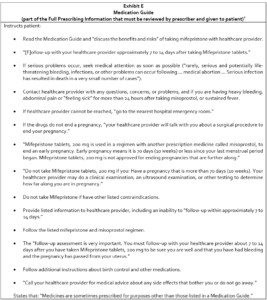
Exhibits B-E in the Appendix summarize the requirements that mifepristone prescribers must meet today under the mifepristone REMS and Full Prescribing Information (label).
B. How abortion drug prescribers are violating federal regulations
Abortion drug prescribers often ignore their key responsibilities under the mifepristone REMS and the Prescribing Information (label). Although the FDA stopped enforcing the in-person dispensing requirement in 2021 and made this change permanent in 2023, the remaining REMS requirements assume that certified prescribers will establish a provider-patient relationship before prescribing mifepristone. They must be able to: (a) “assess the duration of pregnancy accurately;” (b) “diagnose ectopic pregnancies;” (c) “provide surgical intervention” when necessary (or ensure that others are available to provide such care); and (d) “assure patient access to medical facilities equipped to provide blood transfusions and resuscitation, if necessary.”[xlix]These required capabilities are useless if prescribers lack face-to-face contact with patients. Furthermore, a mifepristone prescriber who lives in a different state cannot maintain enough contact to reasonably expect follow-up 7 to 14 days after the patient takes the prescribed drugs. They or their colleagues will not be available to treat the “2 to 7 out of 100 women” who need surgery to complete their abortions.[l] Even if a prescriber does not routinely perform ultrasonography on a patient seeking mifepristone, he should be able to do so if the “duration of pregnancy is uncertain or if ectopic pregnancy is suspected.”[li]
The use of telemedicine to prescribe mifepristone, especially across state lines, eviscerates the oversight and care required by the REMS and is therefore fundamentally incompatible with the REMS requirements. This is particularly evident when examining the practices of online mifepristone prescribers. Louisiana’s complaint in the state’s lawsuit against the FDA provides the following examples of how mifepristone prescribers operate:
The scheme is simple. Take one abortion facilitator, Abuzz, whose website tells Louisianans that they need only fill out a “short form” to obtain abortion drugs “discreetly packaged and delivered by mail.” “In most cases,” Abuzz promises, “providers do not require a phone call or video visit.” Similarly, another abortion facilitator, A Safe Choice, promises mifepristone by mail after a person fills out a “quick” online form, “no phone call required.” Another facilitator, Choices Rising, assures Louisianans that “[t]here is no need to have a telehealth consultation” before receiving the “FDA-approved abortion pill” in “a few days.” And the Massachusetts Medication Abortion Access Project says their form can be completed in “less than 5 minutes,” after which “[t]he pills [will] arrive in the mail and you take them at home or wherever is comfortable for you!” Each of these facilitators states that it sends FDA-approved mifepristone into all fifty states, or to Louisiana specifically, through the mail to induce abortions.[lii]
The prescribers working with these organizations should not have received prescriber certifications from mifepristone sponsors (i.e., manufacturers). They rely on a patient’s responses to online questions to determine the length of pregnancy, whether a patient needs an IUD removed, if she is Rh-negative, and if there are other medical reasons why she should not use mifepristone.[liii] An online form cannot reliably verify a patient’s identity, let alone confirm her pregnancy. While online prescribers may provide phone numbers for patients to call with concerns or questions, they essentially leave patients to decide on their own whether they need to seek care when bleeding, in pain, or scared.
Off-label prescribing
Some certified prescribers also prescribe mifepristone off-label for “advance provision” or to terminate pregnancies beyond 10 weeks of gestation. The mifepristone Medication Guide acknowledges, “Medicines are sometimes prescribed for purposes other than those listed in a Medication Guide.”[liv] However, it also clearly states that “Mifepristone tablets, 200 mg is not approved for ending pregnancies that are further along.” Patients are instructed, “Do not take Mifepristone tablets, 200 mg if you: Have a pregnancy that is more than 70 days (10 weeks). Your healthcare provider may do a clinical examination, an ultrasound examination, or other testing to determine how far along you are in pregnancy.”[lv]
Thus, prescribing mifepristone off-label to terminate pregnancies after 10 weeks of gestation violates the Medication Guide, which certified prescribers are directed to provide to patients under the Full Prescribing Information and which they agree to follow when signing the required Prescriber Agreement Form.[lvi] Additionally, once again, a prescriber whose contact with a patient is limited to chats or emails cannot “do a clinical examination, an ultrasound examination, or other testing to determine how far along [the patient is] in pregnancy.”[lvii]
Prescribing mifepristone for advance provision also violates the mifepristone REMS. Advance provision occurs when abortion drugs are prescribed to women who are not pregnant for future use. This practice conflicts with the careful monitoring required by a risk evaluation and mitigation strategy. When researching mail-order abortion providers, Mia Steupert identified 21 online-only or hybrid brick-and-mortar/online centers that are U.S. based and operate within the formal healthcare system that will prescribe for advance provision.[lviii] This includes the five U.S.-based online-only prescribers that openly prescribe mifepristone under shield laws.[lix] Other organizations outside the formal healthcare system also prescribe drugs for advance provision or will ship drugs at any gestation based on a woman’s word that she had a positive pregnancy test.[lx]
C. How abortion drug prescribers are violating pro-life state laws
Mifepristone prescribers who ship drugs across state lines violate the laws of at least 28 states.[lxi] Again, the SFP states: “Providing abortions under shield laws involves mailing medication abortion pills to people in states with telehealth restrictions, 6-week bans, or total abortion bans.”[lxii] In 2024, “the monthly average number of abortions provided under shield laws was about 10,000 per month,”[lxiii] and “[b]y June 2025, abortions provided under shield laws totaled 14,770 per month.”[lxiv] Abortions under shield laws accounted for 49% of all abortion provided via telehealth in 2024,”[lxv] and “[a]s of June 2025, more than half (55%) of telehealth abortions are provided under shield laws.”[lxvi]
Abortionist legal shields enable drug prescribers to break pro-life state laws with impunity. As an example, in response to a search for abortion pills in Alabama, a pro-life state, Aid Access states:
AidAccess can send abortion pills to you by mail in Alabama. This is because AidAccess works with US-based abortion providers in states with “shield laws” which protect abortion providers who prescribe abortion pills via telehealth.[lxvii]
The “I Need An A” website profiles abortion drug prescribers, including “A Safe Choice,” “Abuzz,” and “Choices Rising” which mail abortion pills to multiple pro-life states. The profiles of these organizations include the following statement:
Since you’re in a state where abortion is restricted, your provider will be located and licensed in a different state with a “Shield Law”. Shield laws help legally protect providers located in states where abortion is not restricted when helping someone in a state where there are restrictions.[lxviii]
While abortion drug prescribers at these and other organizations ship drugs to patients they will never meet in states where they are not licensed, healthcare providers in pro-life states continue to bear the burden of caring for women when they suffer adverse events from drug-induced abortion.
D. How pro-life states are responding
Some pro-life states are pushing back against the onslaught of abortion-inducing drugs from other states by suing the FDA, suing and indicting individual abortion prescribers, and enacting and amending laws that target abortion-inducing drugs.
1. Lawsuits against the FDA
Florida, Texas, Louisiana, Missouri, Idaho, and Kansas are suing the FDA over federal mifepristone regulations in three separate lawsuits.[lxix] While the complaints vary in scope, all three challenge the FDA’s 2021/2023 removal of the in-person dispensing requirement, which legitimized the practice of prescribing abortion-inducing drugs to patients in pro-life states. The Trump administration has filed motions to stay or dismiss these cases pending FDA review of the mifepristone regulations.[lxx] These lawsuits do not explicitly target abortionist protection statutes; however, if the in-person dispensing REMS requirement is restored, it will no longer be legal for prescribers to use telehealth to prescribe abortion-inducing drugs to patients in-state or out-of-state.
2. Lawsuits against and indictments of abortion prescribers
Civil lawsuits in Texas against abortion drug prescribers who reside in New York, California, and Delaware, and criminal indictments in Louisiana against abortion drug prescribers in New York and California—states with abortionist legal shields—are creating conflicts between pro-life states and abortion protection states. Abortion protection states refuse to cooperate with Texas or Louisiana, and the defendants in these cases have not indicated that they intend to stop mailing abortion drugs into pro-life states. It is unlikely that Congress can indefinitely avoid addressing conflicts over abortion-inducing drugs between pro-life states and abortion protection states, and one of these cases may eventually reach the United States Supreme Court.
Texas v. Carpenter[lxxi]
In December 2024, Texas sued Dr. Margaret Daley Carpenter, a licensed physician in New York, for violating multiple Texas laws by prescribing abortion-inducing drugs to a Texas resident.[lxxii] Because Dr. Carpenter “contracted by mail or otherwise with a resident of Collin County, Texas, with performance in whole or in part in Texas,” the District Court claimed personal jurisdiction (i.e., the authority to adjudicate a claim) over Dr. Carpenter.[lxxiii] However, Dr. Carpenter failed to file any responses with the District Court or appear before it.
In February 2025, a Texas state court entered a final judgment and order granting a permanent injunction against Dr. Carpenter. The court found that Dr. Carpenter violated Texas law by practicing medicine without a Texas license and registration and by prescribing abortion drugs that resulted in the death of an unborn child. The court imposed a civil penalty and enjoined Dr. Carpenter from prescribing abortion-inducing drugs to Texas residents, from practicing medicine in Texas without a license and registration, and from further violations of the Texas Health & Safety Code.[lxxiv] However, a New York county clerk has refused to file the Texas judgment against Dr. Carpenter, citing the state’s abortionist shield law.[lxxv] Also, a New York judge dismissed Texas’s legal case seeking enforcement of the civil judgment against Carpenter.[lxxvi]
Texas v. Lynch[lxxvii]
In January 2026, Texas sued a Delaware nurse practitioner, Debra Lynch, who allegedly shipped abortion drugs to patients in Texas through her organization, Her Safe Harbor. The complaint states that Lynch violated multiple Texas laws, including the prohibitions on “performing, inducing, or attempting an abortion,” and “the performance of abortions without a physician’s license.”[lxxviii] Previously, in response to media reports that Lynch ships abortion drugs to pro-life states, Texas had sent her a notice of cease and desist, demanding that she and her organization stop mailing abortion drugs into Texas.[lxxix] For instance, Lynch told the New York Times, as that paper put it, that her practice “is designed for patients in states with abortion bans and restrictions who want to talk with a provider on the phone or who worry that online forms might leave an electronic footprint” and that “she decided not to put copies of the prescriptions in the packages, although such a practice would trouble the providers who follow the rules.”[lxxx] This violates Delaware law, which requires her to include copies of the prescriptions in the abortion pill packages.[lxxxi] She even “permitted reporters to listen in on calls she took from two Texas women seeking abortion pills, during which she advised one woman how best to obtain false documentation from the emergency room that she was having a miscarriage instead of an abortion.”[lxxxii] Because Lynch did not reply but instead announced in the media that she would continue her operations,[lxxxiii] Texas filed this lawsuit.
Texas v. Aid Access[lxxxiv]
In February 2026, Texas sued Aid Access, Remy Coeytaux, and Rebecca Gomperts (the founder and director of Aid Access) for “mail[ing] mifepristone and misoprostol to Texas residents for the purpose of inducing abortions that are illegal under Texas law.”[lxxxv] The complaint states that the defendants violated multiple Texas laws, including “the Human Life Protection Act (HLPA),” “Texas’s prohibitions on mailing abortion-inducing drugs,” and “Texas’s prohibitions on the unlicensed practice of medicine found in the Texas Occupations Code and the Texas Health and Safety Code.”[lxxxvi] According to the lawsuit: “The New York Times profiled two Texas women who received FDA-approved abortion drugs through Aid Access. Likewise, The Washington Post profiled a woman in Houston, Texas, who received abortion drugs from Aid Access, took them, and ended her pregnancy.”[lxxxvii] “Aid Access deliberately solicits Texas residents through a dedicated webpage that instructs users on how to obtain abortion-inducing drugs in defiance of Texas law.”[lxxxviii]Aid Access’s website states: “Aid Access will help you order abortion pills and have them delivered to your TX home in Houston, San Antonio, Dallas, Fort Worth, Austin, El Paso, or anywhere else in the State of Texas.”[lxxxix]
As with Lynch, Texas had previously sent a notice of cease and desist to Remy Coeytaux, a California Aid Access provider. Texas’s letter demanded that he stop mailing abortion drugs into Texas.[xc] There is no indication that Coeytaux intends to stop prescribing abortion drugs to patients in Texas from California, where he is “protected” by an abortionist legal shield.[xci]
Rodriguez v. Coeytaux
In July 2025, a Texas father of two unborn children who were allegedly killed by abortion-inducing drugs brought a wrongful death lawsuit in federal court under Texas[xcii] and federal[xciii] law against Remy Coeytaux.[xciv] The complaint states that the estranged husband of the unborn children’s mother bought abortion-inducing drugs from the defendant twice and pressured her to abort two children, who were also the plaintiff’s children. The complaint alleges that the defendant “purposefully and knowingly mailed abortion-inducing drugs into Texas in violation of state law.” The complaint further alleges that the mother was more than 10 weeks pregnant with the first baby and nearly three months pregnant with the second baby.
In addition to nominal, compensatory, and punitive damages, the plaintiff seeks an injunction and at least $100,000 for each time the defendant “mailed, transported, delivered, or prescribed, or provided any abortion-inducing drug to any person or location in Texas” under Texas’s H.B. 7, which took effect on December 4, 2025.[xcv] The lawsuit also asks that, under H.B. 7, Coeytaux be prohibited “from suing Mr. Rodriguez, his attorneys, or any person providing legal representation or any type of assistance to Mr. Rodriguez, under California’s clawback law or any other type of clawback provision.”[xcvi]
Davis v. Cooprider[xcvii]
In August 2025, plaintiff Liana Davis sued Chris Cooprider for wrongful death in the murder of their unborn child. Ms. Davis claims that Mr. Cooprider tricked her into consuming abortion-inducing drugs. In Texas, “The wrongful-death statute allows surviving parents to sue those who cause the death of an unborn child by a wrongful act, neglect, carelessness, unskillfulness, or default.” [xcviii] Ms. Davis is also suing Aid Access, the seller of the abortion-inducing drugs purchased by Mr. Cooprider, and Rebecca Gomperts, the founder and director of Aid Access. The lawsuit states that Aid Access and Rebecca Gomperts are responsible for violating multiple abortion laws in Texas and federal law because they aided Cooprider by prescribing abortion-inducing drugs to Mr. Cooprider.[xcix]
Louisiana v. Dr. Margaret D. Carpenter and Nightingale Medical, P.C.
In January 2025, a grand jury in Louisiana indicted Dr. Carpenter and her company for violating a Louisiana law that prohibits criminal abortion using abortion-inducing drugs.[c] According to the State, the girl’s mother requested the drugs, and the girl was coerced into taking them. After taking the drugs, the minor suffered an emergency while alone, called 911, and was transported to the hospital.[ci] However, New York Governor Kathy Hochul was unfazed by this tragedy. Rather than cooperate with the State of Louisiana by extraditing Dr. Carpenter, Governor Hochul stated in an interview with CNN:
I will in no way in h— ever extradite a doctor who was simply living up to her oath to take care of patients and to give sometimes life saving medication to someone who desperately needs it. I will never turn her over to the authorities in Louisiana, where she would face criminal prosecution and up to 15 years in jail. It is shocking where this country has come to, but I will continue to be that line of defense against such actions.[cii]
Louisiana v. Remy Coeytaux
The State of Louisiana is also seeking the extradition of Remy Coeytaux from California.[ciii] In January 2026, he was indicted by a grand jury for “Criminal Abortion by Means of Abortion-Inducing Drugs.”[civ] The Bill of Information states: “[O]n or about October 16, 2023, [Coeytaux] knowingly caused an abortion to occur by delivering, dispensing, distributing, or providing a pregnant woman with an abortion inducing drug.”[cv] However, like Governor Hochul, Governor Gavin Newsom of California has refused to extradite, stating, “California protects patients and their doctors. We will not be complicit in efforts to strip away their privacy, autonomy, or dignity. Stay Tuned.”[cvi] Louisiana Attorney General Liz Murrill recently indicated that she plans to sue Governors Hochul and Newsom “for their refusal to honor Louisiana’s extradition requests for doctors in their states who have committed felonies in Louisiana by sending abortion pills into the state.”[cvii]
3. New laws and legislation to protect women from abortion-inducing drugs
In addition to suing abortion drug prescribers, pro-life states are enacting new laws or amending existing laws to keep abortion-inducing drugs out of their states.
a. Controlled substance and drug trafficking laws
In 2024, Louisiana passed a law classifying mifepristone and misoprostol as controlled substances within the state.[cviii] Bills are advancing in Kentucky,[cix] Mississippi,[cx] South Carolina,[cxi] and Texas[cxii] that would classify “abortion-inducing drugs,” when used for pregnancy termination, as controlled substances and prohibit their trafficking. The bills would also establish civil actions.
In August 2025, Louisiana also passed the “Justice for Victims of Abortion Drug Dealers Act,” which increased the statute of limitations from three to five years for a mother’s “right and cause of action for damages … against any person or entity … who knowingly performs or substantially facilitates an abortion with the intent to achieve that result.”[cxiii] The term “substantially facilitates” includes prescribing abortion-inducing drugs. The law does not apply to healthcare providers licensed to practice medicine in Louisiana, or to pharmacists or pharmacies licensed in the state. In other words, this law targets out-of-state abortion providers, not healthcare providers within the state who are complying with state law.
b. Qui Tam (whistleblower)
On December 4, 2025, a Texas law took effect that authorizes qui tam (private citizen whistleblower) actions to enforce prohibitions on the manufacture and provision of abortion-inducing drugs for the purpose of inducing abortions, with emergency exceptions.[cxiv] The law also protects plaintiffs from counteractions under other states’ laws. The law explicitly excludes protected speech and prohibits actions against pregnant women. The case Rodriguez v. Coeytaux, discussed above, is the first test case for this law. The Indiana legislature is considering a bill that also would allow for qui tam actions and includes wrongful death and personal injury causes of action.[cxv]
c. Prohibitions on abortion advertisements
In March 2026, the governor of South Dakota signed a law that prohibits a person from knowingly dispensing, distributing, selling, or advertising “(1) An article or thing designed, adopted, or intended for producing an [unlawful] abortion; or (2) An article, instrument, substance, drug, medicine, or thing that is advertised or described in a manner calculated to lead another to use or apply it for producing an [unlawful] abortion.” The new law imposes both criminal and civil penalties.[cxvi] This legislation followed litigation in which South Dakota sued Mayday Medicines Inc. (Mayday Health) for advertising abortion-inducing drugs in the state, where they are illegal. Mayday Health, in turn, sued South Dakota in a New York federal court.[cxvii] On March 5, 2026, South Dakota and Mayday Health entered a “limited release agreement” in which Mayday Health agreed to “ensure the removal of the Gas Station Placards” and to “terminate its campaign to place additional Gas Station Placards throughout South Dakota.” Mayday Health also agreed that it would not place advertisements in South Dakota “that aid, abet, or solicit illegal conduct as established by law.” Through the agreement, the parties “jointly dismiss[ed] the South Dakota Action and the New York Action.”[cxviii]
The attorney general of Kentucky is also investigating gas station advertisements placed by Mayday Health in that state.[cxix]
d. Mixed civil and criminal penalties
West Virginia’s legislature is considering a bill that would prohibit any “public entity” from entering “into a contract with a manufacturer or wholesale drug distributor for goods or services unless the contract includes a written certification that the person or entity is not currently engaged in, and will not for the duration of the contract, engage in the manufacturing or wholesale distribution of abortifacients.” The bill also makes it a felony for “any person other than a licensed medical professional” to perform or attempt to perform an abortion with an abortifacient by sending an abortifacient to a person in West Virginia, placing an abortifacient into the stream of commerce when they know it will be used in the state or sent into the state, prescribing an abortifacient to a person in West Virginia “regardless of whether the prescriber was in the State of West Virginia,” or disseminating “an abortifacient in the State of West Virginia without a lawfully valid prescription.” If a licensed medical professional performs one of these acts, “he or she is subject to disciplinary action by his or her applicable licensing board” which may lead to the revocation of the professional’s license. The bill also establishes civil causes of action.[cxx]
E. Why a federal response is needed
While state-level efforts to combat abortion-inducing drugs are important, pro-life state efforts to combat the interstate shipment of abortion-inducing drugs are fundamentally insufficient. Abortion protection states will not cooperate. This is a national crisis in need of a national solution. Several proposals have been introduced in Congress to address the interstate shipment of abortion-inducing drugs.
S. 4066,[cxxi] the “Safeguarding Women from Chemical Abortion Act,” would withdraw FDA approval of mifepristone for abortion. The bill would create a federal cause of action that could be brought by a woman harmed by abortion-inducing drugs against a manufacturer of mifepristone.
H.R. 1525,[cxxii] the “Protecting Life from Chemical Abortion Act,” would reinstate the “in-person dispensing requirement” for mifepristone, effectively stopping law-abiding prescribers from mailing abortion-inducing drugs in-state or out of state. The Act would also condition any agency authority to reduce protections in the mifepristone REMS on the submission of abortion data by every state.
H.R. 679,[cxxiii] “To nullify the modifications made by the Food and Drug Administration in January 2023…,” would likewise nullify the FDA’s January 2023 modifications to the mifepristone REMS, which removed the in-person dispensing requirement and permitted mifepristone to be distributed through pharmacies.
S. 1631,[cxxiv] the “Restoring Safeguards for Dangerous Abortion Drugs Act,” would remove the current REMS and replace it with the REMS approved in June 2011. A return to the 2011 REMS would include requiring in-person dispensing, broader adverse event reporting, and three patient appointments (1. to take mifepristone, 2. to take misoprostol, and 3. follow-up). It would also presumably reduce the drug’s indication for ending pregnancy from up to 10 weeks to up to 7 weeks. The bill would also remove the Secretary of Health and Human Services’ authority to modify the REMS. It would create a tort claim that can be brought against “a telehealth provider, pharmacy, or any other person” by individuals harmed when mifepristone is imported or transported in interstate or foreign commerce in violation of the Comstock Act, 18 U.S.C. § 1462. Finally, the bill would ban the importation of mifepristone, “including by mailing such drug to individuals.”
H.R.795,[cxxv] the “Pregnancy Is Not an Illness Act,” would prohibit the Department of Health and Human Services from treating pregnancy as an illness for purposes of “(1) approving any abortion drug …; or (2) imposing or maintaining any risk evaluation and mitigation strategy for an abortion drug.” It would also nullify past approvals of abortion drugs that “relied in whole or in part on the treatment of pregnancy as an illness” and expressly nullifies the approval of mifepristone.
Conclusion
The papers in this series show that, in pro-life states, abortion advocates are relentless in their attacks on limits based on gestation and other protections for unborn children and their mothers. Pro-life states can and should pursue pro-life state constitutional amendments where necessary, provide clear and comprehensive guidance to doctors and hospitals about medical emergency exceptions to the limits, and challenge illegal shipments of abortion-inducing drugs. A federal response is also needed to stop abortion drug prescribers from mailing abortion-inducing drugs into pro-life states. Congress might need to pass a law specifically addressing abortionist legal shields and the refusal of abortion-protection states to work with pro-life states.
Furthermore, in abortion protection states, pro-life advocates should keep pursuing legal and legislative strategies targeting abortion protection statutes and amendments. Unwanted and coerced abortions, inadequate consent processes, trafficking of minors across state lines for abortions, patient neglect, malpractice, and other horrors can lead to change, even in the most hardened abortion protection states.
Mary E. Harned, J.D., is an associate scholar at the Charlotte Lozier Institute.
Appendix
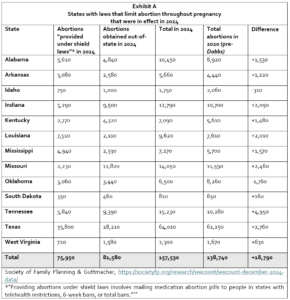
** #WeCount report, April 2022 to December 2024, Society of Family Planning (June 23, 2025), https://societyfp.org/research/wecount/wecount-december-2024-data/.
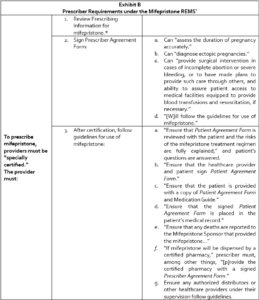
† Risk Evaluation and Mitigation Strategy (REMS) Single Shared System for Mifepristone 200 MG, https://www.accessdata.fda.gov/drugsatfda_docs/rems/Mifepristone_2025_09_30_REMS_Full.pdf. The REMS includes additional guidelines for the sponsors (manufacturers) of mifepristone and for certified pharmacies.
* The Full Prescribing Information for mifepristone provides that mifepristone is indicated “for the medical termination of intrauterine pregnancy through 70 days gestation.” Full Prescribing Information, Mifepristone, https://www.fda.gov/media/164653/download?attachment.
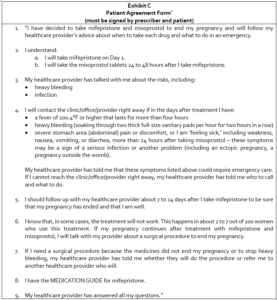
† REMS, supra.
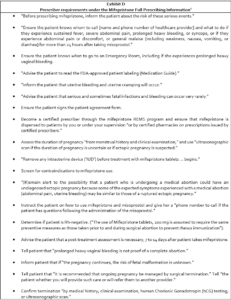
† Full Prescribing Information, supra.
† Full Prescribing Information, supra.
[i] 597 U.S. 215, 222 (2022).
[ii] This is the fourth paper in the series Abortion Law in America Today. For an introduction to the series and examination of the legal landscape in the 20 pro-life states, see Mary E. Harned, Abortion Law in America Today: Introduction and the Pro-Life States, Charlotte Lozier Institute (Dec. 17, 2025), https://lozierinstitute.org/abortion-law-in-america-today-introduction-and-the-pro-life-states/. For an analysis of the legal landscape in the 26 abortion protection states, see Mary E. Harned, Abortion Law in America Today: Abortion Protection States, Charlotte Lozier Institute (Jan. 28, 2026), https://lozierinstitute.org/abortion-law-in-america-today-abortion-protection-states/#_ftn1. For an examination of pro-life responses to pro-abortion challenges in court, see Mary E. Harned, Abortion Law in America Today: Pro-life Responses to Pro-abortion Challenges, Charlotte Lozier Institute (Feb. 4, 2026), https://lozierinstitute.org/abortion-law-in-america-today-pro-life-responses-to-pro-abortion-challenges/.
[iii] Id. at 221.
[iv] This paper defines “gestation-based abortion limits” as laws that restrict abortion, with limited exceptions, throughout or for most of pregnancy. Gestation-based abortion limits are distinct from bans on specific abortion procedures or abortions performed for specific reasons.
[v] Alabama, Arkansas, Florida, Georgia, Idaho, Indiana, Iowa, Kentucky, Louisiana, Mississippi, Nebraska, North Carolina, North Dakota, Oklahoma, South Carolina, South Dakota, Tennessee, Texas, and West Virginia. Utah’s limit is enjoined while in litigation.
[vi] Mia Steupert, How Many Abortions are occurring in America Post-Dobbs? Appendix A, Table 1: Number of Brick-and-Mortar Abortion Centers by State, Charlotte Lozier Institute (May 22, 2025), https://lozierinstitute.org/wp-content/uploads/2025/05/How-Many-Abortions-are-Occurring-in-America-Post-Dobbs-Appendices-.pdf.
[vii] See #WeCount report, April 2022 to December 2024, Society of Family Planning (June 23, 2025), https://societyfp.org/research/wecount/wecount-december-2024-data/. Under “Methods,” and “Limitations,” the SFP states: “In early 2022, #WeCount developed a database of all clinics, private medical offices, hospitals, and virtual clinic providers in the US known to offer abortion care. We started with the Abortion Facility Database from Advancing New Standards in Reproductive Health (ANSIRH) at University of California, San Francisco. Throughout the study period, we added new providers to our database as we became aware of them….This report also includes abortions provided under shield laws by US-based licensed providers who are following their own state law…#WeCount has a comprehensive count of abortions provided by licensed clinicians, with more than 83% of all abortions reported and about 17% imputed.”
[viii] The Society of Family Planning’s “counts [] do not include abortions that take place in the US outside of the formal healthcare system.” The count also does not account for women who did not take abortion pills that were mailed to them. See #WeCount June 23, 2025, supra.
[ix] 2020 was pre-Dobbs.
[x] Alabama, Arkansas, Idaho, Indiana, Kentucky, Louisiana, Mississippi, Missouri, Oklahoma, South Dakota, Tennessee, Texas, and West Virginia.
[xi] WeCount, June 23, 2025, supra.
[xii] According to a new Guttmacher report, “90,600 abortions were provided by clinicians via telehealth to states with total bans in 2025.” That is a 21.7% increase from 2024, when “74,460 abortions were provided by clinicians via telehealth to states with total bans.” Maddow-Zimet I and Forouzan K, Full-Year Estimates Show Overall Stability in Abortion Incidence, Decreased Travel and Increased Telehealth Provision, 2026, New York: Guttmacher Institute, https://www.guttmacher.org/monthly-abortion-provision-study.
[xiii] 597 U.S. at 345.
[xiv] See Planned Parenthood of Montana v. State, Case No. DA 23-0272 (Aug. 14, 2024). The State of Montana sought review from the United States Supreme Court in State of Montana v. Planned Parenthood of Montana, No. 24-745, asking “Whether a parent’s fundamental right to direct the care and custody of his or her children includes a right to know and participate in decisions concerning their minor child’s medical care, including a minor’s decision to seek an abortion.” The Court denied review (Montana v. Planned Parenthood of Montana, 606 U.S. ___ (2025)). Justice Alito, with whom Justice Thomas joined, wrote that this case is “a poor vehicle” for deciding the question submitted by the state. However, he also wrote, “It is [] especially important that the denial of review is not read by interested parties or other courts as a rejection of the argument that the petition asks us to decide.”
[xv] See Guttmacher Institute, Minors’ Access to Abortion Care, State Laws and Policies (as of January 2026), (2026), https://www.guttmacher.org/state-policy/explore/minors-access-abortion-care. Some of these laws are ineffective. For instance, the State of Maryland permits a healthcare provider to waive the parental notification requirement, effectively nullifying it.
[xvi] § 188.250 RSMo.
[xvii] 24BA-CV00990, State of Missouri’s Petition for Declaratory Judgment and Injunctive Relief (Feb. 29, 2024).
[xviii] Id.
[xix] Missouri v. Planned Parenthood Great Plains, 24BA-CV00990, Order (Apr. 28, 2025).
[xx] Burns Ind. Code Ann. § 16-34-2-4.2
[xxi] Planned Parenthood v. Commissioner, 732 F. Supp. 3d 971, 975 (S.D. Ind. 2024).
[xxii] Id. at 978.
[xxiii] Id.
[xxiv] Id. at 982 (emphasis added).
[xxv] Idaho Code § 18-623.
[xxvi] Matsumoto v. Labrador, 122 F.4th 787, 795 (9th Cir. 2024) (citing United States v. Hansen, 599 U.S. 762, 770 (2023) (internal marks and citation omitted)).
[xxvii] Id.
[xxviii] Id.
[xxix] Id. at 815.
[xxx] Carolyn Komatsoulis, Idaho Republicans want to remove “likely unconstitutional” word in abortion law, The Lawton Constitution, Mar. 13, 2026, https://www.swoknews.com/ap/national/idaho-republicans-want-to-remove-likely-unconstitutional-word-in-abortion-law/article_4554c436-0a35-5bab-9faf-eb7db72a9ad7.html.
[xxxi] Tenn. Code Ann. § 39-15-201.
[xxxii] Welty v. Dunaway, 791 F. Supp. 3d 818, 831 (M.D. Tenn. 2025).
[xxxiii] Id. at 841.
[xxxiv] Id at 843.
[xxxv] H.R. 3682; S. 1645.
[xxxvi] H.R. 4964, 119th Cong. (2025); S. 3650, 119th Cong. (2026), https://www.congress.gov/bill/119th-congress/house-bill/4964/text.
[xxxvii] Id.
[xxxviii] A federal law known as the “Comstock Act” prohibits mailing “every article or thing designed, adapted, or intended for producing abortion.” 18 U.S.C. § 1461. This law should be enforced against anyone who mails abortion drugs. However, federal regulations now permit prescribers to mail drugs in contravention of federal statutory law. Further, the Trump administration has refused to enforce the Comstock Act against abortion drug prescribers. See Alice Miranda Ollstein, ‘It’s not a pro-life position’: Anger after Trump says no to Comstock, Politico, Aug. 20, 2024, https://www.politico.com/news/2024/08/20/trump-comstock-enforcement-00175068.
[xxxix] Twenty-six states are “abortion protection states,” with laws that grant abortion a special legal status. They have few, if any, health and safety regulations of abortion, such as clinic safety standards, parental involvement laws for minors, or adequate informed consent requirements.
[xl] Arizona, California, Colorado, Connecticut, Delaware, Hawaii, Illinois, Maine, Maryland, Massachusetts, Michigan (executive order only), Minnesota, Nevada, New Jersey, New Mexico, New York, North Carolina (executive order only), Oregon, Pennsylvania (executive order only), Rhode Island, Vermont, and Washington. See Interactive Map: US Abortion Policies and Access After Roe, Guttmacher, https://states.guttmacher.org/policies?protections=shield-law-protecting-providers; Shield Laws for Reproductive and Gender-Affirming Health Care: A State Law Guide, UCLA Center on Reproductive Health, Law, and Policy, https://williamsinstitute.law.ucla.edu/wp-content/uploads/Shield-Law-NC-Sep-2024.pdf.
[xli] Abortionist legal shields prohibit state and local cooperation in civil actions and criminal investigations initiated in other states against abortionists. The laws generally require the states to decline enforcing judgments or penalties issued against an abortionist in another state and prohibit negative professional consequences. Also, the laws generally require the states to refuse to extradite abortionists or cooperate with any extra-jurisdictional investigation of abortions that are legal in the pro-abortion state.
[xlii] California, Colorado, Maine, Massachusetts, New York, Rhode Island, Vermont, Washington. See Interactive Map: US Abortion Policies and Access After Roe, supra.
[xliii] Mary E. Harned, Abortion “Shield Laws’: Pro-Abortion States Seek to Force Abortion on Life-Affirming States, Charlotte Lozier Institute (Aug. 24, 2023), https://lozierinstitute.org/abortion-shield-laws-pro-abortion-states-seek-to-force-abortion-on-life-affirming-states/; Mary E. Harned, Abortion Law in America Today: Abortion Protection States, Charlotte Lozier Institute (Jan. 28, 2026), https://lozierinstitute.org/abortion-law-in-america-today-abortion-protection-states/.
[xliv] Mifepristone is marketed as Mifeprex (approved in 2000) and has generics manufactured by GenBioPro (approved in 2019) and Evita Solutions (approved in 2025).
[xlv] U.S. Food & Drug Administration, Information about Mifepristone for Medical Termination of Pregnancy Through Ten Weeks Gestation, https://www.fda.gov/drugs/postmarket-drug-safety-information-patients-and-providers/information-about-mifepristone-medical-termination-pregnancy-through-ten-weeks-gestation.
[xlvi] In 2016, the FDA increased the maximum gestational age for mifepristone use for abortion from 49 days (7 weeks) to 70 days (10 weeks). The FDA’s modifications also allowed home administration of mifepristone and misoprostol, permitted non-physicians to become certified prescribers, reduced the number of mandatory patient office visits from 3 to 1, and removed the requirement that prescribers report all serious adverse events associated with mifepristone to a mifepristone sponsor. Today, prescribers are required to report only deaths. See U.S. Food & Drug Administration, Questions and Answers on Mifepristone for Medical Termination of Pregnancy Through Ten Weeks Gestation, https://www.fda.gov/drugs/postmarket-drug-safety-information-patients-and-providers/questions-and-answers-mifepristone-medical-termination-pregnancy-through-ten-weeks-gestation.
[xlvii] On April 12, 2021, the FDA halted enforcement of the REMS in-person dispensing requirement and any in-person requirements related to the Patient Agreement Form during the COVID-19 public health emergency. The FDA also stated that dispensing mifepristone by mail, either by or under the supervision of a certified prescriber, or through a mail-order pharmacy when such dispensing is done under the supervision of a certified prescriber, would be permitted. These changes became permanent in 2023. See Questions and Answers on Mifepristone, supra.
[xlviii] See Section (D)(1), below.
[xlix] REMS, supra.
[l] REMS, supra.
[li] Full Prescribing Information, supra.
[lii] Louisiana v. FDA, Civ. No. 6:25-CV-01491, Complaint, ¶ 81 (internal citations omitted).
[liii] See Full Prescribing Information, supra.
[liv] Full Prescribing Information, supra.
[lv] Id.
[lvi] Full Prescribing Information and REMS, supra.
[lvii] Full Prescribing Information, supra.
[lviii] Steupert, supra.
[lix] Id. See also, #WeCount June 23, 2025, supra. Prescribing under shield laws means “mailing medication abortion pills to people in states with telehealth restrictions, 6-week bans, or total abortion bans.”
[lx] See Steupert, supra.
[lxi] Guttmacher Institute, Medication abortion, State Laws and Policies (as of February 2026), 2026, https://www.guttmacher.org/state-policy/explore/medication-abortion. Even when abortion-inducing drugs are mailed into states that do not place restrictions on abortion-inducing drugs or limit abortion, the use of telemedicine to prescribe abortion-inducing drugs across state lines represents a dangerous shift in locale of care standards. See, Harned, Abortion “Shield Laws,” supra.
[lxii] #WeCount June 23, 2025, supra.
[lxiii] #WeCount, June 23, 2025, supra.
[lxiv] Society of Family Planning, #WeCount Report April 2022 to June 2025. 9 Dec. 2025 (Dec. 9, 2025), https://societyfp.org/research/wecount/wecount-june-2025-data/.
[lxv] #WeCount, June 23, 2025, supra.
[lxvi] #WeCount, Dec. 9, 2025, supra.
[lxvii] Aid Access, Alabama Residents: Order the Abortion Pill Online | Aid Access, https://aidaccess.org/en/page/2934593/where-can-i-buy-the-abortion-pill-online-in-alabama.
[lxviii] I Need an A, https://www.ineedana.com.
[lxix] State of Louisiana et al. v. Food and Drug Administration et al., 6:25-cv-01491 ((1) “The 2023 REMS is Arbitrary and Capricious and an Abuse of Discretion”; (2) “The 2023 REMS is Contrary to Law”); State of Missouri et al. v. Food and Drug Administration et al., 4:25-cv-01580 (The following violate the Administrative Procedure Act (APA), 5 U.S.C.§ 706: the 2016 REMS changes; the 2019 mifepristone REMS Program and 2019 ANDA approval; and the 2021/2023 removal of the in-person dispensing requirement, including the pharmacy authorization); State of Florida et al. v. Food and Drug Administration, et al., 7:25-cv-00126 (The following violate the APA: the 2000 approval of Mifeprex; the 2016 major changes; the 2021/2023 removal of the in-person dispensing protection, including the pharmacy authorization; and the 2019 and 2025 ANDA approvals and REMS Programs).
[lxx] Diana Chandler, Trump administration seeks stay, dismissal of two more pro-life lawsuits against abortion pill, BaptistPress, Mar. 17, 2026, https://www.baptistpress.com/resource-library/news/trump-admin-seeks-stay-dismissal-of-two-more-pro-life-lawsuits-against-abortion-pill/.
[lxxi] “Carpenter is the Co-Medical Director and Founder of the Abortion Coalition for Telemedicine (“ACT”), a nationwide advocacy organization proactively working to advance telemedicine abortion.” She previously worked with Aid Access and helped start Hey Jane. State of Texas v. Margaret Daley Carpenter, Case No. 471-08943-2024, Petition and Application for Temporary and Permanent Injunctive Relief, ¶¶ 19-20 (Filed 12.12.2024), https://www.texasattorneygeneral.gov/sites/default/files/images/press/Dr%20Carpenter%20Filed%20Petition.pdf
[lxxii] The complaint listed the following laws allegedly broken by Dr. Carpenter: Tex. Occ. Code § 155.001; Tex. Occ. Code § 165.159; Tex. Health & Safety Code § 171.003; Tex. Health & Safety Code § 171.0031(a); 22 Tex. Admin. Code § 174.8; Tex. Health & Safety Code § 171.063(b-1); Tex. Health & Safety Code § 171.063(c)(1), (6); (e). Further, persons are generally prohibited from knowingly performing, inducing, or attempting an abortion, and the attorney general may collect civil penalties and other remedies, Tex. Health & Safety Code § 170A.002(a); Tex. Health & Safety Code § 170A.002; .005; .006.
[lxxiii] Carpenter, Petition and Application, supra, citing Tex. Civ. Prac. & Rem. Code § 17.042.
[lxxiv] Texas v. Carpenter, Case No. 471-08943-2024 (Dist. Ct. Collin Co., Feb. 13, 2025), https://statecourtreport.org/case-tracker/texas-v-margaret-daley-carpenter.
[lxxv] Michael Hill, NY county clerk refuses to file Texas’ fine for doctor accused of prescribing abortion pills, AP, Mar. 27, 2025, https://apnews.com/article/abortion-pills-lawsuit-texas-new-york-carpenter-e97d5c38d9429083d03c2a7b385cbbfd; Michael Hill, New York clerk again refuses to enforce Texas judgment against doctor who provided abortion pills, AP, Jul. 14, 2025, https://apnews.com/article/abortion-pills-lawsuit-texas-new-york-carpenter-2601c059ed475f97e8c8bdd722cce7da.
[lxxvi] Michael Hill, New York judge dismisses Ken Paxton’s legal challenge in abortion pills case, AP, Oct. 31, 2025, https://www.texastribune.org/2025/10/31/texas-lawsuit-new-york-abortion-provider-shield-law-ken-paxton/.
[lxxvii] Debra Lynch “is a nurse practitioner who operates an illegal abortion-by-mail enterprise known as Her Safe Harbor. From her home in Delaware, Lynch prescribes and ships abortion-inducing drugs into Texas—knowingly and willfully violating Texas law.” State of Texas v. Lynch, Case No. ___, Petition and Application for Temporary and Permanent Injunctive Relief at 1 (filed Jan. 27, 2026). https://www.texasattorneygeneral.gov/sites/default/files/images/press/Petition%20(2).pdf.
[lxxviii] Id. at 6, citing Tex. Health & Safety Code § 170A.002; Tex. Occ. Code § 155.001; Tex. Occ. Code § 165.159; Tex. Health & Safety Code § 170A.002(b)(1).
[lxxix] Ken Paxton letter to Debra A. Lynch, Notice of Cease and Desist, Aug. 14, 2025, https://www.texasattorneygeneral.gov/sites/default/files/images/press/Her%20Safe%20Harbor%20Cease%20and%20Desist.pdf. Paxton also sent letters to Plan C (Ken Paxton letter to Plan C, Notice of Cease and Desist, Aug. 14 2025, https://www.texasattorneygeneral.gov/sites/default/files/images/press/PlanC%20Cease%20and%20Desist%20Redacted.pdf), and Remy Coeytaux (Ken Paxton letter to Remy Coeytaux, Notice of Cease and Desist, Aug. 14, 2025, https://www.texasattorneygeneral.gov/sites/default/files/images/press/Coeytaux%20Cease%20and%20Desist.pdf).
[lxxx] Pam Belluck, A Day With One Abortion Pill Prescriber, The New York Times, June 9, 2025, https://www.nytimes.com/2025/06/09/health/a-day-with-one-abortion-pill-prescriber.html?register=email&auth=register-email#.
[lxxxi] Lynch, Petition and Application, citing Pam Belluck, supra at ¶ 17.
[lxxxii] Id., quoting Pam Belluck, supra at ¶ 16.
[lxxxiii] Lynch, Petition and Application, supra at 7, citing Wendy Glauser, Despite Legal Threats, Mail-Order Abortions Aren’t Slowing Down, Medscape, Sep. 10, 2025, https://www.medscape.com/viewarticle/despite-legal-threats-mail-order-abortions-arent-slowing-2025a1000nw2.
[lxxxiv] “Defendants Aid Access GmbH, Aid Access B.V. (collectively “Aid Access”), Remy Coeytaux, and Rebecca Gomperts operate an international abortion-by-mail enterprise that illegally ships abortion-inducing drugs into Texas in open defiance of Texas law. From California, Coeytaux uses his ties to Aid Access to mail abortion-inducing drugs to Texas. Together, Defendants advertise, prescribe, and mail mifepristone and misoprostol to Texas residents for the purpose of inducing abortions that are illegal under Texas law.” State of Texas v. Aid Access, Cause No. ___, Petition and Application for Temporary and Permanent Injunctive Relief at 1 (Feb. 24, 2026), https://www.texasattorneygeneral.gov/sites/default/files/images/press/Petition_16.pdf.
[lxxxv] Id.
[lxxxvi] Id. at 2, citing Tex. Health & Safety Code § 170A.002; Tex. Health & Safety Code § 171A.051; Tex. Occ. Code § 155.001; Tex. Occ. Code § 165.159; Tex. Health & Safety Code § 170A.002(b)(1); id. § 171.003.
[lxxxvii] Aid Access, Petition and Application, supra ¶ 20, citing Pam Belluck, Abortion Shield Laws: A Ware Between the States, New York Times, Feb. 22, 2024, https://www.nytimes.com/2024/02/22/health/abortion-shield-laws-telemedicine.html; Caroline Kitchener, Alone in a Bathroom: The Fear and Uncertainty of a Post-Roe Medication Abortion, The Washington Post, Apr. 11, 2024, https://www.washingtonpost.com/politics/interactive/2024/abortion-pill-experience-stories/.
[lxxxviii] Aid Access, Petition and Application, supra ¶ 26, citing www.aidaccess.org/en/page/2934646/where-can-i-get-the-abortion-pill-online-in-texas.
[lxxxix] Aid Access, Get an Abortion Pill Online in Texas. Order Here, www.aidaccess.org/en/page/2934646/where-can-i-get-the-abortion-pill-online-in-texas.
[xc] Ken Paxton letter to Remy Coeytaux, Notice of Cease and Desist, Aug. 14, 2025, https://www.texasattorneygeneral.gov/sites/default/files/images/press/Coeytaux%20Cease%20and%20Desist.pdf.
[xci] See, Petition and Application, supra ¶ 56 (citing Cal. Health & Safety Code §123467.5).
[xcii] Tex. Penal Code §§ 1.07, 19.02, 19.06; Tex. Health & Safety Code § 171.063(a); Tex. Health & Safety Code § 171.0631; Tex. Health & Safety Code § 171.003; Tex. Health & Safety Code § 171.011; Tex. Health & Safety Code § 245.002(2) and 245.003(a); Tex. Rev. St. §§ 4512.1-4512.6; Tex. Health & Safety Code § 170A.002; Tex. Penal Code § 19.02(b)(3).
[xciii] 18 U.S.C. §§ 1461-1462.
[xciv] Rodriguez v. Coeytaux, No. 3:25-cv-225, First Amended Complaint (S.D. Tex filed Feb. 01, 2026), https://reproductiverights.org/wp-content/uploads/2026/01/Amended-Complaint.pdf.
[xcv] First Amended Complaint, supra; See Subsection 3 below for more details about Tex. H.B. 7, Tex. Health & Safety Code § 171A.001- .151.
[xcvi] Id.
[xcvii] Davis v. Cooprider, No. 2:25-cv-220, Complaint (S.D. Tex. filed Aug. 11, 2025).
[xcviii] Id., citing Tex. Civ. Prac. & Rem. Code § 71.002(b) (“A person is liable for damages arising from an injury that causes an individual’s death if the injury was caused by the person’s or his agent’s or servant’s wrongful act, neglect, carelessness, unskillfulness, or default.”); Tex. Civ. Prac. & Rem. Code § 71.001(4) (“‘Individual’ includes an unborn child at every stage of gestation from fertilization until birth.”).
[xcix] The complaint states that Chris Cooprider, Aid Access, and Rebecca Gomperts violated the following laws: Tex. Health & Safety Code § 171.063(a); Tex. Health & Safety Code § 171.0631; Tex. Health & Safety Code § 171.003; Tex. Health & Safety Code § 171.011; Tex. Health & Safety Code § 245.002(2) and 245.003(a); 18 U.S.C. §§ 1461-1462; Tex. Rev. St. §§ 4512.1-4512.6; Tex. Health & Safety Code § 170A.002; Tex. Penal Code §§ 1.07, 19.02, 19.06; Tex. Penal Code § 19.02(b)(3).
[c] State of Louisiana v. Dr. Margaret D. Carpenter and Nightingale Medical, P.C., No. 250187, Bill of Indictment, The Eighteenth Judicial District Court for the Parish of West Baton Rouge (Jan. 31, 2025).
[ci] Sara Cline & Geoff Mulvihill, Arrest warrant issued for New York doctor indicted in Louisiana for prescribing abortion pill, AP, Jan. 31, 2025, https://apnews.com/article/abortion-indictment-lousiana-new-york-doctor-63ff4d9da8a9b592a7ca4ec7ba538cd3.
[cii] Audio & Rush Transcript: Governor Hochul is a Guest on CNN’s “Laura Coates Live,” https://www.governor.ny.gov/news/audio-rush-transcript-governor-hochul-guest-cnns-laura-coates-live.
[ciii] Liz Murrill letter to Jeff Landry, Extradition of Remy Coeytaux, Jan. 9, 2026, https://www.ag.state.la.us/Files/Article/409/Documents/2026.01.09-CoeytauxExtraditionPacket_Flattened.pdf.
[civ] Id. citing La. R.S. 14:87.9.
[cv] Id.
[cvi] Frances Wang, CA denies Louisiana’s request to extradite Bay area doctor accused of mailing abortion pills, ABC7news, Jan. 14, 2026, https://abc7news.com/post/louisiana-seeks-extradition-bay-area-doctor-accused-mailing-abortion-pills-testing-limits-californias-shield-laws/18399802/.
[cvii] Louisiana Right to Life, A.G. Liz Murrill Plans to Sue NY & CA Over LA Forced Abortion Cases (Feb. 5, 2026), https://prolifelouisiana.org/a-g-liz-murrill-plans-to-sue-ny-ca-over-la-forced-abortion-cases/.
[cviii] La R.S. 40:964, as amended by Louisiana Act No. 246, enrolled, https://www.legis.la.gov/legis/ViewDocument.aspx?d=1379398.
[cix] H.B. 496, Reg. Sess. (2026), https://apps.legislature.ky.gov/record/26rs/hb646.html.
[cx] H.B. 1613, Reg. Sess. (2026), https://billstatus.ls.state.ms.us/documents/2026/pdf/HB/1600-1699/HB1613PS.pdf.
[cxi] H. 4760, 126TH Sess. (2025-2026), https://www.scstatehouse.gov/sess126_2025-2026/bills/4760.htm.
[cxii] H.B. 1339, 89th Leg. (2025-2026), https://capitol.texas.gov/tlodocs/89R/billtext/html/HB01339I.htm.
[cxiii] La. R.S. 9:2800.12 as amended by H.B. 575, enrolled (2025), https://legis.la.gov/legis/ViewDocument.aspx?d=1424477.
[cxiv] Tex. Health & Safety Code § 171A.001- .151.
[cxv] S.B. 236, Sec. Reg. Sess. (2026), https://iga.in.gov/pdf-documents/124/2026/senate/bills/SB0236/SB0236.03.ENGS.pdf.
[cxvi] H.B. 1274, enrolled (2026), https://legiscan.com/SD/text/HB1274/id/3385616/South_Dakota-2026-HB1274-Comm_Sub.pdf.
[cxvii] On December 10, 2025, the Attorney General of South Dakota sent a Cease and Desist letter to Mayday Medicines Inc., because, while South Dakota law prohibits abortions in most circumstances, Mayday was advertising “abortion resources indicating that abortion-inducing pills may be obtained in all 50 states, including South Dakota.” Marty J. Jackley letter to Olivia Raisner, Dec. 10, 20205, citing SDCL 22-17-5.1, https://atg.sd.gov/docs/December%2010%202025%20MJJ.LTR%20Mayday%20Cease%20and%20Desist%20Demand.pdf. Mayday’s advertisement “directs South Dakota consumers to resources that insinuate abortion-inducing pills are legal in South Dakota, while also urging women not to seek medical care after taking abortion pills and to keep their abortion a secret.” Mayday’s advertisement directs women to Abuzz, which directs South Dakota women with questions to Plan C. Plan C implies that women who have abortions can be prosecuted in South Dakota, which is untrue. Id., citing SDCL 22-17-5.2. Mayday also “states that ‘[a]bortion pills are safe and effective,’” without addressing adverse event rates. The letter stated that if Mayday did not “cease and desist from conducting any advertising related to the delivery of abortion drugs to the State of South Dakota,” the attorney general may bring a lawsuit. On December 22, 2025, South Dakota filed a lawsuit seeking a preliminary or permanent injunction against Mayday’s advertisements. South Dakota v. Mayday Medicines, Inc., #32CIV25-339 (6th Jud. Cir. Ct., Hughes Co., SD), https://atg.sd.gov/docs/Plaintiffs%20Motion%20for%20a%20Prelininary%20and%20Permanent%20Injunction.pdf. In response, Mayday filed a lawsuit against South Dakota in federal court. Mayday Health v. Marty J. Jackley, 1:26-cv-00078, (S.D. NY), https://www.courtlistener.com/docket/72111761/mayday-health-v-jackley/. While the South Dakota circuit court permitted the State’s case to proceed, a federal judge in New York held that the case should proceed in South Dakota. See, Tamara Chibe, South Dakota court rules AG Jackley’s lawsuit against Mayday Health can proceed, KOTA Territory, Feb. 20, 2026, https://www.kotatv.com/2026/02/20/south-dakota-court-rules-ag-jackleys-lawsuit-against-mayday-health-can-proceed/?mkt_tok=NzEwLVFSUi0yMDkAAAGgMET9hWXGerk5pX_9ZD0B3sOm5WeDMl01zvahMLyKUjFLH37HuZGpYzBXlvNxFnmppA3-rN64cS9YuuLLbDHxiRZEZgxSYje5pZpP66odAhg.
[cxviii] Limited Release Agreement, Mayday Medicines Inc. and the State of South Dakota, Mar. 5, 2026, https://atg.sd.gov/docs/3.5.26%20–%20Mutual%20Release%20of%20All%20Claims%20%28Final%20and%20Executed%20w%20all%20sigs%29.pdf
[cxix] Bridget Sielicki, Kentucky AG to investigate abortion pill ads running at gas stations, LiveAction, Jan. 27, 2026, https://www.liveaction.org/news/kentucky-ag-investigation-abortion-pill-ads.
[cxx] S.B. 173, Reg. Sess. (2026), https://www.wvlegislature.gov/Bill_Text_HTML/2026_SESSIONS/RS/bills/sb173%20sub2%20eng.pdf.
[cxxi] S.___, 119th Cong. (2026), https://www.hawley.senate.gov/wp-content/uploads/2026/03/TAM26317.pdf.
[cxxii] H.R. 1525, 119th Cong. (2025), https://www.congress.gov/119/bills/hr1525/BILLS-119hr1525ih.pdf.
[cxxiii] H.R. 679, 119th Cong. (2025), https://www.congress.gov/119/bills/hr679/BILLS-119hr679ih.pdf.
[cxxiv] S. 1631, 119th Cong. (2025), https://www.congress.gov/119/bills/s1631/BILLS-119s1631is.pdf.
[cxxv] H.R. 795, 119th Cong. (2025), https://www.congress.gov/119/bills/hr795/BILLS-119hr795ih.pdf.