











Missouri’s 2023 abortion report was published online in July 2025, showing that reported brick-and-mortar abortions performed in the state continued to decrease from 2022, reaching the lowest number ever recorded in the state. The data published by the state does not include the total number of abortions obtained by Missouri residents outside of the state (only those performed in certain states) or the number of self-managed abortions performed by women outside of the healthcare system. The report also does not contain the number of mail-order abortion drugs obtained by Missouri residents prescribed by licensed abortion providers in other states. In a separate section, Charlotte Lozier Institute (CLI) will describe data provided by the Guttmacher Institute’s Monthly Abortion Provision Study that details the total number of Missouri residents who traveled out of state in 2023 to obtain abortions at brick-and-mortar facilities or via telehealth in other states.
Missouri’s statute code defines abortion as “the act of using or prescribing any instrument, device, medicine, drug, or any other means or substance with the intent to destroy the life of an embryo or fetus in his or her mother’s womb; or the intentional termination of the pregnancy of a mother by using or prescribing an instrument, device, medicine, drug, or other means or substance with an intention other than to increase the probability of a live birth or to remove a dead unborn child” (§188.015).
In Missouri throughout 2023 and much of 2024, abortion was prohibited at all times throughout pregnancy except in cases where a continued pregnancy would threaten the life or physical health of the mother. However, in November 2024, Missourians voted to enshrine the “right” to an abortion into the state’s constitution, making abortion legal until viability, and on December 20, 2024, a state circuit judge enjoined the state’s life-at-conception law. While the passage of this amendment and the subsequent court ruling technically meant the state could no longer enforce its life-at-conception law, the state had other statutory restrictions in place that kept abortion providers such as Planned Parenthood from performing abortions in the state. However, on February 14, 2025, the same state circuit court judge enjoined the state’s facility licensing requirement, which was keeping abortion facilities from performing surgical abortions in the state. Planned Parenthood then announced it would start offering surgical abortions at three locations in the state. On May 27, 2025, the Missouri Supreme Court overturned the circuit court’s December 2024 and February 2025 rulings, which had allowed the state’s licensing requirement to take effect again and serve as a de facto life-at-conception law. On July 3, 2025, the same circuit judge from previous rulings granted another preliminary injunction that allowed Planned Parenthood to resume surgical abortions in the state. As of August 28, 2025, two Planned Parenthood locations are providing (surgical) abortions in the state up to 14 weeks of gestation, and one is providing surgical abortions up to 26 weeks of gestation.
Abortion Totals and Trends
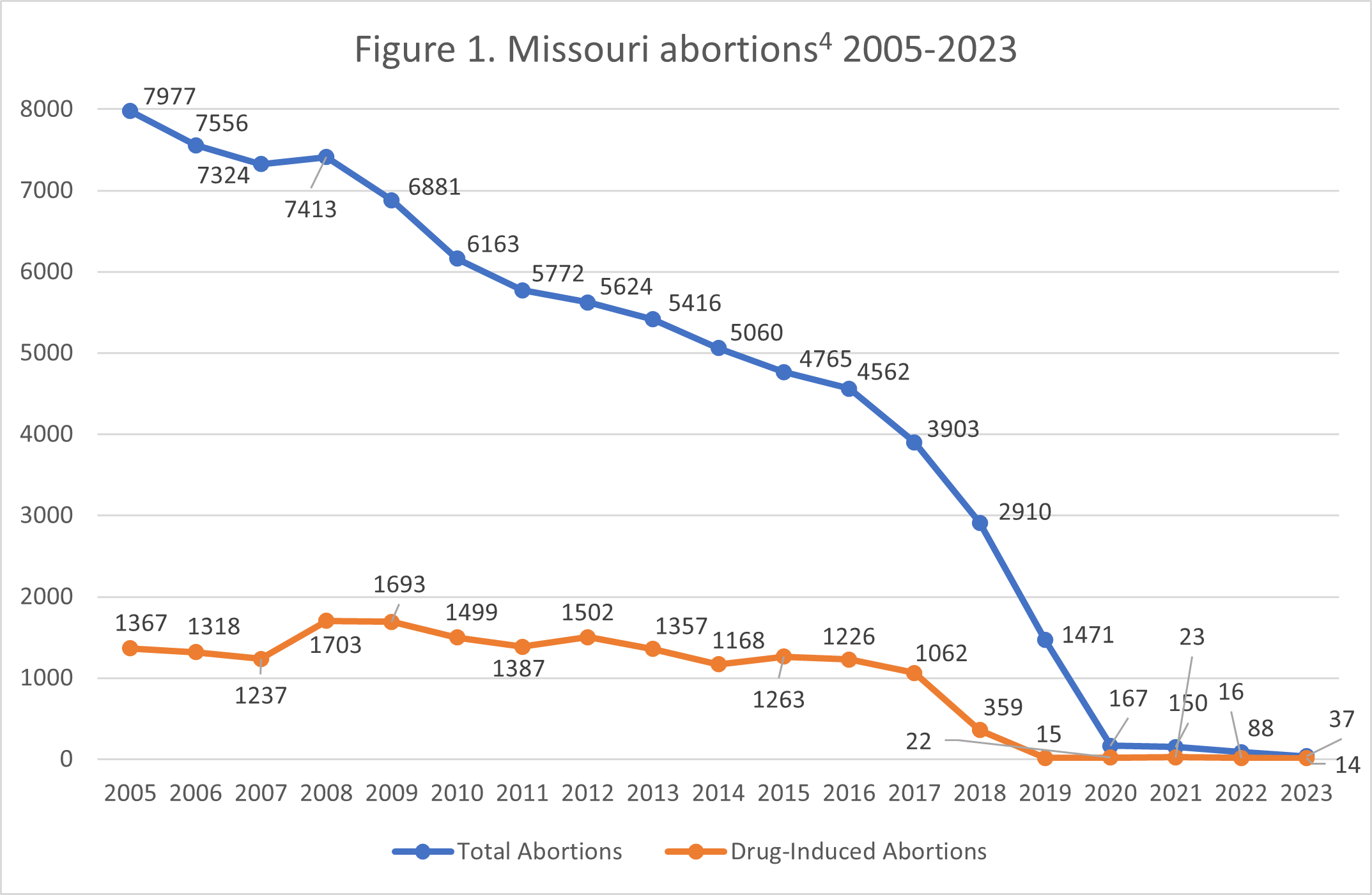
From 88 abortions in 2022 to 37 in 2023, the total number of brick-and-mortar abortions reported in Missouri fell by 58%. Drug-induced abortions decreased by 13%, from 16 in 2022 to 14 in 2023 (Fig. 1). CLI estimates that Missouri’s 2023 abortion rate was 0.03 abortions per 1,000 women ages 15 to 44 (Fig. 2).1
Separately, Missouri reports abortions performed on residents, both those occurring in Missouri and in other states that share data with Missouri. Residents who obtained abortions out of state primarily did so in Kansas and Illinois. There were 3,029 abortions performed on Missouri residents in 2023 compared to 3,012 in 2022.
The data summarized below is broken down into data on Missouri residents, regardless of the location of their abortions, and data on all occurrences of abortion in Missouri, regardless of the residential status of those who obtained abortions. Presumably because brick-and-mortar abortions were almost completely prohibited for the entirety of 2023, the 37 abortions that did occur in Missouri in 2023 were likely due to the state’s life-at-conception law’s exceptions, although that is not stated definitively in the 2023 state report.
State Resident Summary
Residence Data
Of the 3,029 abortions known to have been performed on Missouri women in 2023, the majority (60%) were performed on women in their twenties, with 30% performed on women ages 20 to 24 and 29% on women ages 25 to 29. Thirty percent were performed on women in their thirties, and 3% on women aged 40 or older. Eight percent of the abortions were performed on girls under the age of 20, including 2% on girls under the age of 18.
Forty-four percent of the abortions performed on Missouri residents were performed on non-Hispanic white women, and 36% were performed on non-Hispanic black women. Eleven percent were performed on non-Hispanic women of other races, and 10% were performed on Hispanic women. The black abortion rate of 6.9 abortions per 1,000 women ages 15 to 44 was almost five times the white abortion rate of 1.5.
Seven percent of the abortions were performed on women with fewer than 12 years of education. Thirty-six percent of the abortions were performed on women with 12 years of education, 35% on women with 13 to 15 years, and 15% on women with 16 years of education or more. Level of education was not reported for 7% of abortions. The vast majority of Missouri resident abortions (89%) were on unmarried women or women of unspecified marital status. Eleven percent of abortions were obtained by married women.
The majority of Missouri women undergoing abortions, 61%, already had children. Twenty-three percent of the reported abortions were performed on women with one living child and 38% were performed on women with two or more children, compared to 39% obtained by women with no children. Conversely, the majority of abortions (64%) were performed on women with no previous abortions. Twenty-three percent were performed on women with one prior abortion and 13% on women with two or more previous abortions.
Sixty-seven percent of the abortions were performed earlier than nine weeks of gestation. Sixteen percent of resident abortions occurred between nine and 10 weeks of gestation, and 7% were performed between 11 and 12 weeks, dropping to 4% between 13 and 14 weeks. Three percent were performed between 15 and 16 weeks, and 2% between 17 and 19 weeks. Less than one percent (0.5%) occurred at 20 weeks and 0.6% were reported at 21 weeks of gestation or later.
There were 1,774 (59%) drug-induced abortions reported to have been performed on Missouri residents, whether in-state or in other states that shared data with Missouri. This suggests that the vast majority occurred out of state, as only 14 drug-induced abortions were reported in Missouri in 2023. Thirty-six percent of the abortions performed on Missouri women were curettage abortions, and 5% were laminaria dilation and evacuation procedures. Two abortions were hysterectomy or hysterotomy procedures and 16 were performed via other, unspecified methods.
Occurrence Data
Forty-one percent of the abortions occurring in Missouri were performed on women in their twenties. Fifty-one percent were performed on women in their thirties, 5% on women in their forties or older, and 3% (one abortion) on girls under the age of 20.
Forty-nine percent were performed on non-Hispanic white women. Thirty-two percent were performed on non-Hispanic black women, 14% on non-Hispanic women of other races, and two abortions were performed on Hispanic women.
Unlike the abortions performed on Missouri residents, 5% of the abortions reported in Missouri were performed before nine weeks of gestation. Eight percent were performed between nine and 10 weeks, and 3% between 11 and 12 weeks. While the actual numbers are small, a relatively large percentage of the abortions reported in Missouri occurred in the second trimester. Five percent of the abortions were reported between 13 and 14 weeks of gestation, while 24% occurred between 15 and 16 weeks and 32% occurred between 17 and 19 weeks of gestation. Eight percent of the abortions were performed at 20 weeks and 11% were performed at 21 weeks or later, for a total of 19% (7 abortions) at or after 20 weeks of gestation.
Twenty-two percent of the abortions occurring in Missouri were curettage procedures, while 30% were laminaria dilation and evacuation abortions. There were 14 drug-induced abortions and three hysterectomy or hysterotomy abortions. One abortion was performed using other, unspecified procedures.
Abortion Complications
Missouri requires medical professionals who treat abortion complications to report them to the Missouri Department of Health and Senior Services (MDHSS), regardless of whether the abortion occurred in Missouri or in a different state. In 2023, MDHHS received 69 complication report forms with information on 96 complications. There were four more complication reports submitted in 2023 compared to 2022, but the number of complications decreased by 17%.2
Forty-five percent of the forms were submitted for surgical abortions and 48% for drug-induced abortions. The most common complication was hemorrhage, occurring 25 times, followed by 14 incomplete abortions, 13 cases each of retained products of conception and failed abortion, 10 uterine perforations, three cervical lacerations, and two cases of endometritis. There were 16 unspecified complications. Twenty-eight women were hospitalized, a decrease from 2022, when 36 women were hospitalized.
Only three of the forms submitted were for abortions occurring in Missouri, which MDHSS used to calculate a Missouri complication rate of 8.1 complications per 100 abortions. This means that the vast majority (all but three) of the complication reports involved abortions performed outside of the state, but which doctors in Missouri subsequently had to treat complications for. Missouri does not receive abortion complication reports from other states, so the number of abortion complications suffered by Missouri residents but treated outside of Missouri is unknown.
Out-of-State Abortions
In years past, the state has been able to report estimated resident counts based on individual record-level data shared with Missouri by other states. In 2023, Illinois passed a new abortion reporting law that no longer required the state to report the number of abortions by state of residence. Consequently, Missouri no longer received estimated resident abortion counts regarding the number of Missouri women who traveled to Illinois to get an abortion. Because around two-thirds of Missouri women included in the state’s estimated resident abortion count traveled to Illinois in 2020-2022, a count without Illinois data would be practically meaningless. Therefore, the state decided not to include it in the 2023 abortion report. The report went on to note that of the 3,029 resident abortions reported to Missouri by other states, over 95% (around 2,877) of the abortions were performed in Kansas.
Guttmacher’s Monthly Abortion Provision Study confirms this estimate and notes that in 2023, an estimated 2,860 Missouri residents traveled to Kansas to get an abortion and 8,740 Missouri women traveled to Illinois, meaning an estimated 11,600 Missouri women traveled out of state to obtain an abortion in 2023.3
State Ranking
In 2024, CLI published a paper reevaluating abortion reporting across the country, with Missouri ranked 19th best. To improve its reporting, Missouri could add more context to its data by reporting the percentage of abortions performed in Missouri on nonresident women, as well as the states to which Missouri residents travel for abortions. Additionally, Missouri could report pregnancy history, level of education, and marital status for all women undergoing abortions in the state as many other states do.
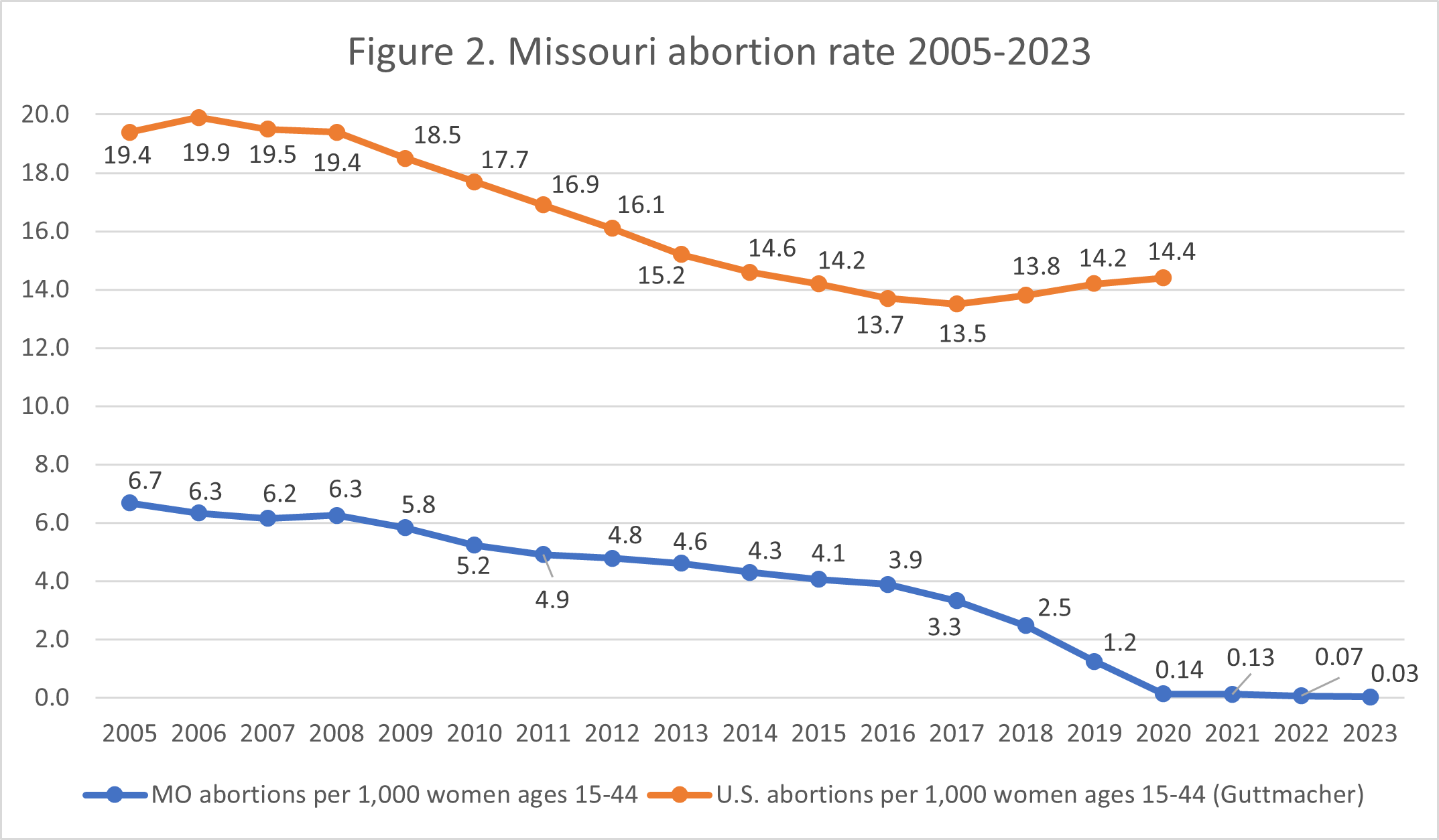
- National rates were calculated by Guttmacher Institute. Missouri rates were calculated by CLI using the following formula: (total number of abortions performed in Missouri ÷ number of resident women ages 15-44 [based on most recent population estimates]) x 1,000. Rates may differ slightly from previous CLI articles due to revised population estimates. Population estimates were obtained using the CDC WONDER database. Estimates for 2005-2009 are intercensal estimates of the July 1 resident population. Estimates for 2010-2019 are Vintage 2020 postcensal estimates of the July 1 resident population. Estimates for 2020-2023 are Vintage 2023 postcensal estimates of the July 1 resident population. Estimates were produced by the U.S. Census Bureau and the National Center for Health Statistics.
- Statistics on abortion complications reported here represent a minimal number of deaths and complications, and the state acknowledges that this data may be incomplete.
- The Guttmacher Institute notes that their travel totals are estimates and that each state’s estimate is within a range of uncertainty. This information is updated as of August 28, 2025. Guttmacher’s travel and residence data can be found here (State_Abortion_Travel_2023.csv).
- This figure represents total abortions occurring in Missouri. Abortion totals for 2011 and 2014 were revised in later reports, but because drug-induced abortion totals were not revised, the original numbers provided by the 2011 and 2014 abortion reports have been used to allow for comparison between total and drug-induced abortions.
Click here to view reporting from:2022202120202019201820172016