












Ohio’s 2024 abortion report was published in September 2025 by the Ohio Department of Health (DOH). Abortions slightly decreased in the state in 2024 compared to 2023. Below, Charlotte Lozier Institute (CLI) summarizes the information in the abortion report published by the state.
The data published by Ohio does not include the number of abortions obtained by Ohio residents out of state or the number of self-managed abortions on women outside of the healthcare system. The report also does not contain the number of mail-order abortion drugs obtained by Ohio residents prescribed by licensed providers in Ohio or in other states. In a separate section, CLI will describe data provided by the Guttmacher Institute’s Monthly Abortion Provision Study that details the total number of abortions occurring in the state in 2024 as estimated by Guttmacher’s sample survey and mathematical models. CLI will also describe Guttmacher’s estimated number of abortions obtained by Ohio women in other states. Guttmacher’s abortion estimates include the number of abortions obtained at brick-and-mortar facilities and those provided via telehealth and virtual providers in the United States.
Ohio’s statute code defines abortion as “the purposeful termination of a human pregnancy by any person, including the pregnant woman herself, with an intention other than to produce a live birth or to remove a dead fetus or embryo…” (ORC §2919.11). In Ohio, abortion is prohibited after 21 weeks of gestation (or 19 weeks’ post-fertilization) (ORC §2919.201). Exceptions to the state’s abortion law include cases where a continued pregnancy would threaten the life or physical health of the mother. In November 2023, Ohio voters approved an amendment to the state’s constitution establishing a “right to one’s own reproductive medical treatment, including but not limited to abortion…” and “prohibit[ing] the state from directly or indirectly burdening, penalizing, or prohibiting abortion before an unborn child is determined to be viable…” After the passage of the amendment prohibiting the state from enforcing any abortion limits before viability (which the amendment failed to define), it is not clear whether any locations are performing abortions after 21 weeks. This could be because of a previous state law limiting abortion to 22 weeks, due to improvements in medicine that have moved the timeline for when preemies survive outside the womb into the early 20-weeks, or because late-term abortions are complex procedures that risk serious adverse events, including the death of the mother or the baby being born alive. The 2024 abortion report represents the first full year of abortion data after the approval of the constitutional amendment.
Statistics and Changes in Ohio Abortions, 2023-2024

The report does not contain information on Planned Parenthood’s abortion market share.
Abortion Totals and Trends
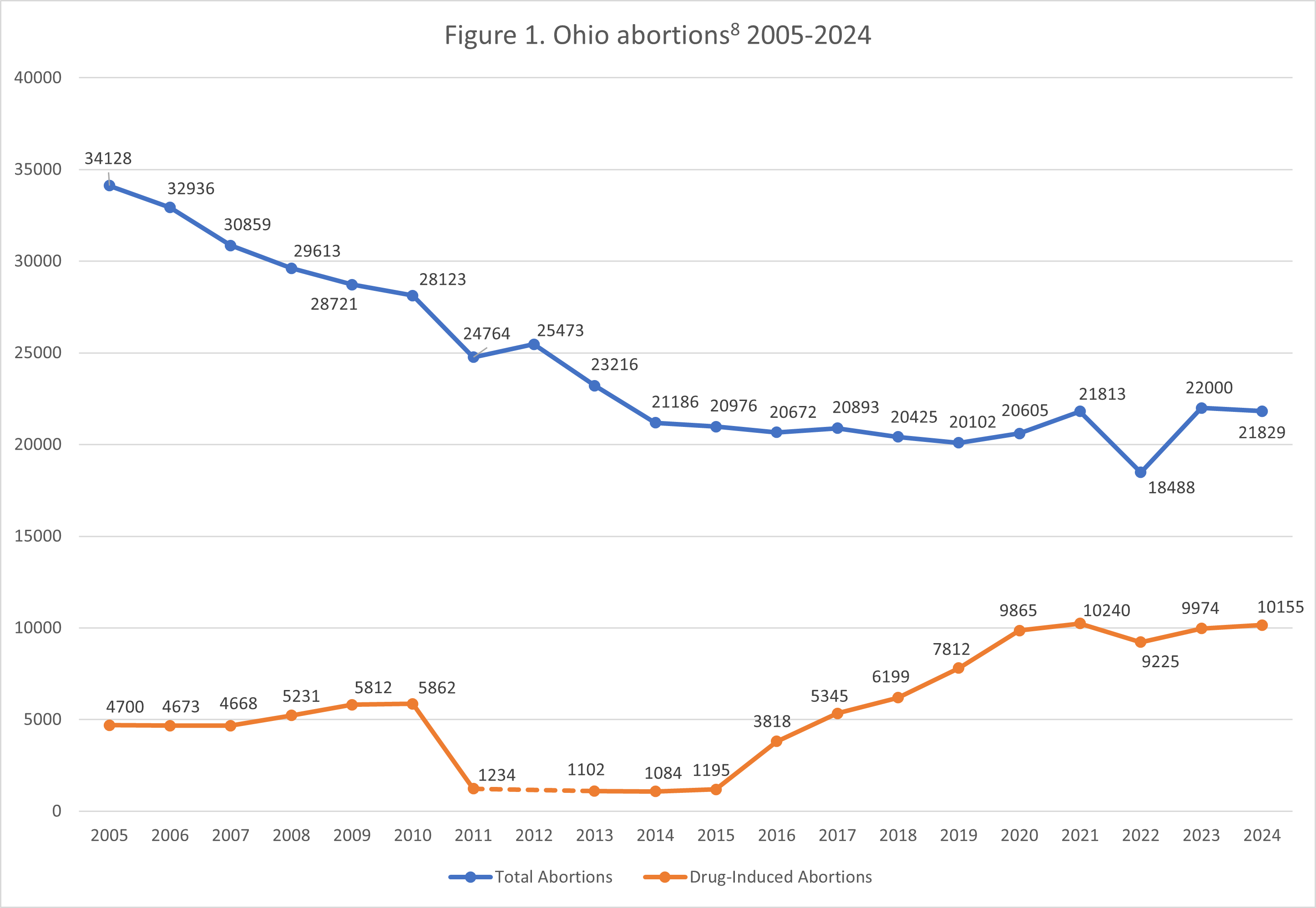
In 2024, there were 21,829 abortions reported in Ohio, a decrease of 0.78% from 2023 when 22,000 abortions were performed in the state. Drug-induced abortions increased from the previous year, from 9,974 in 2023 to 10,155 in 2024, and made up 47% of the state’s abortion total in 2024 (Fig. 1). CLI estimates that Ohio’s 2024 abortion rate was 9.7 abortions per 1,000 women of childbearing age, a decrease of 0.78% (Fig. 2).1 As of October 2025, 17 states have released 2024 abortion reports, five of which showed that abortions had decreased from the year before.
State Report Summary
The vast majority of Ohio abortions (86%) were reported to have been performed on resident women, while 14% were obtained by nonresidents. The number of resident women who obtained abortions in Ohio decreased from 2023 to 2024, while the number of nonresident abortions increased. Ohio’s abortion report does not detail the specific states that nonresidents travel from to obtain abortions in Ohio. It is important to note that the slight change in Ohio’s abortion total from 2023 to 2024 was driven by both the 2.8% decrease in resident abortions as well as the 13% increase in nonresident abortions.
Nine percent of Ohio abortions were performed on girls ages 19 and younger (including 2% on girls under the age of 18). Fifty-six percent of the procedures were performed on women in their twenties, with 28% each performed on women aged 20 to 24 and on women aged 25 to 29. Thirty-two percent of the procedures were performed on women in their thirties, and 3% were performed on women aged 40 and older.
Twelve percent of Ohio abortions were performed on women who had not graduated from high school, and 42% were performed on women with a high school diploma or its equivalent as their highest level of education. Nineteen percent were obtained by women with some college but no degree, and 21% were obtained by women who had received an associate degree or higher. Level of education was not reported for 6% of the abortions that occurred in Ohio.
Eighty-two percent of the abortions were obtained by unmarried women, and 12% by women who were married or separated from their spouses. Marital status was not reported for 6% of the abortions. Just over one quarter (26%) of the abortions were obtained by women with no previous pregnancies, 18% were performed on women with one prior pregnancy, and 55% were performed on women with two or more previous pregnancies. The number of previous pregnancies was unreported for 1% of the abortions.
Fifty-seven percent of the abortions were performed on women who reported no prior abortions, compared to 23% with one prior abortion and 18% with two or more prior abortions. Thirty-seven percent of the abortions were obtained by women with no living children, 25% with one child, and 37% with more than one child. The number of previous abortions and number of living children were each not reported for 1% of the women who obtained abortions. Seventy-seven percent of the women who obtained abortions had never experienced a miscarriage while 16% had experienced one miscarriage and 6% had experienced two or more miscarriages. The number of previous miscarriages was not reported for 1% of the women who obtained abortions.
In 2024, 42% of Ohio abortions were performed on black women. Forty-one percent were obtained by white women, and 3% by Asian or Pacific Islander women. Sixty-five abortions (0.3%) were performed on Native American women, and 5% were performed on women of multiple races. Race was not reported for 9% of abortions. CLI estimates that the black abortion rate was 27 abortions per 1,000 women of childbearing age, over five times the white abortion rate of 5.1. Eighty percent of Ohio abortions were obtained by non-Hispanic women, while 9% were obtained by Hispanic women and 11% by women of unknown ethnicity.
Ohio allows multiple methods to be reported for each abortion. In 2024, there were 21,855 procedures used, compared to 21,829 abortions reported in the state. Forty-seven percent of the abortions were drug-induced. Forty-five percent were performed using suction curettage and 8% were performed using dilation and evacuation. Eleven abortions used dilation and extraction procedures (the same procedure used in a partial birth abortion), three were hysterotomy abortions, and four were hysterectomy abortions. Ohio’s partial birth abortion law, as well as federal law, prohibit the use of dilation and extraction unless the unborn baby is killed before being partially born. There were 17 abortions performed using other, unspecified surgical procedures.
Sixty-five percent of Ohio abortions occurred at eight weeks of gestation or earlier. Twenty-three percent were performed between nine and 12 weeks, and 10% were performed between 13 and 18 weeks of gestation. Two percent were performed between 19 and 20 weeks of gestation, and 146 abortions were performed between 21 and 24 weeks of gestation. Zero abortions were performed past 24 weeks of gestation. To see how the gestational breakdown changed from 2023 to 2024, see the table below:
| # of Abortions, 2023 | # of Abortions, 2024 | |
| 0-8 weeks of gestation | 13,367 | 14,106 |
| 9-12 | 5,687 | 5,070 |
| 13-18 | 2,470 | 2,176 |
| 19-20 | 330 | 331 |
| 21-24 | 145 | 146 |
| 25-36 | 1 | 0 |
| Total | 22,000 | 21,829 |
As one can see, the overall decrease in reported abortions from 2023 to 2024 was driven both by the increase in earlier abortions occurring at eight weeks of gestation or before and the subsequent decrease in abortions occurring between nine and 12 weeks of gestation.
More than one method of determining gestational age could be reported for each abortion. Ultrasound was used to estimate gestational age for most abortions (94%), and the last menstrual period was used for 22%. A clinical exam was used in 16% of the cases, while some other means were used to calculate gestational age in eight cases.
Beginning at 19 weeks of gestation, Ohio requires that doctors test to see if the unborn baby is viable. Of the 477 abortions performed at 19 weeks or later in 2024, two babies were viable, while 475 were not. Ultrasound was used to test viability in 472 cases, while amniocentesis was used in one case. The baby’s weight was used in 11 cases. More than one method of testing for viability may be reported.
In 2024, there were 15 abortions performed after 20 weeks’ post-fertilization (22 weeks of gestation). The report does not indicate the justification for these abortions or if they were performed because the woman’s life or a major bodily function was in danger. Forty-seven were reported to have a medical condition other than “good” at the time of their abortion, but the report does not state whether any of those women obtained abortions after 20 weeks’ post-fertilization.
In 2024, 58 abortion reporting forms indicated that the abortion had resulted in complications, compared to 36 forms in 2023, when 171 more abortions were reported to the Ohio Department of Health.2 Multiple complications could be reported for each abortion, and 61 total complications were reported. There were 10 cases of hemorrhage, seven incomplete abortions, four failed abortions, three cases of cervical laceration, one infection, and 36 cases of other, unspecified complications.
Ohio also received 186 post-abortion care report forms reporting 196 complications. In 2023, there were 121 post-abortion care report forms reporting 142 complications. In 2024, there were 80 incomplete abortions (when pieces of the unborn baby or placenta were retained in the uterus) and 54 failed abortions (typically referring to ongoing pregnancy). Hematometra occurred 22 times, hemorrhage 15 times, and infection seven times. There was one case each of a perforated uterus and a cervical laceration, and 16 other, unspecified complications.
Ohio has an adverse event reporting system for drug-induced abortions; however, it is separate from the state’s annual abortion report released by the health department. When a complication arises from a drug-induced abortion, the doctor who administered the abortion drugs must report the complication to the Ohio State Medical Board and the health department.
Fifty-four percent of the abortions were performed on women who said they were not using contraception at the time they became pregnant, while 13% were performed on women who were using contraception. Contraceptive use was not reported for 33% of the abortions. Contraception was recommended after all abortions.
Ohio reports the type of counseling provided in advance of an abortion, and women can report having obtained multiple forms of counseling. Sixty-seven percent of the abortions were performed on women who had received medical counseling, and 16% on women who had received counseling from social services. Pastoral counseling was provided before 16 abortions, and psychological counseling was provided before 11 abortions. Twenty-six women received some other form of counseling, while 33% didn’t receive counseling.
Ohio administrative code requires that for all abortions performed at 14 weeks of gestation or beyond, written discharge instructions be given to the woman. In 2024, for 2,078 abortions, the woman was given the appropriate information. In 11 cases, the woman was not given such information.
The majority of Ohio’s abortions (85%) were performed in ambulatory surgical facilities. Fourteen percent occurred in non-surgical clinics, and 202 abortions were performed in hospitals.
Abortion Data and Ohio’s Heartbeat Law
As previously mentioned, Ohio’s 2019 heartbeat law went into effect immediately after the Dobbs decision was handed down on June 24, 2022. However, it was indefinitely blocked on September 14, 2022, and permanently blocked on October 24, 2024. While the law is no longer in effect, and hasn’t been since September 14, 2022, certain statutory and administrative reporting requirements under this law remain in effect and were included in the state’s 2024 abortion report. Of the 21,829 abortions reported to have been performed in Ohio in 2024, there were 9,100 cases in which the abortion was performed after a fetal heartbeat was detected. A fetal heartbeat was not detected for 12,729 abortions. Ninety-seven abortions were performed because of a medical necessity or emergency, while 21,732 were not. Of the 97 performed because of a medical necessity or emergency, 52 medical conditions were specified, and 52 were labelled as “other.” More than one medical condition could be reported for a single patient, and the Ohio report does not specify how many women had a particular medical condition reported before the abortion. There were 19 cases of PPROM (premature rupture of the membrane), nine cases of an “inevitable abortion,” another nine cases of cardiac disease, four cases of preeclampsia, and three cases of hemorrhage. There were two cases each of diabetes, respiratory failure, and infection, and one case each of multiple sclerosis and acute fatty liver.
Abortions by County of Occurrence and Residence
Abortions in Ohio were performed in 12 of its 88 counties. The number of abortions occurring by county is as follows (in descending order):3
- Cuyahoga County – 6,173 abortions (3 abortion providers exist in the county)
- Franklin County – 4,260 abortions (2 abortion providers exist in the county)
- Hamilton County – 4,161 abortions (1 abortion provider exists in the county)
- Montgomery County – 3,464 abortions (1 abortion provider exists in the county)
- Summit County – 2,694 abortions (1 abortion provider exists in the county)
- Lucas County – 953 abortions (1 abortion provider exists in the county)
- Athens County – 10 abortions (1 abortion provider exists in the county, but it started performing abortions in late 2024/early 2025, so some abortions may have occurred at a hospital or physician’s office not listed in abortion provider databases)
- Delaware and Shelby Counties – 3 abortions each (a Delaware County provider started performing abortions sometime in 2025, so these three abortions were likely performed at a hospital or physician’s office not listed in the abortion provider databases; no abortion provider exists in Shelby County, so the abortions most likely occurred at a hospital or physician’s office not listed in abortion provider databases)
- Lake, Pickaway, and Richland Counties – 1 abortion each (no abortion providers exist in those counties, so the abortions most likely occurred at a hospital or physician’s office not listed in abortion provider databases)
One hundred and five abortions were performed in an unknown county. The number of abortion facilities stayed constant from 2023 to 2024, so an increased or decreased supply and demand from these existing facilities seemed to drive the change in where women were obtaining abortions, instead of the opening or closing of facilities. The biggest difference in provision by county occurred in Franklin and Hamilton counties, where totals increased by 660 and 550, respectively, as well as in Montgomery and Summit counties, where totals decreased by 819 and 909, respectively.
The abortions by county of residence for Ohio residents who obtained abortions in Ohio (the top five counties of residence) were as follows:4
- Cuyahoga – 4,202 abortions
- Franklin – 3,117 abortions
- Hamilton – 1,930 abortions
- Montgomery – 1,275 abortions
- Summit – 1,188 abortions
Cumulatively, within all five of those counties, black women obtained more than two times more abortions than white women, despite composing only 15% of the state’s reproductive age population, as opposed to white women who compose 78%. Furthermore, the percentage of abortions obtained by black residents of those counties accounts for 36% of the state’s total resident abortion total (18,696).
Breakdown of Abortion Providers in Ohio5
| # of brick-and-mortar locations | 11 |
| # of independent centers | 6 |
| # of Planned Parenthood centers | 5 |
| # of hospitals/doctors’ offices that perform abortions | 0 |
| # of abortion drug providers | 11 |
| # of abortion drug-only providers | 4 |
| # of surgical and abortion drug providers | 7 |
| Latest gestational age that a center performs surgical abortion | Through 21 weeks |
Guttmacher Data
In 2024, Guttmacher estimated that 30,940 abortions occurred in Ohio, while the state reported 21,829. Guttmacher’s estimated total was 42% higher than the abortion total reported by the state. Guttmacher also estimated that 3,530 abortions were obtained by women who traveled to Ohio to get an abortion in 2024, while the state estimated that 3,133 nonresidents obtained abortions in Ohio. The 3,530 abortions are included within Guttmacher’s total estimate of 30,940 abortions occurring in the state. To see the number of abortions obtained in Ohio by women from various states according to Guttmacher, see below:6
| States of Residence for Women Who Traveled to Ohio | # of Abortions Obtained by Non-Resident Women in Ohio, 2024 |
| Indiana | 960 |
| Kentucky | 2,250 |
| Michigan | 130 |
| West Virginia | 190 |
| Total | 3,530 |
Guttmacher also estimated the number of abortions obtained by Ohio women who traveled to other states for theirabortions (2,590). To see the number of abortions obtained by Ohio women in various states, see below:6
| States Traveled to by Ohio Women | # of Abortions Obtained by Ohio Women Who Traveled to Other States to Get Abortions, 2024 |
| Illinois | 220 |
| Michigan | 1,020 |
| Pennsylvania | 1,350 |
| Total | 2,590 |
When looking at the totals estimated by Guttmacher and those reported by the state, one can see a large discrepancy between the totals. To see those discrepancies further highlighted, see below:

One possible explanation for these differences is that Guttmacher’s estimates include abortions occurring at brick-and-mortar facilities and telehealth abortions, where abortion drugs are mailed to the woman or are picked up by the woman, while the state’s estimates most likely do not. The Ohio DOH never responded to CLI’s email regarding the question of whether the state reports the number of telehealth abortions. However, data from the Society of Family Planning (SFP) provides more context. Their #WeCount project estimated that of the 29,970 abortions that occurred in the state in 2024, 22,680 were performed in person at brick-and-mortar facilities, and 7,290 were performed via mail-order abortion drugs.7 While Guttmacher’s occurrence total (30,940) is higher than #WeCount’s (29,970), it appears both totals do, in fact, include the number of mail-order abortion drugs sent to women residing in Ohio, while the state’s total most likely does not. It also appears that, because the difference in Guttmacher and the state’s totals eclipses the number of virtual-only abortion drugs as reported by SFP, providers in Ohio failed to report all the brick-and-mortar abortions occurring in the state.
State Ranking
In 2024, CLI published a paper reevaluating abortion reporting across the country, with Ohio tied for 4th place. To further improve its reporting, Ohio could include the drug-induced abortion adverse events report in the annual abortion report that the health department publishes. Additionally, the state could detail the reasons for all the abortions that women obtain in Ohio, not just the medical conditions that implicate the state’s different gestational protections.
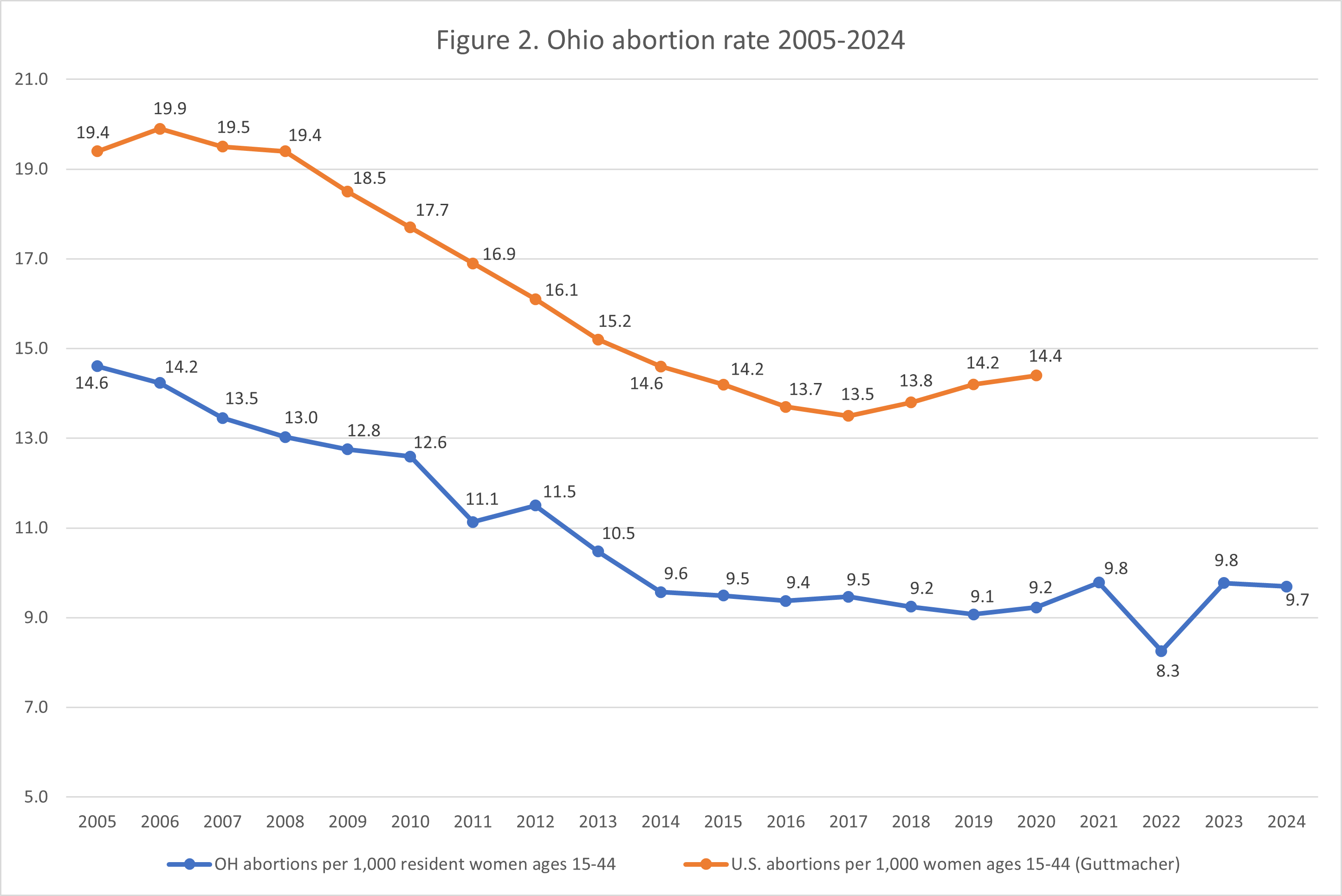
- National rates were calculated by the Guttmacher Institute. Ohio rates were calculated by CLI using the following formula: (total number of abortions performed in Ohio ÷ number of resident women ages 15-44 [based on most recent population estimates]) x 1,000. Rates may differ slightly from previous CLI articles due to revised population estimates. Population estimates were obtained from the CDC WONDER database. Estimates for 2005-2009 are intercensal estimates of the July 1 resident population. Estimates for 2010-2019 are Vintage 2020 postcensal estimates of the July 1 resident population. Estimates for 2020-2023 are Vintage 2023 postcensal estimates of the July 1 resident population. Estimates were produced by the U.S. Census Bureau and the National Center for Health Statistics. Rates for 2024 were calculated using the Vintage 2023 postcensal estimates because 2024 population estimates have not yet been released by the CDC.
- Statistics on abortion complications reported here represent a minimal number of deaths and complications, as this data is collected in a non-systematic and non-verifiable way. As such, this data cannot be used to calculate either an accurate abortion mortality rate or an accurate abortion complication rate for the state.
- The number of providers is included in this section not to imply that the abortions occurring in the mentioned counties were definitely performed by the providers in the county (as the report doesn’t include that information) but rather to give the reader some context about abortion access in the counties, generally. Provider totals do not include hospitals or physician offices not listed in databases that compile abortion provider locations in different states but do include Planned Parenthood locations, independent abortion centers, and hospitals/doctor’s offices included in databases like Abortion Finder and Ineedana.
- Abortions obtained by residents of the mentioned counties did not necessarily obtain the abortion in their county of residence.
- Provider totals do not include hospitals or physician offices not listed in databases that compile abortion provider locations in different states, but do include Planned Parenthood locations, independent abortion centers, and hospitals/doctor’s offices included in databases like Abortion Finder and Ineedana. Abortions are reported by the state as occurring in counties that don’t have any operative abortion centers. However, these counties have hospitals/doctor’s offices that perform abortions in certain cases but aren’t included in the aforementioned databases. This information is updated as of October 14, 2025.
- The Guttmacher Institute notes that their monthly abortion totals by state are estimates and that each state’s estimate is within a range of uncertainty. Guttmacher also notes that their estimates do not reflect abortions obtained by women in states with total abortion bans under shield laws in effect in pro-abortion states. Guttmacher’s travel and residence data can be found in the CSV folder here(State_Abortion_Travel_2024.csv). This information is updated as of October 14, 2025.
- #WeCount’s data can be found here by downloading the “Report data tables [.xlsx]” document. The #WeCount report specifies that the numbers included in their tables for abortions performed under shield laws only represent the number of women whom abortion drugs were sent to, not the number of drug-induced abortions that resulted from the mailed drugs. However, because #WeCount’s data is the only source of data that delineates the number of abortions by mode of provision (in-person, telehealth/mail order, and/or abortion drugs obtained under shield laws), their data is the best available.
- This chart does not contain the number of drug-induced abortions reported in 2012. Ohio changed its abortion reporting formatting between 2011 and 2012, and the Ohio Department of Health was not able to confirm the number of drug-induced abortions reported in 2012.
Click here to view reporting from:202520232022202120202019201820172016