











Alabama’s 2024 abortion report was published online by the Alabama Department of Public Health in September 2025, showing that only three abortions at brick-and-mortar facilities in the state were reported to the Department. After Roe v. Wade was overturned in June 2022, the state immediately started enforcing its prohibition on abortions within the state except in cases where continued pregnancy would threaten the life and/or physical health of the mother (Ala. §26-23H-4).
The data published by the state does not include the total number of abortions obtained by Alabama residents outside of the state or the number of self-managed abortions performed by women outside of the healthcare system. The report also does not contain the number of mail-order abortion drugs obtained by Alabama residents prescribed by licensed abortionists in other states with shield laws. Below, Charlotte Lozier Institute (CLI) will describe data provided by the Guttmacher Institute’s Monthly Abortion Provision Study that details the total number of Alabama women who traveled out of state to obtain an abortion in 2024. Guttmacher’s abortion estimates include the number of abortions obtained at brick-and-mortar facilities and those provided via telehealth and virtual providers in states where such abortions are legal. CLI will also describe data from the Society of Family Planning’s (SFP) #WeCount project that details the number of abortion drugs mailed to Alabama women.
Alabama law defines abortion as “the use or prescription of any instrument, medicine, drug, or any other substance or device with the intent to terminate the pregnancy of a woman known to be pregnant with knowledge that the termination by those means will with reasonable likelihood cause the death of the unborn child” (Ala. §26-23H-3). The statute code notes that the state’s definition of abortion does not include the removal of an ectopic pregnancy, activities performed to save the life or health of the unborn child and/or mother, or the termination of an unborn child with a lethal fetal anomaly.
Abortion Totals and Trends
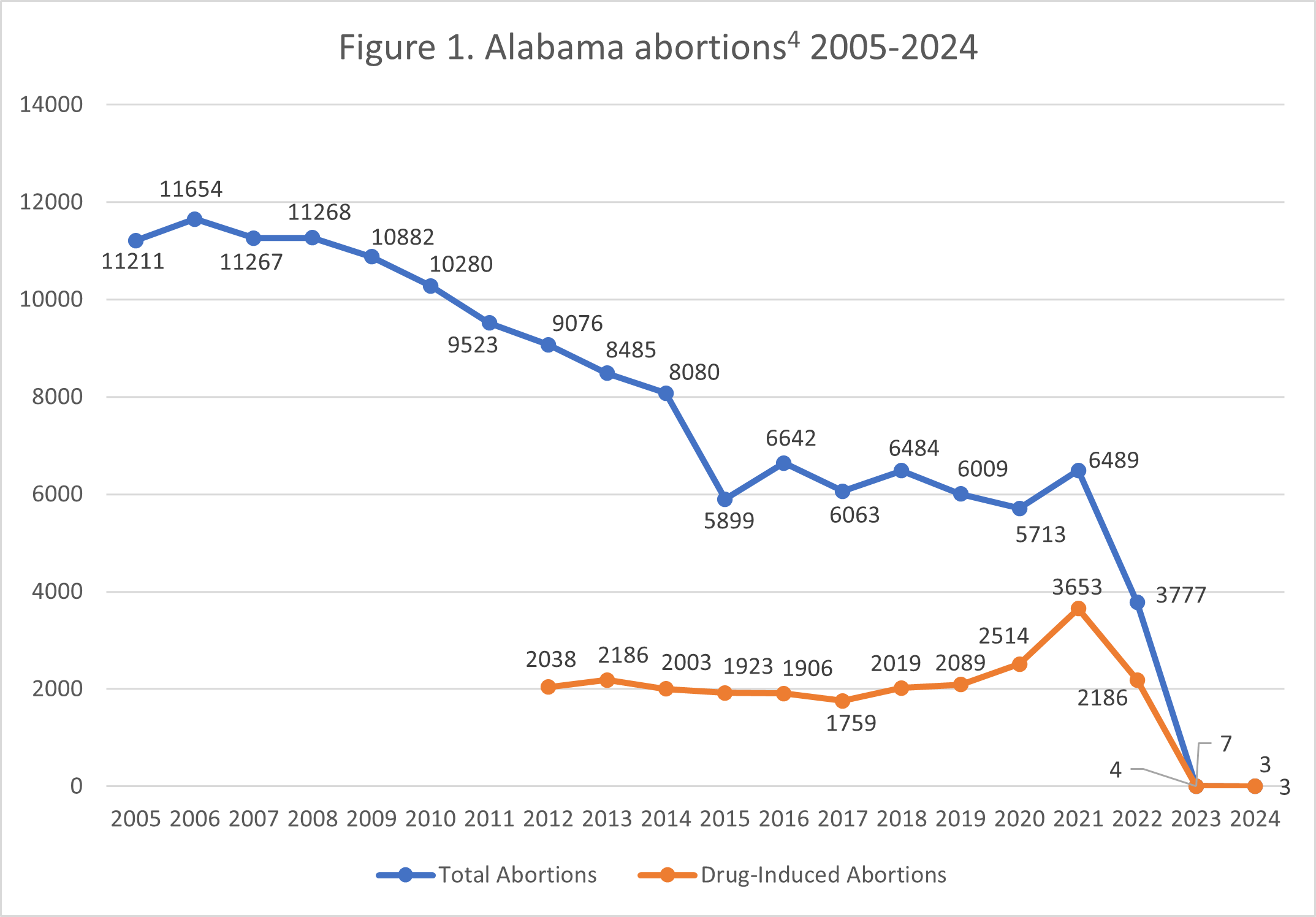
In 2024, there were only three brick-and-mortar abortions reported in Alabama, down by four from the previous year when seven were reported. Drug-induced abortions decreased by one, going from four in 2023 to three in 2024 (Fig. 1). CLI estimates that Alabama’s abortion rate decreased from 0.007 abortions per 1,000 women ages 15 to 44 in 2023 to 0.003 in 2024 (Fig. 2).1 Alabama separately reports the number of abortions performed on state residents, both in Alabama and other states. However, not all states share abortion data with Alabama. Abortions known to have been performed on Alabama residents decreased by 10% from 3,307 in 2023 to 2,970 in 2024.
State Report Summary
Abortions Performed on Alabama Residents
Six percent of Alabama resident abortions were performed on girls under the age of 20. Thirty percent of abortions were performed on women ages 20 to 24, and 29% on women ages 25 to 29. Thirty-two percent of the abortions were obtained by women in their thirties, and 3% of the abortions were obtained by women over the age of 40.
Sixty-seven percent of Alabama resident abortions were performed on black women. White women obtained twenty-five percent, and 4% were performed on women of a different race. Race was not reported for 5% of the abortions. The black abortion rate, 6.6 abortions per 1,000 women ages 15 and 44, was almost six times the white abortion rate of 1.1. A majority of the abortions (72%) were performed on unmarried women, compared to 6% on married women and 22% on women of unknown marital status.
Over one third of the abortions performed on Alabama residents (36%) were obtained by women with no previous live births. Twenty-eight percent were obtained by women with one prior live birth, and 36% by women with two or more live births. Most abortions (67%) were performed on Alabama women with no previous abortions. Twenty-two percent were on women with one prior abortion, and 11% were obtained by women with two or more previous induced abortions.
Thirty-seven percent of the abortions were performed on resident women who had completed at least some college. Forty percent were performed on women who had completed 12th grade as their highest level of education. A little under 1% (0.007%) were performed on women with an 11th grade or education or less, and education was not reported for 23% of abortions.
Seventy-nine percent of the abortions performed on Alabama women occurred at six weeks of gestation or earlier. Eleven percent of Alabama resident abortions in 2024 were performed between seven and eight weeks of gestation, as opposed to 1% in 2023. The number of abortions performed between seven and eight weeks of gestation on Alabama residents increased by 712% from 2023 to 2024. Six percent of abortions occurred between nine and 10 weeks and increased by 1,013% from 2023 to 2024, and 87 abortions were performed between 11 and 12 weeks and increased more than 12-fold. Two abortions were performed between 13 and 14 weeks and three between 15 and 19 weeks of gestation. One abortion was performed at 20 weeks and another one at 21 weeks of gestation.
Abortions Performed in Alabama
Separately, Alabama reports on all brick-and-mortar abortions that occurred in the state, including those performed on resident and nonresident women. However, the report did not delineate the breakdown of abortions by residency. There were three abortions reported in Alabama in 2024.
One abortion was performed on a woman between the ages of 20 and 24, another on a woman between the ages of 25 and 29, and another on a woman in her thirties. No abortions were performed on minors in Alabama. One abortion was obtained by a white woman and two by black women. All three abortions performed in Alabama were performed via abortion-inducing drugs. Intra-fetal injections were not used in any of the three abortions performed in the state.
Alabama reports all abortions occurring in the state using probable post-fertilization age (pfa), rather than gestational age, which the state uses to report abortions performed on resident women. In 2024, one abortion was performed between 11 and 12 weeks, another at 18 weeks’ pfa, and one at 19 weeks’ pfa. For all three abortions performed in Alabama, it was unknown whether the method of abortion provided the best opportunity for the unborn child to survive.
Alabama Women’s Center for Reproductive Alternatives performed all three abortions that occurred in the state despite their website saying, “Due to the overturning of Roe v. Wade, as of June 24 we are unable to perform surgical and non-surgical abortions until further notice.”
Guttmacher Data
In 2024, Guttmacher estimated that 4,680 abortions were obtained by Alabama residents who traveled to other states to obtain an abortion. To compare, Alabama reported between 2,967 and 2,970 (the state didn’t note the residency of the three women who obtained abortions in Alabama) abortions obtained by Alabama women out of state, a total 58% lower than Guttmacher’s estimate. One potential partial explanation for this large discrepancy is that not every state that Alabama women travel to reports abortion data back to Alabama. To see the number of abortions obtained by Alabama women according to Guttmacher in various states, see below:2
| States Traveled to by Alabama Women | # of Abortions Obtained by Alabama Women Who Traveled to Other States to Get Abortions, 2024 |
| Florida | 860 |
| Georgia | 2,020 |
| Illinois | 810 |
| North Carolina | 710 |
| Virginia | 280 |
| Total | 4,680 |
Additionally, data from the Society of Family Planning (SFP) showed that 5,610 additional abortion drugs were sent to Alabama women.3 These drugs were sent into the state by prescribers in other states who then mailed the drugs to Alabama women under their respective states’ shield laws. The total number of abortions obtained by Alabama residents (10,290) as reported by Guttmacher and SFP is 246% higher than the total number of resident abortions as reported by the state.
State Ranking
In CLI’s 2024 reevaluation of abortion reporting across the 50 states, the District of Columbia, and New York City, Alabama was tied for 12th best in the nation. To improve its reporting, as CLI has previously recommended, Alabama could report demographic information for all abortions occurring in the state. Additionally, Alabama could report the states to which Alabama residents travel for abortions, as well as the states of residence for nonresidents who obtain abortions in Alabama. Lastly, Alabama could also report abortion complication data.
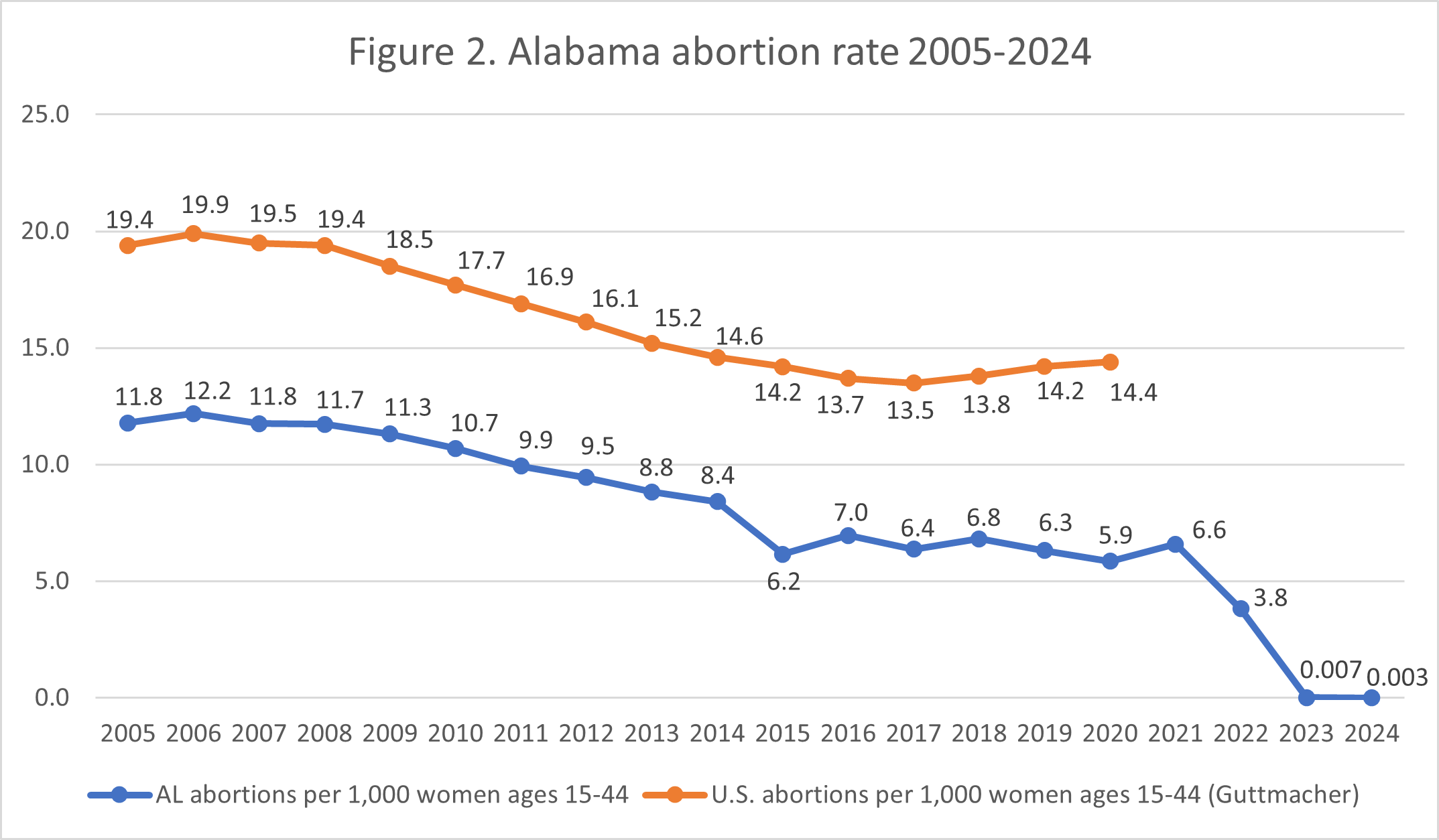
- National rates were calculated by the Guttmacher Institute. Alabama rates were calculated by CLI using the following formula: (total number of abortions performed in Alabama ÷ number of resident women ages 15-44 [based on most recent population estimates]) x 1,000. Rates may differ slightly from previous CLI articles due to revised population estimates. Population estimates were obtained from the CDC WONDER database. Estimates for 2005-2009 are intercensal estimates of the July 1 resident population. Estimates for 2010-2019 are Vintage 2020 postcensal estimates of the July 1 resident population. Estimates for 2020-2024 are Vintage 2023 postcensal estimates of the July 1 resident population. Estimates were produced by the U.S. Census Bureau and the National Center for Health Statistics. Rates for 2024 were calculated using the Vintage 2023 postcensal estimates because 2024 population estimates have not yet been released by the CDC.
- The Guttmacher Institute notes that their monthly abortion totals by state are estimates and that each state’s estimate is within a range of uncertainty. Guttmacher also notes that their estimates do not reflect self-managed abortions or those obtained by women in states with total abortion bans under shield laws. This information is updated as of October 14, 2025. Guttmacher’s travel and residence data can be found here (State_Abortion_Travel_2024.csv).
- #WeCount’s data can be found here by downloading the “Report data tables [.xlsx]” document. The #WeCount report specifies that the numbers included in their tables for abortions performed under shield laws only represent the number of women whom abortion drugs were sent to, not the number of drug-induced abortions that were a result of the mailed drugs. However, because #WeCount’s data is the only source of data that delineates the number of abortions by mode of provision (in-person, telehealth/mail order, and/or abortion drugs obtained under shield laws), their data is the best available.
- The changes in total abortions and drug-induced abortions reflect all abortions reported in Alabama. Alabama first reported drug-induced abortions as a separate type of procedure in 2012.
Click here to view reporting from:202520232022202120202019201820172016