



Search Icon
close-panel

Charlotte Lozier Institute

Phone: 202-223-8073
Fax: 571-312-0544

2776 S. Arlington Mill Dr.
#803
Arlington, VA 22206

Get Notifications

Sign up to receive email updates from Charlotte Lozier Institute.

This field is for validation purposes and should be left unchanged.

close-panel

Become A Defender of Life

Your donation helps us continue to provide world-class research in defense of life.

DONATE

Charlotte Lozier Institute

Phone: 202-223-8073
Fax: 571-312-0544

2776 S. Arlington Mill Dr.
#803
Arlington, VA 22206

Blood formation

Dive Deeper

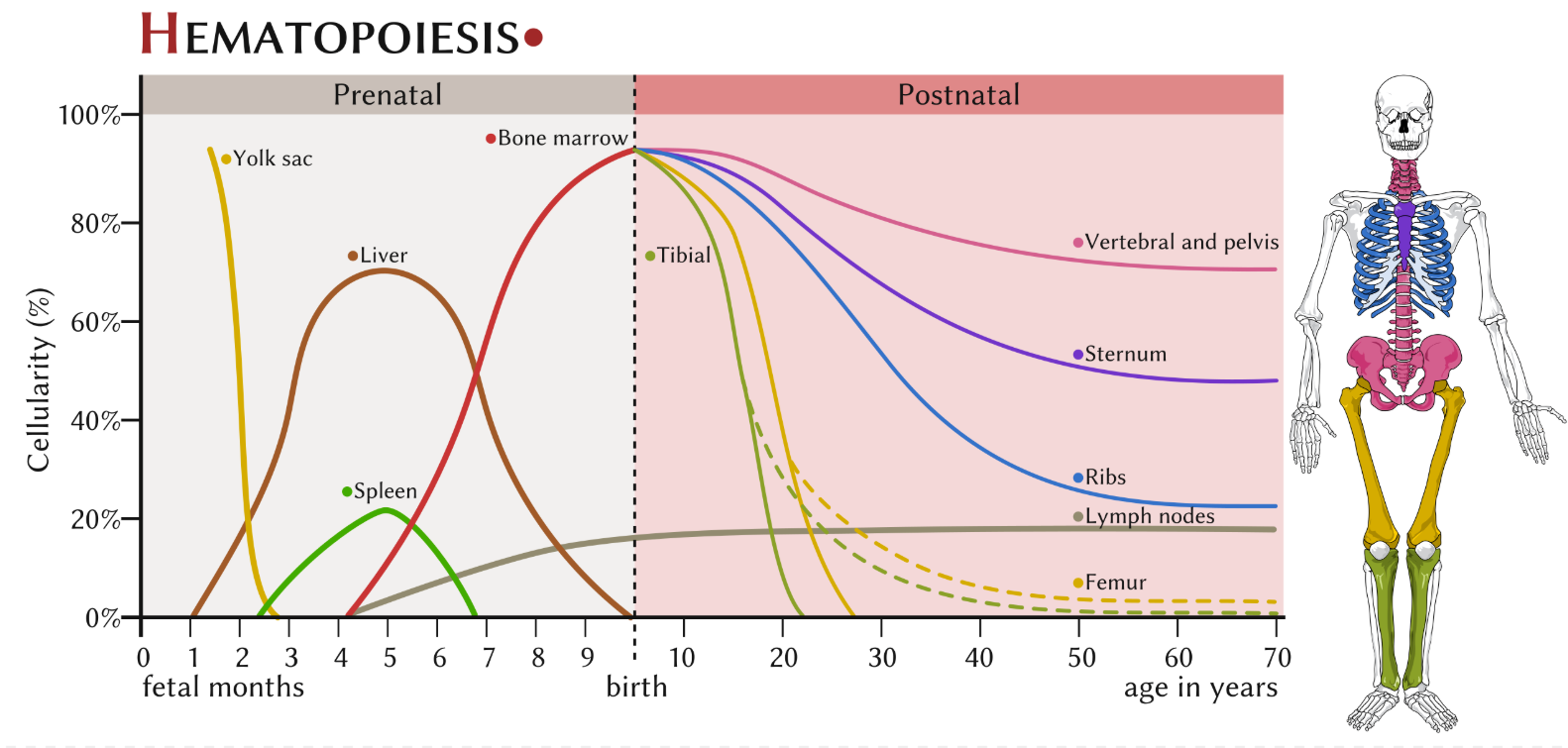
When the heart first begins to beat, the embryo already has blood, but that blood is made in surprising ways. Unlike adults, whose blood cells are produced deep inside their bones, an unborn baby’s blood cells are made in different locations. About 17 days after conception, blood cells start forming in a temporary structure outside the embryo called the umbilical vesicle or yolk sac.1 These early cells are mostly immature red blood cells and they help carry oxygen to the growing tissues. From 27 to 40 days after conception, blood cells get produced in clusters near the embryo’s growing aorta.2

Graph showing hematopoiesis sites by age: yolk sac, liver, and spleen dominate before birth; bone marrow—especially in vertebrae/pelvis—becomes primary for blood cell production after birth. Image includes a color-coded human skeleton.
Before birth, many different sites in the body help produce blood. (Image credit Michal Komorniczak, Creative Commons)

As the baby grows, blood production shifts locations. Between weeks 5 and 7, two waves of blood-producing cells move into the liver.3 4 The liver becomes the main site for blood cell production from 8 weeks until about 7 months.5 6 During this time, the liver creates more advanced red blood cells, along with white blood cells and platelets. In fact, by weeks 13 to 14, almost 60% of the cells in the liver make blood!7 Between weeks 19 and 24, blood production gradually shifts again: bone marrow takes over making red blood cells,8 while the thymus and spleen assume responsibility for many white blood cells starting in week 11.9 Even so, the liver doesn’t fully retire—it continues producing blood cells until about a week after birth.10

After birth, and throughout childhood and adulthood, blood is made in the soft, spongy tissue inside bones known as bone marrow. Scientists have identified the earliest blood-forming stem cells in bone marrow as early as 10 weeks of gestation,11 12  though some researchers place the start slightly later, around 12½ weeks. 13 14 By 14 weeks gestation about 35% of the bone marrow cells are already making red blood cells.15 Around 7 months, the bone marrow becomes the primary source of new blood cells for the rest of that person’s life.16 17 This carefully timed process ensures the baby has the oxygen and immune support needed at each stage of growth.


Gestational Age Milestone
Day 17 post-conception (Week 4) The umbilical vesicle (yolk sac) makes the first blood cells.18
Day 23 post-conception (Week 5) Some blood stem cells colonize the liver, but most blood is still made in the umbilical vesicle.19
Days 27-40 post-conception (Weeks 5-7) True blood stem cells form near the aorta.20
Weeks 8-24 The fetal liver becomes the primary site of blood production and makes many types of blood cells.21
Week 11 and onward The spleen, lymph nodes, and thymus create different types of immune cells.22 23
Week 12 ½ and onward Bone marrow gradually becomes the dominant site of all blood formation.24