




Search Icon
close-panel

Charlotte Lozier Institute

Phone: 202-223-8073
Fax: 571-312-0544

2776 S. Arlington Mill Dr.
#803
Arlington, VA 22206

Get Notifications

Sign up to receive email updates from Charlotte Lozier Institute.

This field is for validation purposes and should be left unchanged.

close-panel

Become A Defender of Life

Your donation helps us continue to provide world-class research in defense of life.

DONATE

Charlotte Lozier Institute

Phone: 202-223-8073
Fax: 571-312-0544

2776 S. Arlington Mill Dr.
#803
Arlington, VA 22206

Smell and taste in the womb

Dive Deeper
The sense of smell before birth

The fetal nose starts detecting smell molecules around 7 months gestation. But before the fetus can smell, the appropriate structures and circuits must develop first. Smell-sensing cells, called olfactory receptor neurons, are made to detect over 1 trillion different smells in humans.1 Located in the top of the nasal cavity, olfactory receptors bind to smell molecules. These olfactory receptor neurons start growing in week 11 and have a mature shape by week 13.2 3 When the olfactory receptor neurons detect a smell, it sends an electrical signal to the olfactory bulb in the brain. The olfactory bulb starts forming in week 94 5 with a distinct layered structure in place by week 14.6

Smell-sensing cells, called olfactory receptor neurons, are made to detect over 1 trillion different smells in humans.7 These olfactory receptor neurons have a mature shape by week 13.8

Thousands of olfactory receptor neurons that detect the same type of smell connect to a single neural cluster called a glomerulus. Each unique glomerulus corresponds to distinct type of odor, forming many glomeruli for the detection of many smells. While thousands of olfactory receptor neurons may synapse on one glomerulus, only about 25 mitral relay cells send outputs from that glomerulus to the rest of the brain.9 The mitral cells start forming by week 11.10

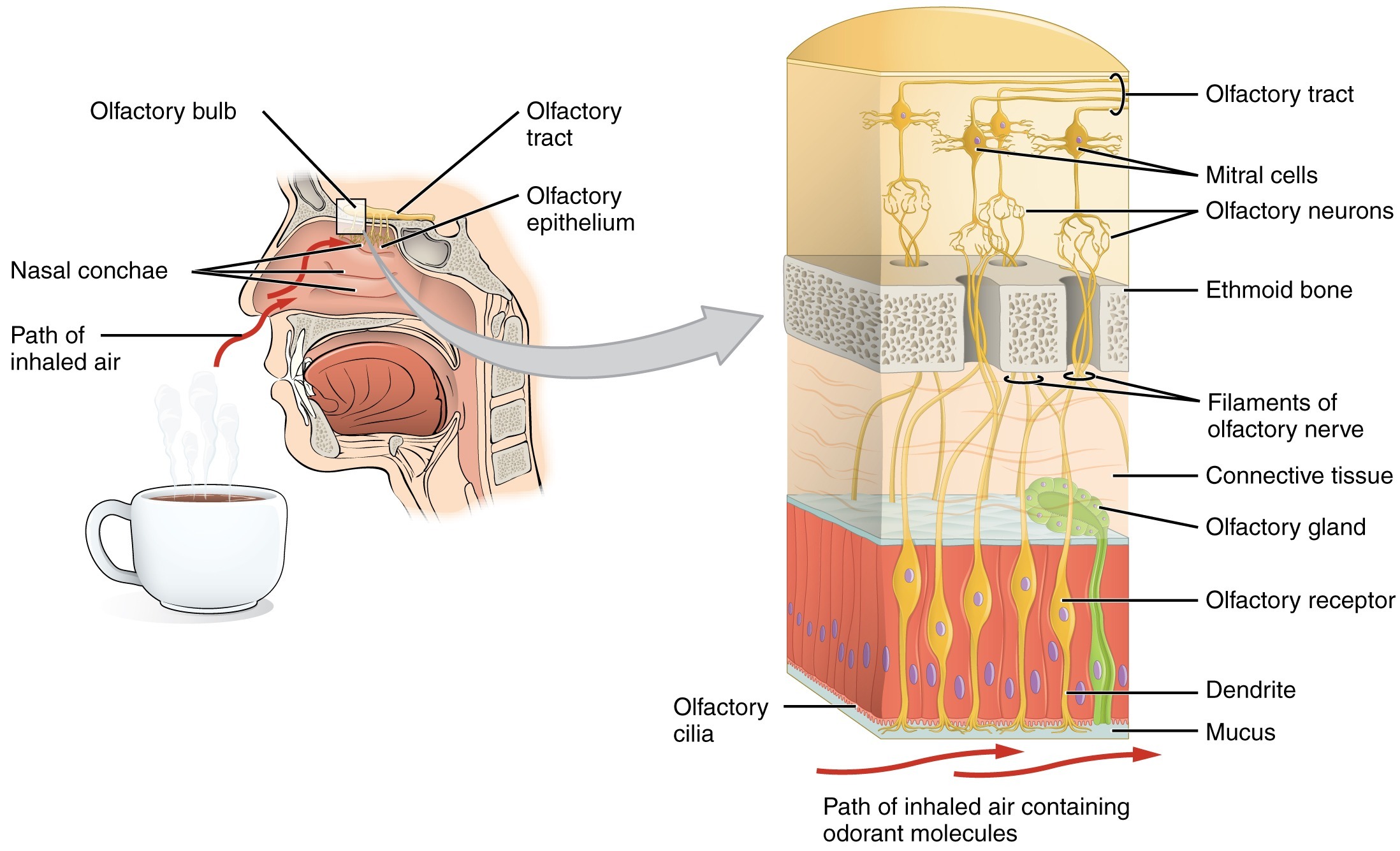
Diagram illustrating the path of inhaled air from the nose to the olfactory epithelium, highlighting how smell in the womb begins as olfactory cells detect odorant molecules, with labels for each anatomical feature.
Scent molecules in the air or amniotic fluid stimulate olfactory receptor neurons in the top of the nasal cavity. These neurons send projections through the skull bone into the olfactory bulb. The output cells from the olfactory bulb are mitral cells. (Image credit OpenStax, Creative Commons)

By 14 weeks, most of the structures needed for smell have formed, but clear evidence of smell processing only appears around 28 to 30 weeks.11 Around that time, scientists detect olfactory marker protein. This protein is a strong indicator that smell receptors are mature, functional, and ready to process smells in the baby’s environment.12 13 Another nerve, called the trigeminal nerve—which senses irritation and touch in the nose—is active much earlier, around 8 to 10 weeks, and may respond to certain chemicals before true smell sensation has fully developed.14

What can the fetus smell in the womb?

Between 28 and 30 weeks, unborn babies begin smelling through the amniotic fluid around them. 15 The fluid carries a mix of scents that come from the baby’s own body and from the mother’s diet.16 Studies of premature infants show that by about 29 weeks, babies change their breathing, alertness, and facial expressions in response to different odors. Pleasant smells like vanilla increase the baby’s breathing rates, while unpleasant odors such as rancid acid or disinfectant, trigger slower breathing rates and grimacing, even in small amounts.17 18 By 7 months preborn babies can react to a variety of scents.19

Timeline of smell development
Gestational Age Milestone
Week 9 Olfactory bulb starts forming.20
Week 11 Olfactory receptor neurons form.21Mitral output cells are forming. 22
Week 13 Olfactory receptor neurons have a mature shape.23
Week 14 Olfactory bulb has distinctive layers and outputs.24
Weeks 28-30 Olfactory marker proteins found in olfactory receptors and smelling starts.25 26
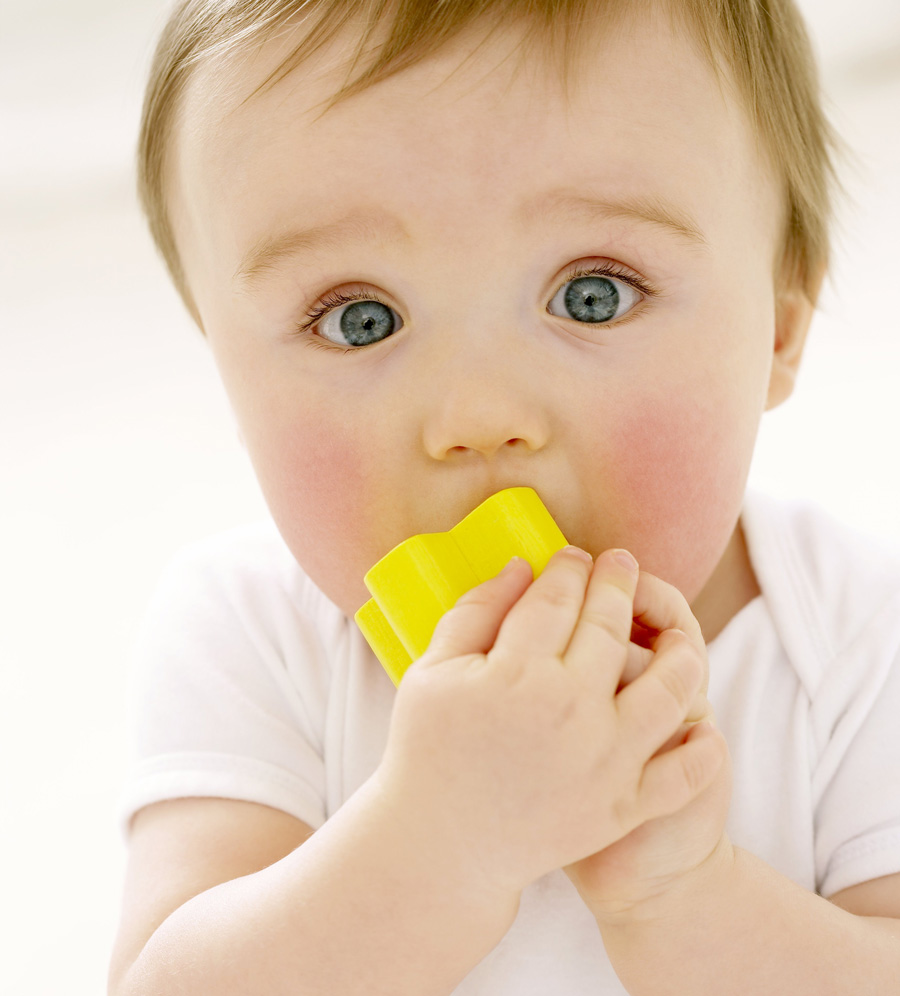
This baby's tongue was covered with taste buds by 17 weeks. (Image credit <a href="https://commons.wikimedia.org/wiki/File:Baby_Face.JPG">Avsar Aras</a>, Creative Commons)
This baby's tongue was covered with taste buds by 17 weeks. (Image credit Avsar Aras, Creative Commons)
How do taste buds form?

Each taste bud is like a tiny basket made up of 50 to 100 taste receptor cells that work together to detect the flavors in food. These cells surround a tiny opening called the taste pore, where taste chemicals from food and drink collect. The microvilli on the taste receptor cells extend into the taste pore to interact with food molecules.27 Nerves in the tongue send signals from the taste bud to the brain.

Taste receptor cells don’t last long — they only live for about 10 days before being replaced by fresh ones.28 But during their short lives, they pass along taste signals to the brain through nerve connections at the base of the taste bud that can be observed as early as 10 weeks gestation.29 Each taste bud contains multiple types of taste receptors. As such, most taste buds can detect multiple flavors, including sweet, sour, salty, bitter, and savory. Both olfactory and taste receptors must be functional for a human fetus to sense flavor.30

The taste system starts coming together early in pregnancy.  Starting at 8 weeks, small bumps called papilla start forming on the tongue.31 Taste papilla are small ridges or mushroom-shaped bumps that house taste buds and increase surface area to enhance taste perception. In week 8, nerves start entering the tongue.32 These nerves are especially important for causing taste buds to form.33 In weeks 9 and 10, early taste buds start developing.34 Mushroom-shaped papillae start growing.35 In week 11, about one quarter of early taste buds are connected to nerve fibers.36 Two different types of taste bud cells can be observed on the fetal tongue by 14 weeks.37 Taste pores, commonly acknowledged as a sign of taste bud maturity, appear between weeks 12 and 16.38 By week 16, the inside of the taste pore, called the taste pit, is full of microvilli, tiny fibers that interact with taste molecules. Most of the taste buds have connected to nerves, and the fetus may be able to taste. By 17 weeks, fetal taste buds resemble adult taste buds in shape if not size.39

The taste system develops between 8 and 17 weeks.40 After that, the preborn baby may be able to taste the amniotic fluid.
What can the fetus taste before birth?

The fetus gets lots of taste experience before birth. Flavors from the mother’s food, like garlic, spice, or kale change the flavor of the amniotic fluid after a meal.41 By 34 weeks, unborn babies will swallow less amniotic fluid if the amniotic fluid tastes bitter,42 and more if it tastes sweet.43 Another recent study showed that fetuses this same age make more “laughter-like” facial expressions after their moms eat a sweet carrot flavor, while those exposed to kale made more “cry-like” faces.44

Timeline of taste development
Gestational Age Milestone
Week 8 First papilla (bumps) forming,45 and nerves enter the tongue.46
Weeks 9-10 Early taste buds developing.47
Weeks 10-17 Fungiform (mushroom-shaped) papilla grow on the tongue.48
Week 11 ¼ of taste buds have connected to nerve fibers.49
Weeks 12-16 Taste pores develop in taste buds, showing that they buds are mostly mature.50
Week 14 Multiple types of taste cells found inside a taste bud.51
Week 16 Taste pit full of microvilli. Most taste buds connected to nerves.52
Week 17 Taste buds resemble adult taste buds in shape if not size. Tasting may be possible.53
Week 34 The fetus makes happier faces after the mom eats sweeter foods.54