











The eyes of Maine and the entire country are on the Maine state legislature this week. On Tuesday, the Committee on Health Coverage, Insurance and Financial Services in the State House approved L.D. 820 by a 7-5 vote. This bill, sponsored by Democratic Representative Joyce McCreight and supported by Maine Governor Janet Mills, has over 80 cosponsors. It would require taxpayer funding of abortion for low-income women through Maine’s Medicaid program. Literally hundreds of innocent lives are at stake.
There is a considerable amount of debate among scholars about various aspects of abortion policy. However, when it comes to the issue of taxpayer subsidies, there is a very broad consensus among both pro-life and pro-choice researchers that funding abortion through Medicaid significantly increases abortion rates. In 2009, the Guttmacher Institute–which was Planned Parenthood’s research arm until 2007–published a literature review on the research about public funding of abortion. They found that 19 of 22 studies found taxpayer funding of abortion increases the incidence of abortion.
Similarly, in 2010, the Center for Reproductive Rights did an analysis of the Hyde Amendment, which limits the use of federal Medicaid dollars to pay for abortions. They found that the Hyde Amendment had prevented over 1,000,000 abortions since 1976. My 2016 analysis of the Hyde Amendment, published by the Charlotte Lozier Institute, updated the Center for Reproductive Rights study. It found that the Hyde Amendment has stopped over 2.1 million abortions in 40 years. Furthermore, the Hyde Amendment has stopped 15,160 abortions in Maine between 1976 and 2015. Additionally, it protects over 350 unborn children in Maine every year.
Historically, very few politicians have supported taxpayer funding of abortion. Since the 1970s, the Hyde Amendment has consistently passed with broad bipartisan majorities in both the U.S. House and U.S. Senate. Pro-choice Presidents Bill Clinton and Barack Obama both willingly signed appropriations bills that included Hyde Amendment protections. The Democratic Party’s platform was silent on the matter of taxpayer funding of abortion every election cycle up until 2016.
Furthermore, a substantial body of survey data finds that taxpayer funding of abortion is unpopular among the general public. For instance, a 2016 poll conducted by Politico and the Harvard T.H. Chan School of Public Health showed that 58 percent of likely voters oppose taxpayer funding of abortion. Additionally, four consecutive surveys conducted by the Marist Poll have all found that over 60 percent of Americans oppose having taxpayer dollars fund abortion. Opposition to taxpayer funding of abortion is strong among a range of demographic groups. The 2016 poll found that over 60 percent of African-Americans, Hispanics, and independents all oppose taxpayer funding of abortion.
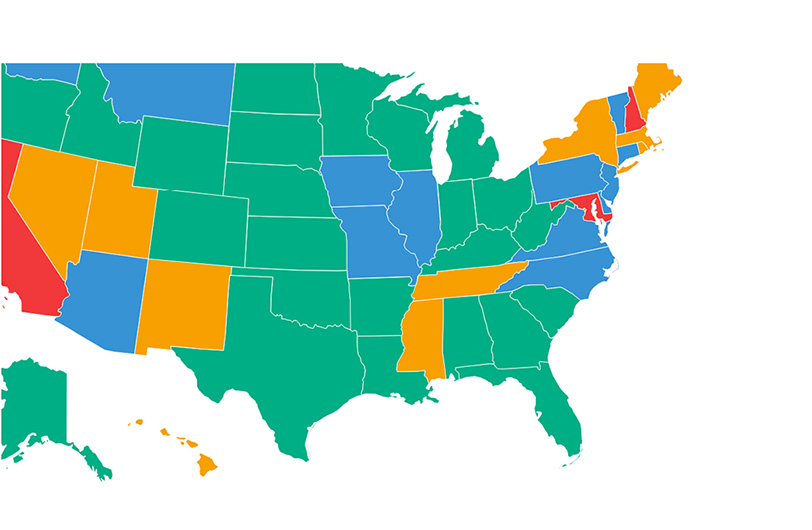
Additionally, while there are 16 states that fund elective abortions through Medicaid, in 11 states this policy was decided by a judicial ruling and not a legislative determination. In four other states where the funding policy came about through the democratic process it did so indirectly. Hawaii, Maryland, New York, and Washington all legalized abortion prior to Roe v. Wade. Subsequently, administrative agencies in these states decided Medicaid would cover abortions. Language about taxpayer funding for abortion was nowhere to be found in the actual legislation.
In fact, the only state that has enacted legislation which explicitly called for taxpayer funding for elective abortions was Illinois. In September 2017, Illinois Governor Bruce Rauner (R) signed HB 40 which mandated taxpayer funding of abortion for low-income women through Illinois’ Medicaid program. The results were predictable. Since HB 40 went into effect, the number of abortions paid for by Illinois taxpayers has skyrocketed — increasing by 1,700 percent. Rauner was subsequently defeated in his bid for reelection in 2018.
Most candidates who argue that abortion should be legal say it should only be a last resort. When campaigning for President in 1992, Bill Clinton stated abortion should be “safe, legal, and rare.” President Obama at times expressed interest in trying to get abortion numbers down. Furthermore, until recently, very few “pro-choice” politicians have supported taxpayer funding of abortion. Opposing L.D. 820 gives Maine legislators a unique opportunity to show the country these pledges made by pro-choice politicians to reduce abortion numbers are more than just empty rhetoric.
After all, over 350 innocent lives are at stake in the next year alone.
Michael J. New is a Visiting Assistant Professor at the Busch School of Business at The Catholic University of America and an Associate Scholar at the Charlotte Lozier Institute. Follow him on Twitter @Michael_J_New.