











Abortion Law in America Today: Introduction and the Pro-Life States


This is Issue 36 of the American Reports Series.
Originally published December 2025; updated January 2026 to address the January 6, 2026 decision from the Wyoming Supreme Court striking down Wyoming’s gestation-based abortion limit
Introduction
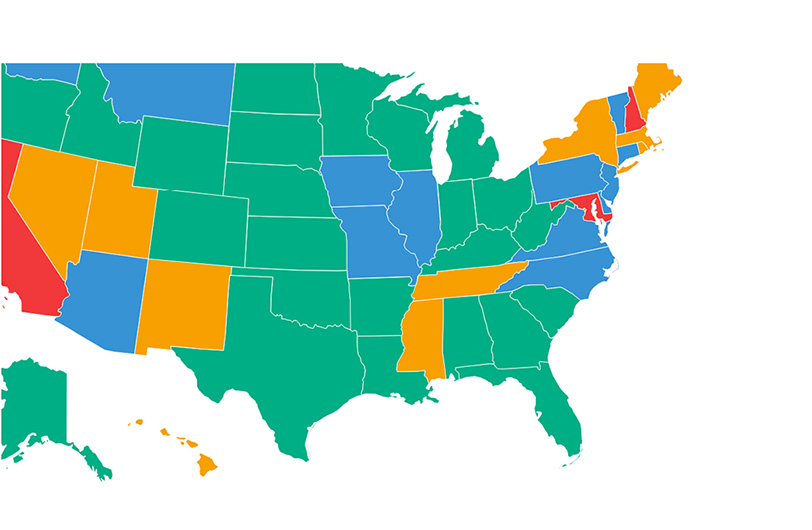
In post-Roe America, a legal divide exists between states that protect unborn children and their mothers and those that shield abortion and abortionists. On one side, there are 20 “pro-life states”[1] where abortions are limited throughout or for most of pregnancy. Exceptions are made in rare cases where pregnancy termination is necessary to prevent a woman’s death or serious injury and, in some states, in additional rare and tragic circumstances. On the other side, there are 26 “abortion protection states” and the District of Columbia, which have statutes, constitutional amendments, and/or state supreme court decisions[2] that explicitly grant abortion a special legal status.[3] Many of these laws were enacted, approved by ballot initiative, or broadened in recent years. Only four states—New Hampshire,[4] Pennsylvania,[5] Virginia,[6] and Wisconsin[7]—are in limbo, offering broad protections for neither unborn babies nor abortion.
While this close divide may seem to reflect the political landscape in the United States, abortion policy remains unsettled in every state. Just as efforts across the country to protect unborn babies and their mothers did not end with Roe v. Wade,[8] it is imprudent to assume, only three years after Roe was overturned in Dobbs v. Jackson Women’s Health Organization,[9] that even the strictest pro-life or pro-abortion laws are permanent. Abortion advocates continue to impose abortion in pro-life states through litigation and heavily funded ballot initiatives. Additionally, abortion-protection states are shielding abortionists from criminal, civil, or professional repercussions when they sell and mail abortion-inducing drugs to patients in states where these drugs are illegal and the abortionists are unlicensed.
These challenges notwithstanding, pro-life lawmakers have options for countering the encroachment of abortion in pro-life states and for enacting protections for unborn children and their mothers in abortion-protection states. This paper, the first in a series, examines the legal landscape in pro-life states. The second paper will analyze both the legal landscape in abortion-protection states and how, given the proliferation of abortion-inducing drugs, abortion-protection states’ policies are impacting pro-life states. The third paper will explore how pro-life lawmakers are responding to the strategies and arguments employed by abortion activists. The final paper will focus on potential state responses to “abortionist legal shield laws.”
Pro-Life States
Fourteen states have laws that limit abortion throughout pregnancy.[10] Another four states limit abortion after six weeks of gestation or once the unborn child’s heartbeat is detectable.[11] Two more states limit abortion after 12 weeks of gestation.[12] Among these 20 states with “gestation-based abortion limits,”[13] six have state constitutional amendments that express a commitment to protecting unborn children, affirm their rights, and/or clarify that the state constitution does not include an unenumerated right to abortion. Lawmakers in states with “pro-life state constitutional amendments” are reassured that they can pass and enforce pro-life laws.[14] In eight of the 21 states, the state Supreme Courts have held that their state constitutions do not contain a right to abortion[15] or only recognize a right to an abortion when necessary to protect a mother from death or serious health risks.[16] Six of the 21 states lack either a pro-life state constitutional amendment or pro-life state supreme court precedent clarifying that abortion rights cannot be “read” into their state constitutions.[17] The laws protecting unborn children and their mothers in these seven states are thus more susceptible to changes in public opinion or to courts establishing a constitutional right to abortion.
Abortion advocates are currently challenging gestation-based abortion limits in approximately two-thirds of the 20 pro-life states. The plaintiffs in these cases mainly argue that state constitutions include unenumerated abortion rights, that gestation-based abortion limits pose unconstitutional risks to pregnant women, and/or that the exceptions to the limits are vague and could lead to arbitrary enforcement. Section (A) covers litigation and developments in the pro-life states with gestation-based abortion limits that may be more susceptible to a state constitutional challenge. Section (B) highlights litigation and developments in states that have both enforceable gestation-based abortion limits and pro-life state constitutional amendments or pro-life state supreme court precedents.
A. Litigation threats and developments in vulnerable pro-life states
Six states—Georgia, Kentucky, Mississippi, North Carolina, South Dakota, and Utah—lack a state constitutional amendment or pro-life state supreme court precedent confirming that abortion rights cannot be “read” into their state constitutions. After a plaintiff brought a constitutional challenge against the gestation-based abortion limit in Utah, the court issued a preliminary injunction that was affirmed by the state supreme court. This case and challenges to gestation-based abortion limits in the other five states are discussed below.
Utah
After Roe was decided, a federal court struck down Utah’s law that prohibited abortion unless it was necessary to preserve the mother’s life on federal, not state, grounds.[18] The law was later repealed.[19] In 2020, Utah enacted a trigger law set to take effect “on the date that the legislative general counsel certifies … that a court of binding authority has held that a state may prohibit the abortion of an unborn child at any time during the gestational period ….”[20] After the June 2022 U.S. Supreme Court decision in Dobbs, the state started enforcing the gestation-based abortion limit, which prohibits abortion unless “the abortion is necessary to avert: (i) the death of the woman on whom the abortion is performed; or (ii) a serious physical risk of substantial impairment of a major bodily function of the woman on whom the abortion is performed;” the unborn baby has a fetal abnormality “incompatible with life;” or the baby is under 18 weeks of gestation and the pregnancy resulted from rape or incest or the pregnant child is under the age of 14.[21]
Utah’s gestation-based abortion limit was quickly challenged and enjoined by a lower court, and the Supreme Court of Utah affirmed the injunction while the case continues.[22] Although Utah’s highest court did not directly state what the outcome might be, its analyses of Utah’s constitution and previous rulings suggest a tendency to “read” unenumerated rights into the state’s constitution.[23] It seems unlikely that the court will uphold the gestation-based abortion limit as it is written. While Utah’s 18-week gestational limit remains in effect during the ongoing litigation of the broader gestation-based abortion law,[24] that law could also be threatened if the state’s supreme court “finds” an abortion right in the state constitution. Utah might need to pass a pro-life constitutional amendment to explicitly clarify that its constitution does not protect abortion.
Georgia
Georgia’s pre-Roe abortion laws were invalidated on federal grounds, not state grounds, in Doe v. Bolton,[25] and were repealed in 1973.[26] In 2019, Georgia enacted the Living Infants Fairness and Equality (LIFE) Act, establishing a six-week gestational limit on abortions.[27] After the U.S. Supreme Court’s decision in Dobbs, the U.S. Court of Appeals for the Eleventh Circuit reversed an injunction that had been issued by a lower federal court against the LIFE Act.[28] Georgia’s six-week abortion limit remains in effect as it is now litigated in state court.
In SisterSong v. State of Georgia, a trial court held that the LIFE Act violated Georgia’s state constitution.[29] Judge Robert C.I. McBurney wrote:
A review of our higher courts’ interpretations of ‘liberty’ demonstrates that liberty in Georgia includes … the power of a woman to control her own body, to decide what happens to it and in it, and to reject state interference with her healthcare choices. That power is not, however, unlimited. When a fetus growing inside a woman reaches viability, when society can assume care and responsibility for that separate life, then — and only then — may society intervene.[30]
The Supreme Court of Georgia quickly granted a stay of the trial court’s order pending appeal, allowing the law to remain in effect.[31] Then, on February 20, 2025, the court vacated the trial court’s order and remanded the case for the trial court to reconsider the plaintiffs’ standing under a recent decision by the state supreme court that removed the federal doctrine of third-party standing from Georgia’s law.[32]
It is unlikely that this current challenge to Georgia’s gestational abortion limit will succeed. However, the state would benefit from a pro-life state constitutional amendment that affirms unborn children’s rights or, at the very least, clarifies that the state constitution does not include an unenumerated right to abortion.
Kentucky
Before the U.S. Supreme Court decision in Roe, abortion was prohibited in Kentucky unless it was necessary to preserve the mother’s life.[33] The law was declared unconstitutional on federal grounds, not state grounds, and subsequently repealed.[34] However, in 2019, Kentucky enacted both a trigger law, written to take effect following the Supreme Court’s overturning of Roe or if an amendment to the U.S. Constitution restored the authority of the states to ban abortion,[35] and a heartbeat/six-week gestational abortion limit.[36] The trigger law, which permits abortion only if it is necessary to save a mother’s life or protect her from a serious health impairment, is currently in effect.
In 2022, Kentucky voters had the chance to amend their state constitution to explicitly state: “To protect human life, nothing in this Constitution shall be construed to secure or protect a right to abortion or require the funding of abortion.”[37] However, political action committees opposing this proposed constitutional amendment spent nearly $5.5 million more than political action committees supporting it, with much of the funding donated by out-of-state donors.[38] This resulted in the measure’s defeat by over 66,000 votes,[39] a missed opportunity that has left pro-life laws in Kentucky susceptible to court challenges.
A recent decision from the Supreme Court of Kentucky that “abortion providers lack third-party standing to challenge the [trigger law and the heartbeat limit] on behalf of their patients”[40] makes it less likely that abortion advocates will successfully challenge the state’s gestation-based abortion limit. The court held that “abortion providers have first-party, constitutional standing to challenge [one of the statutes] on their own behalf;” however, the plaintiffs asked the court to dismiss a challenge without prejudice, perhaps because the plaintiffs did not anticipate they would win the challenge.[41] Nonetheless, another lawsuit against Kentucky’s gestation-based abortion limit is pending in a Kentucky court.[42] Since the state supreme court has not explicitly ruled that Kentucky’s constitution does not protect abortion, state lawmakers should again campaign for a pro-life state constitutional amendment.
Mississippi
Before Roe, Mississippi prohibited abortion unless it was “necessary for the preservation of the mother’s life” or “where the pregnancy was caused by rape.”[43] The statute was declared unconstitutional on federal grounds, not state grounds,[44] but it was never repealed. In 2007, Mississippi enacted the statute as a trigger law, which would become enforceable following the reversal of Roe and a publication by the state attorney general.[45] The Mississippi attorney general certified the state’s trigger law on June 27, 2022, and it is currently in effect.
While there has not been a successful challenge to Mississippi’s current gestation-based abortion limit, in the 1998 decision in Pro-Choice Mississippi v. Fordice, a slim majority of the Mississippi Supreme Court held that the unenumerated rights provision of Mississippi’s constitution protects a right of privacy, which includes an implied right to abortion.[46] Because the court has never retracted that interpretation, Mississippi members of the American Association of Pro-life Obstetricians and Gynecologists sought a declaratory judgment that the gestation-based abortion limit is lawful under the state constitution. However, this lawsuit was dismissed by the trial court for lack of standing in October 2024.[47] The plaintiffs are now appealing to the state Supreme Court.[48]
Importantly, in 2022, a state court held that “[w]hen considering Fordice, in light of Roe, Casey and Dobbs, it is more than doubtful that the Mississippi Supreme Court will continue to uphold Fordice.”[49] Nevertheless, as in other pro-life states, an offense is the best defense, and pro-life citizens or lawmakers should initiate a ballot initiative to protect unborn children under the state’s constitution or preserve state lawmakers’ right to do so through legislation.
North Carolina
In 1973, North Carolina liberalized its abortion laws to comply with U.S. Supreme Court precedent.[50] In 2023, the state began enforcing a 12-week gestational abortion limit, which a federal district court upheld in July 2024.[51] The court affirmed that “there is no fundamental right to abortion” under the United States Constitution. However, considering this decision was issued by a federal court, a state court may reach a different conclusion when interpreting North Carolina’s constitution. The state would therefore benefit from a pro-life state constitutional amendment affirming unborn children’s rights or clarifying that the state constitution does not contain an unenumerated right to abortion.
South Dakota
Before Roe, South Dakota prohibited abortion unless it was necessary to preserve the mother’s life.[52] This law was declared unconstitutional on federal, not state, grounds[53] and was later repealed.[54] In 2005, South Dakota enacted a trigger law that was written to prohibit abortion except “to preserve the life of the pregnant female” if the U.S. Supreme Court overturned Roe and recognized that states have the authority to enact abortion bans.[55] The law took effect in June 2022 following the Dobbs decision. Abortion supporters tried to amend the state constitution to protect abortion in 2024, but the measure failed by over 73,000 votes.[56]
Notably, in South Dakota, the funds spent in support of the proposed abortion-protection amendment were more closely matched by the funds spent against it than in states that approved similar amendments (see the second paper in this series, forthcoming).[57] Without millions of dollars in additional out-of-state funding, abortion activists failed to persuade voters to abandon the state’s long history of protecting unborn children and their mothers. The next logical step for South Dakota would be to pass a pro-life state constitutional amendment to protect unborn children or to preserve the right to enact and enforce such protections.
B. Continued threats in states with pro-life state constitutional amendments or court decisions
Abortion advocates continue to challenge gestation-based abortion limits in states with pro-life state constitutional amendments or pro-life state supreme court precedents. The plaintiffs in these lawsuits argue that abortion limits pose unconstitutional risks to pregnant women and/or that the exceptions to these laws are too vague, potentially leading to arbitrary enforcement. Such allegations against gestation-based abortion limits emphasize the importance of states providing better education to physicians about the laws. Suppose a state supreme court finds that the exceptions to a gestational abortion limit are inadequate to protect women’s lives. In that case, the court would enjoin the limit, regardless of the state’s public policy stance on abortion. Current cases in South Carolina, Indiana, and Tennessee provide examples of the challenges faced even in the states most protective of unborn children.
South Carolina
After Roe, South Carolina’s gestational abortion limit was invalidated on federal grounds, not state grounds,[58] and was repealed in 1974.[59] The state enacted a six-week gestational abortion limit in 2021, which was enjoined.[60] After the state began enforcing this limit in 2022, the Supreme Court of South Carolina struck it down.[61] Nonetheless, in 2023, the state enacted a new six-week limit,[62] which the state supreme court upheld: “[T]he legislature has found that the State has a compelling interest in protecting the lives of unborn children. That finding is indisputable and one we must respect. The legislature has further determined … that its interest in protecting the unborn becomes actionable upon the detection of a fetal heartbeat …we … hold the 2023 Act is constitutional.”[63] Then, in May 2025, the Court upheld the state’s interpretation of the definition of “fetal heartbeat” in the gestational abortion limit.[64]
The maternal health exception in South Carolina’s law reflects longstanding provisions that have been part of pro-life legislation for decades. Additionally, the law specifies certain conditions that are presumed to “constitute a risk of death or serious risk of a substantial and irreversible physical impairment of a major bodily function of a pregnant woman,” including “molar pregnancy, partial molar pregnancy, blighted ovum, ectopic pregnancy, severe preeclampsia, HELLP syndrome, abruptio placentae, severe physical maternal trauma, uterine rupture, intrauterine fetal demise, and miscarriage.” However, South Carolina’s gestational abortion limit is now being challenged for vagueness in federal court. Instead of arguing that the state constitution grants a right to abortion, an argument that failed in state court, the plaintiff physicians claim that the exceptions to the gestational limit are unconstitutionally vague, potentially exposing physicians to criminal penalties without fair notice of what the law prohibits.[65]
Indiana
Before Roe, Indiana prohibited abortion unless it was necessary to save the mother’s life.[66] The law was repealed in 1977.[67] After Dobbs, Indiana enacted a new law prohibiting abortion[68] that was upheld by the state supreme court in Members of the Medical Licensing Board of Indiana v. Planned Parenthood Great Northwest.[69] The court held that the state constitution “protects a woman’s right to an abortion that is necessary to protect her life or to protect her from a serious health risk, but the General Assembly otherwise retains broad legislative discretion for determining whether and the extent to which to prohibit abortions.”[70] In other words, the constitution contains no right to abortion except in those rare circumstances when it is necessary to save the mother’s life or protect her from serious damage to her health. This decision from Indiana’s highest court requires no further legal clarification; however, abortion advocates are urging courts to define health broadly in the exception.
Planned Parenthood filed a motion for preliminary injunction in November 2023, arguing that the gestation-based abortion limit’s health and life exceptions are too narrow and thus violate the constitutional rights of women with serious health risks during pregnancy.[71] As in South Carolina, the plaintiffs shifted from claiming that the law violates a “constitutional right” to abortion to arguing that the law’s language is constitutionally flawed. In this case, the plaintiffs assert that the exceptions are too narrow to protect a mother’s constitutional right to life. However, in 2024, the trial court disagreed, holding that “[p]laintiffs have not shown that the Health or Life Exception prohibits any constitutionally protected abortion.”[72] Additionally, the definition in Indiana’s law “does not require physicians to wait until a woman is clinically unstable to provide care.”[73]
The 2024 trial court decision, which the Indiana Court of Appeals affirmed,[74] is positive and provides more guidance to doctors. However, the plaintiffs have appealed to the Indiana Supreme Court.[75] As in other states, it would be best for Indiana to approve a pro-life state constitutional amendment. In Indiana, that amendment should confirm the 2023 decision in Members of the Medical Licensing Board of Indiana, which held that the state constitution only guarantees a right to abortion when, based on a physician’s reasonable medical judgment, abortion is necessary to prevent a mother’s death or serious injury to her health.
Tennessee
In Tennessee, abortion was illegal before Roe v. Wade unless it was necessary to save a mother’s life.[76] The substantive provisions of this law were repealed by later laws enacted after Roe.[77] In 2019, Tennessee enacted a trigger law that limits abortion throughout pregnancy,[78] which the state started enforcing after Dobbs. Today, Tennessee has a constitutional amendment stating: “Nothing in this Constitution secures or protects a right to abortion or requires the funding of an abortion.”[79] However, the Center for Reproductive Rights is suing to stop the enforcement of the state’s gestation-based abortion limit, arguing that the law “imperils the lives and health of pregnant people and the sole exception to that ban … threatens doctors with arbitrary enforcement.”[80]
In October 2024, the trial court issued an injunction preventing the enforcement of the law in certain situations, listing specific “pregnancy-related conditions” which are considered “serious medical emergencies that come within the Medical Necessity Exception of the criminal abortion statute.”[81] In 2025, Tennessee further clarified the state law by adding a definition of “serious risk of substantial and irreversible impairment of a major bodily function” to the state’s gestational abortion limit. The definition explicitly includes “previable preterm rupture of the membranes; inevitable abortion; severe preeclampsia; mirror syndrome associated with fetal hydrops; and an infection that can result in uterine rupture or loss of fertility.” The new law also defines “inevitable abortion” as “a dilation of the cervix prior to viability of the pregnancy, either by preterm labor or cervical insufficiency.”[82]
Despite this clarification, the case continues. The plaintiffs declined to amend their complaint to address the new statute, and in October 2025, the trial court partially denied the state’s Joint Motion for Judgment on the Pleadings.[83] If the trial court ultimately invalidates the state’s gestational limit, Tennessee’s legislature may need to take further action to specify when doctors may perform abortions.
Mary E. Harned, J.D., is an associate scholar at the Charlotte Lozier Institute. Research and editing assistance for this series: Genevieve Plaster, Tessa Cox, Elyse Gaitan, Mariana Timler. The author consulted Paul Benjamin Linton’s book, Abortion under State Constitutions: A State-by-State Analysis, 2nd ed. (Carolina Academic Press 2012), when reviewing states’ pre-Roe history.
[1] Alabama, Arkansas, Florida, Georgia, Idaho, Indiana, Iowa, Kentucky, Louisiana, Mississippi, Nebraska, North Carolina, North Dakota, Oklahoma, South Carolina, South Dakota, Tennessee, Texas, Utah, and West Virginia.
[2] Kansas, Alaska, and Wyoming do not have abortion protection statutes or amendments. Their state supreme courts have interpreted their state constitutions as protective of abortion, and Kansas voters rejected a state constitutional amendment to protect unborn children and their mothers in 2022. See Ballotpedia, Kansas No State Constitutional Right to Abortion and Legislative Power to Regulate Abortion Amendment (August 2022), https://ballotpedia.org/Kansas_No_State_Constitutional_Right_to_Abortion_and_Legislative_Power_to_Regulate_Abortion_Amendment_(August_2022) (last visited Nov. 19, 2025). See Valley Hosp. Ass’n v. Mat-Su Coalition for Choice, 948 P.2d 963 (Alaska 1997) (abortion protected by Alaska’s privacy clause, article I, § 22); Hodes & Nauser, MDS, P.A. v. Schmidt, 440 P.3d 461, 486 (Kan. 2019) (Kansas’s constitution’s “proclamation of natural rights … protects the right” to abortion); State of Wyoming v. Johnson, 2026 WY 1 (WY 2026) (“A woman has a fundamental right to make her own health care decisions, including the decision to have an abortion … the Abortion Laws violate Article I, § 38 [of the Wyoming Constitution] …”).
[3] Alaska, Arizona, California, Colorado, Connecticut, Delaware, Kansas, Hawaii, Illinois, Maine, Maryland, Massachusetts, Michigan, Minnesota, Missouri, Montana, Nevada, New Jersey, New Mexico, New York, Ohio, Oregon, Rhode Island, Vermont, Washington, and Wyoming.
[4] In New Hampshire, abortion is prohibited after 24 weeks of gestation, with exceptions for life, serious physical impairment risks, and when there are “fetal abnormalities incompatible with life.” NH Rev. Stat. Ann. §§ 329:43-44. While pro-life and pro-abortion legislation was introduced in the recent legislative session, all efforts failed.
[5] In Pennsylvania, abortion is prohibited after 24 weeks of gestation, with exceptions for life and serious physical impairment risks. 18 PA. Cons. Stat. § 3211.The Supreme Court of Pennsylvania held that a state restriction on abortion funding through Medicaid potentially violated the Equal Rights Amendment and equal protection provisions of the Pennsylvania Constitution, requiring strict scrutiny analysis. While the court did not find that the state constitution guarantees a general right to abortion, the decision certainly indicates that the state needs a pro-life constitutional amendment. See Allegheny Reprod. Health Ctr. v. Pa. Dep’t of Hum. Servs., 309 A.3d 808 (PA 2024).
[6] In Virginia, abortion in the second trimester must be performed in a hospital and abortion is prohibited in the third trimester, with exceptions for life and mental or physical health impairments. VA. Co. Ann. §§ 18.2-71-74.1. An abortion protection amendment is likely to be on the ballot for the 2026 election. See Ballotpedia, Virginia Right to Reproductive Freedom Amendment (2026), https://ballotpedia.org/Virginia_Right_to_Reproductive_Freedom_Amendment_(2026) (last visited Nov. 19, 2025).
[7] On July 2, 2025, in a sharply divided opinion, the Supreme Court of Wisconsin ruled that 50 years of state abortion legislation in the wake of Roe “was meant as a substitute for the 19th century near-total ban on abortion;” therefore, “the legislature impliedly repealed” the law as it applied to abortion. Kaul v. Urmanski, 2025 WI 32 (Wis. July 2, 2025). However, the court also dismissed a case filed by Planned Parenthood asking the court to find a constitutional right to abortion in the state constitution. Planned Parenthood of WI v. Urmanski, 2024 WI 33 (Wis. July 2, 2025). Abortion is presently prohibited in Wisconsin at 20 weeks post-fertilization age (22 weeks gestational age) except when necessary to prevent a mother’s death or a “serious risk of substantial and irreversible impairment of one or more of the woman’s major bodily functions.” (Wis. Stat. §§ 253.107(3), 253.10(2)(d)).
[8] 410 U.S. 113 (1973).
[9] 597 U.S. 215 (2022).
[10] Alabama, Arkansas, Idaho, Indiana, Kentucky, Louisiana, Mississippi, North Dakota, Oklahoma, South Dakota, Tennessee, Texas, Utah, and West Virginia.
[11] Florida, Georgia, Iowa, and South Carolina.
[12] Nebraska and North Carolina.
[13] This paper uses the term “gestation-based abortion limits,” because no state “bans” abortion entirely. All pro-life states’ abortion laws contain exceptions permitting the separation of a mother and her unborn child prior to fetal viability when it is necessary to save the mother’s life, and some states have additional circumstance-based reasons for permitting abortion. See Mary E. Harned & Ingrid Skop, Pro-Life Laws Protect Mom and Baby: Pregnant Women’s Lives are Protected in All States, Charlotte Lozier Institute (Dec. 9, 2025), https://lozierinstitute.org/pro-life-laws-protect-mom-and-baby-pregnant-womens-lives-are-protected-in-all-states/#_edn1. Also, women who seek or have abortions are not subject to prosecution in pro-life states. See Amanda Stirone Mansfield, Pro-Life Laws Exempt Women from Prosecution: An Analysis of Abortion Statutes in 27 States, Charlotte Lozier Institute (Jan. 10, 2024), https://lozierinstitute.org/pro-life-laws-exempt-women-from-prosecution-an-analysis-of-abortion-statutes-in-27-states/.
[14] Alabama, Arkansas, Louisiana, Nebraska, Tennessee, West Virginia. Nebraska’s constitutional amendment states explicitly that “unborn children shall be protected from abortion in the second and third trimesters” unless there is a “medical emergency” or when pregnancy results from sexual assault or incest. While the amendment does not restrict abortion in the first trimester, it also does not require that first trimester abortions be permitted.
[15] Florida, Idaho, Iowa, South Carolina, Texas. While the Supreme Court of South Carolina has not explicitly held that an unenumerated right to abortion is absent from the state’s constitution, and had in fact held that such a right could be found within the state’s right to privacy in “Planned Parenthood I” (Planned Parenthood S. Atl. v. South Carolina, 438 S.C. 188 (S.C. 2023)), the court nonetheless upheld the state’s heartbeat law in “Planned Parenthood II,” writing that it must respect the legislature’s determination that “the State has a compelling interest in protecting the lives of unborn children.” Planned Parenthood S. Atl. v. State, 440 S.C. 465, 485 (S.C. 2023).
[16] Indiana (“to protect her life or to protect her from a serious health risk,” Members of the Medical Licensing Board of Indiana v. Planned Parenthood Great Northwest, 211 N.E.3d 957, 962 (Ind. 2023); North Dakota (“the right to pursue and obtain safety, which necessarily includes a pregnant woman has a fundamental right to obtain an abortion to preserve her life or her health,” Access Indep. Health Servs. v. Wrigley, 2023 ND 50, ¶ 27 (N.D. 2023); Oklahoma (“[T]he Oklahoma Constitution … protects the right of a woman to terminate her pregnancy in order to preserve her life,” Okla. Call for Reprod. Just. v. Drummond, 2023 OK 24, P16 (Okla. 2023).
[17] Georgia, Kentucky, Mississippi, North Carolina, South Dakota, and Utah.
[18] Doe v. Rampton, No. C-234-70 (D. Utah 1973), striking down Utah Code Ann. §§ 76-2-1, -2 (1953). See Paul Benjamin Linton, Abortion under State Constitutions: A State-by-State Analysis, 2nd ed. (Carolina Academic Press 2012).
[19] 1973 Utah Laws 584, 684, ch. 196, (sub.) ch. 10, pt. 14.
[20] 2020 UT. SB 174, enacted, March 28, 2020.
[21] Utah Code Ann. § 76-7a-101, 201, as amended 2023 ch. 158, § 15 and ch. 301, § 29, effective May 3, 2023.
[22] Planned Parenthood Ass’n of Utah v. State, 2024 UT 28 (UT 2024).
[23] Id. e.g., The court emphasized “[t]he Utah Constitution makes plain that not all rights it protects are enumerated.” ¶ 91 (internal citations omitted). Further, the court’s job “is to define the constitutional principle as it was understood by those who voted our constitution into existence. That understanding will govern the breadth of the principle” (emphasis added). ¶ 119. The State’s “proffered history does not negate the district court’s conclusion that there are serious issues going to the merits.” ¶ 125. “Failure to distinguish between principles and application of those principles would hold constitutional protections hostage to the prejudices of the 1890s.” ¶ 127. Previous court decisions in Utah “[a]t a minimum … raise a serious issue regarding the existence of a right to bodily integrity and whether [the abortion limit] infringes that right.” ¶ 172. “Language can change meaning over time and what seems plain to us today might have had a different import when it was written.” ¶ 184.
[24] Utah Code Ann. § 76-7-302.
[25] 319 F.Supp. 1048 (N.D. Ga. 1970).
[26] 1973 Ga. Laws 635-38.
[27] Ga. Code Ann. § 16-12-140, 141.
[28] SisterSong Women of Color Reprod. Justice Collective v. Governor of Georgia, 40 F.4th 1320 (11th Cir. 2022).
[29] SisterSong women of Color Reproductive Justice Collective v. State, Civil Action 2022CV367796, Final Order (Fulton Co. Sup. Ct., Sept. 30, 2024).
[30] Id.
[31] State v. SisterSong Women of Color Reproductive Justice Collective, Case No. S25M0216, order (Ga. Oct. 7, 2024).
[32] State v. SisterSong Women of Color Reproductive Justice Collective, Case No. S25A0300, order (Ga. Feb. 20, 2025).
[33] Ky. Rev. Stat. Ann. § 436.020.
[34] Sasaki v. Commonwealth, 497 S.W.2d 713 (Ky. 1973); 1974 Ky. Acts ch. 255, sec. 19; 1974 Ky. Acts ch. 406, sec. 336.
[35] Ky. Rev. Stat. § 311.772.
[36] Ky. Rev. Stat. § 311.7706.
[37] Ballotpedia, Kentucky Constitutional Amendment 2, No Right to Abortion in Constitution Amendment (2022), https://ballotpedia.org/Kentucky_Constitutional_Amendment_2,_No_Right_to_Abortion_in_Constitution_Amendment_(2022) (last visited Nov. 19, 2025).
[38] Id. See also, Open Secrets, Protect Kentucky Access: Top Donors, https://www.opensecrets.org/ballot-measures/committees/protect-kentucky-access/54451349/2022 (last visited Dec. 19, 2025).
[39] Id. 675,634 thousand votes in favor, 742,232 votes opposed.
[40] Cameron v. EMW Women’s Surgical Ctr., P.S.C., 664 S.W. 3d 633, 640 (Ky 2023).
[41] EMW Women’s Surgical Center, P.S.C., v. Daniel Cameron, No. 22-CI-003225, Agreed Order of Dismissal (Jefferson Cir. Ct., June 27, 2023).
[42] See Sobel v. Cameron, Ky. Ct. App. No. 2024-CA-0849.
[43] Miss. Code Ann.§ 2223 (Supp. 1970), renumbered as MS Code § 97-3-3 (2017).
[44] Spears v. State, 278 So.2d 443 (Miss. 1973).
[45] Miss. Code § 41-41-45.
[46] 716 So.2d 645, 650-54 (Miss. 1998).
[47] American Association of Pro-life Obstetricians and Gynecologists v. Mississippi State Board of Medical Licensure, Miss. Ch. Ct. No. 25CH1:22-cv-01371.
[48] Bobby Harrison, Doctors group asks state Supreme Court to clarify that abortions are illegal in Mississippi, Mississippi Today, Nov. 18 2024, https://mississippitoday.org/2024/11/18/mississippi-abortion-right-constitution-lawsuit-supreme-court/.
[49] Jackson Women’s Health Organization, et al v. Dobbs, Cause No. 25CH1:22-cv-00739 (Ch. Court of Hinds County, MS, 1st Judicial District, July 5, 2022).
[50] 1973 N.C. Sess. Laws 1057-58, ch. 711, §§1, 2.
[51] Planned Parenthood South Atlantic v. Stein, 1:23-CV-480 (M. Dist. NC July 26, 2024). The court held that one provision of the law was “unconstitutionally vague,” but upheld the gestational abortion limit.
[52] S.D. Codified Laws § 22-17-1 (1967).
[53] State v. Munson, 206 N.W.2d 434 (S.D. 1973).
[54] 1973 S.D. Laws 206, 209 ch. 146, § 15; 1976 S.D. Laws 227, 257, ch. 158, § 17-1; 1977 S.D. Laws 258, 282 ch. 189, § 126.
[55] S.D. Codified Laws § 22-17-5.1.
[56] Ballotpedia, South Dakota Constitutional Amendment G, Right to Abortion Initiative (2024), https://ballotpedia.org/South_Dakota_Constitutional_Amendment_G,_Right_to_Abortion_Initiative_(2024) (last visited Nov. 19, 2025).
[57] Id. 1.6 million compared to 1.1 million.
[58] State v. Lawrence, 198 S.E.2d 253 (S.C. 1973).
[59] 1974 S.C. Acts 2837, 2841, Act. No. 1215, §8.
[60] Planned Parenthood v. Wilson, 3:21-00508 (Dist. SC 2021).
[61] Planned Parenthood S. Atl. v. South Carolina, 438 S.C. 188 (S.C. Jan. 5, 2023).
[62] S.C. Code Ann. § 44-41-610-690.
[63] Planned Parenthood S. Atl. v. State, 440 S.C. 465, 485 (S.C. Aug. 23, 2023).
[64] Planned Parenthood S. Atlantic v. State, 2025 S.C. LEXIS 59 (S.C. May 14, 2025).
[65] Bingham v. Wilson, Order and Opinion, Case No. 2:25-cv-163 (D. of S.C. May 7, 2025); See also court order and opinion denying Defendants’ motion for judgment on the pleadings, Bingham v. Wilson, Order and Opinion, Case No. 2:25-cv-163 (D. of S.C. Sept. 16, 2025).
[66] Ind. Code Ann. § 35-1-58-1.
[67] 1977 Ind. Acts 1513, 1524, Pub. L. No. 335, § 21.
[68] Ind. Code Ann. § 16-34-2-1.
[69] 211 N.E.3d 957 (Ind. 2023).
[70] Id. at 961-62.
[71] Planned Parenthood v. Members of the Medical Licensing Board, Brief in Support of Plaintiffs’ Motion for Preliminary Injunction, Cause No. 53C06-2208-PL-001756 (Nov. 9, 2023).
[72] Planned Parenthood v. Members of the Medical Licensing Board, Cause No. 53C06-2208-PL-001756 (Sept. 11, 2024), ¶ 14.
[73] Id. at ¶ 15.
[74] Planned Parenthood v. Members of the Medical Licensing Board, Ind. Case No. 24A-PL-2467 (Ind. Ct. App. Aug. 11, 2025), https://public.courts.in.gov/Decisions/api/Document/Opinion?Id=4ADcrAkhtivlyKlmBu1BDuXvtxOAdVAgghWh5qAg5MbcxImawA4ZErw2HFdEOxs00.
[75] State and Federal Reproductive Rights and Abortion Litigation Tracker, KFF (Dec. 5, 2025), https://www.kff.org/womens-health-policy/report/state-and-federal-reproductive-rights-and-abortion-litigation-tracker/. In an additional challenge to Indiana’s gestational abortion limit, plaintiffs are arguing that the restriction violates the state’s Religious Freedom Restoration Act. See Individual Members of the Medical Licensing Board v. Anonymous Plaintiff 1, et al., 22A-PL-2938 (Ct. of App. In. Apr. 4, 2024), affirming an injunction of the state’s enforcement of the gestational abortion limit against the plaintiffs.
[76] Tenn. Code Ann. §§ 39-301, 39-302 (1956).
[77] 1973 Tenn. Pub. Acts 901 et seq., ch. 235, §§ 1, 3.
[78] Tenn. Code Ann. § 39-15-213.
[79] Tenn. Const. Art. I, § 36.
[80] Phillips v. Tennessee, Case No. 23-1196-I, Plaintiffs’ Second Amended and Supplemental Complaint for Declaratory Judgment and Permanent Injunction (Chancery Ct. of Tn, Mar. 12, 2025).
[81] Phillips, et al., v. State of Tennessee (formerly Blackmon v. State of Tennessee), No. 23-1196-I (Chancery Ct., 12th Jud. Dist., Oct. 17, 2024).
[82] 2025 Tenn. Pub. Acts ch. 217, § 1., SB No. 1004, amending Tenn. Code Ann. § 39-15-213.
[83] Phillips, et al., v. State of Tennessee, No. 23-1196-IV(I) (Chancery Ct., 12th Jud. Dist., Oct. 16, 2025).