











Connecticut’s 2020 abortion report was provided to the Charlotte Lozier Institute (CLI) by the Connecticut Department of Public Health upon request.
Changes in Connecticut Abortions: 2019-2020

The report does not include information on Planned Parenthood’s Connecticut abortion market share.
Abortion Totals and Trends
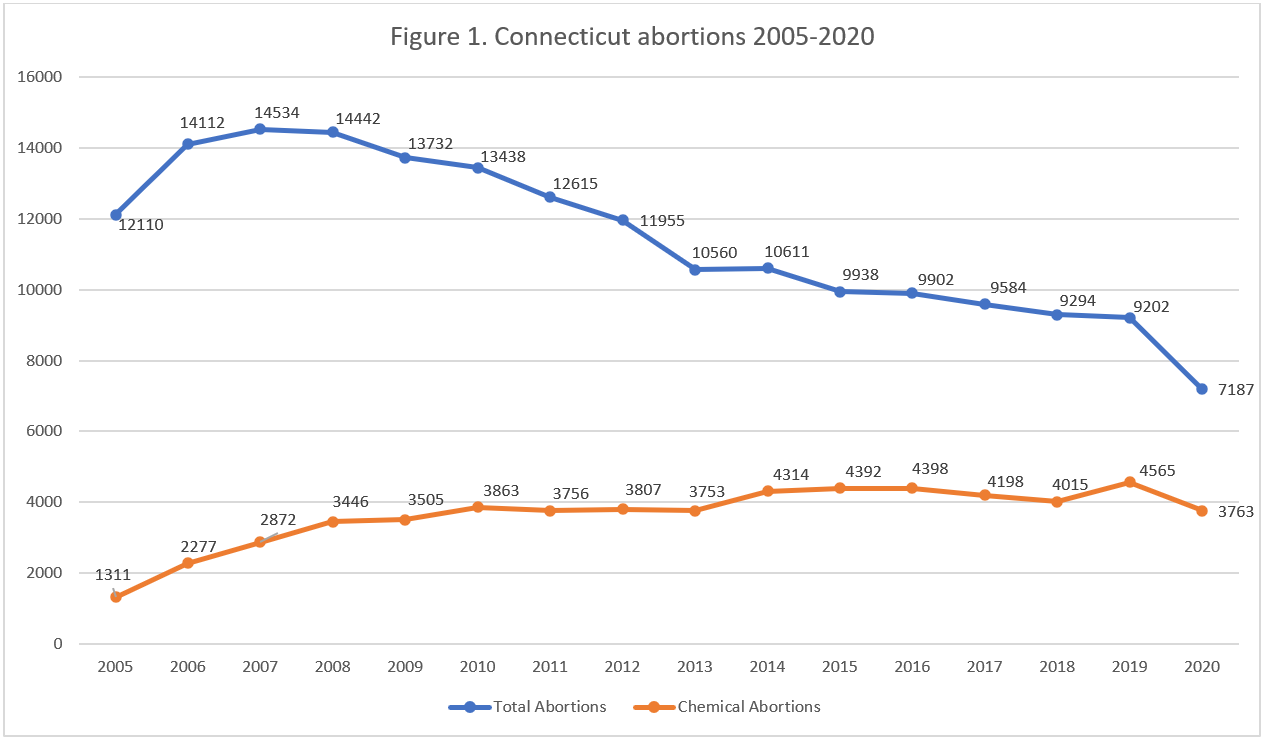
There were 7,187 abortions reported in Connecticut in 2020, down 22 percent from 2019 (Fig. 1). Chemical abortions dropped 18 percent from 4,565 in 2019 to 3,763 in 2020, composing 52 percent of the total in 2020. CLI estimates that Connecticut’s abortion rate fell to 10.7 abortions per 1,000 women ages 15-44, lower than the national average (Fig. 2). As of August 2022, 34 states had released 2020 abortion statistics, with 11 states reporting that abortions had declined.
State Report Summary
Most Connecticut abortions, 96 percent, were reported to have been performed on state residents. Rhode Island women accounted for not quite two percent, and Massachusetts residents obtained a little over one percent of the abortions. Women from New York underwent 0.6 percent of the abortions, while the remaining 0.3 percent were performed on other nonresident women.
Eight percent of the abortions were obtained by girls under the age of 20, including two percent on girls under the age of 18. Twenty-seven percent of the abortions were on women in their early twenties, while 28 percent were on women in their later twenties. Thirty-two percent of the abortions were performed on women in their thirties. Four percent were performed on women age 40 and above. Age was not reported for one percent of the abortions.
The majority of abortions reported in Connecticut (88 percent) were performed in the first trimester at 12 weeks of gestation or earlier. Five percent were performed between 13 and 15 weeks, and three percent occurred from 16 to 20 weeks. One percent of the abortions were reported at 21 weeks of gestation or later, while two percent occurred at unknown gestational ages.
Over half of Connecticut abortions were chemical (52 percent). Forty-three percent were conducted using suction curettage, and four percent were performed via dilation and evacuation. Forty abortions were performed using sharp curettage (0.6 percent). There were four hysterectomy or hysterotomy abortions and 25 abortions performed using unknown means.
Ninety-two percent of the abortions reported in Connecticut were performed in clinics, while six percent were hospital outpatient procedures. Less than one percent of the abortions were performed as hospital inpatient procedures, and not quite two percent were performed in doctors’ offices or other facilities.
Declining Abortions in Connecticut
Abortions reported in Connecticut declined dramatically in 2020, with much of the decline occurring in the second half of the year. According to monthly data shared with CLI by the Connecticut Department of Public Health, there were 4,270 abortions reported between January and June, and just 2,895 abortions between July and December. The report does not indicate the reason for the decrease, but it is likely that the pandemic played a role. Planned Parenthood, which operates all but one of Connecticut’s abortion centers, permanently closed two of its centers as a result of the pandemic and temporarily removed several others from its website. Planned Parenthood also reduced hours at most of its centers.
Changes to Food and Drug Administration (FDA) regulations on chemical abortion may also have contributed to the drop in abortions. In July 2020, the FDA suspended a requirement that the abortion drug mifepristone be distributed in person, allowing abortion by mail. Most online abortion pill distributors did not launch in Connecticut until 2021; however, international abortion pill website Aid Access advertised abortion pills to Connecticut women in 2020. Additionally, Massachusetts and New York had abortion pill websites begin operating in 2020, and these may have attracted women from Connecticut. The Connecticut Department of Health informed CLI that they did not believe that chemical abortion providers who mailed abortion pills to Connecticut women, whether within Connecticut or from out-of-state, would be required to report the abortions. Consequently, any abortions from pills sent via the mail are likely not reflected in Connecticut’s abortion data.
However, surgical abortions may increase in Connecticut now that the state has enacted a law permitting them to be performed by non-physicians. The law also establishes Connecticut as a destination for out-of-state women seeking abortions.
State Ranking
In CLI’s 2016 paper ranking abortion reporting across the United States, Connecticut’s reporting was ranked at 41st best. As CLI has previously recommended, Connecticut could make its abortion reports easier to access by publishing them online. Connecticut could also report demographic information that is reported by many other states and the Centers for Disease Control and Prevention, including the race, education, pregnancy history, and marital status of women who obtain abortions. Connecticut could also collect and report data on abortion-related complications.
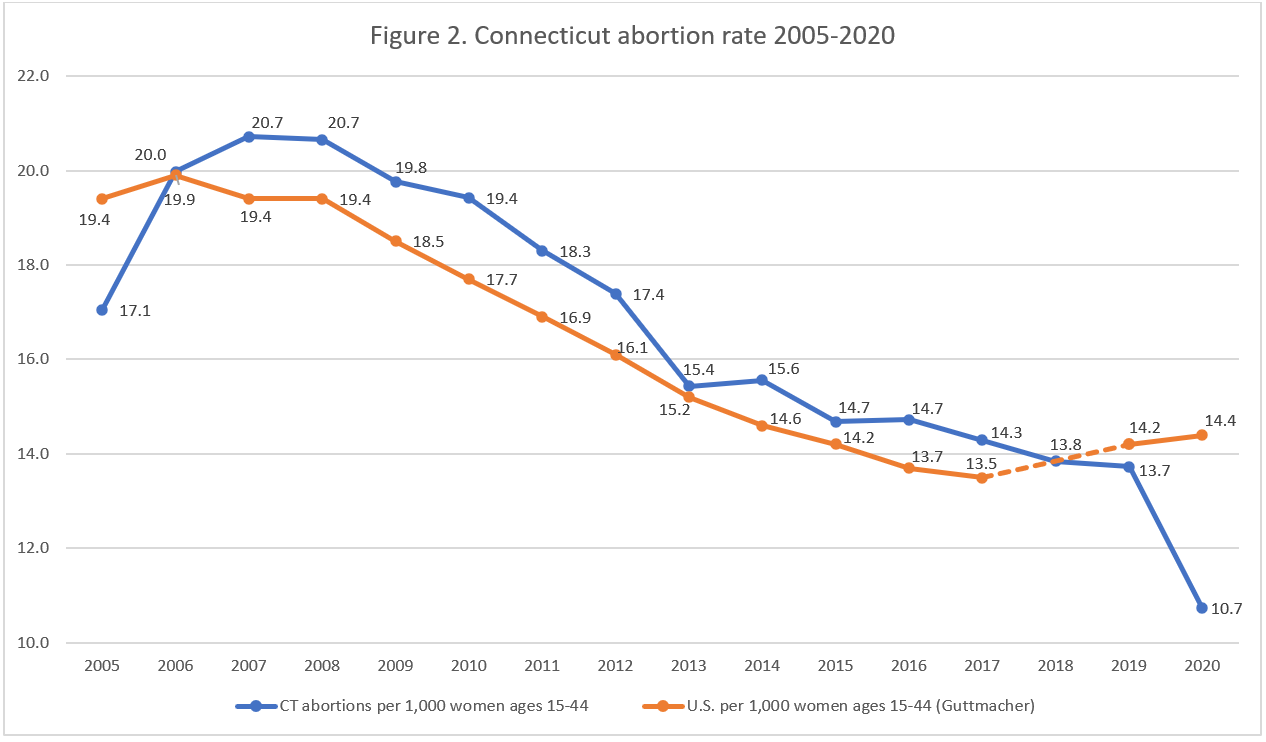
- Rates were calculated by CLI using the following formula: (total number of abortions performed in Connecticut ÷ number of resident women ages 15-44) x 1,000. Rates may differ slightly from previous CLI articles due to revised population estimates. Population estimates were obtained from CDC WONDER.
Percentages may not add to 100% due to rounding.
Click here to view reporting from:2025202420222021201920182017