












Connecticut’s 2023 and 2024 abortion reports were provided to the Charlotte Lozier Institute (CLI) by the Connecticut Department of Public Health (DPH) upon request in July and August 2025. This article primarily covers 2024 abortion statistics. Abortions in Connecticut increased both from 2022 to 2023 and from 2023 to 2024.
The data published by the state does not include the total number of abortions obtained by Connecticut residents out of state or the number of self-managed abortions on women outside of the healthcare system. The report also does not contain the total number of mail-order abortion drugs obtained by Connecticut residents prescribed by licensed abortion providers in Connecticut or in other states. In a separate section, CLI will describe data provided by the Guttmacher Institute’s Monthly Abortion Provision Study that details the total number of abortions occurring in the state in 2023 and 2024 as estimated by Guttmacher’s sample survey and mathematical models. CLI will also describe Guttmacher’s estimated number of abortions obtained by Connecticut women in other states. Guttmacher’s abortion estimates include the number of abortions obtained at brick-and-mortar facilities and those provided via telehealth and virtual providers in the United States.
Connecticut’s statute code defines abortion as “termination of a pregnancy for purposes other than producing a live birth. Abortion includes, but is not limited to, a termination of pregnancy using pharmacological agents” (CT Gen. Stat. §19a-912).
In Connecticut, abortion is widely available throughout pregnancy because of the state’s ineffective gestational limit at viability. While the language of the law limits abortion after viability, the law contains a broad health (life and health of the mother) exception that doesn’t differentiate between physical and mental health, which, in turn, allows abortion throughout pregnancy for nearly any reason (CT Gen. Stat. §19a-602).
Statistics and Changes in Connecticut Abortions, 2023-2024

The report does not include information on Planned Parenthood’s abortion market share.
Abortion Totals and Trends
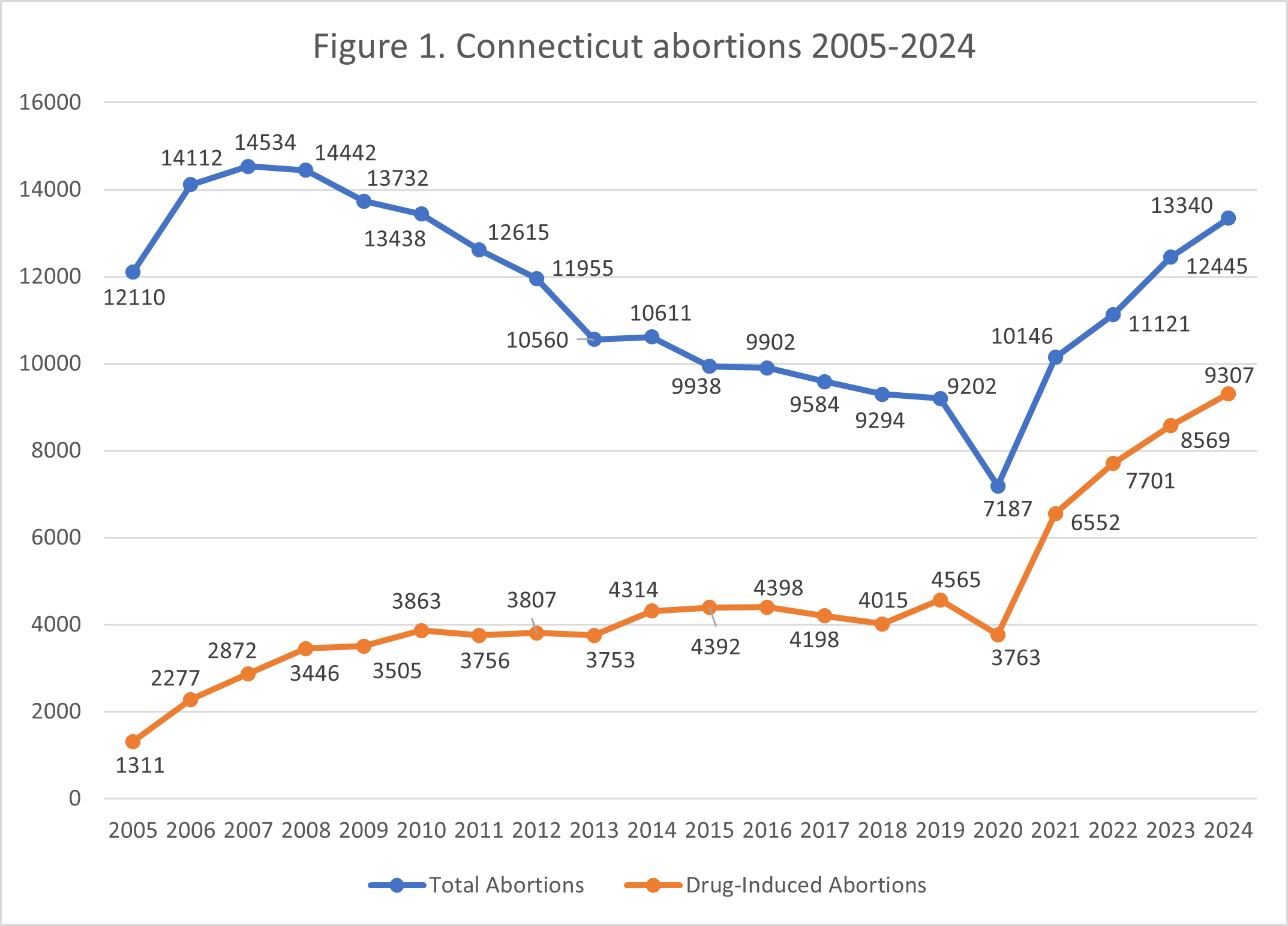
There were 13,340 brick-and-mortar abortions reported in Connecticut in 2024, up 7% from 2023 when 12,445 abortions were reported. Drug-induced abortions increased by 9% from 2023, rising from 8,569 to 9,307 (Fig. 1). CLI estimates that Connecticut’s 2024 abortion rate was 19.4 abortions per 1,000 women ages 15 to 44, an increase of 7% from 2023 (Fig. 2).1 As of August 2025, 12 states had released 2024 abortion reports, with five showing increases in abortion totals from the previous year.
State Report Summary
In early 2023, the Connecticut DPH issued a new abortion reporting form for abortionists to use without the adoption of revised regulations by the Legislature’s Regulations Review Committee. Seven of the nine reporting categories previously included in the 2007 version of the form no longer existed on the 2023 version of the form. As a result of these changes to the reporting form, the public-facing abortion reports the DPH sends to those who request them no longer include data on abortions by gestational age or the age of the mother.
Ninety-four percent of Connecticut abortions were reported to have been performed on state residents. Rhode Island women accounted for 2% of the abortions, while Massachusetts and New York women accounted for 1% each. One percent of abortions were performed on women from other states or territories, while 11 abortions were obtained by women whose residence was unknown.
Seventy percent of Connecticut abortions were drug-induced, while 30% were surgical/aspiration abortions. When the state changed abortion reporting requirements in 2023, they condensed the categories used for reporting the number of abortions by method, which is why surgical and aspiration abortions are a combined category now. Both the number of surgical/aspiration abortions and drug-induced abortions increased from 2023.
Ninety-one percent of the abortions reported in Connecticut were performed in outpatient clinics, while 4% were performed in a hospital. One percent of abortions were performed at licensed practitioners’ offices, while 4% were performed at other, unknown locations. Like the method of termination category, the 2023 changes to abortion reporting regulations changed the categorizations for data related to the number of abortions by type of facility, which is why the 2024 numbers are not easily comparable to the 2023 numbers.
Because of a change to the state’s requirements regarding who can perform aspiration abortions, Connecticut started reporting the type of “medical professional” performing abortions for both 2023 and 2024. In 2024, a quarter of abortions were performed by physicians, and 33% were performed by advanced practice registered nurses. Twenty-seven percent were performed by licensed nurse midwives, while 14% were performed by physician assistants. Two percent of abortions were performed by other, unknown types of medical professional.
Breakdown of Abortion Providers in Connecticut2
| # of brick-and-mortar locations | 17 |
| # of independent centers | 1 |
| # of Planned Parenthood centers | 14 |
| # of hospitals/doctors’ offices that perform abortions | 2 |
| # of abortion drug providers | 17 |
| # of abortion drug-only providers | 10 |
| # of surgical and abortion drug providers | 7 |
| Latest gestational age that a center performs surgical abortion | Through 23 weeks |
Guttmacher 2024 Data3
Guttmacher estimated that 15,090 abortions were performed in Connecticut in 2024, a total 13% higher than the total reported by the state.4 To see total abortions, resident abortions, and non-resident abortions as reported by the state versus Guttmacher in 2024, see the table below:
| Total # of Abortions | # of Resident Abortions | # of non-Resident Abortions | |
| Guttmacher | 15,090 | 14,400 | 580 |
| Connecticut DPH | 13,340 | 12,568 | 761 |
As one can see, the state reported significantly fewer resident abortions compared to Guttmacher, and there was also a notable divergence between the numbers of non-resident abortions reported (but in the opposite direction). A possible explanation for the state’s underreporting is that it does not report telehealth abortions obtained by Connecticut residents from abortion drug prescribers in state or out of state. When CLI emailed the Connecticut DPH to confirm whether they reported telehealth abortions in their public-facing abortion totals, no answer was received. However, this hypothesis is the most plausible, as the Society of Family Planning’s 2024 #WeCount data showed that 1,770 telehealth abortions occurred in Connecticut, which was similar to the difference in total abortions (1,750) as reported by the state and Guttmacher.5
In 2024, Guttmacher estimated that 750 Connecticut women traveled to other states to obtain an abortion, with 210 traveling to New Jersey and 540 traveling to New York.6
State Ranking
In 2024, CLI published a paper reevaluating abortion reporting across the country, with Connecticut tied for 36th best out of 52 reporting areas. This ranking would likely decrease if reevaluated today due to Connecticut’s change to its abortion reporting requirements. To improve its reporting, Connecticut could report the categories of data it eliminated in 2023, as well as report demographic information that is reported by many other states, including race, education, pregnancy history, and marital status of those who obtain abortions.

- National rates were calculated by the Guttmacher Institute. Connecticut rates were calculated by CLI using the following formula: (total number of abortions performed in Connecticut ÷ number of resident women ages 15-44 [based on most recent population estimates]) x 1,000. Rates may differ slightly from previous CLI articles due to revised population estimates. Population estimates were obtained from the CDC WONDER database. Estimates for 2005-2009 are intercensal estimates of the July 1 resident population. Estimates for 2010-2019 are Vintage 2020 postcensal estimates of the July 1 resident population. Estimates for 2020-2023 are Vintage 2023 postcensal estimates of the July 1 resident population. Estimates were produced by the U.S. Census Bureau and the National Center for Health Statistics. Rates for 2024 were calculated using the Vintage 2023 postcensal estimates because 2024 population estimates have not yet been released by the CDC.
- Provider totals do not include hospitals or physician offices not listed in databases that compile abortion provider locations in different states but do include Planned Parenthood locations, independent abortion centers, and hospitals/doctor’s offices included in databases like Abortion Finder and Ineedana. This information is updated as of August 28, 2025.
- The Guttmacher Institute notes that their monthly abortion totals by state are estimates and that each state’s estimate is within a range of uncertainty. Guttmacher also notes that their estimates do not reflect abortions obtained by women in pro-life states under shield laws in effect in pro-abortion states. This information is updated as of August 28, 2025.
- Note that the data on Guttmacher’s website may differ from that contained in its csv tables (which can be found here). It is likely this is due to the fact that one or the other source is more frequently updated.
- #WeCount’s data can be found here by downloading the “Report data tables [.xlsx]” document. The #WeCount report specifies that the numbers included in their tables for abortions performed under shield laws only represent the number of women whom abortion drugs were sent to, not the number of drug-induced abortions that were a result of the mailed drugs. However, because #WeCount’s data is the only source of data that delineates the number of abortions by mode of provision (in-person, telehealth/mail order, and/or abortion drugs obtained under shield laws) their data is the best available.
- Guttmacher’s travel and residence data can be found here (State_Abortion_Travel_2024.csv).