











For the second year, Kansas’ abortion data was included in the state’s vital statistics report published in December by the Kansas Department of Health and Environment (KDHE), instead of being published as a standalone report published in July. The report shows that abortions increased from 2023 to 2024. Below, Charlotte Lozier Institute (CLI) summarizes the information in the state’s vital statistics report.
The data published by the KDHE does not include the total number of abortions obtained by Kansas residents out of state or the number of self-managed abortions on women outside of the healthcare system. The report also does not contain the number of mail-order abortion drugs obtained by Kansas residents prescribed by licensed providers in Kansas or other states. In a separate section, CLI will describe data provided by the Guttmacher Institute’s Monthly Abortion Provision Study that details the total number of abortions occurring in the state in 2024 as estimated by Guttmacher’s sample survey and mathematical models. CLI will also describe Guttmacher’s estimated number of abortions obtained by Kansas women in other states. Guttmacher’s abortion estimates include the number of abortions obtained at brick-and-mortar facilities and those provided via telehealth and virtual providers in the United States.
Kansas’ statute code defines abortion as “the use or prescription of any instrument, medicine, drug or any other means to terminate the pregnancy of a woman knowing that such termination will, with reasonable likelihood, result in the death of the unborn child” (Kans. §65-6701). In Kansas, abortion is prohibited at 22 or more weeks of gestation except in cases where a continued pregnancy would threaten a mother’s life or physical health (Kansa. §65-6724).
Statistics and Changes in Kansas Abortions, 2023-2024

The report does not contain information on Planned Parenthood’s abortion market share.
Abortion Totals and Trends
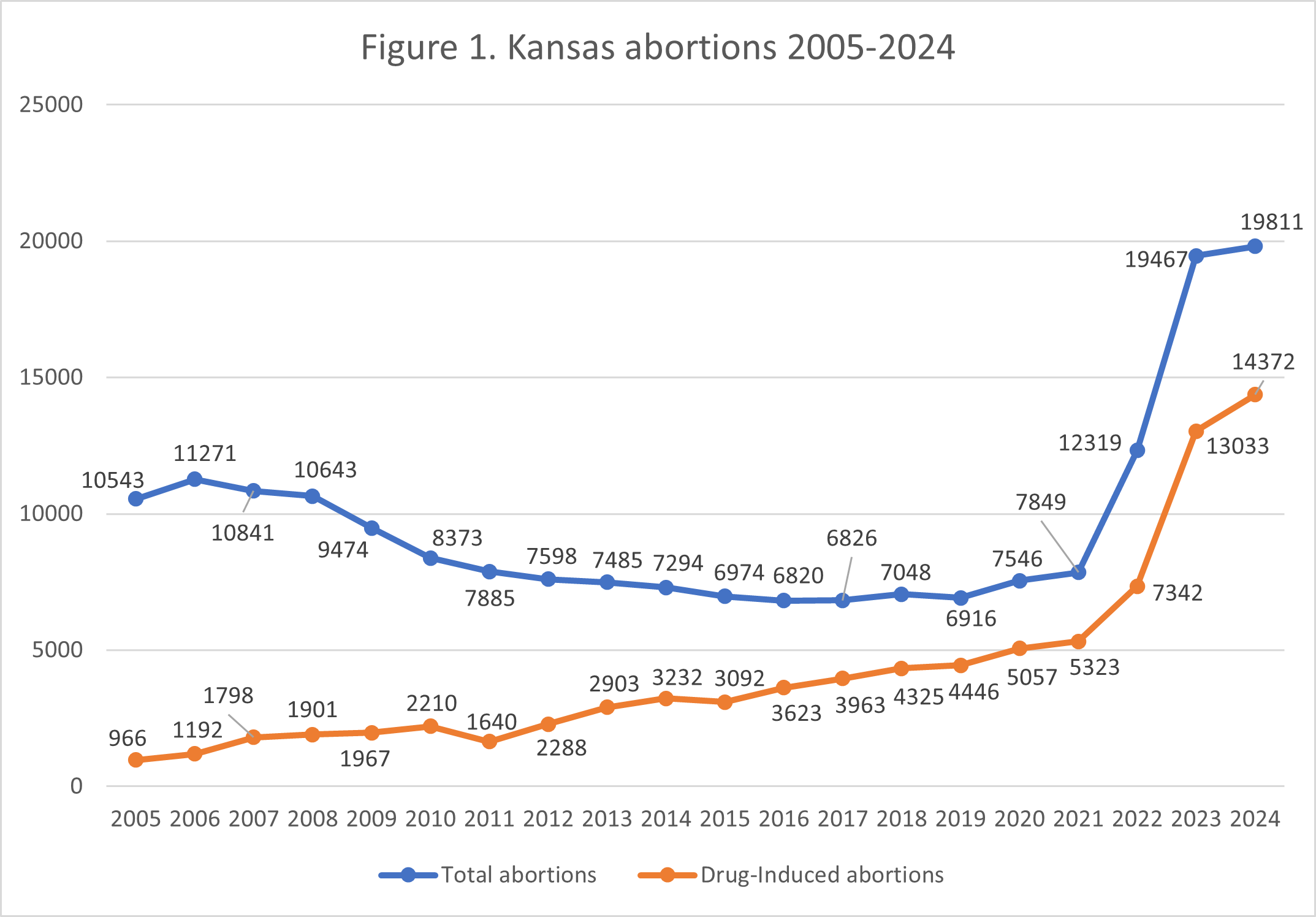
There were 19,811 abortions reported by Kansas in 2024 (19,806 reported in-state occurrences, and five reported out-of-state occurrences), an increase of 2% from 2023 and 61% from 2022. Kansas’ 2024 abortion total was the highest the state ever reported since it started doing so in 1976. Drug-induced abortions increased by 10%, making up a majority (73%) of all Kansas abortions in 2024 (Fig. 1). Kansas’ abortion rate increased by 1%, from 33.8 to 34 abortions per 1,000 women of childbearing age (Fig. 2).1 As of January 2026, 24 states have released 2024 abortion statistics, with seven showing that abortions had increased from the previous year.
State Report Summary
Kansas has consistently reported a large number of abortions obtained by women from other states. In 2024, 76% of Kansas abortions were performed on nonresidents, but nonresident abortions decreased by 63 from 2023. Kansas is the only state in the country, among those that report abortion data, where nonresidents obtain a majority of abortions. Only 24% of Kansas abortions (including five on Kansas women who traveled out of state for their abortions) were performed on Kansas residents.
Nine percent of Kansas abortions were performed on girls under the age of 20. Thirty-one percent were performed on women ages 20 to 24, and 28% were performed on women ages 25 to 29. Twenty-nine percent of Kansas abortions were obtained by women in their thirties (19% on women ages 30 to 34 and 10% on women ages 35 to 39), and 3% on women ages 40 and older. Maternal age was unknown for one abortion.
Thirty-two percent of the abortions were performed on non-Hispanic white women, while 23% were obtained by non-Hispanic black women. Five percent of abortions were obtained by Asian or Pacific Islander women and 2% by Native American women. Five percent were performed on other non-Hispanic women. Thirty-two percent of Kansas abortions were performed on Hispanic women of any race.
Eighty-four percent of Kansas abortions were performed on unmarried women, compared to only 14% on married women. Two percent were performed on women of unknown marital status. Sixty-seven percent (rounded) of the women had been pregnant before: 20% of the abortions were performed on women with one prior pregnancy, and 47% on women with two or more previous pregnancies. Nineteen percent of the abortions were performed on women with one previous abortion, and 10% on women with more than one. Fifteen percent of the abortions were obtained by women who had previously suffered at least one miscarriage, and 56% were performed on women with one or more living children. In contrast, 34% of Kansas abortions were performed on women with no previous pregnancies, 71% on women with no previous abortions, 44% on women with no living children, and 85% on women with no prior miscarriages.
In 2024, 73% of Kansas abortions were drug-induced; all but one of these were induced with mifepristone, while the remaining one was induced using methotrexate. Twenty-four percent of the abortions were conducted via suction curettage, and 2% were dilation and evacuation procedures. There were 84 digoxin induction abortions and 126 sharp curettage abortions, an increase of 120 from 2023, when there were six. There was one hysterotomy abortion and one performed via another method.
Seventy-five percent of Kansas abortions were performed before nine weeks of gestation. Eighteen percent occurred between nine and 12 weeks, 5% were performed between 13 and 16 weeks, and 3% between 17 and 21 weeks. Zero abortions were performed at 22 weeks or later. A possible explanation for the significant increase in abortions occurring before nine weeks of gestation and subsequent decrease in abortions occurring between nine and 12 weeks from 2023 is that the number of drug-induced abortions increased significantly as well during this time. A majority of drug-induced abortions occur during the early stages of pregnancy.
Of the abortions performed in Kansas, sonograms were reported to have been used to determine the gestational age in 60% of cases, while ultrasound was used in 39% of cases. Last menstrual period calculations were used in 2% of the abortions.
Kansas requires medical professionals to file a report when they encounter a patient who is a victim of abuse or neglect. In 2024, 21 abortion reporting forms indicated that a report of abuse or neglect had been filed. In 19,785 cases, no reports were filed, and in one case, it was unknown whether a report had been filed regarding potential abuse or neglect of a patient.
The top five counties of residence in terms of abortion totals for Kansas residents included Sedgwick County (1,228 abortions, 6% of the state’s total), Johnson (1,041, 5%), Wyandotte (662, 3%), Shawnee (286, 1%), and Douglas (230, 1%).
Breakdown of Abortion Providers in Kansas2
| # of brick-and-mortar locations | 7 |
| # of independent centers | 3 |
| # of Planned Parenthood centers | 4 |
| # of hospitals/doctors’ offices that perform abortions | 0 |
| # of abortion drug providers | 7 |
| # of abortion drug-only providers | 2 |
| # of surgical and abortion drug providers | 5 |
| Latest gestational age that a center performs surgical abortion | Through 21 weeks |
Guttmacher Data
In 2024, Guttmacher estimated that 22,610 abortions occurred in Minnesota, while the state reported that 19,806 abortions occurred in the state. Guttmacher also estimated that 15,620 nonresidents traveled to Kansas to obtain an abortion. To see the comparison of totals for nonresident women obtaining abortions in Kansas by state, as reported by Guttmacher and the KDHE, see below.3
| # of Abortions Obtained by Non-Resident Women in KS by State, Reported by Guttmacher | # of Abortions Obtained by Non-Resident Women in KS by State, Reported by the State | |
| Texas | 6,940 | 6,736 |
| Missouri | 3,960 | 3,760 |
| Oklahoma | 3,170 | 3,141 |
| Arkansas | 870 | 851 |
| Louisiana | 200 | 206 |
| Nebraska | 140 | 138 |
| Other States (whose individual counts were under 100 abortions each) | 310 | 216 |
| Non-Resident Total | 15,590 | 15,048 |
While there is a difference in the state’s reported total and Guttmacher’s estimated total for non-resident abortions in Kansas (a difference of 542 abortions), the majority of the discrepancy comes from the reported totals of state resident abortions occurring in the state. Additionally, the number of Kansas women who traveled out of state to obtain an abortion differs greatly between Guttmacher’s estimate (150 Kansas women to Colorado) and the state’s reported total (five women). To see the discrepancy in the various data points reported by Guttmacher and the KDHE and how they contribute to the overall difference in totals as reported by the two entities, see below.

One possible explanation for these differences is that Guttmacher’s estimates include abortions occurring at brick-and-mortar facilities and telehealth abortions, where abortion drugs are mailed to or are picked up by the woman, while the state’s estimates do not. CLI emailed the KDHE to inquire whether telehealth totals are included in Kansas’ abortion totals, and the department informed CLI that they are not.
However, data from the Society of Family Planning (SFP) provides more context. Their #WeCount project estimated that of the 22,780 abortions that occurred in the state in 2024, 20,650 occurred in person at brick-and-mortar facilities, and 2,130 were performed via mail-order abortion drugs. The differences between Guttmacher’s and SFP’s estimated abortion totals and the state’s reported total (a difference of 2,804 and 2,974, respectively) can at least be partially explained by the state’s exclusion of telehealth abortions from their reported total. Because a majority of mail-order abortions are obtained by residents, the difference (2,262) in the state’s reported resident totals versus Guttmacher’s estimated resident total can partially be explained by the state’s exclusion of telehealth totals in its overall reported total.
State Ranking
In 2024, CLI published a paper reevaluating abortion reporting across the country, with Kansas tied for fourth place. Now that babies who have survived abortions have been afforded greater protections under Kansas law, the state could improve its reporting by noting whether any babies are born alive during abortions and, if so, what happens to the babies. Lastly, Kansas could report complications data related to any post-abortion complications that Kansas medical professionals treat.
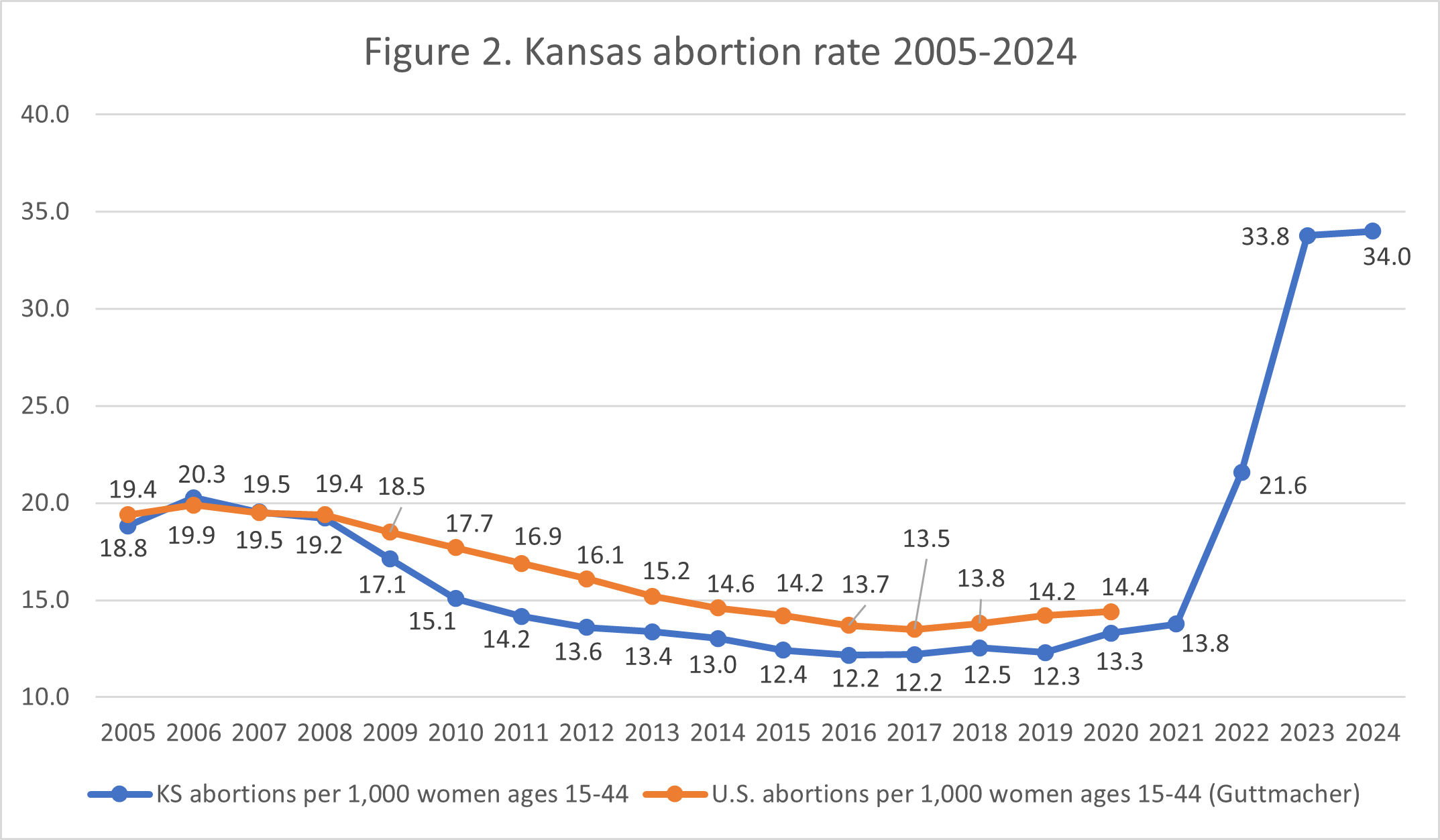
- National rates were calculated by Guttmacher Institute. Kansas rates were calculated by CLI using the following formula: (total number of abortions performed in Kansas ÷ number of resident women ages 15-44 [based on most recent population estimates]) x 1,000. Rates may differ slightly from previous CLI articles due to revised population estimates. Population estimates were obtained using the CDC WONDER database. Estimates for 2005-2009 are intercensal estimates of the July 1 resident population. Estimates for 2010-2019 are Vintage 2020 postcensal estimates of the July 1 resident population. Estimates for 2020-2024 are Vintage 2024 postcensal estimates of the July 1 resident population. Estimates were produced by the U.S. Census Bureau and the National Center for Health Statistics.
- Provider totals do not include hospitals or physician offices not listed in databases that compile abortion provider locations in different states but do include Planned Parenthood locations, independent abortion centers, and hospitals/doctor’s offices included in databases like Abortion Finder and Ineedana. This information is updated as of January 7, 2026.
- The Guttmacher Institute notes that their monthly abortion totals by state are estimates and that each state’s estimate is within a range of uncertainty. Guttmacher also notes that their estimates do not reflect abortions obtained by women in states with total abortion bans under shield laws in effect in pro-abortion states. Guttmacher’s travel and residence data can be found in the CSV folder here (State_Abortion_Travel_2024.csv). This information is updated as of January 7, 2026. One of the reasons the individual state’s totals for nonresident women who obtained abortions in Kansas differ between the state and Guttmacher is that Guttmacher rounds by tens in their estimates.
- #WeCount’s data can be found hereby downloading the “Report data tables [.xlsx]” document. The #WeCount report specifies that the numbers included in their tables for abortions performed under shield laws only represent the number of women to whom abortion drugs were sent, not the number of drug-induced abortions that resulted from the mailed drugs. However, because #WeCount’s data is the only source of data that delineates the number of abortions by mode of provision (in-person, telehealth/mail order, and/or abortion drugs obtained under shield laws), their data is the best available. This information is updated as of January 7, 2026.
Click here to view reporting from:2023202220212020201920182017