















In 2025, five brick-and-mortar abortions were reported in Kentucky by the state’s Cabinet for Health and Family Services. After Roe v. Wade was overturned on June 24, 2022, the state prohibited abortion from conception on the very same day. The law (KRS §311.772) was then blocked on June 30, but went back into effect later that summer on August 1 and has remained in effect since. The state’s life-at-conception law allows abortion in cases where a continued pregnancy would threaten the life and/or physical health of the mother. All five brick-and-mortar abortions reported by the state were performed because of these exceptions. One abortion was performed because the mother’s life was endangered due to liver cirrhosis, and another was performed as a “maternal life sustaining measure” due to PPROM. Two abortions were performed due to cases of previable PPROM, and one other was performed due to a case of PPROM, sepsis, and acute chorioamnionitis.
The data published by the state doesn’t include the total number of abortions obtained by Kentucky residents out of state or the number of self-managed abortions performed by women outside of the healthcare system. The report also does not contain the total number of mail-order abortion drugs obtained by Kentucky residents prescribed by licensed abortionists in other states with shield laws. Below, Charlotte Lozier Institute (CLI) will describe data provided by the Guttmacher Institute’s Monthly Abortion Provision Study that details the total number of Kentucky women who traveled out of state to obtain an abortion in 2025 and the number of Kentucky women who obtained mail-order abortion drugs shipped into the state by out-of-state abortionists. Guttmacher’s abortion estimates include the number of abortions obtained at brick-and-mortar facilities and those provided via telehealth and virtual providers in states where such abortions are still legal. CLI will also describe data from the Society of Family Planning’s #WeCount project that details the number of abortion drugs mailed to Kentucky women.
The state’s statute code defines abortion as “any act with the intent to terminate the clinically diagnosable pregnancy of a woman known to be pregnant with knowledge that the termination by those means will, with reasonable likelihood, cause the death of the unborn child” (KRS §311.720).
Abortion Totals and Trends
There were five abortions reported in Kentucky, a slight decrease from the nine that were reported in the previous year. In 2025, there were three drug-induced abortions (Fig. 1). CLI estimates that Kentucky’s abortion rate was 0.006 abortions per 1,000 women of childbearing age (Fig. 2).1
State Report Summary
In 2025, all five abortions were performed on state residents. One abortion was performed on a woman between the ages of 20 and 24, and another on a woman between the ages of 25 and 29. Zero abortions were performed on a minor. Three abortions were obtained by women in their thirties. The age of the father was known in the case of one abortion. The father was between the ages of 25 and 29.
Two abortions were performed on white women, and another two were performed on black women. One abortion was performed on a woman of another race. Two abortions were obtained by Hispanic women, while three were obtained by non-Hispanic women.
Three of the abortions reported in Kentucky were obtained by women with no previous live births, and two were obtained by women with two or more previous live births. All five abortions were obtained by women who had never had a previous abortion. Two women who obtained abortions had never been pregnant before, while three had had two or more previous pregnancies.
Three of the abortions reported in Kentucky were drug-induced, and two were performed via a dilation and evacuation procedure.
One abortion was performed between 13 and 15 weeks of gestation, and two were performed between 16 and 19 weeks. One abortion was obtained at 20 weeks and one other at 21 weeks, which was the latest gestational age at which a woman obtained an abortion in Kentucky in 2025. Ultrasound alone was used in four cases to confirm the gestational ages of the unborn babies killed by abortion, and last menstrual period was used for one case.
Kentucky also collects data on abortions by post-fertilization age (PFA), which is around two weeks earlier than the unborn babies’ gestational age. Two abortions were performed between 13 and 14 weeks post-fertilization. One abortion was performed on a woman between 15 and 17 weeks post-fertilization, and another between 18 and 19 weeks. While the report claims one abortion was obtained at 21 weeks post-fertilization, that number seems to be incorrect as it not possible that an abortion be performed at both 21 weeks of gestation and 21 weeks post-fertilization. Gestational age is around two weeks higher than post-fertilization age, so either the gestational age or PFA is incorrect in Kentucky’s report. Ultrasound alone was used to confirm the post-fertilization age of all five unborn babies. A pathological examination was performed in one case and not performed in three cases. In one case, it was unknown whether a pathological examination was performed.
Due to Kentucky’s law prohibiting elective abortions, no abortions were performed at Planned Parenthood locations in Kentucky or independent abortion centers. All five abortions were performed at hospitals. Three abortions were performed at the University of Louisville Hospital, one at Norton Hospital, and one at Norton Women’s and Children’s Hospital.
In 2025, there was one reported complication: a case of incomplete abortion or retained tissue/retained placenta requiring dilation and curettage.2 All five abortions were performed on mothers with preexisting medical conditions. Women were not tested for an STD before any of the five abortions. In two cases, women with Rh-negative status were not “provided with an Rh-negative information fact sheet and treated with the prevailing medical standard of care to prevent harmful fetal or child outcomes or Rh incompatibility in future pregnancies.” The three other cases of abortion were not applicable to this question, presumably because the women did not have Rh-negative status.
The heartbeat of all five unborn children aborted in Kentucky in 2025 was detected. Standard ultrasound was used to detect the heartbeat in four cases and doppler ultrasound was used in one case. The unborn child was not viable in any of the five cases. In 2025, there were no babies born alive following an attempted abortion.
One abortion was obtained in January, one in March, and three in September.
Guttmacher Data3
In 2025, Guttmacher estimated that 3,780 women traveled out of Kentucky to obtain abortions. For the number of abortions obtained by Kentucky women in other states, according to Guttmacher, see the following table:
| States Traveled to by Kentucky Women | # of Abortions Obtained by Kentucky Women Who Traveled to Other States to Get Abortions, 2025 |
| Illinois | 1,450 |
| Ohio | 2,170 |
| Unknown | 160 |
| Total | 3,780 |
Guttmacher estimated that 3,400 Kentucky women were mailed abortion drugs by out-of-state abortionists via shield laws, while #WeCount reported that abortion drugs were mailed to 3,800 Kentucky women.4 While the state reported that five abortions occurred at brick-and-mortar hospitals within state lines, these other sources of data provide a more complete picture of abortion totals in the state.
In January 2026, the Kentucky Attorney General (AG), Russell Coleman, initiated an investigation of the New York nonprofit Mayday Health after the AG’s office learned about Mayday placing gas station placards at Kentucky gas stations advertising where Kentucky women could get abortion pills out of state. On September 3, 2026, Coleman filed a civil lawsuit in a Circuit Court against Mayday Health. The lawsuit alleges Mayday Health is breaking Kentucky abortion laws (KRS 311.7733 and KRS 311.728) via its gas station placard advertisements, as well as when they attached an advertisement banner to a plane that flew over the Kentucky State Fair in August 2026. The case remains in litigation.
State Ranking
In CLI’s 2024 reevaluation of abortion reporting requirements across the country, Kentucky’s reporting was tied for fourth best. The state has vastly improved its reporting since 2016, adding several important categories of data, starting with its 2023 abortion report. However, the completeness of Kentucky’s data could be improved by adding back data points on abortions by marital status, education status, whether the unborn baby was given the best chance at survival during the abortion, and the breakdown of abortions by previous miscarriages. Kentucky could also require health care providers, including emergency room providers, to report abortion complications they treat.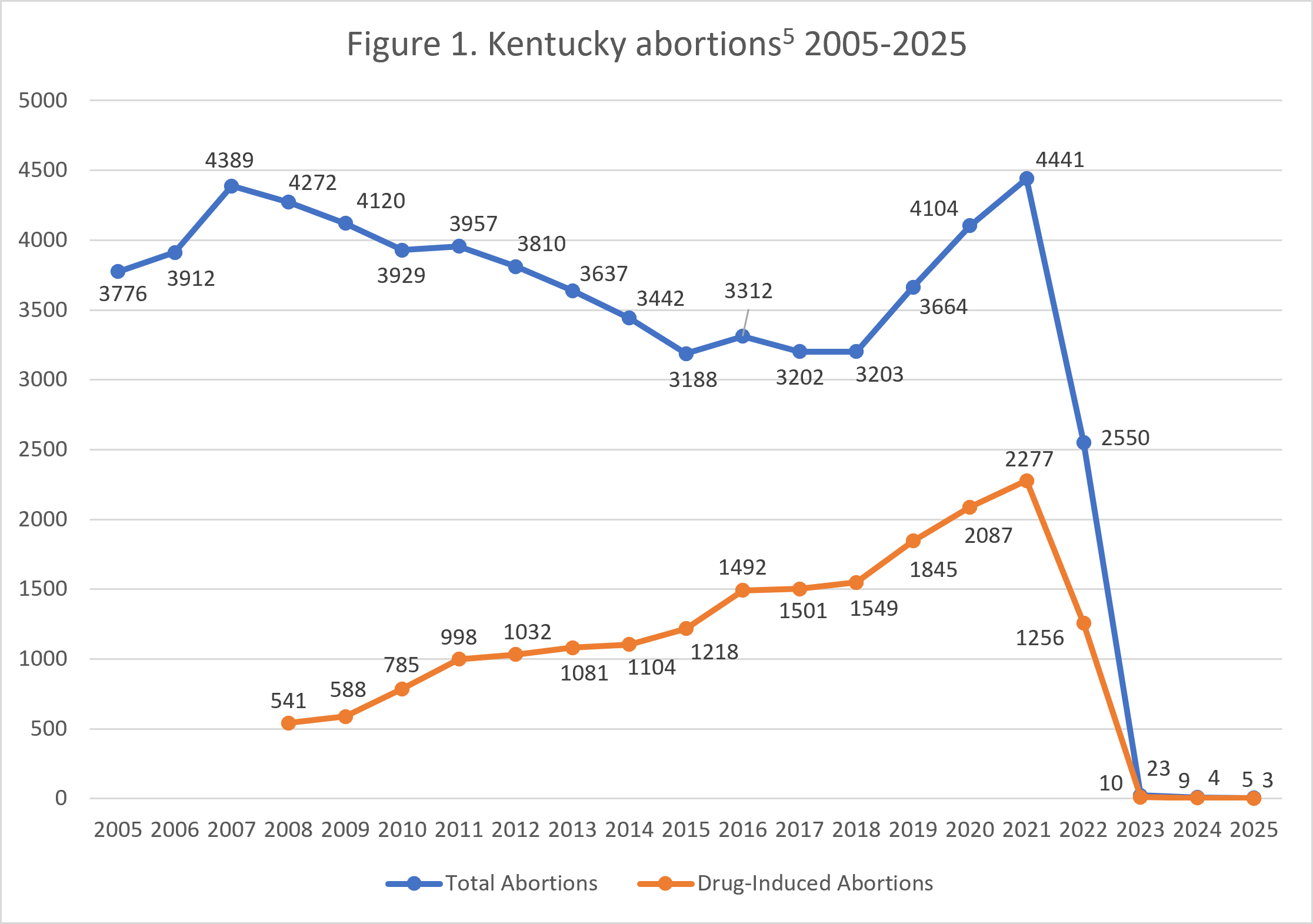
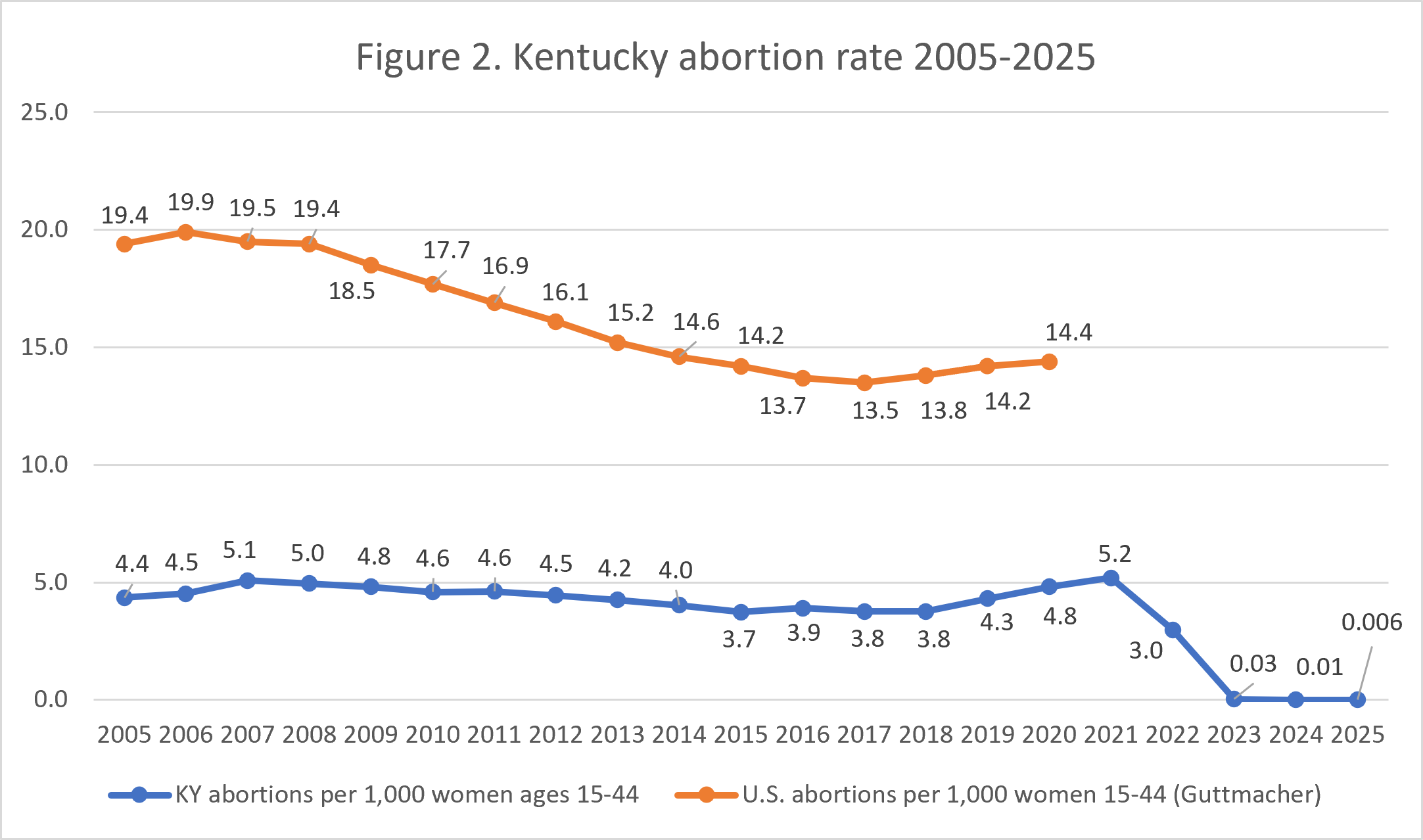
- National rates were calculated by the Guttmacher Institute. Kentucky rates were calculated by CLI using the following formula: (total number of abortions performed in Kentucky ÷ number of resident women ages 15-44 [based on most recent population estimates]) x 1,000. Rates may differ slightly from previous CLI articles due to revised population estimates. Population estimates were obtained from the CDC WONDER database. Estimates for 2005-2009 are intercensal estimates of the July 1 resident population. Estimates for 2010-2019 are Vintage 2020 postcensal estimates of the July 1 resident population. Estimates for 2020-2025 are Vintage 2024 postcensal estimates of the July 1 resident population. Estimates were produced by the U.S. Census Bureau and the National Center for Health Statistics. Rates for 2025 were calculated using the Vintage 2024 postcensal estimates because 2025 population estimates have not yet been released by the CDC.
- Statistics on abortion complications reported here represent a minimal number of deaths and complications, as this data is collected in a non-systematic and non-verifiable way. As such, this data cannot be used to calculate either an accurate abortion mortality rate or an accurate abortion complication rate for the state.
- The Guttmacher Institute notes that its monthly abortion totals by states are estimates and that each state’s estimate is within a range of uncertainty. This information is updated as of October 5, 2026. Guttmacher’s travel and residence data can be foundhere (State_Abortion_Travel_2023_2024_2025.csv).
- #WeCount’s data can be foundhere by downloading the “Report data tables [.xlsx]” document. The #WeCount report specifies that the numbers included in their tables for abortions performed under shield laws only represent the number of women whom abortion drugs were sent to, not the number of drug-induced abortions that were a result of the mailed drugs. However, because #WeCount’s data is the only source of data that delineates the number of abortions by mode of provision (in-person, telehealth/mail-order, and/or abortion drugs obtained under shield laws), their data is the best available.
- Kentucky published reports for 2017 through 2025 online and provided CLI with reports for 2015 through 2018. Abortion totals for 2005 through 2014 were taken from the annual abortion surveillance reports published by the CDC. Kentucky first reported drug-induced abortion data to the CDC in 2008.
Click here to view reporting from:20242023202220212020201920182017