












Massachusetts’ 2024 abortion statistics were published in December 2025 by the Massachusetts Department of Public Health (MDPH). Reported abortions in Massachusetts more than doubled from 2023 to 2024.
This data does not include the total number of abortions obtained by Massachusetts residents out of state or the number of self-managed abortions performed on women outside of the formal healthcare system. In a separate section, CLI will describe data provided by the Guttmacher Institute’s Monthly Abortion Provision Study that details the number of women who traveled to Massachusetts to obtain abortions and their states of residence, as well as the number of abortions obtained by Massachusetts women in other states. Guttmacher’s abortion estimates include the number of abortions obtained at brick-and-mortar facilities and those provided via telehealth and virtual providers in the United States.
Massachusetts’ statute code defines abortion as “any medical treatment intended to induce the termination of, or to terminate, a clinically diagnosable pregnancy except for the purpose of producing a live birth” (Mass. General Laws c. 112 §12K). In Massachusetts, abortion is widely available throughout pregnancy because of the state’s ineffective gestational limit at 24 weeks. While the language of the law limits abortion at or after 24 weeks of gestation, the law contains a broad health (life and physical/mental health of the mother) exception that doesn’t differentiate between physical and mental health, which, in turn, allows abortion throughout pregnancy for nearly any reason. In addition, Massachusetts’ law contains an exception for what the state categorizes as a “lethal fetal anomaly” (Mass. General Laws c. 112 §12M–N).
Statistics and Changes in Massachusetts Abortions, 2023-2024

Abortion Totals and Trends
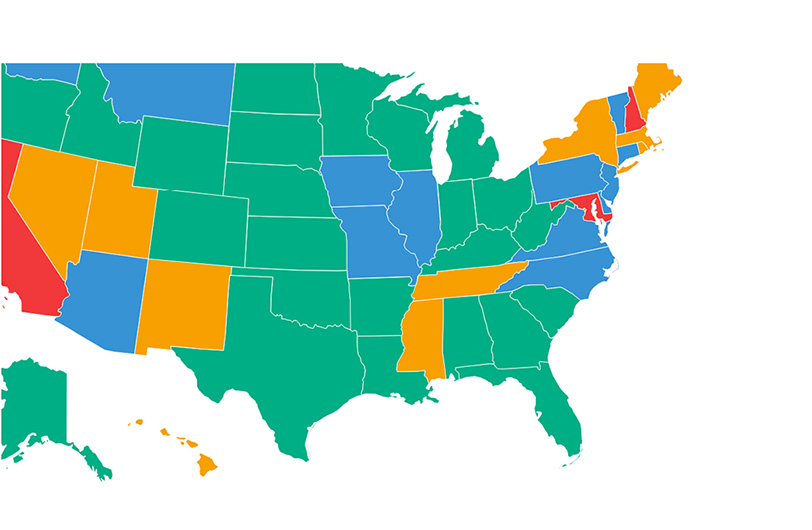
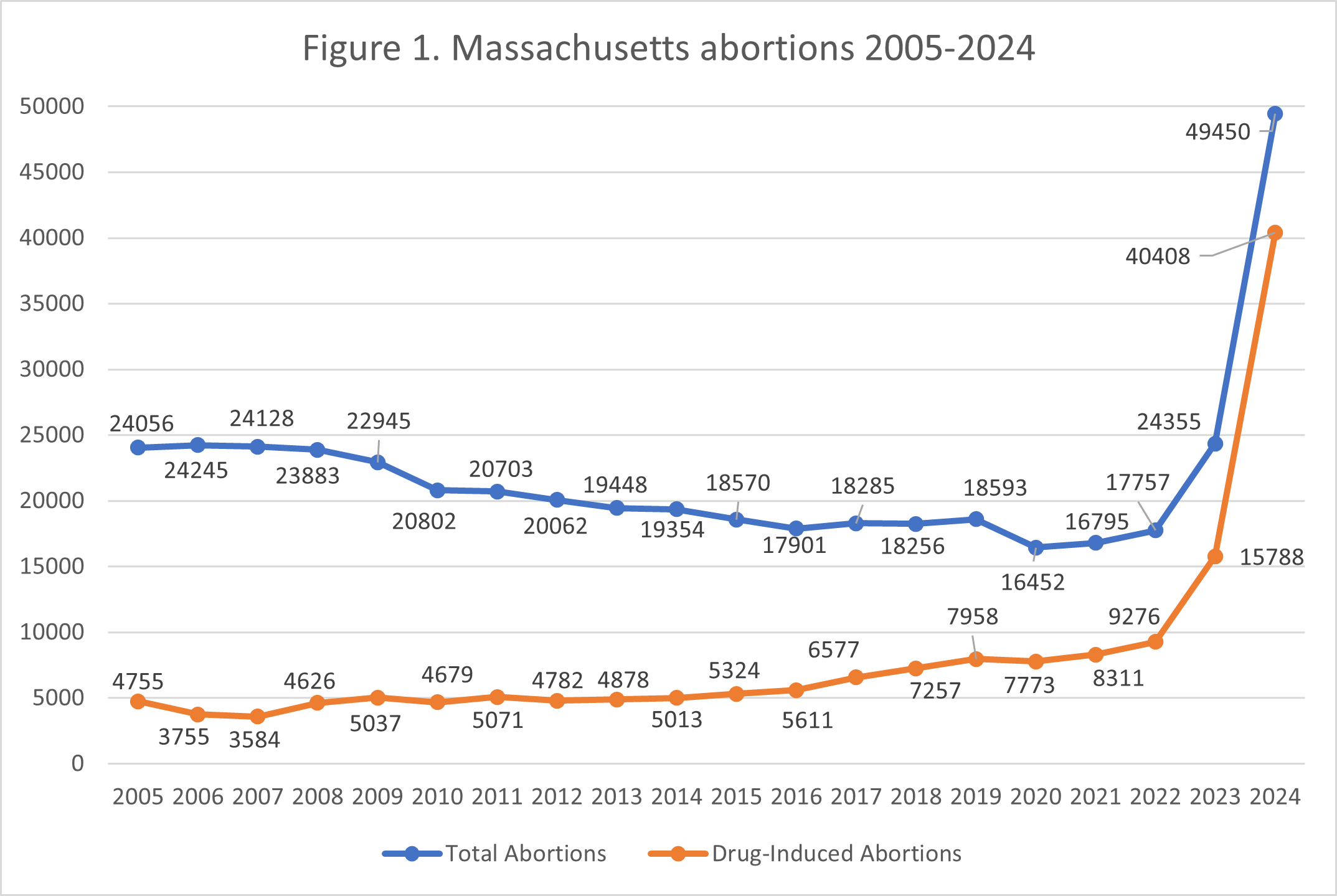
In 2024, there were 49,450 abortions reported in Massachusetts, an increase of 103% from 2023, when there were 24,355 reported. Drug-induced abortions composed 82% of the total, increasing from 15,788 in 2023 to 40,408 in 2024 (up 156%) (Fig. 1). CLI estimates that Massachusetts’ 2024 abortion rate was 33.9 abortions per 1,000 women ages 15 to 44, 100% higher than the 2023 abortion rate of 16.9 (Fig. 2). 1 As of June 2026, 30 states had released abortion statistics for 2024, with nine reporting that abortions had increased.
State Report Summary
The MDPH excluded several categories of data that they had incorporated in previous abortion reports, including the number of abortions by the mother’s level of education, state of residence, previous pregnancy history, marital history, race, ethnicity, and Executive Office of Health and Human Services (EOHHS) region by residency. Furthermore, the state’s 2024 abortion report does not break down the number of abortions by specific telehealth abortion organizations.
In 2024, unlike in years past, a majority of the abortions performed in Massachusetts (56%) were performed on nonresidents. The number of abortions performed on nonresidents in Massachusetts increased by 355%, from 6,112 in 2023 to 27,836 in 2024. Forty-three percent of abortions performed in Massachusetts were performed on residents, while less than one percent were performed on women of unknown residence status. The number of abortions performed on residents decreased by 19% from 2023 to 2024. Unlike in years past, Massachusetts’ 2024 abortion report did not break down abortions by regions of residence or specific states. The report did not cross-tabulate abortions by residence and method of termination. Hence, it is unclear from the report whether the astronomical increase in nonresident abortions was due to an increase in abortions performed via telehealth or were performed on women who traveled to Massachusetts to have an in-person drug-induced or surgical abortion. However, because Massachusetts has a shield law enacted that allows for Massachusetts’ abortion providers to send abortion drugs into pro-life states via telehealth, and the fact that telehealth abortions and nonresident abortions increased from 2023 to 2024 by similar amounts (an increase of 25,158 for telehealth abortions and an increase of 21,724 nonresident abortions), it is safe to assume that a majority of the increase in nonresident abortions was due to the widespread availability and utilization of Massachusetts’ telehealth shield law.
Nine percent of the abortions were performed on girls ages 19 or younger. A quarter of abortions were performed on women ages 20 to 24, and 27% on women ages 25 to 29. Thirty-four percent of the abortions in Massachusetts were performed on women in their thirties, and 5% were performed on women ages 40 or above.
Drug-induced abortions made up 82% of the total in 2024, compared to 65% in 2023. For the second year in a row, Massachusetts’ abortion report broke down the number of drug-induced abortions provided in person (9,402) and via telehealth (31,006). The number of drug-induced abortions performed via telehealth increased by 365% from 2023 to 2024. Thirteen percent of the abortions performed in Massachusetts were dilation and evacuation abortions, and 5% were performed via suction curettage procedures. The percentage of Massachusetts abortions performed via dilation and evacuation procedures in 2023 (26%) decreased to 13% in 2024, even though the total number of dilation and evacuation abortions increased. The same trend occurred for suction curettage abortions: in 2023, suction curettage abortions composed 8% of the state’s abortion total. In 2024, that figure was 5%, even though the total number of suction curettage abortions performed in Massachusetts increased from 2023 to 2024. Under one percent of abortions were performed using sharp curettage procedures (0.3%), and 21 abortions were labor induction abortions. Nineteen abortions were performed via some other means.
Massachusetts changed the way they categorize abortions by gestational age in their 2024 abortion report by making the time periods more broad. In 2024, 97% of abortions in the state were performed before 13 weeks of gestation. Two percent occurred between 13 and 16 weeks of gestation, while 0.7% were performed between 17 and 20 weeks of gestation. Under one percent (0.5%) were performed between 21 and 23 weeks, while 99 abortions were performed at 24 weeks of gestation or later.
The 2024 report is the second where the MDPH included the number of abortions by the methods of payment that women used to pay for their abortions as well as a breakdown of the number of women who used abortion funds to help pay for a portion or the entirety of their abortion. The state defines abortion funds as money given to women from nonprofit organizations to pay for their abortion. Eleven percent of women used private insurance to pay for their abortion while 17% used public insurance including MassHealth plans or other state-subsidized coverage plans. Sixty-six percent of women paid for their abortion out of pocket and the payment was not known for 5% of abortions. Twenty-six percent of women who obtained abortions in Massachusetts in 2024 used abortion funds while 65% did not. It is not known for 9% of women if they used abortion funds.
Abortions by Facility
Unlike in years past, a majority of the abortions performed in Massachusetts in 2024 (62%) were performed via telehealth. Twenty-nine percent of abortions were performed in abortion centers, compared to 58% in 2023. Despite the percentage of total abortions performed in abortion centers decreasing significantly from 2023 to 2024, the raw number of abortions performed in abortion centers actually increased by 368. In 2024, 36 abortions were reported to have been performed in university clinics.
Planned Parenthood’s four abortion centers accounted for 17% of all abortions reported in Massachusetts and 58% of the abortions performed in abortion centers. Of the 42 brick-and-mortar locations that performed abortions in Massachusetts in 2024, Planned Parenthood’s Greater Boston Health Center performed the most abortions (4,614), accounting for 9% of the state’s total. Twenty-eight percent of the state’s abortions performed at brick-and-mortar facilities were performed at either a Planned Parenthood location, one of the state’s three Health Quarters locations, the Four Women abortion center, or the Women’s Health Services abortion center.
Hospitals accounted for 8% of the state’s total abortions performed, while individual physicians or physician groups performed 111 abortions in Massachusetts in 2024. Boston Medical Center performed the most abortions of any hospital in the state (1,137), with Brigham and Women’s Hospital and Beth Israel Deaconess Medical Center performing the second and third most, respectively.
Guttmacher Data
In 2024, Guttmacher estimated that 22,120 abortions occurred in Massachusetts, while the state reported 49,450. It seldom happens that the state reports significantly more abortions than Guttmacher estimates, and the state never answered CLI’s email request for an explanation of the discrepancy. Guttmacher also estimated that of the 22,120 abortions performed in the state, 1,050 were obtained by nonresidents who traveled to Massachusetts to obtain an abortion, while the state reported 27,836. However, the state did not specify the states from which women traveled. To see the number of abortions obtained in Massachusetts by women from various states, according to Guttmacher, see below.2
| States of Residence for Women Who Traveled to Massachusetts | # of Abortions Obtained by Non-Resident Women in Massachusetts, 2024 |
| New Hampshire | 180 |
| Rhode Island | 400 |
| Unknown | 470 |
| Total | 1,050 |
Additionally, Guttmacher estimated that 760 Massachusetts residents traveled out of state to obtain an abortion. The breakdown of where those women traveled to is as follows:
- 240 to Connecticut
- 260 to New Hampshire
- 260 to Rhode Island
As mentioned previously, there is a significant discrepancy in total abortions reported by the state and total abortions estimated by Guttmacher. To see the discrepancies broken down in a tabular manner, see below.2

Additionally, the Society of Family Planning’s (SFP) #WeCount report estimated that 22,990 abortions occurred in Massachusetts in 2024. The report estimated that 18,590 abortions occurred at brick-and-mortar facilities, which is similar to the 18,548 figure reported by the state. However, the discrepancy in the total reported by the state and estimated by SFP lies in their respective telehealth totals. SFP estimated that 4,400 telehealth abortions occurred in the state in 2024 (3,710 through virtual-only organizations and 690 through hybrid brick-and-mortar facilities). By contrast, the state reported a telehealth total of 30,902.3
State Ranking
In 2024, CLI published a paper reevaluating abortion reporting across the country, with Massachusetts tying for 23rd place. However, that paper was published before Massachusetts released its improved 2023 report and subsequent incomplete 2024 report. While the 2023 report included several new data categories in addition to the state’s typical demographic data, the 2024 report dropped those new categories as well as several demographic data categories mentioned at the beginning of this report. Massachusetts could improve its reporting by re-including all the data categories it dropped in 2024 and including information on complications caused by abortion.
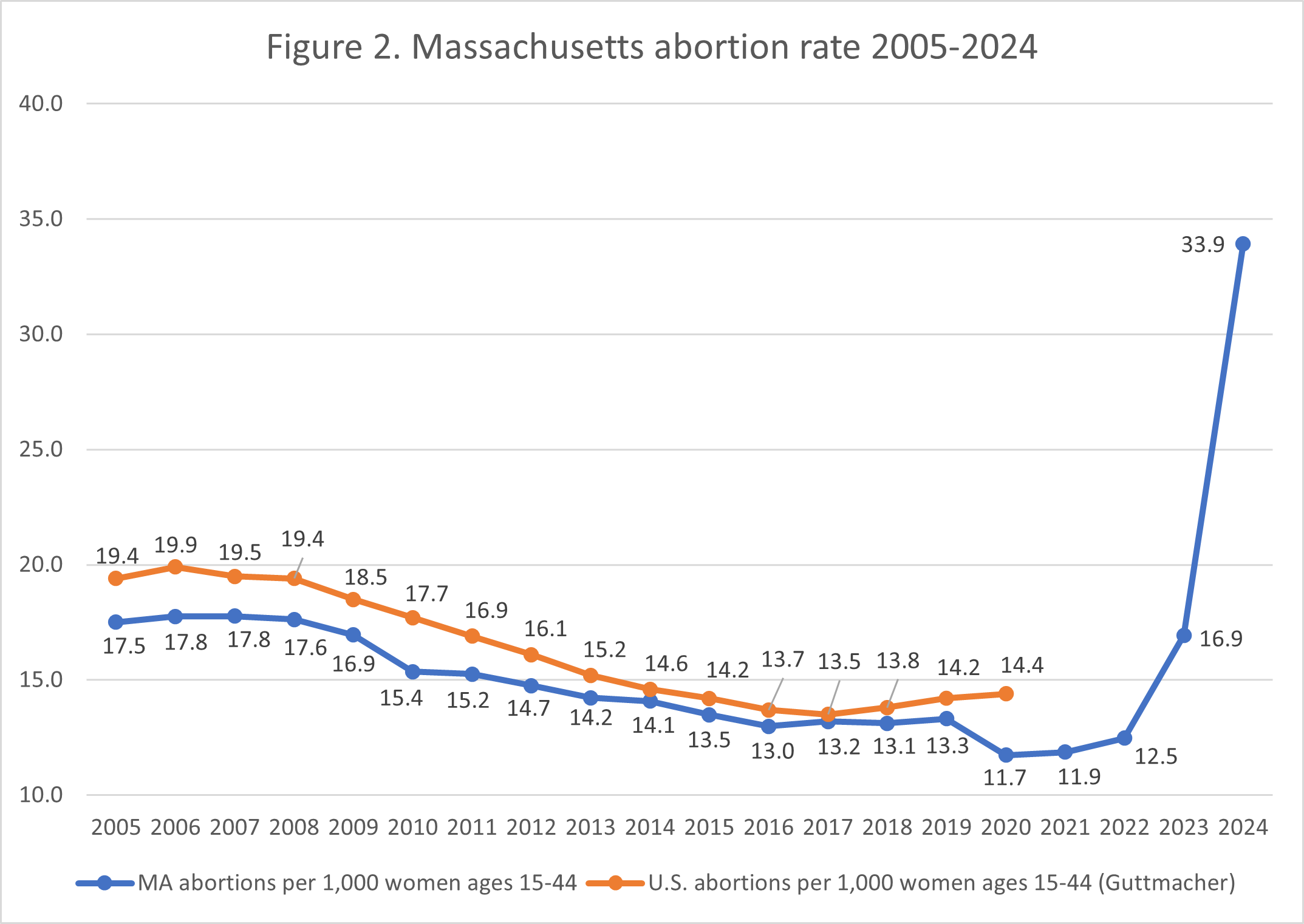
- National rates were calculated by Guttmacher Institute. Massachusetts rates were calculated by CLI using the following formula: (total number of abortions performed in Massachusetts ÷ number of resident women ages 15-44 [based on most recent population estimates]) x 1,000. Rates may differ slightly from previous CLI articles due to revised population estimates. Population estimates were obtained using the CDC WONDER database. Estimates for 2005-2009 are intercensal estimates of the July 1 resident population. Estimates for 2010-2019 are Vintage 2020 postcensal estimates of the July 1 resident population. Estimates for 2020-2024 are Vintage 2024 postcensal estimates of the July 1 resident population. Estimates were produced by the U.S. Census Bureau and the National Center for Health Statistics.
- The Guttmacher Institute notes that their monthly abortion totals by state are estimates and that each state’s estimate is within a range of uncertainty. Guttmacher’s travel and residence data can be found in the CSV folder here (State_Abortion_Travel_2023_2024.csv). This information is updated as of June 1, 2026.
- #WeCount’s data can be found here by downloading the “Report data tables [.xlsx]” document. The #WeCount report specifies that the numbers included in their tables for abortions performed under shield laws only represent the number of women to whom abortion drugs were sent, not the number of drug-induced abortions that resulted from the mailed drugs. However, because #WeCount’s data is the only source of data that delineates the number of abortions by mode of provision (in-person, telehealth/mail order, and/or abortion drugs obtained under shield laws), their data is the best available. This information is updated as of June 1, 2026.