













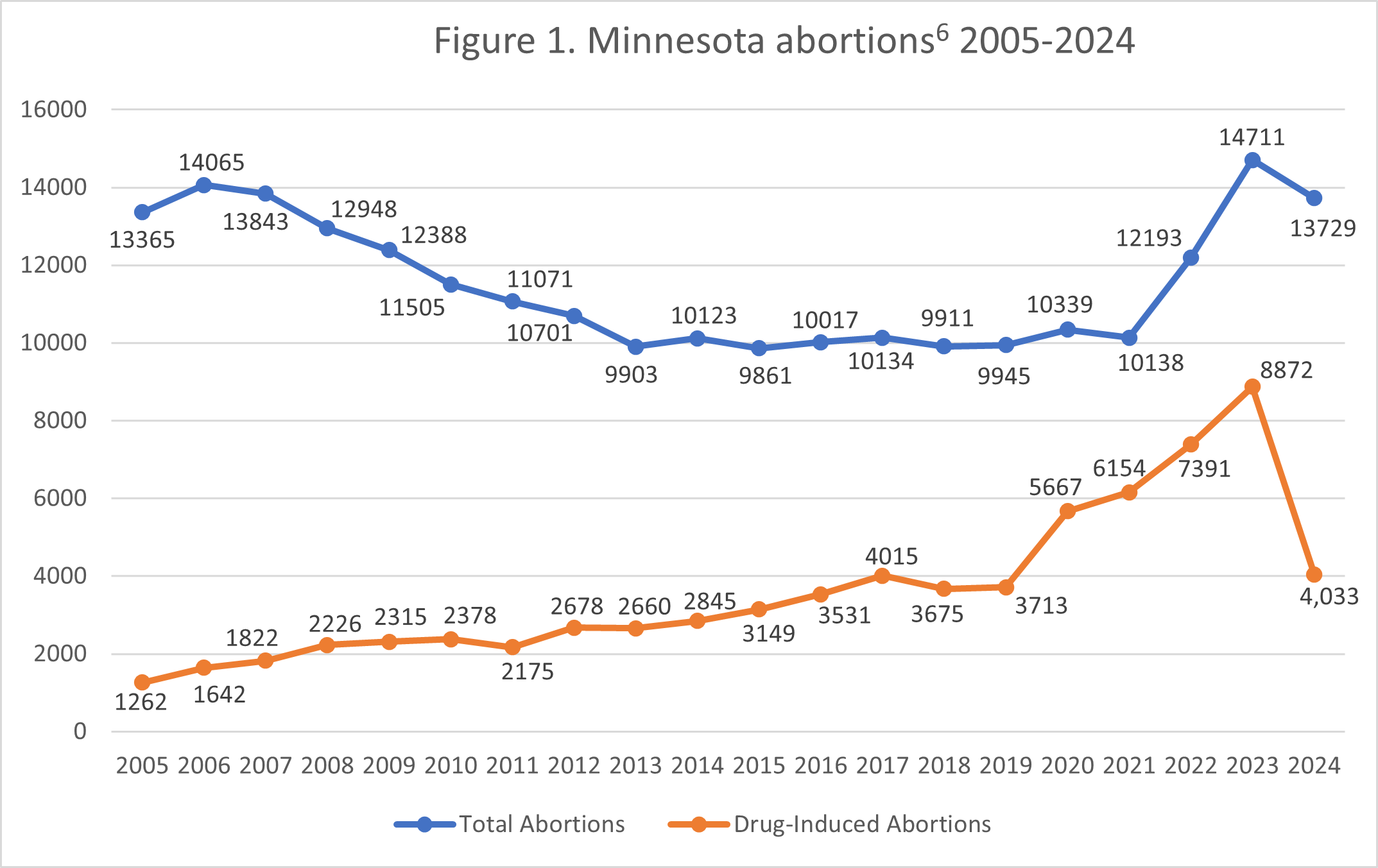
Minnesota’s original version of its 2024 abortion report was published online by the Minnesota Department of Health (DOH) on December 31, 2025. However, an updated version was uploaded on January 2, 2026, “to correct an overcount of 2,586 duplicated records submitted into the Minnesota Registration and Certification (MR&C) System.” The original version reported that 16,315 abortions occurred in the state. However, the original 2024 report was removed from the DOH website. Additionally, Minnesota’s 2024 report included revised estimates for several 2023 data categories. These updated totals are reflected in Figures 1 and 2 in this report. A majority of the information in this summary will summarize the data provided in the state’s updated 2024 abortion report from January 2, 2026.
As a result of legislative changes made in 2023 (S.F. 2995), Minnesota’s public abortion report no longer includes information on the reasons for abortion, postoperative complications, how abortions were paid for, and the number of born-alive infants, as well as whether any subsequent medical action was provided to born-alive infants. S.F. 2995 claimed that the state would no longer be required to report the number of abortions by the number of previous live births, abortions, and miscarriages, but the state’s 2023 report noted that, in the interest of public health, that information would still be included in the state’s annual reports. However, the 2024 abortion report noted that, in alignment with 2025 guidance from the CDC, which reportedly paused national abortion surveillance reporting as of July 2025, the DOH didn’t include tables showing the number of abortions by the number of previous live births, abortions, and miscarriages.
It is important to note that there are significant questions associated with the data presented in Minnesota’s 2024 abortion report. For example, the number of abortions by a race and education level was not reported for 66% of abortions by each demographic category, while the number of abortions by marital status was not reported for 61% of abortions occurring in the state. Because of the incompleteness of such data points, they will not be included in this summary.
Furthermore, the data published by Minnesota does not include the number of abortions obtained by Minnesota residents out of state or the number of self-managed abortions on women outside of the healthcare system. The report also does not contain the total number of mail-order abortion drugs obtained by Minnesota residents prescribed by licensed providers in Minnesota or in other states. In a separate section, Charlotte Lozier Institute (CLI) will describe data provided by the Guttmacher Institute’s Monthly Abortion Provision Study that details the number of abortions occurring in the state in 2024 as estimated by Guttmacher’s sample survey and mathematical models. Guttmacher’s abortion estimates include the number of abortions obtained at brick-and-mortar facilities and those provided via telehealth and virtual providers in the United States.
Minnesota’s statute code defines abortion as “an act, procedure or use of any instrument, medicine or drug which is supplied or prescribed for or administered to an individual with the intention of terminating, and which results in the termination of, pregnancy” (Minn. §145.411). Abortion is available in Minnesota throughout all nine months of pregnancy.
Abortion Totals and Trends
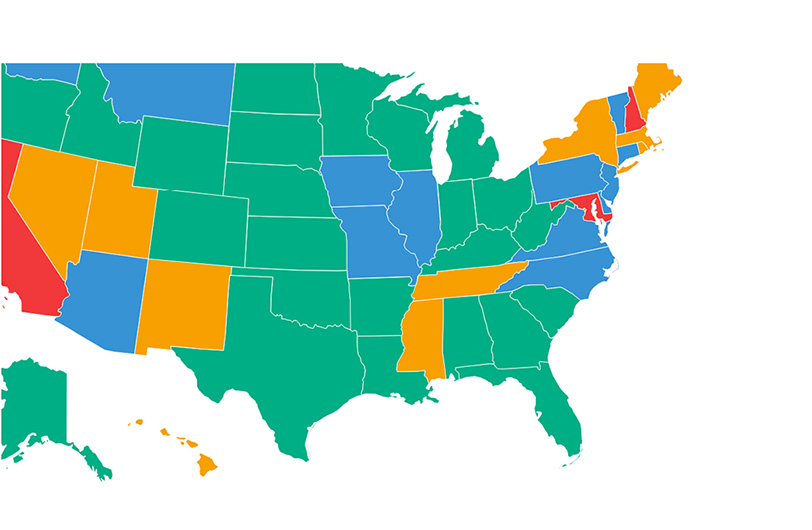
In 2024, there were 13,729 abortions reported in Minnesota, a decrease of 7% from 2023 when there were 14,711 abortions, according to the revised 2023 figures included in the 2024 report (Fig. 1). CLI estimates that Minnesota’s reported abortion rate decreased by 8% from 2023 to 12.2 abortions per 1,000 women ages 15 to 44 (Fig. 2).1 As of January 2026, 24 states have released 2024 abortion statistics, with 10 states indicating that abortions had decreased from the prior year.
State Report Summary
Eighty percent of Minnesota abortions reported in 2024 were carried out on state residents, while 20% were performed on women from other states, a reported decrease of 12% from 2023. Ninety-three percent of the nonresident abortions in Minnesota were obtained by residents of states bordering Minnesota, including Iowa, Michigan, North Dakota, South Dakota, and Wisconsin, with North Dakota residents obtaining the highest number of abortions (898) in Minnesota besides Minnesota residents.
A majority of Minnesota abortions were performed on women in their twenties, with 26% performed on women ages 20 to 24 and 27% on women ages 25 to 29. Thirty-five percent were obtained by women in their thirties. Seven percent were performed on girls under the age of 20, including 2% on girls under the age of 18. Five percent were performed on women over the age of 40. The age of the woman was not reported for 28 abortions.
Eighty-nine percent of the abortions were performed on non-Hispanic women, and 5% were performed on Hispanic women. Ethnicity was not reported for 6% of reported abortions in Minnesota.
Another data point that seems to have significant accuracy issues is the number of abortions by procedure type. Minnesota’s 2024 abortion report claims that 29% of abortions were drug-induced. Most of the drug-induced abortions were induced using mifepristone (29% of all abortions reported in Minnesota, while 0.3% were induced using misoprostol as the principal drug). There were 5,190 “other” drug-induced abortions, a category that includes late-term induction abortions. However, in 2023, revised totals show that 60% of all abortions reported in Minnesota were induced via mifepristone, and 4% (540 abortions) were induced using “other,” drug-induced means, including induction abortions. CLI emailed the DOH to explain the sudden and large shift in the methods of abortion provision. The Department emailed back, noting that they believed the significant change was the result of a “change in a reporting procedure from one provider who is now selecting ‘other medication’ to account for multiple medications potentially provided rather than a single primary medication.” Given this change, it appears that a majority of Minnesota’s drug-induced abortions are being performed via mifepristone or a combination of multiple drugs, but because of the lack of specificity regarding what “other medication” means, CLI will continue to exclude the “Medical: Other medication (includes labor induction)” category from its drug-induced abortion total in Figure 1.
Twenty-five percent of Minnesota’s reported abortions in 2024 were dilation and curettage abortions, while 8% were dilation and evacuation procedures. There were seven intra-uterine instillation abortions, two surgical abortions using other, unknown means, and one hysterectomy/hysterotomy abortion. Four abortions were performed via an unknown method.
Sixty-seven percent of the abortions took place earlier than nine weeks of gestation. Twelve percent were performed between nine and 10 weeks, and 4% occurred between 11 and 12 weeks. Five percent were performed between 13 and 15 weeks, and 3% between 16 and 20 weeks of gestation. There were 241 abortions (2%) between 21 and 24 weeks, one abortion between 25 and 30 weeks of gestation, and one abortion between 31 and 36 weeks. No abortions were performed at 37 weeks of gestation or later. For context, there were 282 abortions between 21 and 24 weeks in 2023, four abortions between 25 and 30 weeks, and zero abortions performed at 31 weeks or later. In 2024, 85% percent of abortions occurred in the first trimester, 8% in the second trimester, and two abortions occurred in the third trimester. The trimester was unknown for 7% of abortions.
In 2024, there were 25 intraoperative complications, or complications identified at the time of the abortion procedure and reported on the abortion reporting form. 2 Multiple complications could be reported for a single abortion. There were nine cases of heavy bleeding or hemorrhage, eight cases of cervical laceration, two cases of uterine perforation, and six cases of other, unknown complications.
Minnesota requires abortion providers to report the methods used to dispose of the bodies of unborn babies killed by abortion. In 2024, 27% were cremated, and 0.3% (44 abortions) were buried. Seventy-three percent had not reached the stage of development to be legally required to be reported as fetal remains.
A majority of abortions (59%) were performed in Planned Parenthood’s Minnesota centers. Thirteen percent were reported (in Table 1.1) by Whole Women’s Health, 9% by Red River Women’s Clinic, and 4% by Women’s Health Center (WE Health Center). Four percent were reported by hospitals, doctors’ offices, and small clinics. Telehealth providers Carafem and Just the Pill each performed 6% of the abortions that occurred in the state in 2024. A separate table within the report (Table 3) noted that 87% (11,889) of Minnesota abortions occurred in clinics and 1% occurred in hospitals (138 abortions as outpatient procedures and 21 on an inpatient basis). Two abortions were performed in ambulatory surgery centers. Thirty-eight abortions were performed in a doctor’s office, and 12% were performed via telehealth. The number of abortions performed in clinics differed between Table 1.1 (11,594 abortions performed in clinics) and Table 3 (11,889 abortions performed in clinics), further highlighting the data issues within Minnesota’s report.
In Minnesota, doctors, nurse practitioners, physician assistants, and nurse midwives can perform abortions. A majority of Minnesota abortions (44%) were performed by abortionists specializing in obstetrics and gynecology, while 33% were performed by general/family practice providers. Three abortions were performed by those specializing in emergency medicine, while 23% were performed by those whose medical specialty was unknown.
Two hundred and thirty-three providers performed abortions in Minnesota in 2024. One hundred and ninety-six of the providers performed fewer than 100 abortions each. Thirty-one providers performed between 100 and 499 abortions, three providers performed between 500 and 999 abortions, and another three providers performed between 1,000 and 1,499 abortions. Zero providers provided 1,500 or more abortions. The individual provider who performed the most abortions performed 1,204 abortions (9% of the state’s total).
The month with the highest number of abortions performed was August (1,254 abortions), while the month with the lowest number was April (1,041 abortions). The average number of abortions performed per month in 2024 was 1,144.
The top five counties of residence in terms of abortion totals included Hennepin County (3,582 abortions, 26% of the state’s total), Ramsey (1,750, 13%), Dakota (856, 6%), Anoka (667, 5%), and Washington (485, 4%).
Guttmacher Data
In 2024, Guttmacher estimated that 16,870 abortions occurred in Minnesota, while the state reported that 13,729 abortions occurred in the state. Guttmacher’s estimated total is 23% higher than the state’s reported total. Guttmacher estimated almost the same number of non-residents (2,780 women) who traveled to Minnesota to obtain an abortion as the state reported (2,760 women). To see the comparison of totals for nonresident women obtaining abortions in Minnesota by state, as reported by Guttmacher and the state, see below.3
| # of Abortions Obtained by Non-Resident Women in MN by State, Reported by Guttmacher | # of Abortions Obtained by Non-Resident Women in MN by State, Reported by the State | |
| North Dakota | 820 | 898 |
| Wisconsin | 800 | 754 |
| Iowa | 490 | 524 |
| South Dakota | 330 | 371 |
| Other States (whose individual counts were under 100 abortions each) | 340 | 213 |
| Non-Resident Total | 2,780 | 2,760 |
As one can see, the difference in the state’s reported total and Guttmacher’s estimated total does not come primarily from differing nonresident counts. The difference in totals as reported by the state and estimated by Guttmacher, as displayed below, comes almost entirely from the reported totals of state resident abortions occurring in the state.

While Minnesota’s state report does provide the number of abortions performed via telehealth (1,629 according to Table 1.1 and 1,641 according to Table 3),4 data from a different source, the Society of Family Planning (SFP), estimates that a much higher number of telehealth abortions were obtained in Minnesota in 2024. This discrepancy could explain why SFP’s and Guttmacher’s estimates (though different) are much higher than the state’s reported total. SFP estimated that in 2024, of the 17,540 abortions estimated to have taken place in Minnesota, 12,220 took place in person at brick-and-mortar facilities (a total close to the state’s total in Table 1.1, 12,100) while 5,320 were performed via telehealth (5,030 from virtual-only online organizations obtained via the mail and 290 from hybrid brick-and-mortar centers that mailed women abortion drugs).5 One possible explanation for the discrepancy in telehealth abortions between the state and SFP is that SFP captures abortion drugs mailed into Minnesota as prescribed by providers located in and out of the state. However, it is unknown but highly unlikely, as few if any states do this, that the state captures telehealth abortions obtained in Minnesota from out-of-state prescribers. When CLI emailed the Minnesota DOH in spring 2025 to inquire whether the state captured telehealth abortions prescribed by out-of-state providers, no answer was received.
State Ranking
In 2024, CLI published a paper reevaluating abortion reporting across the country in which Minnesota tied for 9th place. However, since 2024 and as a result of 2023 legislative changes, Minnesota has eliminated even more data points from its annual abortion report (due to CDC reporting guidance) than it had in its 2023 report. These changes would place Minnesota even lower in national abortion reporting rankings. To improve its reporting, Minnesota could repeal all the changes it has made to its reporting as a result of the 2023 legislative changes and 2025 CDC guidance. Additionally, Minnesota could report the number of complications caused by each type of abortion procedure and revise its data collection and reporting procedures to ensure that such drastic revisions do not need to be made to previous years’ abortion data and/or current abortion data. Lastly, Minnesota should aim to provide complete demographic data.
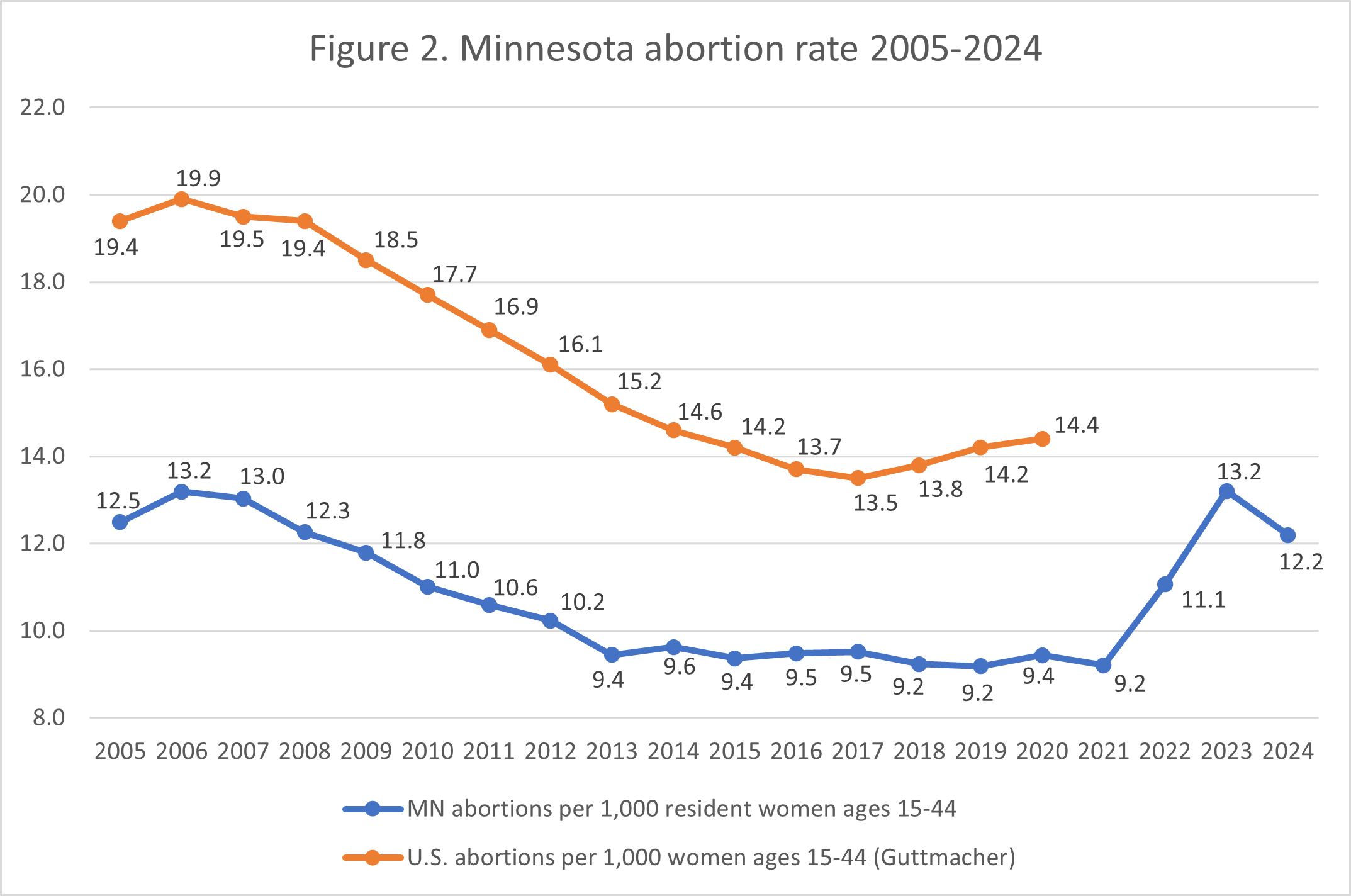
- National rates were calculated by Guttmacher Institute. Minnesota rates were calculated by CLI using the following formula: (total number of abortions performed in Minnesota ÷ number of resident women ages 15-44 [based on most recent population estimates]) x 1,000. Rates may differ slightly from previous CLI articles due to revised population estimates. Population estimates were obtained using the CDC WONDER database. Estimates for 2005-2009 are intercensal estimates of the July 1 resident population. Estimates for 2010-2019 are Vintage 2020 postcensal estimates of the July 1 resident population. Estimates for 2020-2024 are Vintage 2024 postcensal estimates of the July 1 resident population. Estimates were produced by the U.S. Census Bureau and the National Center for Health Statistics.
- Statistics on abortion complications reported here represent a minimal number of deaths and complications, as this data is collected in a non-systematic and non-verifiable way. As such, this data cannot be used to calculate either an accurate abortion mortality rate or an accurate abortion complication rate for the state.
- The Guttmacher Institute notes that their monthly abortion totals by state are estimates and that each state’s estimate is within a range of uncertainty. Guttmacher also notes that their estimates do not reflect abortions obtained by women in states with total abortion bans under shield laws in effect in pro-abortion states. Guttmacher’s travel and residence data can be found in the CSV folder here (State_Abortion_Travel_2024.csv). This information is updated as of January 7, 2026. The individual state’s totals for nonresident women who obtained abortions in Minnesota differ slightly between the state and Guttmacher because Guttmacher rounds by tens in their estimates.
- A possible explanation for the discrepancy in the state’s telehealth total within the same report but different tables is that, in Table 1.1, the state lumps all Planned Parenthood locations together, even though some Minnesota Planned Parenthood locations do provide telehealth abortions. Theoretically, the lower total of telehealth abortions in Table 1.1 could be because the report didn’t break down Planned Parenthood abortions by in-person and telehealth abortions, while Table 3 provides more aggregate, facility-level data that separates the in-person and telehealth categories amongst all providers in the state.
- #WeCount’s data can be found here by downloading the “Report data tables [.xlsx]” document. The #WeCount report specifies that the numbers included in their tables for abortions performed under shield laws only represent the number of women to whom abortion drugs were sent, not the number of drug-induced abortions that resulted from the mailed drugs. However, because #WeCount’s data is the only source of data that delineates the number of abortions by mode of provision (in-person, telehealth/mail order, and/or abortion drugs obtained under shield laws), their data is the best available. This information is updated as of January 7, 2026.
- Minnesota updated its abortion procedure categories in 2017. To allow for comparison with earlier reports, “other” drug-induced abortions, which include labor induction abortions, are excluded from the drug-induced abortion total. There were 5,190 “other” drug-induced abortions in 2024 as a result of the change in reporting procedures by one abortion provider in Minnesota (described above).
Click here to view reporting from:20232022202120202019201820172016