













Oregon’s 2024 abortion statistics were published in October 2025 on the state’s Induced Termination of Pregnancy Dashboard run by the Oregon Health Authority’s (OHA) Center for Health Statistics. During 2024, reported abortions in the state decreased from 2023.
The data published by the state does not include the total number of abortions obtained by Oregon residents out of state or the number of self-managed abortions on women outside of the healthcare system. The report also does not contain the total number of mail-order abortion drugs obtained by Oregon residents prescribed by licensed abortion providers in Oregon or in other states. In a separate section, Charlotte Lozier Institute (CLI) will describe data provided by the Guttmacher Institute’s Monthly Abortion Provision Study that details the total number of abortions occurring in the state in 2024 as estimated by Guttmacher’s sample survey and mathematical models. CLI will also describe Guttmacher’s estimated number of abortions obtained by Oregon women in other states. Guttmacher’s abortion estimates include the number of abortions obtained at brick-and-mortar facilities and those provided via telehealth and virtual providers in the United States.
Oregon’s statute code does not define abortion. Abortion is legal throughout all nine months of pregnancy in Oregon. As of January 2026, 24 states had released 2024 abortion statistics, 10 of which reported a decrease in abortions from 2023.
Statistics and Changes in Oregon Abortions, 2023-2024

The report does not include information on Planned Parenthood’s Oregon abortion market share.
Abortion Totals and Trends
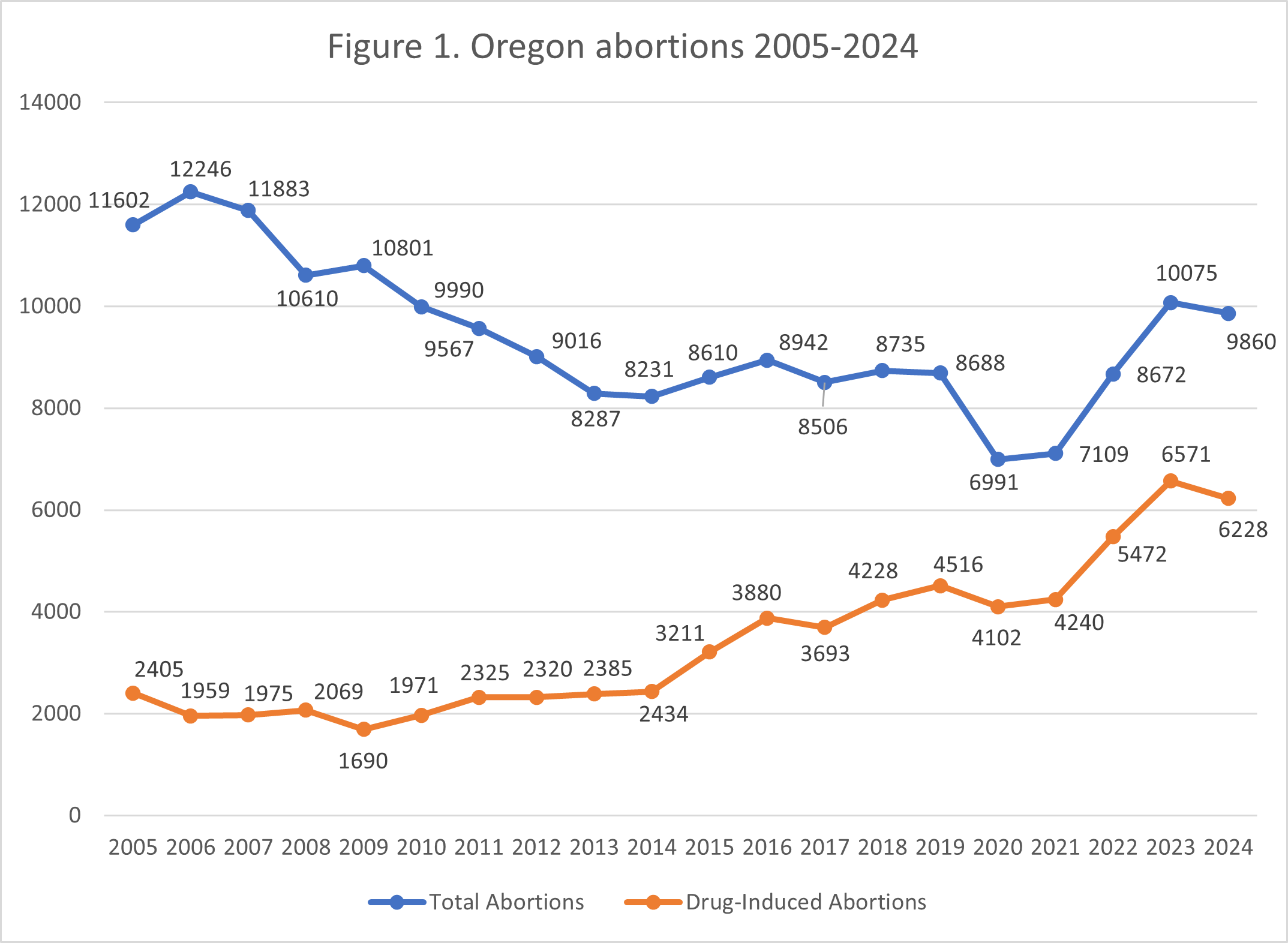
A total of 9,860 abortions were reported in Oregon in 2024, a decrease of 2% from 2023. There were 6,228 drug-induced abortions in 2024, constituting 63% of the total and a decrease of 5% from 2023 (Fig. 1). The abortion rate decreased by 3% from 12.0 abortions per 1,000 women of childbearing age in 2023 to 11.7 in 2024 (Fig. 2).1
State Report Summary
In 2024, 81% of the abortions reported in Oregon were performed on state residents. Nineteen percent of the abortions (1,861) were performed on nonresidents, an increase of 12% from 2023, when there were 1,661 nonresident abortions. The total number of abortions in the state includes 31 telehealth abortions, including those from licensed providers located out of the state, a 66% decrease from 2023, when 90 telehealth abortions were reported.
Eleven percent of the abortions were performed on girls ages 19 or younger, including 23 on girls less than 15 years old (0.2% of the total). Fifty-six percent of Oregon abortions were obtained by women in their twenties, 29% by women in their thirties, and 4% by women ages 40 or older. A majority of women who obtained abortions in Oregon in 2024 had at least a high school diploma or a GED equivalent, with 28% having this as their highest level of educational attainment. Seventeen percent of these women attended some college but did not obtain a degree. Nine percent had a bachelor’s degree, 5% had an associate degree, and 3% had a master’s degree. One percent of women who received abortions in Oregon had an eighth-grade education or less and one percent had a doctorate or other professional degree. Nine percent of the women had attended some high school but did not obtain a degree. The level of education was not known for 27% of the women.
Oregon reports abortion by race, but because more than one race may be selected on the abortion reporting form, the total of the figures for each race are higher than the total number of abortions that occurred in Oregon. Sixty-six percent of abortions were performed on white women, and 9% on Black/African American women. Four percent of abortions were performed on Asian women, and 2% and 1%, respectively, on American Indian/Alaska Native and Native Hawaiian/Pacific Islander women. Seven percent of women who obtained abortions in 2024 reported their race as “other,” and race was unreported for 9% of the abortions. CLI estimates that the black abortion rate (38.2 abortions per 1,000 women ages 15 to 44) was over four times higher than the white abortion rate (9.3). Twenty-nine percent of Oregon abortions were obtained by Hispanic women of any race.
A majority of the abortions performed in Oregon (63%) were drug-induced. Suction curettage abortions accounted for 28% of the state’s total and dilation and evacuation abortions accounted for 7%. The number of suction curettage abortions increased by 19% from 2023 to 2024. Under one percent of the abortions were sharp curettage abortions, and 58 abortions were performed using vaginal prostaglandins. The number of abortions performed using vaginal prostaglandins increased more than eleven-fold from five in 2023 to 58 in 2024. There were eight hysterectomies/hysterotomies and 1% of the abortions were performed by other, unspecified means.
Fifteen percent of the abortions reported in Oregon were performed on women who were married, separated, or in domestic partnership. Sixty-four percent were performed on unmarried women. Marital status was unknown for 21% of the women. Fifty-four percent had no living children, 19% had one living child, and 26% had two or more living children. A majority of abortions were performed on women who had never had an abortion (68%). Eighteen percent had one prior abortion, and 26% had more than one.
Twenty-one percent of the abortions occurring in Oregon were performed on women who reported using contraception, while 59% were performed on women who were not using any contraception when they became pregnant. Six percent of the abortions were performed on women who reported using oral contraception, and 6% on women who used condoms. Two percent of women used emergency contraception, 1% used the rhythm method, and another 1% used contraceptive rings. Two percent of women used multiple contraceptive methods while 20% did not report whether they were using contraception.
Seventy-three percent of reported abortions were performed before nine weeks of gestation, and 14% occurred between nine and 12 weeks. Five percent were performed between 13 and 16 weeks, and 2% between 17 and 20 weeks. One percent were performed between 21 and 22 weeks, while 3% were performed at 23 weeks of gestation or later. The number of abortions performed at 23 weeks and later increased by 26% from 2023 to 2024, while the number performed before nine weeks decreased by 5%. The gestational age was not reported for 1% of the abortions.
Abortion-Related Complications
In 2024, abortions at later gestational ages had the highest rates of reported complications.2 Of the abortions performed at nine weeks of gestation or earlier, Oregon reported that 5% resulted in complications. Abortions performed between nine and 12 weeks resulted in complications 7% of the time. For abortions performed between 13 and 16 weeks, 8% resulted in complications, while 13% of abortions performed between 17 and 20 weeks resulted in complications. Furthermore, 7% of the abortions between 21 and 22 weeks and 12% of abortions performed at 23 weeks or later resulted in complications. Overall, the risk of abortion complications increases with gestational age.
Retained products of conception was the most common complication, occurring 161 times. There were 131 cases in which the abortion method failed, 46 cases of hemorrhage, 23 cases of infection, and six cases of cervical lacerations. Sixty-eight women experienced multiple complications. There were 130 unspecified complications, accounting for 23% of the total.
Abortions Performed by County of Occurrence
Abortions were performed in 13 of Oregon’s 36 counties. Following is a breakdown of the number of abortions occurring in Oregon by county in 2024, and the numerical change by county from 2023 to 2024.3
| # of Abortions (2024) | Change in # of Abortions from 2023 | |
| Benton County | 37 | -5 |
| Clackamas County | 748 | +23 |
| Columbia County | 7 | -2 |
| Deschutes County | 21 | -570 |
| Jackson County | 426 | +49 |
| Josephine County | 51 | -14 |
| Lane County | 944 | +157 |
| Lincoln County | 11 | +7 |
| Malheur County | 876 | +449 |
| Marion County | 717 | -245 |
| Multnomah County | 4,978 | -4 |
| Wasco County | 1 | 0 |
| Washington County | 1,012 | -1 |
| Remote Telehealth | 31 | -59 |
| Total | 9,860 | -215 |
As the table above displays, the decrease in abortions performed in the state between 2023 and 2024 is a result of a reduction in abortions performed in Deschutes and Marion counties. It is unclear what led to the significant decline in abortions in Deschutes County. In November 2024, the Grants Pass Planned Parenthood location in Josephine County announced it would be temporarily closing. The center remains closed as of January 2026.
Abortion Provider Breakdown in Oregon as of October 20253
| # of brick-and-mortar locations | 13 |
| # of independent centers | 1 |
| # of Planned Parenthood centers | 10 |
| # of hospitals/doctors’ offices that perform abortions | 2 |
| # of abortion drug providers | 13 |
| # of abortion drug-only providers | 4 |
| # of surgical and abortion drug providers | 9 |
| Latest gestational age that a center performs surgical abortion | Through 33 weeks |
Guttmacher Data
In 2024, Guttmacher estimated that 12,280 abortions occurred in Oregon, while the state reported 9,860. Guttmacher’s estimate was 25% higher than the abortion total reported by the state. Guttmacher also reported that of the 12,280 abortions that occurred in Oregon in 2024, 1,120 were obtained by women from other states who traveled to Oregon to get an abortion. Of the 1,120 women who traveled to Oregon to get an abortion, 140 were from Idaho and 980 were from Washington State. Additionally, 300 Oregon women traveled out of state to Washington State.4
When looking at the totals estimated by Guttmacher and those reported by the state, one can see a large discrepancy. To see those discrepancies further highlighted, see below:

One possible explanation for these differences is that Guttmacher’s estimates include abortions occurring at brick-and-mortar facilities and telehealth abortions, where abortion drugs are mailed to the woman by prescribers in and outside of the state. In a response to a CLI email inquiring about the types of telehealth abortions captured by the state, the OHA stated, “The telehealth column in our table of abortions by place of occurrence only counts those reported by telemedicine providers outside of the state, not within.” Because Oregon does not have any restrictions on mail-order abortion and because of the existence of several brick-and-mortar facilities within the state that offer (hybrid) mail-order abortion drugs, it is likely that the unreported abortions are ones that occurred via telehealth by prescribers within the state.
Data from the Society of Family Planning (SFP) provides more context. Their #WeCount project estimated that of the 12,670 abortions that occurred in the state in 2024, 10,520 were performed in person at brick-and-mortar facilities, while 1,830 were mail-order abortion drug regimens sent from online-only organizations, and 320 were abortion drug regimens sent from hybrid brick-and-mortar facilities.5 While Guttmacher’s occurrence total (12,280) is slightly lower than #WeCount’s (12,670), it appears both totals do, in fact, include the number of mail-order abortion drugs sent within the state, while the state’s total does not.
State Ranking
In 2024, CLI published a paper reevaluating abortion reporting across the country, with Oregon ranking 16th best. To improve, Oregon could be more transparent in reporting data it already collects, such as the facilities where abortions take place, de-identified data on the state of residence of nonresident women who obtain abortions in Oregon, as well as previous miscarriages experienced by women who undergo abortions. Oregon could also collect and report information on the methods of payment used to fund abortion, as well as women’s reasons for choosing abortion. Oregon could further require all healthcare providers, including those in emergency rooms, to report any abortion complications they encounter. As Oregon’s complications statistics illustrate, abortions become more dangerous for women as gestational age increases, and Oregon permits abortions throughout all nine months of pregnancy.
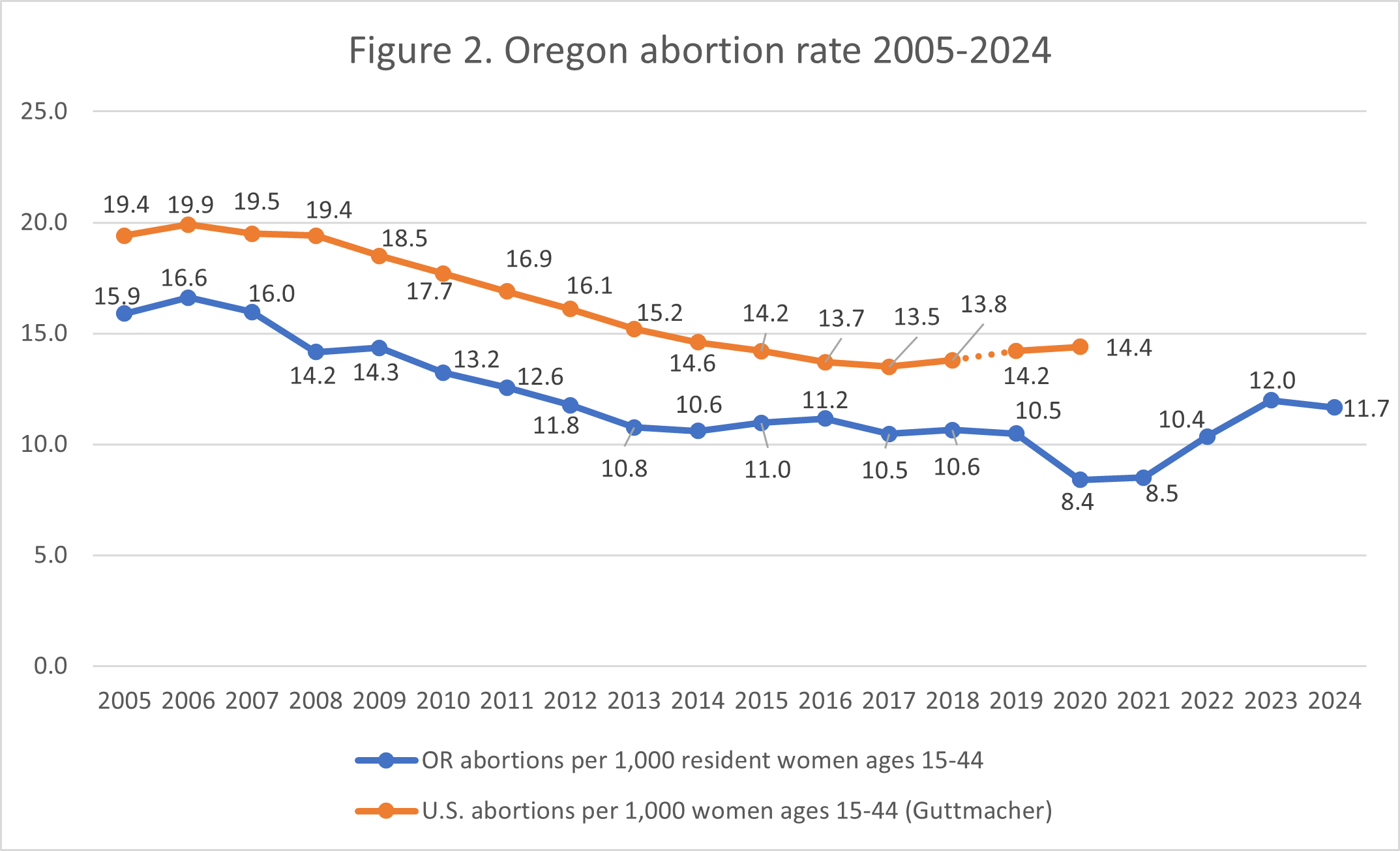
- National rates were calculated by Guttmacher Institute. Oregon rates were calculated by CLI using the following formula: (total number of abortions performed in Oregon ÷ number of resident women ages 15-44 [based on most recent population estimates]) x 1,000. Rates may differ slightly from previous CLI articles due to revised population estimates. Population estimates were obtained using the CDC WONDER database. Estimates for 2005-2009 are intercensal estimates of the July 1 resident population. Estimates for 2010-2019 are Vintage 2020 postcensal estimates of the July 1 resident population. Estimates for 2020-2024 are Vintage 2024 postcensal estimates of the July 1 resident population. Estimates were produced by the U.S. Census Bureau and the National Center for Health Statistics.
- Statistics on abortion complications reported here represent a minimal number of deaths and complications, as this data is collected in a non-systematic and non-verifiable way. As such, this data cannot be used to calculate either an accurate abortion mortality rate or an accurate abortion complication rate for the state.
- Provider totals do not include hospitals or physician offices not listed in databases that compile abortion provider locations in different states, but do include Planned Parenthood locations, independent abortion centers, and hospitals/doctors’ offices included in databases like Abortion Finder and Ineedana. Abortions are reported by the state as occurring in counties that don’t have any operative abortion centers. However, these counties have hospitals/doctors’ offices that perform abortions in certain cases but aren’t included in the aforementioned databases. This information is updated as of October 15, 2025.
- The Guttmacher Institute notes that its monthly abortion totals by state are estimates and that each state’s estimate is within a range of uncertainty. Guttmacher also notes that their estimates do not reflect abortions obtained by women in states with total abortion bans under shield laws in effect in pro-abortion states. Guttmacher’s travel and residence data can be found in the CSV folder here (State_Abortion_Travel_2024.csv). This information is updated as of October 14, 2025.
- #WeCount’s data can be found hereby downloading the “Report data tables [.xlsx]” document. The #WeCount report specifies that the numbers included in their tables for abortions performed under shield laws only represent the number of women whom abortion drugs were sent to, not the number of drug-induced abortions that resulted from the mailed drugs. However, because #WeCount’s data is the only source of data that delineates the number of abortions by mode of provision (in-person, telehealth/mail order, and/or abortion drugs obtained under shield laws), their data is the best available.