











Nevada’s 2024 abortion statistics were provided to the Charlotte Lozier Institute (CLI) by the Nevada Department of Health and Human Services (DHHS) upon request in January 2026. The report shows that total abortions, as well as drug-induced abortions, increased from 2023 to 2024.
The data does not include the number of abortions obtained by Nevada residents out of state or the number of self-managed abortions on women outside of the healthcare system. The report also does not contain the total number of mail-order abortion drugs obtained by Nevada residents prescribed by licensed providers in Nevada or other states. In a separate section, CLI will describe data provided by the Guttmacher Institute’s Monthly Abortion Provision Study that details the number of abortions occurring in the state in 2024 as estimated by Guttmacher’s sample survey and mathematical models. CLI will also describe Guttmacher’s estimated number of abortions obtained by Nevada women in other states. Guttmacher’s abortion estimates include the number of abortions obtained at brick-and-mortar facilities and those provided via telehealth and virtual providers in the United States.
Nevada’s statute code defines abortion as “the termination of a human pregnancy with an intention other than to produce the birth of an infant capable of sustained survival by natural or artificial supportive systems or to remove a dead fetus” (NRS §442.240). In Nevada, abortion is widely available throughout pregnancy because of the state’s ineffective gestational limit at viability. While the language of the law limits abortion after viability, the law contains a broad health (life and health of the mother) exception that doesn’t differentiate between physical and mental health, which, in turn, allows abortion throughout pregnancy for nearly any reason (NRS §442.250). On November 5, 2024, Nevadans voted to enshrine the right to an abortion into the state’s constitution. This didn’t change the law in Nevada because the state’s ineffective viability law was already in effect.
Statistics and Changes in Nevada Abortions, 2023-2024

Planned Parenthood’s market share includes abortions performed by brick-and-mortar locations in the state and telemedicine abortions performed by Planned Parenthood of Southern Nevada.
Abortion Totals and Trends
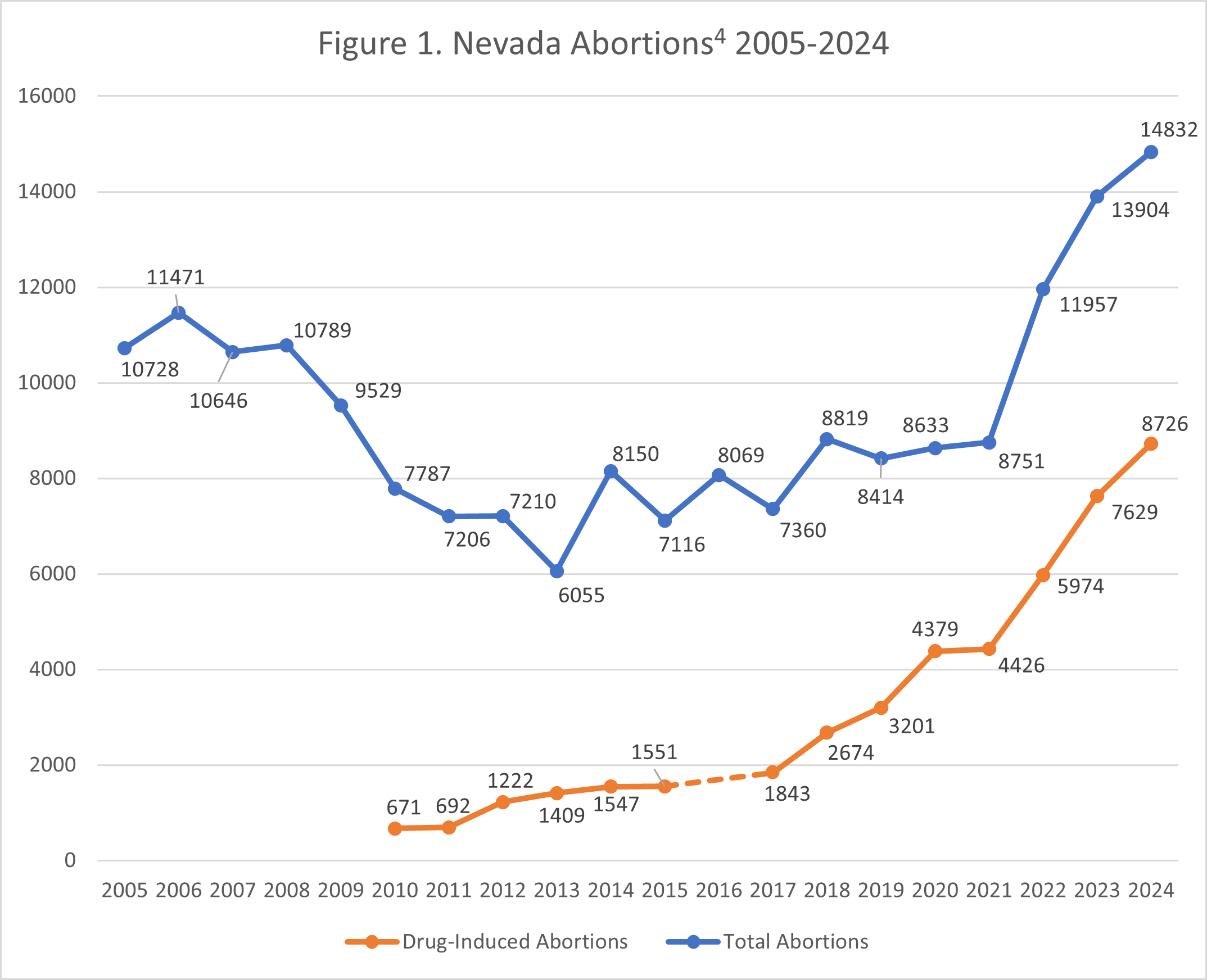
In 2024, there were 14,832 reported abortions in Nevada, an increase of 7% from the previous year. There were 13,273 abortions performed in Nevada on state residents, 11% more than in 2023. The increase in reported resident abortions is numerically responsible for the entire increase in total abortions from 2023 to 2024. More than half (59%) of the abortions performed in Nevada were drug-induced (8,726), with the total number of those occurring in the state increasing by 14% from the previous year (Fig. 1). CLI estimates that Nevada’s 2024 abortion rate was 23 abortions per 1,000 women of childbearing age (Fig. 2).1 As of January 2026, 24 states have released 2024 abortion statistics, with seven states reporting that abortions have increased.
State Report Summary
Ninety percent of the abortions reported in Nevada in 2024 were performed on state residents. Eleven percent, or 1,551, of the abortions reported in Nevada were performed on nonresidents, a decrease of 14% from 2023. Eight abortions were performed on women of unknown residence status.
Nevada changed the categorization of age groups for minors in the state’s 2024 abortion report to bring the report in line with others released by the DHHS. Seven percent of abortions were performed on girls under the age of 19, with nearly all of this 7% performed on girls ages 15-19 and just 16 abortions performed on girls under the age of 15. Forty-nine percent of abortions were obtained by women in their twenties, with 24% on women ages 20 to 24 and 25% on women ages 25 to 29. Thirty percent were performed on women in their thirties, and 4% were performed on women in their forties or older. Age was not reported for 11% of Nevada abortions.
Five percent of Nevada abortions were performed on women with less than a high school education, and 38% were performed on women with a high school diploma or GED. Sixteen percent were performed on women who had attended some college but did not obtain a degree. Eleven percent of Nevada abortions were performed on women with a college degree, and 31% on women whose level of education was not reported.
Ten percent of the abortions were reported to have been performed on married women, and 71% were performed on unmarried women. Nineteen percent of the abortions that occurred in Nevada were performed on women whose marital status was not reported.
Forty-one percent of the abortions were performed on women with no living children, while 20% were performed on women with one child and 29% on women with two or more children. The number of living children was not reported for 11% of the abortions that occurred in Nevada.
For the first time since sending CLI abortion data, Nevada’s 2024 abortion report included the number of abortions by other pregnancy outcomes, including deceased children, previous abortions, and previous miscarriages. Eighty-one percent of abortions were performed on women with zero deceased children, while 40 abortions were performed on women with one deceased child, and 12 abortions were performed on women with two or more deceased children. Eighteen percent of abortions were performed on women whose number of deceased children was unknown. Seventy-four percent of abortions were performed on women who had not had a prior miscarriage, while 16% were performed on women with one or more prior miscarriages and 11% on women whose number of previous miscarriages, if any, was unknown. Fifty percent of abortions were performed on women with no prior abortions, while 23% were performed on women with one prior abortion. Seventeen percent were obtained by women with two or more prior abortions, while 11% were performed on women whose previous abortion history was unknown.
In 2024, 22% of the abortions performed in Nevada were suction curettage procedures. Fifty-nine percent were drug-induced abortions, and 3% were conducted via dilation and evacuation. Sharp curettage abortions made up 5% of the total abortions, a decrease of 23% from 2023. Eleven percent of the abortions were performed using an unknown method.
Five percent of abortions were reported between one and four weeks of gestation. Forty-two percent occurred between five and six weeks of gestation, and 24% were reported between seven and eight weeks. Ten percent were performed between nine and 10 weeks of gestation, while 2% occurred between 11 and 12 weeks and 3% between 13 and 15 weeks of gestation. Two percent of the abortions were performed between 16 and 19 weeks, and 1% at 20 weeks of gestation or later. The latest reported abortion was performed at 24 weeks of gestation. Gestational age was not reported for 11% of the abortions performed in the state. Compared to 2023, the number of abortions occurring at earlier gestational ages (1-6 weeks) significantly increased, while abortions performed between seven and ten weeks increased slightly. Abortions occurring between eleven and 19 weeks of gestation decreased from 2023 to 2024, while there was a slight increase (18 more abortions) in abortions performed at 20 weeks or later from 2023 to 2024.
Sixteen of Nevada’s 17 counties had residents who obtained abortions in the state in 2024. Of those 17 counties, the top three by number of abortions obtained by county residents include:
- Clark County – 11,317 abortions
- Washoe County – 1,353 abortions
- Carson City – 138 abortions
Abortion Centers in Nevada
Thirty-seven percent of Nevada abortions were performed by Planned Parenthood, an increase of 40% from 2023. The number of abortions performed by brick-and-mortar Planned Parenthood locations in the state increased by 34% from 2023 to 2024. Abortions performed at brick-and-mortar Planned Parenthood locations were responsible for 95% of Planned Parenthood’s total abortion count in the state and 35% of the state’s total. Telehealth abortions performed by their Planned Parenthood Southern Nevada entity composed 5% of Planned Parenthood’s total abortion count in the state and 2% of the state’s total. Fourteen percent of Nevada’s abortions were performed by Planned Parenthood’s East Flamingo location, 12% by their West Charleston location, and 9% by their Reno location.
Forty-two percent of the abortions were performed by independent centers in 2024, compared to 59% in 2023 and 76% in 2022. Fourteen percent of Nevada abortions were performed by the A-Z Women’s Center, which has been renamed Lilith Clinic. Twelve percent occurred at Birth Control Care Center, 9% at Safe and Sound for Women, 6% at Women to Women to Gynecology, and 1% at the Desert Inn Medical Center.
Two non-Planned Parenthood telemedicine abortion companies performed 3,180 drug-induced abortions (21%) in the state, an increase of 78% from 2023, when there were 1,782 reported abortions from these entities. One percent of Nevada abortions were performed by IGH PLLC, which does business under the name Abortion on Demand, and 20% by Carafem Telehealth. Carafem’s share of the total Nevada abortion count increased 84% from 2023 to 2024 and performed the highest number of abortions among the 11 reporting entities.
Abortion provision in the state greatly changed from 2023 to 2024. While Planned Parenthood and non-Planned Parenthood telemedicine entities were both significantly more responsible for Nevada’s abortions in 2024, independent clinics were responsible for significantly less. Some explanations for these changes include Planned Parenthood opening its Reno location in 2024, and the West End Women’s Medical Group closing. The West End Women’s Medical Group closed sometime between 2023 and the beginning of 2024, and the state reported zero abortions occurring at this location in 2024 compared to 855 in 2023. The explosion of telehealth abortions performed by Carafem and in Nevada in general closely mirrors the national increase in telehealth abortions as a proportion of the nation’s total abortions.
Abortion provision in Nevada changed in 2025, as well. The state’s East Flamingo and West Charleston locations closed at the end of March, and a new location opened in their place on April 1, 2025. Additionally, the newly opened Las Vegas location is now controlled by the Planned Parenthood Mar Monte affiliate, whereas the East Flamingo and West Charleston locations (both previously located in Las Vegas, as well) were controlled by the Planned Parenthood of the Rocky Mountains affiliate.
Guttmacher Data
In 2024, Guttmacher estimated that 17,260 abortions occurred in Nevada, while the state reported 14,832. Guttmacher also estimated that of the 17,260 abortions performed in the state, 1,500 were obtained by nonresidents who traveled to Nevada to obtain an abortion, while the state reported 1,589 (1,581 with known nonresident states of residence and eight with unknown nonresident states of residence). However, the state did not specify the states from which women traveled. To see the number of abortions obtained in Nevada by women from various states according to Guttmacher, see below.2
| States of Residence for Women Who Traveled to Nevada | # of Abortions Obtained by Non-Resident Women in Nevada, 2024 |
| Arizona | 550 |
| Texas | 360 |
| Utah | 250 |
| California | 110 |
| Unknown | 230 |
| Total | 1,500 |
Additionally, Guttmacher estimated that 850 Nevada residents traveled out of state to obtain an abortion. The breakdown of where those women traveled to is as follows:
- 430 in California
- 300 in Colorado
- 120 in Utah
As one can see, the discrepancy in abortions reported by the state and estimated by Guttmacher (a difference of 2,428 abortions) is not a result of a significant discrepancy in nonresident abortions performed in Nevada. The discrepancy is a result of significantly different resident abortion totals reported by the state and those estimated by Guttmacher. To see this discrepancy in occurrence abortions as influenced by underreported resident abortions by the state, as well as a discrepancy in total resident abortions, see below.2

Additional context for the underreporting of resident abortions occurring in Nevada by the state is provided by the Society of Family Planning (SFP). While the state reported telehealth abortions (3,472) in 2024, this figure is a significant undercount. SFP estimated that of the 17,510 abortions estimated to have occurred in Nevada in 2024, 11,850 (compared to the state’s total of 11,360) were performed in brick-and-mortar facilities, and 5,660 were performed via telehealth and obtained via mail-order (5,460 by virtual-only organizations and 200 by hybrid brick-and-mortar facilities).3 The difference in virtual-only telehealth abortions as reported by the state and SFP (1,988) accounts for a majority of the difference in resident abortions between Guttmacher and the state (2,517), and the difference in total abortions occurring in the state between Guttmacher and the state (2,428) and SFP and the state (2,678). Telehealth abortions, as estimated by SFP, are always almost entirely obtained by resident women, as SFP measures the occurrence of abortions as having occurred in the state where a woman obtained a surgical abortion (in-person), a drug-induced abortion (in-person), or where abortion drugs are mailed to (telehealth abortion). It is plausible that prescribers mailing drugs into or throughout the state underreported to the state’s DHHS (causing an artificially low resident abortion count and therefore, an inaccurate total abortion count), but fully reported to SFP.
State Ranking
In 2024, CLI published a paper reevaluating abortion reporting across the country, with Nevada tied for 23rd place. With the inclusion of several more data points related to abortions by other pregnancy outcomes, Nevada’s ranking has improved. Nevada could continue to improve its reporting and increase transparency by publishing its reports online and working to decrease the number of unknown abortions for certain data points reported by the state. Nevada could also collect and report data on complications caused by abortion.
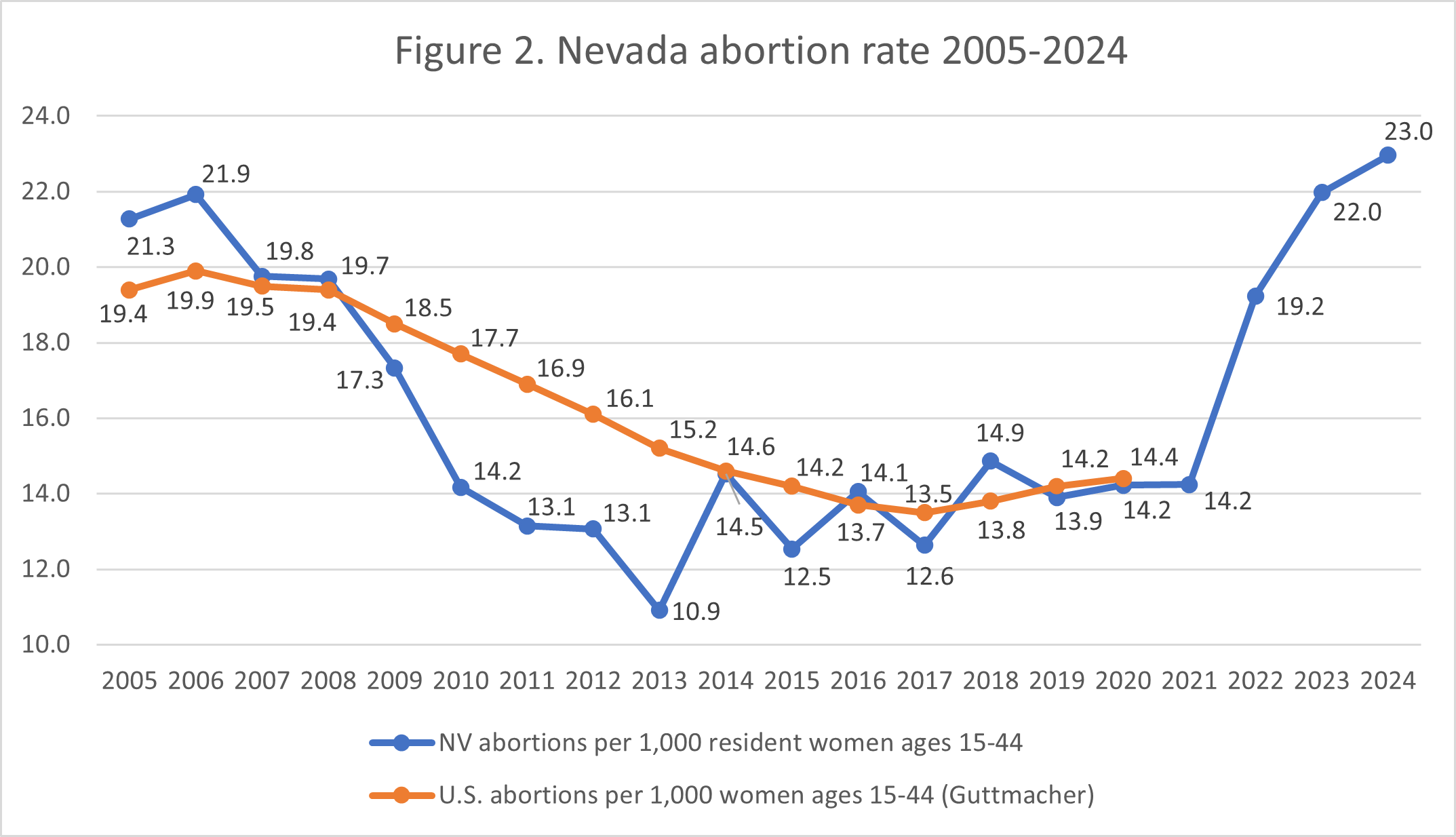
- National rates were calculated by Guttmacher Institute. Nevada rates were calculated by CLI using the following formula: (total number of abortions performed in Nevada ÷ number of resident women ages 15-44 [based on most recent population estimates]) x 1,000. Rates may differ slightly from previous CLI articles due to revised population estimates. Population estimates were obtained using the CDC WONDER database. Estimates for 2005-2009 are intercensal estimates of the July 1 resident population. Estimates for 2010-2019 are Vintage 2020 postcensal estimates of the July 1 resident population. Estimates for 2020-2024 are Vintage 2024 postcensal estimates of the July 1 resident population. Estimates were produced by the U.S. Census Bureau and the National Center for Health Statistics.
- The Guttmacher Institute notes that their monthly abortion totals by state are estimates and that each state’s estimate is within a range of uncertainty. Guttmacher also notes that their estimates do not reflect abortions obtained by women in states with total abortion bans under shield laws in effect in pro-abortion states. Guttmacher’s travel and residence data can be found in the CSV folder here (State_Abortion_Travel_2024.csv). This information is updated as of January 9, 2026. The individual state’s totals for nonresident women who obtained abortions in Nevada differ slightly between the state and Guttmacher because Guttmacher rounds by tens in their estimates.
- #WeCount’s data can be found here by downloading the “Report data tables [.xlsx]” document. The #WeCount report specifies that the numbers included in their tables for abortions performed under shield laws only represent the number of women to whom abortion drugs were sent, not the number of drug-induced abortions that resulted from the mailed drugs. However, because #WeCount’s data is the only source of data that delineates the number of abortions by mode of provision (in-person, telehealth/mail order, and/or abortion drugs obtained under shield laws), their data is the best available. This information is updated as of January 9, 2026.
- Abortion occurrence totals were obtained from the Nevada Department of Health and Human Services upon request. Drug-induced abortion totals were obtained from the CDC. 2010 was the first year of drug-induced abortion data that Nevada reported to the CDC. Nevada later revised its 2016 abortion total after data was submitted to the CDC. Consequently, the 2016 abortion total Nevada shared with CLI (8,069 abortions) was higher than that reported to the CDC (7,284), so CDC’s 2016 Nevada drug-induced abortion total is not included in this graph.