












Georgia’s 2019 abortion statistics are available in the Online Analytical Statistical Information System (OASIS). Abortions performed on Georgia residents increased from 2018 to 2019.
Changes in Georgia Abortions, 2018-2019*

*This graphic shows changes in Georgia resident abortions only. Information on Planned Parenthood’s Georgia abortion market share is not included in the abortion report.
Abortion Totals and Trends
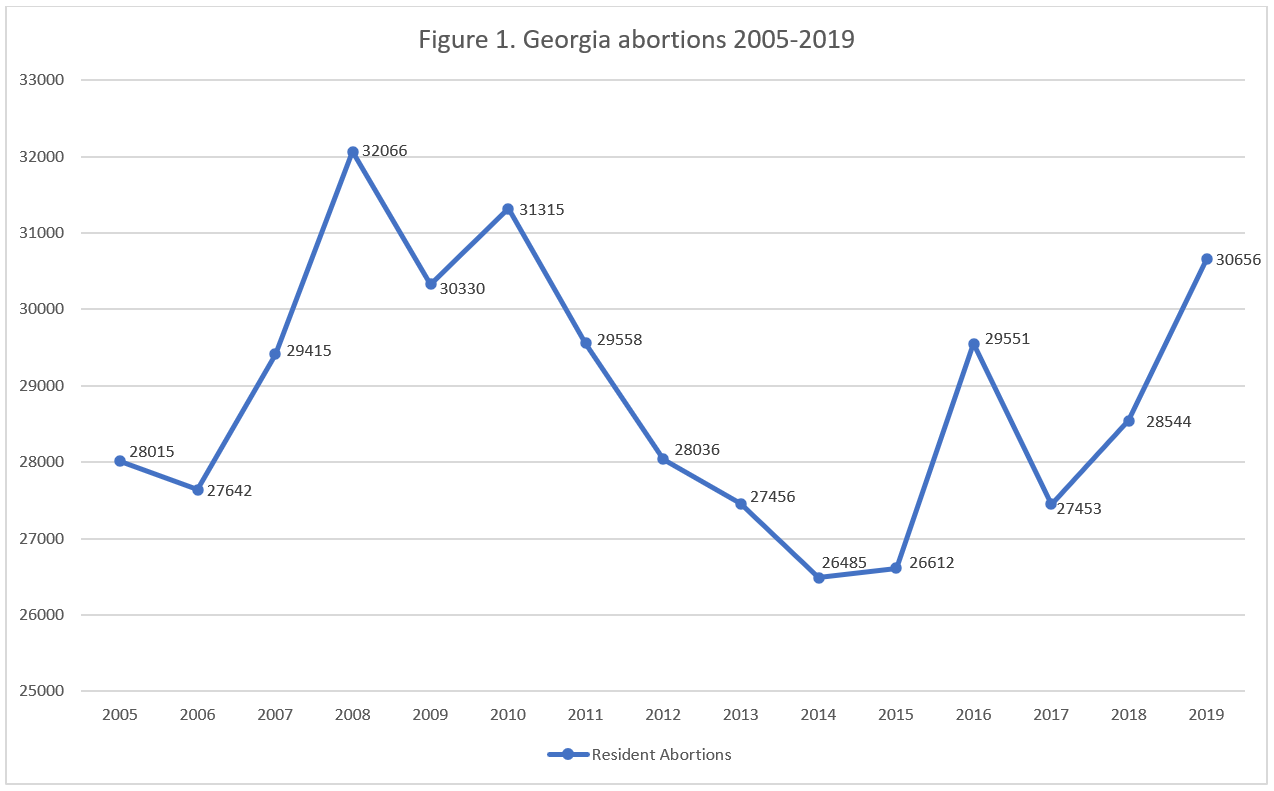
In 2019, there were 30,656 abortions reported to have been performed on Georgia residents (Fig. 1). These could have been performed both on residents in Georgia and on residents who traveled out of state for abortions, which were then reported back to the Georgia Department of Public Health. Georgia resident abortions increased by seven percent between 2018 and 2019. The Charlotte Lozier Institute (CLI) estimates that Georgia’s state abortion rate increased by six percent to 14.1 abortions per 1,000 women of childbearing age in 2019 – higher than the national abortion rate (Fig. 2). Georgia abortion data is available in OASIS, which does not include abortions performed in Georgia on nonresident women.
State Report Summary
In 2019, eight percent of the abortions reported to have been performed on Georgia residents were obtained by girls under the age of 20. Two percent were performed on girls between the ages of 10 and 17, and six percent were on girls ages 18 and 19. Well over half the abortions, 58 percent, were performed on women in their twenties. Twenty-seven percent were on women ages 20 to 24, and 30 percent were on women ages 25 to 29. A fifth of the abortions performed on Georgia residents were performed on women in their early thirties. Eleven percent were on women in their later thirties, dropping to three percent on women in their early forties. Just 0.3 percent of the abortions were performed on women between the ages of 45 and 55.
A disproportionate share of the abortions reported in 2019 were obtained by black women. Sixty-three percent of Georgia abortions were performed on black women, compared to just 21 percent on white women. Four percent were on Asian women, and two percent were on women of multiple races. There were 48 abortions (0.2 percent) on American Indian or Alaska Native women and 52 abortions (0.2 percent) on Native Hawaiian or Pacific Islander women. A full 11 percent of the abortions were performed on women whose race was not reported. Eighty-four percent of the women were non-Hispanic, and nine percent were Hispanic. Ethnicity was not reported for eight percent of the Georgia residents undergoing abortions.
Changing Abortions
Reported abortions on Georgia residents increased sharply between 2018 and 2019. However, Georgia’s reported abortion totals vary widely from year to year. While these fluctuating abortion totals are influenced by multiple factors, the fact that Georgia reports only abortions performed on residents likely plays a role. Not all states report abortions back to Georgia, and those that do have not been consistent, with one of Georgia’s closest neighbors, Florida, only in 2017 beginning to collect the state of residence of women getting abortions. According to Florida’s 2019 abortion statistics, there were 1,202 Georgia women who obtained abortions in Florida.
The total number of abortions occurring in Georgia, as reported to the CDC, also tends to vary from year to year, although not as much as Georgia resident abortions. Estimates from the Guttmacher Institute are higher than those reported by the CDC but demonstrate the same variation.
State Ranking
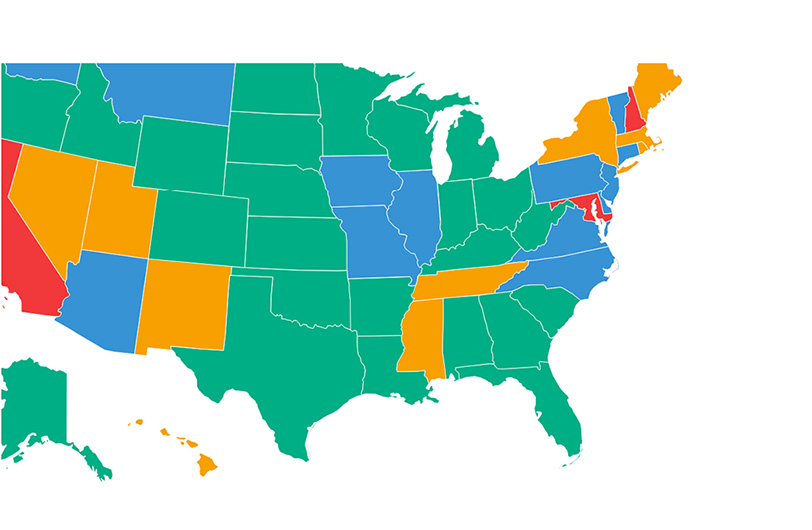
In 2016, CLI surveyed abortion reporting across the country, and Georgia’s reporting tied for 25th best, standing in contrast to Georgia’s 12th place spot on Americans United for Life’s most recent annual ranking of states based on the larger context of a state’s various pro-life policies. Georgia could improve its reporting by including data on the types of abortion procedures used in the state and the gestational ages at which abortions occur. In addition, Georgia could provide information for all abortions occurring in the state, including those performed on nonresident women.
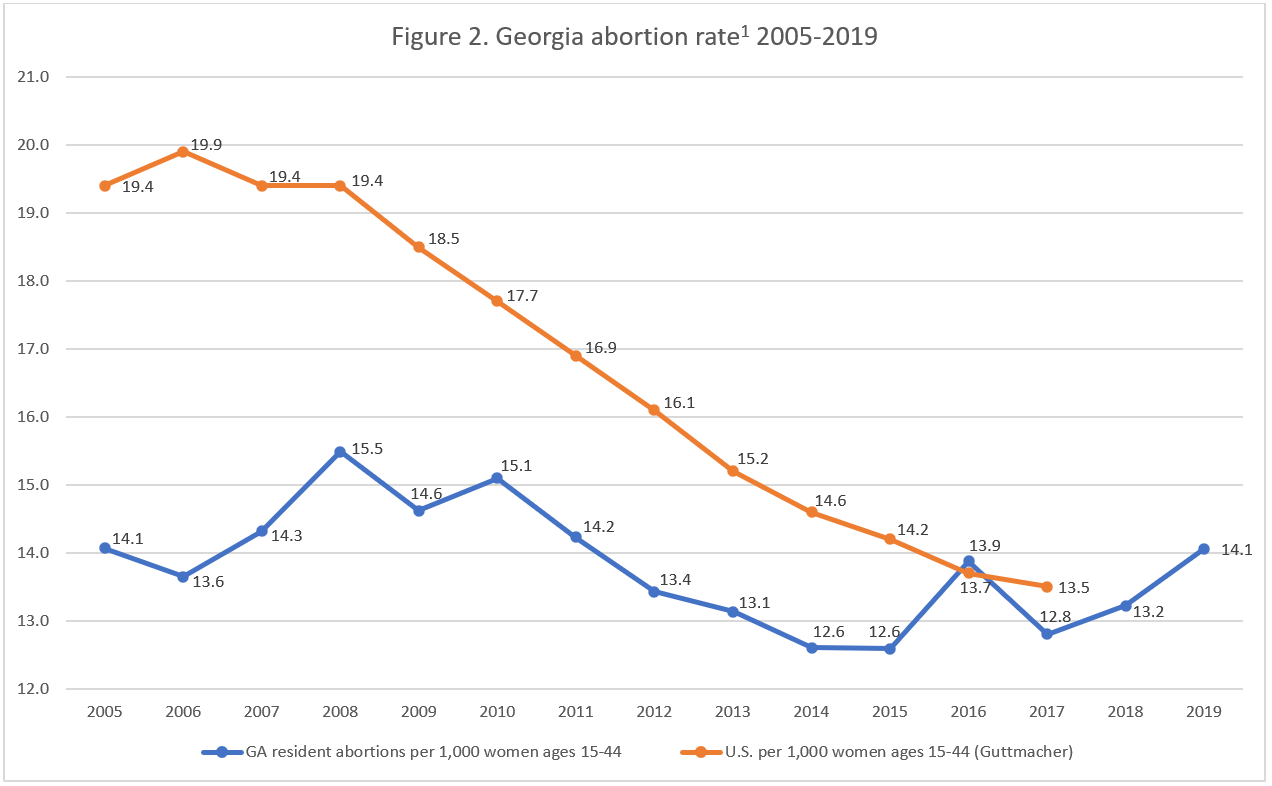
- Rates were calculated by CLI using population estimates from the United States Census Bureau. The rates were calculated using the following formula: (abortions performed on Georgia residents ÷ number of resident women ages 15-44) x 1,000. Rates may differ slightly from previous CLI articles due to revised population estimates.
Click here to view reporting from:2024202320222021202020182017