













Originally published in September 2024, this fact sheet was updated in January 2025, and again in November 2025.
Executive Summary
- “Abortion up to birth” is sometimes used to describe abortions in the seventh, eighth, or ninth month of pregnancy because these abortions occur in the same general timeframe in which babies are born.
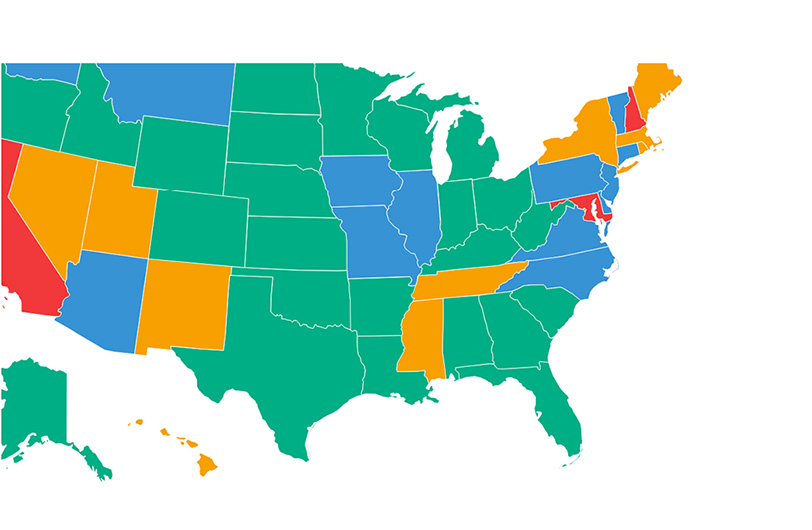
- Since the United States does not have a national limit on when elective abortions may be performed, nine states plus the District of Columbia place no limits on how late an abortion can be performed. Five others have adopted extreme ballot amendments that would permit abortion throughout all nine months.
- While many abortion centers only perform abortions in early pregnancy, there are abortion centers across the U.S. that advertise abortions in the last three months of pregnancy for any reason.
- Although media coverage tends to focus on late-term abortions performed because the unborn baby has a serious health condition or the mother’s life is threatened, research indicates that a significant number of late-term abortions occur for reasons unrelated to serious maternal or fetal health concerns.
- Despite claims that born-alive abortion survivors are a myth, babies have survived late abortions. A 2024 Canadian study of 13,777 abortions between 15 and 29 weeks of gestation found that 11.2% resulted in a live birth.
What is “abortion up to birth”?
The phrase “abortion up to birth” is sometimes used to describe abortions carried out in the seventh, eighth, or ninth month of pregnancy. Before 28 weeks (the seventh month of pregnancy), a baby would be considered extremely preterm.[1] However, once the pregnancy has reached 28 weeks, the baby is no longer considered “extremely” premature. A baby born at 28 weeks has an over 90% expected survival rate.[2] Babies born between 28 and 32 weeks are considered very preterm, and babies born between 32 weeks and 37 weeks are considered moderate or late preterm. A baby is considered “term” when born between 37 and 42 weeks. The “due date” occurs at 40 weeks.[3] The U.S. Centers for Disease Control and Prevention’s (CDC) data shows that, in 2023, 78% of all live births occurred prior to 40 weeks of gestation.[4] Two percent of babies were born between 28 and 33 weeks, 8% between 34 and 36 weeks, 30% between 37 and 38 weeks, and 38% at 39 weeks.
Are abortions during the last three months of pregnancy legal in the United States?
Federal law does not prohibit women from obtaining an abortion at any point during a pregnancy, nor does it restrict a woman from seeking an abortion for any reason. After the Supreme Court’s decision in Dobbs v. Jackson Women’s Health Organization overturned Roe v. Wade, states and the federal government regained the ability to protect life throughout pregnancy, though many states have chosen not to do so. Currently, nine states plus the District of Columbia place no limits on how late an abortion can be performed, while five others have adopted extreme ballot amendments that either create an unrestricted right to abortion or contain such broad exceptions that abortion is effectively permitted throughout all nine months.[5] Additionally, three states have explicitly weakened or removed protections for abortion-surviving born babies.[6] Of the 193 countries that are members of the United Nations, the United States is one of only eight that has no national gestational limit for elective abortion.[7]
Are most abortions that are performed late in pregnancy carried out because the unborn baby has an abnormality?
Media coverage of abortions in the final months of pregnancy often focuses on abortions performed because the unborn baby has a very serious health condition. However, research shows that many late-term abortions are performed for the same reasons as abortions earlier in pregnancy.
A qualitative analysis of interviews with 28 women who obtained abortions between 24 and 35 weeks identified two “pathways” that led women to seek an abortion late in pregnancy.[8] The first pathway involved receiving new information—this included both women who learned their unborn baby had an abnormality and those carrying healthy babies who were unaware of their pregnancy until a later stage. The second pathway involved obstacles that delayed access to abortion, such as cost, among other barriers. Although some women referenced prenatal diagnosis of fetal abnormalities as a factor in their decision, the author clarified that “[t]he new information respondents received that led to their decision to obtain an abortion was not exclusively related to fetal health.” The author concluded that reasons for abortion late in pregnancy are similar to reasons for earlier abortions, and that “despite the enumerated ways that third-trimester abortion differs from earlier abortion—in clinical complexity, cost, logistics, and social support—there are clear consistencies in why people seek abortion care, regardless of gestation.”
A second study by the same author analyzed interviews of 30 women who obtained abortions between 24 and 35 weeks, focusing on their travel across state lines.[9] The study found that some of the women who underwent extremely late abortions intended to get them earlier but encountered delays that prevented them from obtaining abortions until late in pregnancy. Additionally, consistent with the previously cited study, some women sought abortion late in pregnancy because they were unaware of their pregnancy until a later stage. Unfortunately, this study did not provide further details about the reasons for abortion.
The results above are similar to those from an earlier study by the same researcher that examined the experiences of women who obtained abortions after 20 weeks of gestation. Although this study did not analyze abortions performed because of a poor prenatal diagnosis, it did find that many women delayed abortions due to finding out about the pregnancy late, logistical problems, trouble deciding, and disagreements with their male partner.[10] Speaking to the prevalence of late-term abortion in the mid-second trimester and later, one of the authors made the argument that “[o]ne percent of [total abortions] is not nothing. It’s small from a data analysis or statistical perspective, but when you’re thinking about that as real people, that’s a pretty big number.”[11]
According to research published by a former Colorado abortion center that specialized in late-term abortions, fewer than one-third of abortions performed between 2007 and 2012 were carried out on babies with health conditions, suggesting that most abortions were performed on healthy babies.[12] Of the unborn babies aborted because of a prenatal diagnosis, the most common health condition was Down syndrome, a condition which in most cases does not present a lethal threat to the child. In fact, most children with Down Syndrome go on to lead happy, fulfilling lives.[13] While the aforementioned study did not indicate the exact gestational ages at which abortions unrelated to a prenatal diagnosis were performed, another study published by the same abortion center reported that of over one thousand abortions performed between 18 and 38 weeks, only a fifth were performed because the unborn baby had a poor prenatal diagnosis.[14]
Are late-term abortion procedures medically necessary for pregnancy emergencies?
The procedures used during late-term abortions are generally not considered medically necessary to save the life of a pregnant woman during a medical emergency. In fact, abortions performed during the final three months of pregnancy may be prolonged, as it can take several days for an abortionist to dilate the woman’s cervix. This extended process makes the procedure unsuitable for emergencies that require immediate medical intervention.[15] Additionally, by this point in pregnancy, the pregnancy can instead be ended via labor induction, or if indicated, cesarean section, with the goal of saving both the mother and child. Intentionally and directly ending an unborn child’s life is never medically necessary.[16]
Do abortion centers offer elective abortion in the last three months of pregnancy?
While many abortion centers only perform abortions early in pregnancy, several centers across the country offer late-term elective abortions. An abortion center in Washington, D.C., advertises abortion up to 31 weeks 6 days and, in a now-removed part of its website, had assured customers that “[i]f you are 26 weeks or later into your pregnancy, we can still see you, regardless of your medical history, background, or fetal indications. We do not require any particular ‘reason’ to be seen here–if you would like to terminate your pregnancy, we support you in that decision.”[17] The center also currently states that “[w]e firmly believe that access to abortion is a right for all people regardless of the reason behind their decision.”[18]Shortly after the Dobbs decision, a new, “all trimester” abortion center opened in Maryland to perform abortions up to 34 weeks of gestation, in the eighth month of pregnancy.[19] The abortionist explained her rationale for opening a late-term abortion center: “Every time we draw a line and we say ‘no more abortions after this point,’ someone’s going to fall on the other side of that line, and they’re going to be harmed.”[20]
Similarly, an abortion center in New Mexico, which describes itself as the first queer and BIPOC-led abortion center, advertises “abortion care in all stages.”[21] This center also performs abortions up to 34 weeks of gestation.[22] Pro-abortion advocates view this center as “stepping up to meet the urgent and growing demand” for late-term abortions, given abortion restrictions in other states.[23]
Prior to closing in January 2025, the aforementioned abortion center in Colorado performed abortions up to 32 weeks, with later procedures considered on a case-by-case basis. [24] Published research shows that the center performed abortions at 38 and 39 weeks–in the ninth month of pregnancy.[25] The abortionist who operated this center has been described as an “absolutist” for his willingness to perform elective late-term abortions.[26] In fact, the abortion center stopped performing first trimester abortions altogether and at least half of the late-term abortions were performed on healthy women and babies.[27] According to a profile published by The Atlantic, “The reason doesn’t really matter” to the owner of the abortion center.[28] Following this abortionist’s decision to retire, RISE Collective, an organization founded by former employees, announced a new abortion center specializing in late-term abortion projected to open in Fall 2025.[29]
Do abortion centers actually perform elective abortions in the last three months of pregnancy?
One retired abortionist shared her experience of performing elective abortions in the last three months of pregnancy.[30] She asserts that reasons for later abortions are “the same things” as reasons for abortions early in pregnancy, and that while some late-term abortions are performed because the unborn baby has an abnormality, others are due to “difficult life situations” and all are equally “deserving.” While she admits the idea of abortion so late in pregnancy makes some individuals (even those who are pro-abortion) uncomfortable, she does not recall personal discomfort with performing them, though she notes “there may have been moments.”
In Dobbs v. Jackson Women’s Health Organization, an amicus brief was submitted on behalf of 375 women who were harmed by abortions performed between their third and eighth months of pregnancy, including two women who obtained abortions at 28 weeks and one woman at 32 weeks.[31] Additionally, an abortion advocate described her experience with an elective abortion at 28 weeks.[32] The woman, who suffers from polycystic ovary syndrome and irritable bowel syndrome, said she obtained her abortion “because I was too sick, not ready, and I simply couldn’t afford it.”
Several women have shared their experiences with elective abortion in their last three months of pregnancy anonymously online; their quotes are included here with original spelling and punctuation retained. One woman who described getting an abortion in Oregon at 28 weeks of pregnancy explained that she was surprised to learn she was pregnant: “I took a pregnancy test randomly and it was positive, so I got an ultrasound and found out I was at 27-28 weeks.”[33] She decided to pursue an abortion because: “I had been drinking and smoking the entire pregnancy and cannot afford to take too much time off work so abortion was my only option.”
Another woman who underwent an abortion in Washington, D.C., at 30 weeks of gestation (in the seventh month) had a similar experience, sharing: “I found out I was pregnant at 24 weeks and it was a complete surprise.”[34] Notably, this woman described the sense of grief she felt after the procedure was completed: “I did opt to see the fetus after the procedure which was very emotional for me, and I was allowed private time to grieve and take photos. They even took foot and hand prints for me to keep…”
A woman who underwent an abortion around 30 weeks of pregnancy in New Mexico said, “surprise, turns out I was pregnant! I was baffled and had no clue how long I could have been pregnant.”[35] She shared the thought process behind her decision to undergo an abortion: “Since a lot of people have asked, I will share my rationale for my decision. Besides the fact that, simply, this is how I wanted to handle it (and that should honestly be reason enough)….I certainly wasn’t going to raise it, for a lot of reasons – not enough income, mental health issues, my partner was honest in that while they would not argue child support, they would not stay with me and would want nothing to do with the child, and if I wasn’t prepared emotionally or financially for a child as a couple, I certainly wasn’t prepared to be a single parent.”
Another woman in New Jersey, who underwent an abortion in the seventh month (at 31 weeks), shared: “My periods are rare already thanks to PCOS [polycystic ovary syndrome] so I never once thought these things combined meant I was pregnant. I just really regret not catching this sooner so I could have saved myself a lot of anguish.”[36] Another woman who obtained an abortion in New Mexico at 31 weeks similarly described: “i also did not know that i was pregnant. not until the quickening, that is. when i immediately went to my local abortion clinic, they informed me of how far along i was. 31 weeks.”[37] She also described the difficult experience of a late-term abortion, sharing that she had thought of abortion as “a ‘take two pills and wear a maxi pad for a couple weeks’ kind of situation. i never knew that i would have to euthanize, go into labor with, and fully deliver, a viable fetus. a baby. my baby.”
The same woman, tragically relaying her feelings on the euthanizing injection involved in the abortion, wrote: “that last bit was pretty upsetting. before it happened, i held my small protuberance and cried, and said over and over: ‘i’m so sorry baby. even though i’ll never hold you in my arms, i will hold you forever in my heart.’”
A woman who was scheduled for an abortion in D.C. in the eighth month of pregnancy (at 35 weeks), but who ultimately changed her mind, related: “I was suppose to get an induced abortion tomorrow. I’m 35 weeks and didn’t even find out i was pregnant until 2 weeks ago because i didn’t have any symptoms.”[38] She decided against abortion because she felt she couldn’t go through the process without support: “I don’t think i could of done it alone considering it is literal labor and delivery.”
Is it possible for a baby to survive a late-term abortion?
Although abortion advocates sometimes claim born-alive abortion survivors are a myth, some babies do survive abortions[39] –which one abortionist labeled the “dreaded complication.”[40] Most very late abortions are performed through labor induction, or sometimes a combination of labor induction and dismemberment. Often, at the start of a late-term abortion, the abortionist will kill the unborn baby (feticide) via methods such as a lethal intraamniotic or intracardiac (into the heart) injection of digoxin or potassium chloride.[41] However, feticide is not always performed, and it does not always successfully kill the unborn baby. A European study documented that, among 241 babies with poor prenatal diagnoses who underwent induction abortion between 20 and 24 weeks without feticide at the Medical University of Vienna, more than half (50.6%) were born alive.[42] Similarly, a 2024 Canadian study of 13,777 abortions in the second and early third trimesters (between 15 and 29 weeks) found that 11.2% resulted in a live birth (even though feticide and dilation and evacuation were performed in many of these abortions).[43]
Many babies born after 22 weeks of gestation or even earlier could survive if given appropriate medical care,[44] but the fate of most babies born alive after this gestational age is unknown. Although the federal Born-Alive Infants Protection Act of 2002 clarified that infants who survive abortion are persons under the law, it lacks enforcement mechanisms and many politicians have voted repeatedly against strengthening the law.[45] Infamously, former Virginia governor and physician Ralph Northam stated in an interview that “the infant would be kept comfortable … and then a discussion would ensue” in response to the question of what would be done if an infant survived an abortion.[46] The Abortion Survivors Network has documented at least 700 people alive today who survived abortion.[47]
Tessa Cox is senior research associate at Charlotte Lozier Institute
Ingrid Skop, M.D., FACOG, is vice president and director of medical affairs for Charlotte Lozier Institute
[1] World Health Organization. Preterm birth. May 10, 2023. Accessed September 11, 2024. https://www.who.int/news-room/fact-sheets/detail/preterm-birth
[2] Bell EF, Hintz SR, Hansen NI, et al. Mortality, In-Hospital Morbidity, Care Practices, and 2-Year Outcomes for Extremely Preterm Infants in the US, 2013-2018. JAMA. 2022;327(3):248-263. doi:10.1001/jama.2021.23580
[3] See “Calculator: Estimated date of delivery (EDD) (Patient education),” Up to Date, accessed 11/20/2025, https://www.uptodate.com/contents/calculator-estimated-date-of-delivery-edd-patient-education
[4] Centers for Disease Control and Prevention, National Center for Health Statistics. National Vital Statistics System, Natality on CDC WONDER Online Database. Data are from the Natality Records 2016-2023, as compiled from data provided by the 57 vital statistics jurisdictions through the Vital Statistics Cooperative Program. Accessed September 19, 2024, at https://wonder.cdc.gov/controller/saved/D149/D406F791
[5] Susan B. Anthony Pro-Life America. Pro-abortion laws. Accessed November 20, 2025. https://sbaprolife.org/lifesavinglaws. States without limits are Alaska, Colorado, District of Columbia, Maryland, Michigan, Minnesota, New Jersey, New Mexico, Oregon, and Vermont. States with extreme ballot amendments are Arizona, California, Missouri, Montana, and Ohio. Additionally, some of the states with no gestational limits have also adopted extreme ballot initiatives (Colorado, Maryland, Michigan, and Vermont).
[6] New York, Illinois, and Minnesota. See: Charlotte Lozier Institute, “Fact Sheet: Questions and Answers on Born-Alive Abortion Survivors,” Charlotte Lozier Institute, December 19, 2024, https://lozierinstitute.org/fact-sheet-questions-and-answers-on-born-alive-abortion-survivors/; Matthew McDonald, “Tim Walz Removed Requirement to Try to Save Babies Born Alive After Abortion,” National Catholic Register, August 9, 2024, https://www.ncregister.com/news/tim-walz-born-alive-abortion.
[7] Mary E. Harned and Mia Steupert, “Gestational Limits on Abortion in the United States Compared to International Norms (April 2024),” Charlotte Lozier Institute, April 30, 2024, https://lozierinstitute.org/gestational-limits-on-abortion-in-the-united-states-compared-to-international-norms/.
[8] Kimport K. Is third-trimester abortion exceptional? Two pathways to abortion after 24 weeks of pregnancy in the United States. Perspect Sex Reprod Health. 2022;54(2):38-45. doi:10.1363/psrh.12190
[9] Kimport K. Reducing the burdens of forced abortion travel: Referrals, financial and emotional support, and opportunities for positive experiences in traveling for third-trimester abortion care. Soc Sci Med. 2022;293:114667. doi:10.1016/j.socscimed.2021.114667
[10] Foster DG, Kimport K. Who seeks abortions at or after 20 weeks? Perspect Sex Reprod Health. 2013;45(4):210-218. doi:10.1363/4521013
[11] Vagianos A. No one wants to talk about the people who get abortions later in pregnancy. HuffPost. May 22, 2024. Accessed September 19, 2024, https://www.huffpost.com/entry/people-who-get-abortions-later-in-pregnancy_n_664cecbee4b0f45dcbadc518.
[12] Hern WM. Fetal diagnostic indications for second and third trimester outpatient pregnancy termination. Prenat Diagn. 2014;34(5):438-444. doi:10.1002/pd.4324
[13] “The Voyage of Life: Down Syndrome,” Charlotte Lozier Institute, accessed September 18, 2024, https://lozierinstitute.org/dive-deeper/down-syndrome/.
[14] Hern WM. Misoprostol as an adjunctive medication in late surgical abortion. Int J Gynaecol Obstet. 2005;88(3):327-328. doi:10.1016/j.ijgo.2004.12.008
[15] Ingrid Skop, “Fact Sheet: Medical Indications for Separating a Mother and Her Unborn Child,” Charlotte Lozier Institute, May 17, 2022, https://lozierinstitute.org/fact-sheet-medical-indications-for-separating-a-mother-and-her-unborn-child/.
[16] American Association of Pro-Life Obstetricians and Gynecologists. State restrictions on abortion: evidence-based guidance for policymakers. Committee Opinion 10. September 2022. https://aaplog.org/wp-content/uploads/2022/06/CO-10-State-Level-Restrictions-1.pdf
[17] Dupont Clinic. Abortion after 26 weeks in Washington D.C. Page saved June 3, 2023. Accessed September 11, 2024. https://web.archive.org/web/20230603051644/https:/dupontclinic.com/services/abortion-after-26-weeks/
[18] “About Us,” DuPont Clinic, accessed September 18, 2024, https://dupontclinic.com/.
[19] “Induction Abortion: (After 26 Weeks) – Third Trimester Abortion,” Partners in Abortion Care, accessed September 18, 2024, https://partnersclinic.com/induction-abortion/. Information on abortions up to 34 weeks obtained from https://www.abortionfinder.org/provider/111610.
[20] Block M. An all-trimester abortion clinic prepares to open in Maryland, one of few nationally. NPR. September 1, 2022. Accessed September 11, 2024. https://www.npr.org/2022/09/01/1120124723/an-all-trimester-abortion-clinic-prepares-to-open-in-maryland-one-of-few-nationa
[21] VAG Clinic. Accessed September 16, 2025. https://vagclinic.com/.
[22] “VAG Clinic: Valley Abortion Group,” AbortionFinder, accessed September 16, 2025, https://www.abortionfinder.org/provider/112407-vag-clinic-valley-abortion-group.
[23] “ABC Funds the First Women of Color-Led, Employee-Owned Abortion Clinic in the U.S.,” Women Donors Network (WDN), accessed September 16, 2025, https://womendonors.org/abc-funds-the-first-women-of-color-led-employee-owned-abortion-clinic-in-the-u-s/.
[24] Boulder Abortion Clinic, P.C. Third trimester abortion. Accessed September 11, 2024. https://www.drhern.com/third-trimester-abortion/. Information on abortion up to 32 weeks obtained from https://www.abortionfinder.org/provider/109365.
[25] Hern WM. Fetal diagnostic indications for second and third trimester outpatient pregnancy termination. Prenat Diagn. 2014;34(5):438-444. doi:10.1002/pd.4324
[26] Godfrey E. The abortion absolutist. The Atlantic. May 12, 2023. Accessed September 11, 2024. https://www.theatlantic.com/politics/archive/2023/05/dr-warren-hern-abortion-post-roe/674000/
[27] Id.
[28] Id.
[29] RISE Collective. Accessed September 8, 2025. https://riseboulder.org/.
[30] Andrea Gonzalez-Ramirez, “What It’s Like to Provide Abortions Later in Pregnancy,” The Cut, June 3, 2025, accessed September 8, 2025, https://www.thecut.com/article/dr-shelley-sella-on-providing-third-trimester-abortions.html.
[31] Dobbs v. Jackson Women’s Health Organization. Brief amici curiae of 375 Women Injured by Second and Third Trimester Late Term Abortions and Melinda Thybault, Individually and Acting on Behalf of 336,214 Signers of The Moral Outcry Petition filed. App. 1. 20 Jul 2020, https://www.supremecourt.gov/DocketPDF/19/19-1392/148153/20200720161158567_39927%20pdf%20Parker%20app.pdf.
[32] Vial B. What it was like to get a later abortion. Teen Vogue. February 8, 2019. Accessed September 11, 2024, https://www.teenvogue.com/story/what-it-was-like-to-get-a-later-abortion
[33] Abortion at 28 weeks. r/abortion. April 15, 2024. Accessed September 11, 2024. https://www.reddit.com/r/abortion/comments/1c56oje/abortion_at_28_weeks/
[34] My experience at 30 weeks (lengthy post). r/abortion. June 17, 2023. Accessed September 11, 2024. https://www.reddit.com/r/abortion/comments/14c326v/my_experience_at_30_weeks_lengthy_post/
[35] Abortion at 30 weeks, during covid, 2 years later. r/abortion. June 16, 2022. Accessed September 11, 2024, https://www.reddit.com/r/abortion/comments/vdfkgm/abortion_at_30_weeks_during_covid_2_years_later/.
[36] Getting abortion at 31 weeks. This sub has been a godsend. r/abortion. July 17, 2024. Accessed September 13, 2024, https://www.reddit.com/r/abortion/comments/1e5ycfg/getting_abortion_at_31_weeks_this_sub_has_been_a/
[37] No one to talk to about my induction abortion. r/abortion. September 25, 2019. Accessed September 13, 2024, https://www.reddit.com/r/abortion/comments/d9blz9/no_one_to_talk_to_about_my_induction_abortion/
[38] Changed my mind about my abortion. r/abortion. August 9, 2023. Accessed September 13, 2024, https://www.reddit.com/r/abortion/comments/15m6cqo/changed_my_mind_about_my_abortion/
[39] Fact sheet: questions and answers on born-alive abortion survivors. Charlotte Lozier Institute. December 19, 2024. Accessed January 17, 2025. https://lozierinstitute.org/fact-sheet-questions-and-answers-on-born-alive-abortion-survivors/
[40] Jeffries L, Edmonds R. Abortion: the dreaded complication. The Philadelphia Inquirer. August 2, 1981. Accessed September 13, 2024, https://web.archive.org/web/20210712064915/https:/digitalcollections.library.cmu.edu/awweb/awarchive?type=file&item=693589
[41] Diedrich J, Drey E; Society of Family Planning. Induction of fetal demise before abortion. Contraception. 2010;81(6):462-473. doi:10.1016/j.contraception.2010.01.018
[42] Springer. Fetal survival in second trimester termination of pregnancy without feticide. Obstet Gynecol. 2018;131(3):575-579.
[43] Auger N, Brousseau E, Ayoub A, Fraser WD. Second-trimester abortion and risk of live birth. AJOG. 2024;230(6):679.
[44] Younge et al. Survival and neurodevelopmental outcomes among periviable infants. NEJM. 2017;376:617-628; Smith LK et al. Effect of national guidance on survival for babies born at 22 weeks’ gestation in England and Wales: population based cohort study. BMJ Medicine. 2023;2:e000579. doi:10.1136/bmjmed-2023-000579.
[45] SBA Pro-Life America. Fact-checking the Trump-Harris debate on abortion: five points. September 11, 2024. Accessed September 13, 2024, https://sbapla.substack.com/p/fact-checking-the-trump-harris-debate.
[46] Cole D. Virginia governor faces backlash over comments supporting late-term abortion bill. CNN. January 31, 2019. Accessed September 13, 2024, https://www.cnn.com/2019/01/31/politics/ralph-northam-third-trimester-abortion/index.html
[47] The Abortion Survivors Network. It’s hard to grasp the impact of abortion – we know. Accessed September 13, 2024, https://abortionsurvivors.org.