




Search Icon
close-panel

Charlotte Lozier Institute

Phone: 202-223-8073
Fax: 571-312-0544

2776 S. Arlington Mill Dr.
#803
Arlington, VA 22206

Get Notifications

Sign up to receive email updates from Charlotte Lozier Institute.

This field is for validation purposes and should be left unchanged.

close-panel

Become A Defender of Life

Your donation helps us continue to provide world-class research in defense of life.

DONATE

Charlotte Lozier Institute

Phone: 202-223-8073
Fax: 571-312-0544

2776 S. Arlington Mill Dr.
#803
Arlington, VA 22206

Week 11

Complex behaviors

Human Prenatal Age
  • Post-conception week 9
  • Days of life 63-69
  • Gestational Week 11
Highlights
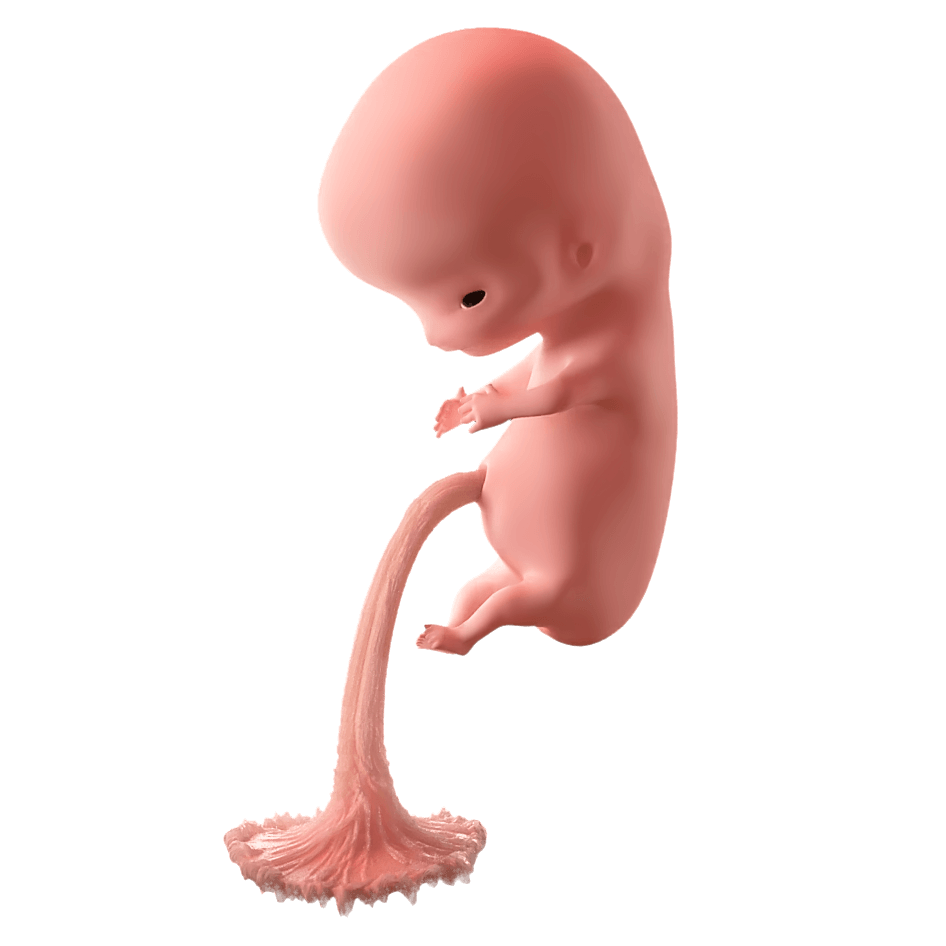
  • Although the organs will continue to grow and mature, the essential structure of the baby’s body is already in place.1

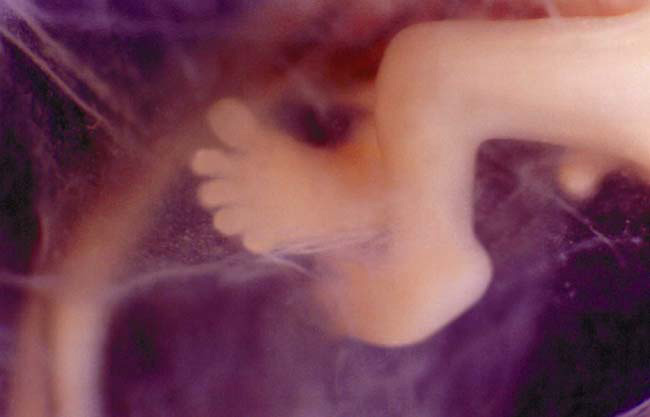
  • A light touch can prompt the unborn baby to curl fingers, bend the knee, withdraw the foot, and curl the toes.2

  • Between weeks 11 and 14, an ultrasound can predict the baby’s sex with about 75% accuracy. 3

By 11 weeks, once the unborn baby starts moving, he usually keeps moving for nearly two minutes straight. When he does stay still, it’s not for long—typically no more than five minutes at a time!4 Ultrasound studies reveal lively whole-body motions—small jumps, swimming-like movements, stretching, and rotating within the womb.5 6

This composite image rendered from light-guided endoscopy recordings shows a real living fetus at 9 weeks following [tooltip anchor="fertilization"]Sperm-egg fusion[/tooltip] (or 11 weeks gestation). At this point, he rarely stays still.  (Image Credit: <a href="https://erf.science/#high-resolution">Education Resource Fund</a>)
This composite image rendered from light-guided endoscopy recordings shows a real living fetus at 9 weeks following fertilization (or 11 weeks gestation). At this point, he rarely stays still. (Image Credit: Education Resource Fund)
What is the difference between an embryo and a fetus?

Human development unfolds in a continuous and precise process. From conception through about 8 weeks after conception, also known as 10 weeks gestation, the developing baby is called an embryo. During this time, the basic blueprint of the body is established. The baby who began as a single cell now has over one billion cells which have formed the baby’s major organs.7

By 11 weeks of pregnancy, the baby is called a fetus. Although the organs will continue to grow and mature, the essential structure of the body is already in place.8 It is one of biology’s greatest marvels that a single cell can give rise to the intricate complexity of a human being.

It is one of biology’s greatest marvels that a single cell can give rise to the intricate complexity of a human being.
What can the unborn baby feel and do at 11 weeks of pregnancy?

The unborn baby moves a lot! Arm movements become more frequent as the weeks progress,9 and the unborn baby starts bending his elbows.10 The baby also starts yawning.11 Between 11 and 17 weeks, the baby hiccups a lot. In fact, researchers observed about 100 hiccups per hour at these ages!12 Even in these early weeks, the womb is full of motion, practice, and preparation for life outside.

At the same time, the baby’s sense of touch is spreading across the body. By this stage, the face, forearm, palm, and sole of the foot are all sensitive to gentle contact.13 When the palm is touched, the tiny fingers begin to curl inward. If his foot is lightly touched, he may bend his knee, pull the foot away, and curl his toes.14 These increasingly coordinated motions reflect a remarkable surge in brain growth.15

At 11 weeks, if something touches the unborn baby's foot, he will pull it away and curl his toes. (Image Credit: <a href="https://www.priestsforlife.org/graphic-images/index.aspx?gid=1&sid=1">Priests for Life</a>)
At 11 weeks, if something touches the unborn baby's foot, he will pull it away and curl his toes. (Image Credit: Priests for Life)
At 11 weeks of pregnancy, a light touch can prompt the developing baby to curl fingers, bend the knee, withdraw the foot, and curl the toes.16
These twins started to grow differently around 9 weeks gestation. By 14 weeks, ultrasound imaging could identify each baby’s sex with almost perfect accuracy. (Image Credit: Adobe Stock Photos)
When is the baby’s sex determined?

The baby’s sex is determined at conception by the combination of X and Y sex chromosomes that the baby receives from the egg of the mother and the sperm of the father. Eggs contribute an X chromosome, while sperm contribute either an X or a Y chromosome. A baby with XY chromosomes develops male sex organs, while a baby with XX chromosomes develops female sex organs. Therefore, the father’s sperm determines a baby’s sex, meaning gender is determined at the moment of fertilization. 17

How do male and female babies develop differently?

Before week 9, both males and females begin with reproductive structures that are identical in appearance. The internal structures start to differentiate in week 9 as the SRY gene on the Y chromosome causes the testes to develop in males. Between 9 and 14 weeks, the baby’s internal sex organs start to develop. In males, the testes produce hormones essential for creating the male anatomy. In females, the lack of male hormones allows the development of the ovaries, uterus, fallopian tubes and upper vagina.18

Even while the internal structures change based on the baby’s gender, the baby’s external genitalia remain similar in appearance until about 11 weeks gestation. By 12 weeks, the external genitalia have started to lengthen in males to form the penis or shorten in females to form the clitoris and labia.19 Between weeks 11 and 14, an ultrasound can determine the baby’s sex with about 75% accuracy. 20 By 14 weeks, ultrasound imaging can identify the baby’s sex with almost perfect accuracy.21
The sense of smell before birth

A baby in the womb starts detecting smells around 7 months gestation. But before the baby can smell, the appropriate structures must develop first. Smell-sensing cells, called olfactory receptor neurons, can detect over 1 trillion different smells in humans.22 Located in the top of the nasal cavity, olfactory receptor neurons start growing in week 11 and reach a mature shape by week 13.23 24

When the olfactory receptor neurons detect a smell, they send an electrical signal to the olfactory bulb in the brain. The olfactory bulb starts forming in week 925 26 and has its layered structure by week 14.27 Even before the sense of smell is fully active, the trigeminal nerve can sense touch in the nose as early as 8 to 10 weeks and may respond to irritating chemicals as well.28

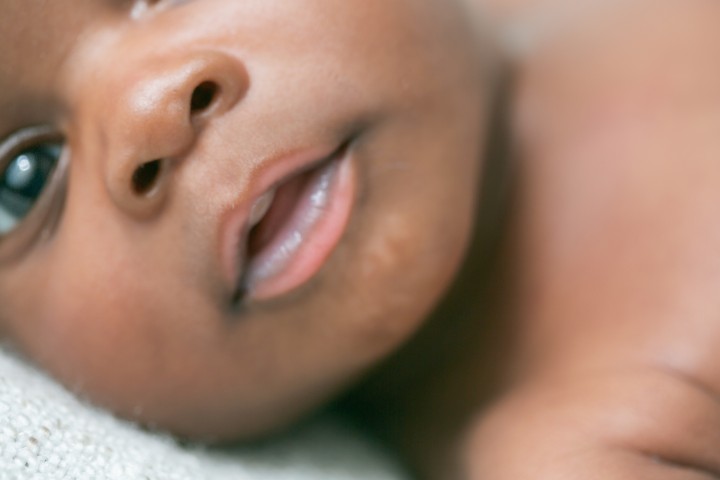
By the end of the first trimester, the baby has already formed much of the remarkable system that will one day detect over 1 trillion smells. (Image Credit: Adobe Stock Photos)
Continued development at 11 weeks gestation

In week 11 of pregnancy, in the third month, the baby’s body weight increases by 75%.29 Now the head is almost half of the entire crown-rump length of the baby.30

Light-sensitive cells, called rods and cones start forming in the back of the eye. These cells turn light into neural signals.31

This week, the first hair follicles start growing.32

In adults, the primary role of the thymus is to create white blood cells. This week, the thymus starts creating white blood cells, which it will do for the rest of the baby’s life.33

Between 11 and 17 weeks, the unborn baby hiccups a lot. In fact, researchers observed about 100 hiccups per hour at these ages!34
Dive Deeper
Around 11 weeks, male and female external genitalia start to develop differently...
Sperm-egg fusion
Sperm-egg fusion
Sperm-egg fusion
Sperm-egg fusion
Sex-determining Region Y
An ultrasound measurement of the distance between the top of the baby's head and the bottom of its buttocks