Search Icon
close-panel

Charlotte Lozier Institute

Phone: 202-223-8073
Fax: 571-312-0544

2776 S. Arlington Mill Dr.
#803
Arlington, VA 22206

Get Notifications

Sign up to receive email updates from Charlotte Lozier Institute.

This field is for validation purposes and should be left unchanged.

close-panel

Become A Defender of Life

Your donation helps us continue to provide world-class research in defense of life.

DONATE

Charlotte Lozier Institute

Phone: 202-223-8073
Fax: 571-312-0544

2776 S. Arlington Mill Dr.
#803
Arlington, VA 22206

Week 14

Goal-oriented hand movements

Human Prenatal Age
  • Post-conception Week 12
  • 4 Months Pregnant
  • Gestational Week 14
Highlights
  • The unborn child makes goal-oriented hand movements.1

  • Ultrasounds performed at 14 weeks predict the baby’s sex with almost perfect accuracy.2

  • Several eyelashes have formed.3

In gestational week 14, the baby grows rapidly, gaining about 25% more body weight.4 His body finally starts grows faster than his head, and his arms and legs become more proportional.5 In the weeks ahead, babies grow at different speeds, but all follow the same basic developmental path.

14 weeks of pregnancy: First conscious movements

At 14 weeks, the baby is very active, rarely staying still for more than about 2 minutes at a time.6 While some of the baby’s movements at 14 weeks gestation are jerky and uncoordinated,7 the first conscious and coordinated movements also emerge. If the baby has a twin, some of his movements will be directed towards the twin, and the baby moves more gently when reaching towards his twin’s face.8 Additionally, by 14 weeks the baby seems to display intentional movements — he will slow his hands down as they approach his own eyes or mouth.9 10

These purposeful movements will continue to occur in subsequent weeks. By 18 weeks, the baby will reach for his eyes and mouth faster and with greater precision when he uses his dominant hand,11 and by 22 weeks, an unborn child appears to recognize that his eyes are more delicate than his mouth and adjusts his movements accordingly.12

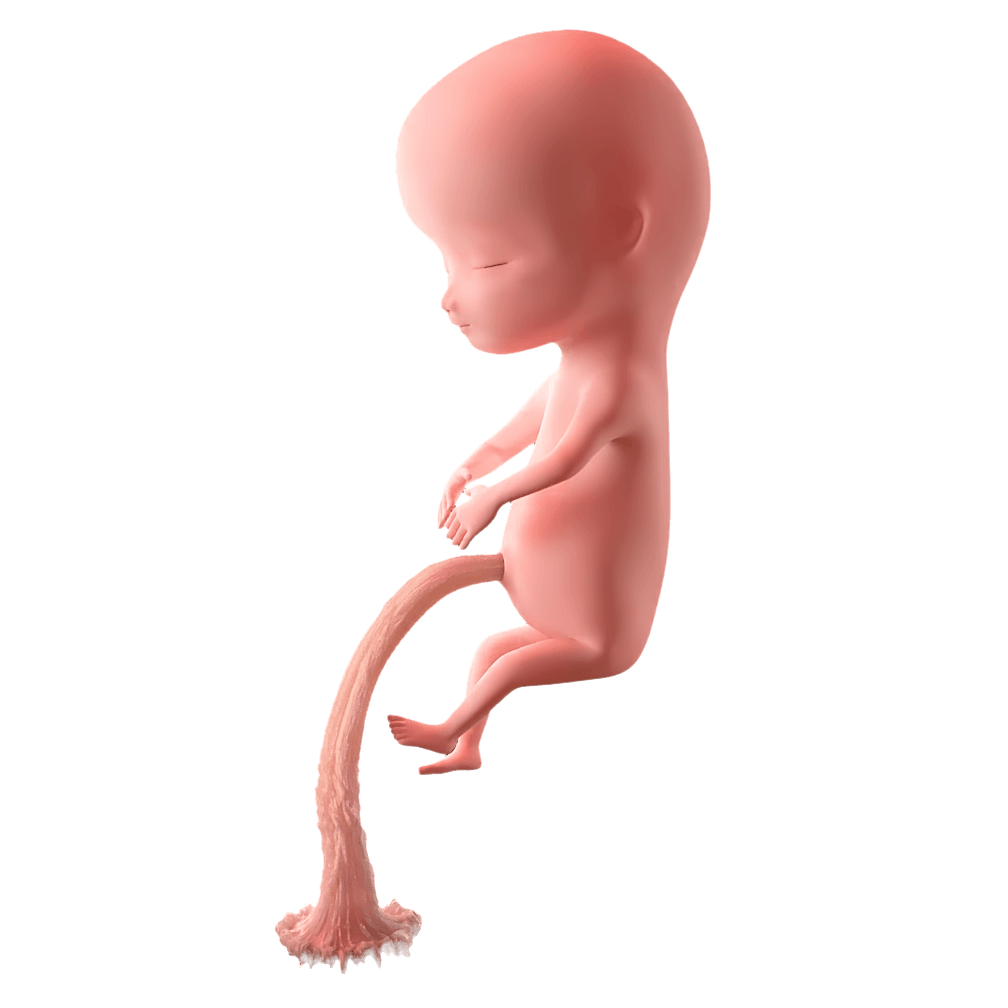
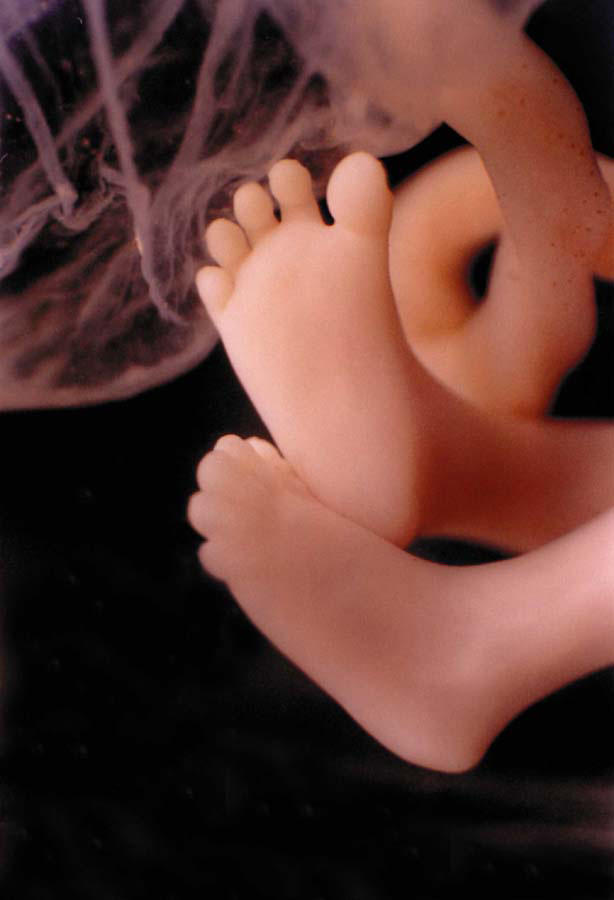
This composite image rendered from light-guided endoscopy recordings shows the embryo alive in the uterus 12 weeks following [tooltip anchor="fertilization"]Sperm-egg fusion[/tooltip] (or 14 weeks gestation). The first signs of conscious, goal-directed movements are recorded at this age. (Image Credit: <a href="https://erf.science/#high-resolution">Education Resource Fund</a>)
This composite image rendered from light-guided endoscopy recordings shows the embryo alive in the uterus 12 weeks following fertilization (or 14 weeks gestation). The first signs of conscious, goal-directed movements are recorded at this age. (Image Credit: Education Resource Fund)
At 14 weeks gestation, the unborn baby makes goal-oriented hand movements.13
When does the unborn baby start moving his eyes?

The unborn baby can spontaneously move his eyes starting between 14 and 16 weeks of pregnancy.14 These eye movements help the retina develop different types of cells15 and help link the visual and motor areas of the brain before birth.16

The baby starts drinking amniotic fluid. Individual fingerprints and toeprints are forming. (Image Credit: <a href="https://www.priestsforlife.org/graphic-images/index.aspx?gid=1&sid=1">Priests for Life</a>)
The baby starts drinking amniotic fluid. Individual fingerprints and toeprints are forming. (Image Credit: Priests for Life)
Swallowing, smell, and taste

Early in development, a fetus pulls away from touch. But by 12 weeks, he turns toward something brushing his face. By 14 weeks, he closes his mouth, swallows, and even moves his tongue when his lips are touched.17 Beginning around 14 weeks, the baby makes rhythmic jaw-opening and closing movements followed by swallowing, showing that he is drinking amniotic fluid.18 These movements mark the start of the rooting reflex that will later help him nurse.

By 14 weeks, all the major smell circuitry is in place, and the olfactory bulb, which processes scent in the brain, has distinctive layers.19 20 However, the fetal nose remains plugged until about week 18, preventing amniotic fluid from washing through the nasal cavity and moving scents into the fetal nose.21 Nevertheless, the baby likely reacts to irritating touches and chemicals in the nose at this point, before smell sensation has fully developed.22

A taste bud is a tiny cluster of 50 to 100 receptor cells that work together to detect flavor. Distinct types of taste cells are visible by 14 weeks.23 These cells surround a small opening called a taste pore, where food chemicals collect. Taste pores, which are only seen as tastebuds mature, start forming between 12 and 16 weeks.24

 

How do female babies form a uterus?

The uterus begins forming early in pregnancy. Around week 8, two symmetrical tubes called Müllerian ducts appear in a female embryo. These ducts grow downward and move closer together. By week 12, they start to fuse in the middle to form a single hollow organ. The upper part becomes the uterus, while the lower part forms the cervix and upper vagina. By week 14, the basic shape of the uterus is formed, though it will keep growing and maturing throughout the rest of pregnancy. The uterus will eventually be the strong, muscular organ that supports a baby if she becomes pregnant in the future.25

By 14 weeks, boys and girls have very different genitalia. Ultrasounds performed at 14 weeks predict fetal sex with almost perfect accuracy.26

Continued development at 14 weeks of pregnancy

At 14 weeks gestation, in the fourth month of pregnancy, every body system in the unborn baby continues to advance. The stomach lining and intestines secrete a wide variety of digestive hormones and enzymes.27

By 14 weeks, the entire length of the baby’s small intestine is lined with villi, finger-like structures that increase the surface area in the intestine so that it can absorb more nutrients. The cells in the intestinal walls have been absorbing water and glucose for over a week, but the villi make this process more efficient.28 Peristalsis are wave-like muscle contractions that propels food, fluids, and waste through the digestive tract. Peristalsis can begin as early as week 14 in the baby’s large intestine.29

Around week 14, the liver starts producing bile.30 The bile moves into the digestive tract via the gallbladder and cystic duct, which formed in gestational week 7. 31 The bile gives the fluids in the intestines a dark green color and will make the baby’s first poop greenish-black.32

At 14 weeks of pregnancy, the skin is now 3 layers thick.33 Hair starts to form on the face and head around 14 weeks.34 The eyebrows grow through the skin and can now be seen.35 Several eyelashes have formed.36 Individual fingerprints and toeprints keep forming.37

The cerebellum has started to form. The cerebellum will control muscle coordination. It starts having its typical accordion-folded shape around 4 months.38 At 14 weeks, nerve cells are reproducing at the rate of about 15 million per hour.39

At 14 weeks, nerve cells are reproducing at the rate of about 15 million per hour!40
Dive Deeper
Why do some viruses, like Zika virus, infect the unborn while others, like COVID-19, rarely do...
Several COVID-19 vaccine candidates used abortion-derived cell lines in laboratory testing
Sperm-egg fusion
Wave-like muscle contractions that propels food, fluids, and waste through the digestive tract
Digestive fluid that breaks down fats