




Search Icon
close-panel

Charlotte Lozier Institute

Phone: 202-223-8073
Fax: 571-312-0544

2776 S. Arlington Mill Dr.
#803
Arlington, VA 22206

Get Notifications

Sign up to receive email updates from Charlotte Lozier Institute.

This field is for validation purposes and should be left unchanged.

close-panel

Become A Defender of Life

Your donation helps us continue to provide world-class research in defense of life.

DONATE

Charlotte Lozier Institute

Phone: 202-223-8073
Fax: 571-312-0544

2776 S. Arlington Mill Dr.
#803
Arlington, VA 22206

Week 4

The emergence of a body plan

Human Prenatal Age
  • Post-conception week 2
  • Days of life 14-20
  • Gestational Week 4
Highlights
  • A pregnancy test should accurately report a pregnancy this week.1

  • The baby’s cells may enter the mother’s body, and the mother’s cells may enter the baby’s body, potentially remaining for years.2

  • Early brain tissue starts to form.3 Early heart tissue starts to form a simple tube.4

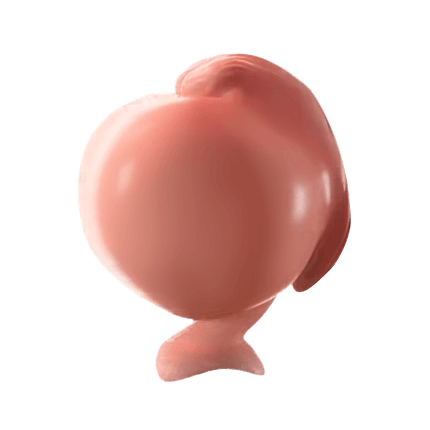
This is no ball of cells! The complexity of the embryo in week four gives the developing human a well-defined blueprint. Cells form distinct layers and the entire body plan begins to emerge. Each cell’s position will give it a specific destiny based on the chemical messages surrounding it.

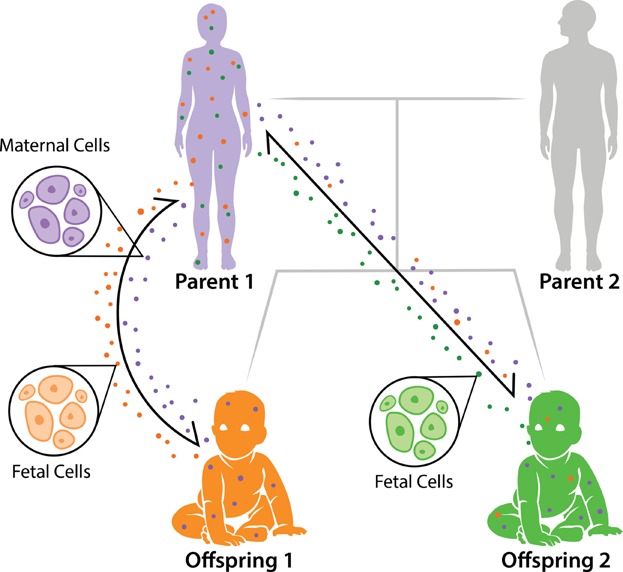
Microchimerism happens when cells pass between mother and baby during pregnancy. During pregnancy the baby’s cells enter the mother’s body, and the mother’s cells enter the baby’s body. These cells can stay for years. Sometimes, cells from an older sibling may even be passed to a younger one. (Image Credit: <a href="https://onlinelibrary.wiley.com/doi/full/10.1002/bies.201500059">BioEssays</a>)
Microchimerism happens when cells pass between mother and baby during pregnancy. During pregnancy the baby’s cells enter the mother’s body, and the mother’s cells enter the baby’s body. These cells can stay for years. Sometimes, cells from an older sibling may even be passed to a younger one. (Image Credit: BioEssays)
Can a baby’s cells stay in the mother’s body?

During pregnancy, mother and baby share more than nutrients—they exchange living cells. This process, called microchimerism, begins as early as 4 weeks. Maternal cells help train the baby’s immune system, and astonishingly, even a grandmother’s cells can be found in a newborn.5 At the same time, the baby’s cells enter the mother’s body and can remain there for decades.6 These fetal cells have been found in organs like the heart, where they may help repair tissue.7 For some mothers, especially after loss, this offers a quiet truth: a child’s presence remains in her body in a real, physical way long after pregnancy ends.

For anyone who has experienced loss, the discovery that a baby’s cells can remain in a mother’s body for years offers a quiet, tangible reminder that this small life is still present in a real and lasting way.
The early circulatory system

The circulatory system also starts developing remarkably early.  Early blood vessels start to form a network throughout the unborn baby by 18 days after conception.8 Remarkably, the embryo’s earliest heart cells start to develop even earlier, by 16 days after conception.9 Heart cells start forming a simple tube.10 By the end of the week, some of the early heart muscle cells begin to twitch, but their movements are not yet coordinated.11 By 22 days after conception, the heart starts beating rhythmically.12 13

Interestingly, blood forming cells start growing outside the embryo in the umbilical vesicle, also known as the yolk sac, around 18 days after conception. These blood forming cells move into the liver about 5 days later, then finally settle in the bone marrow at 10 ½ weeks after conception.14 Further clusters of blood-producing cells can be found near the embryonic aorta between days 27 and 40 after conception.15 The liver becomes the primary blood-forming organ from about 8 weeks until 24 weeks gestation.16

The early nervous system

At 18 days after conception, scientists observe the first sign of the developing brain. Neuroectoderm tissue thickens and forms the neural plate. The neural plate will fold together to become the neural tube, which later becomes the brain and spinal cord.17

Cell layers

Remember how the zygote and the early embryonic cells could become almost any cell in the human body? Now the cells start to specialize based on their position. As can be seen in the picture, the embryo becomes wide and flat. A cross section of the embryo reveals three different layers: endoderm, mesoderm, and ectoderm.18 19

Different body systems form from each layer. Cells from the ectoderm will become the skin, hair, and fingernails. A specialized layer of ectoderm, called neuroectoderm, becomes the nerves and brain. Cells from the middle layer, called mesoderm, will become the heart, kidneys, bones, blood vessels and muscles. Cells from the endoderm, near the yolk sac, become major parts of the intestines, pancreas, liver, and lungs.20 21

The inner cells of the embryo now form three layers: The top layer becomes the skin, nervous system, eyes and ears. The middle layer contributes to the muscles, bones, kidneys and reproductive system. The inner layer contributes to the baby’s lungs and intestines.[citation text="Rehman, B., & Muzio, M. R. (2023). Embryology, Week 2-3. In StatPearls. StatPearls Publishing. https://www.ncbi.nlm.nih.gov/sites/books/NBK546679/" href="https://www.ncbi.nlm.nih.gov/sites/books/NBK546679/"] (Image Credit: Nik Spencer/<em><a href="https://www.nature.com/articles/d41586-021-02343-7">Nature</a></em>)
The inner cells of the embryo now form three layers: The top layer becomes the skin, nervous system, eyes and ears. The middle layer contributes to the muscles, bones, kidneys and reproductive system. The inner layer contributes to the baby’s lungs and intestines.22 (Image Credit: Nik Spencer/Nature)
Bonded by blood: the placenta

The placenta and umbilical cord are the lifeline for the rapidly developing baby. Oxygen and vital nutrients flow from the mother to the unborn child, while harmful wastes like carbon dioxide are carried back to the mother through placental circulation. Just 13 days after conception, blood flow between the uterus and placenta has begun.23 The embryo, as pictured above, is connected to the early placenta via a connecting stalk. The connecting stalk later develops into the umbilical cord.24 The placenta forms through an intricate interaction between maternal and embryonic tissues. Perhaps most fascinating of all, the placenta is the only fetal organ shared by mom and baby. The placenta carries the baby’s DNA but is intimately embedded in the mother.25

Dive Deeper
A baby's cells may remain in the mother's body for decades ...
The placenta and umbilical cord form as maternal and embryonic tissues interact...
Sperm-egg fusion
Sperm-egg fusion
Sperm-egg fusion
Sperm-egg fusion
Sperm-egg fusion
Sperm-egg fusion
Sperm-egg fusion
Unique single-celled human
Sperm-egg fusion