












Authored by Mariana Timler, Elyse Gaitan, & Tessa Cox
This is Issue 112 of the On Point Series. (An earlier version of this paper, published in 2021 as On Point Issue 71, can be found here.) Editor’s note: this paper was updated on October 30, 2025 to reflect an amendment to Tennessee’s safe haven law.
Executive Summary:
- Safe haven laws provide mothers in crisis an alternative to abortion or child abandonment by allowing them to safely and anonymously relinquish the child at a safe haven for future adoption.
- All 50 states and DC have safe haven laws permitting babies to be relinquished at various health care or other facilities, with different states having different requirements for where, when, and how babies can be relinquished. This paper provides a table detailing the specifics of each state’s safe haven laws.
- Data suggests that safe haven laws have led to a fall in infanticide rates in the U.S. From 2008 to 2017, when most states passed safe haven laws, infanticide incidence saw a 66.7% decrease from the incidence between 1989 to 1998. 5,068 infants have been relinquished since 1999, the year of the first safe haven law.
- Another approach to relinquishing infants is the use of “baby boxes”—temperature-controlled hatches located on the wall of an emergency medical services location accessible from the outside. They provide a place for women to surrender their infants without human interaction.
- There is room for greater clarity and cohesion between safe haven statutes. Mothers in crisis need to know their options and that safe haven laws offer a life-saving choice.
Introduction
In the wake of the U.S. Supreme Court’s decision in Dobbs v. Jackson, which mentioned safe haven laws in both oral arguments and in the majority opinion of the court,[1] there has been renewed focus on safe haven laws. These laws provide women in crisis an alternative to abortion or child abandonment by allowing for a child to be relinquished at a safe haven anonymously, afterwards intending that any child surrendered will be placed with a suitable adoptive family. Thus, these laws provide a way for a mother in crisis to surrender her child, without endangering her infant’s life in her desperation.
Background
Enacted in 1999, Texas’s Baby Moses Law was the first safe haven law in the United States. It was passed in reaction to a significant increase in child abandonment. In 1999 alone, Texas had 13 incidents of child abandonment with three of them resulting in the infants’ deaths.[2] Sadly, until the advent of the Baby Moses Law, there was no protocol in the United States to prevent infant abandonment. While the Texas legislature originally sought to prevent infant abandonment in its own state with this law, it inspired safe haven legislation throughout the country.[3]
Soon after Texas passed its safe haven law, the rest of the 50 states (as well as the District of Columbia) followed. While these laws vary in wording and format, they have a few similarities. All of them specify an age cutoff and the locations where an infant can be relinquished.[4] In all 50 states and DC, infants can be surrendered at a licensed health care facility or hospital with a twenty-four hour, open seven days a week emergency department. Additionally, 41 states allow infants to be surrendered at designated fire stations or to firefighters, and 35 states at law enforcement agencies or to law enforcement officers. Eight states allow EMS providers responding to an emergency call to take custody of an infant, and five different states allow for babies to be relinquished at places of worship. Additional designated safe haven locations are outlined in each state’s law.
In most states, a parent (either father or mother) or a legal guardian must relinquish the child. However, two states require the mother to relinquish the baby, and seven allow any person, without specifying their relation to the infant. Certain states also allow for an individual designated by the infant’s parents to relinquish the child. In 21 states, the age limit to surrender an infant is approximately 30 days, and in nine states, the limit is approximately 60 days. The remaining states vary on age, with some only allowing an infant to be relinquished within the first 72 hours of his or her life, and one state allowing the relinquishment of infants up to one year of age.
The goal of every safe haven law is to protect the safety of the infant; thus, each of these laws are fashioned around what each state believes to be best for the infant’s protection. However, it is crucial to note that safe havens are not meant to be interchangeable with adoption. Whenever possible, adoption is the best option for the overall well-being of the child, birth parents, and adoptive family, but in desperate situations, safe havens are necessary to ensure that an infant’s life is not put into jeopardy. See Table 1 below for specifics on each state’s safe haven laws.
Table 1: Safe Haven Criteria by State[5]
| State | Infant Age Limits | Who Can Relinquish | Where (or With Whom) Can a Person Relinquish |
| Alabama | 45 days old or younger | A parent | 1) Licensed hospital 2) Any fire station staffed 24/7 with at least one EMS worker |
| Alaska | Younger than 21 days | A parent | 1) Peace officer 2) Community health aide 3) Physician 4) Hospital employee 5) Employee or volunteer for a fire department EMS 6) Any person who the parent reasonably believes would provide for the health and safety of the infant and would act appropriately to care for the infant |
| Arizona | 30 days old or younger | A parent or an agent of a parent | 1) On duty firefighter 2) On duty EMT 3) On duty staff member at a general hospital or rural general hospital 4) A staff member or volunteer at an organization including a licensed private child welfare agency, a licensed adoption agency, or a church that publicly posts a notice that it is willing to accept a newborn infant under this safe haven law |
| Arkansas | 30 days old or younger | A parent | 1) Medical provider 2) Law enforcement agency 3) Fire department |
| California | 72 hours old or younger | A parent or an individual with lawful custody of the child | 1) All hospitals, public or private 2) Designated fire stations 3) Designated safe-surrender site by the board of supervisors of a county or by a local fire agency |
| Colorado | 72 hours old or younger | A parent | 1) Firefighter 2) Staff member who engages in the admission, care, or treatment of patients at a hospital or community clinic emergency center |
| Connecticut | 30 days old or younger | A parent or a lawful agent of the parent |
ER nursing staff |
| Delaware | 14 days old or younger | An individual | Employee or volunteer of the emergency department of a hospital or a police station |
| District of Columbia | 14 days old or younger | A custodial parent who is a resident of D.C. | Hospital or other place authorized by the mayor |
| Florida | 30 days old or younger | A parent | 1) Hospital 2) EMS station 3) Fire station |
| Georgia | 30 days old or younger | The mother | Employee or volunteer of a: 1) Fire station 2) Medical facility (excludes dentist’s or doctor’s offices) 3) Police station |
| Hawaii | 72 hours old or younger | Any person | Personnel of: 1) Hospital 2) Fire station 3) Police station4) Emergency services |
| Idaho | 30 days old or younger | Custodial parent | 1) Licensed hospitals 2) Licensed physicians and staff working in their offices and clinics 3) Advanced professional nurses 4) Licensed PAs 5) First responders 6) EMTs 7) Paramedics 8) Fire station |
| Illinois | 30 days old or younger | A parent | Personnel of a: 1) Hospital 2) Police station 3) Fire station 4) Emergency medical facility |
| Indiana | 30 days old or younger | A parent | 1) Firefighter 2) Law enforcement officer 3) Paramedic 4) EMT 5) Physician 6) Nurse 7) Other person who provides emergency medical services 8) 911 call |
| Iowa | 90 days old or younger | A parent or another person authorized to act on behalf of the parents |
1) Institutional health facility 2) Fire station 3) Adoption service provider 4) Medical staff at hospital or other facility following delivery 5) 911 call |
| Kansas | 60 days old or younger | A parent or another person with lawful custody |
On-duty employee at a: 1) Police station 2) Sheriff’s office 3) Law enforcement center 4) Fire station 5) City or county health department 6) Medical care facility |
| Kentucky | Younger than 30 days | A parent | 1) With an EMS provider
2) Police station |
| Louisiana | 60 days old or younger | A parent | Employee of: 1) Licensed hospital 2) Local or parish public health units 3) Licensed rural health clinics 4) Licensed ambulatory surgical centers 5) Federally qualified health centers 6) Manned fire station 7) Manned law enforcement station |
| Maine | Younger than 31 days | Any person | 1) Law enforcement officer 2) Staff at a medical ER 3) Medical services provider including, but not limited to, a physician, nurse, podiatrist, optometrist, chiropractor, physical therapist, dentist, psychologist, PA, or EMS person 4) A hospital staff member at a hospital 5) A firefighter 6) A person staffing a facility with a safe haven baby box |
| Maryland | 60 days old or younger | The mother or a person with the mother’s approval | 1) Hospital 2) Office of a licensed medical provider 3) Police department or state police barracks 4) Insured professional or volunteer fire company 5) Any facility designated by the Secretary of Human Services by regulation |
| Massachusetts | 7 days old or younger | A parent | 1) Hospital 2) Police department 3) Manned fire station |
| Michigan | 72 hours old or younger | A parent | A uniformed employee at a: 1) Fire department 2) Hospital 3) Police station4) A paramedic or EMT when responding to a 911 call |
| Minnesota | 7 days old or younger | The mother or a person with the mother’s permission | 1) Licensed hospital 2) Health care provider who provides urgent care medical services 3) Ambulance service dispatched by a 911 call from the mother or a person with the mother’s permission |
| Mississippi | 45 days old or younger | A parent or a person designated by the parent |
EMS provider: 1) Licensed hospital with an ER 2) Adoption agency duly licensed by the Department of Child Protection Services 3) After delivery at a hospital 4) State or local law enforcement agency 5) Fire station 6) Mobile ambulance staffed with full-time firefighters, EMTs, paramedics 7) 911 call |
| Missouri | 45 days old or younger | The biological parent or a person acting on the parent’s behalf | Any staff member or volunteer: 1) Hospital 2) Maternity home 3) Pregnancy resource center 4) Firefighter 5) EMT 6) Law enforcement officer |
| Montana | 30 days old or younger | A parent | Uniformed employee: 1) Fire department 2) Hospital 3) Law enforcement agency |
| Nebraska | 90 days old or younger | Any person | Employee: 1) Licensed hospital 2) Staffed fire station 3) Staffed law enforcement agency 4) Emergency medical care provider |
| Nevada | 30 days old or younger | A parent | 1) Hospital 2) Freestanding birthing center 3) Licensed independent center for emergency medical care 4) Public fire-fighting agency, including a volunteer fire department 5) Law enforcement agency 6) Permit-holding ambulance service 7) Child welfare agency |
| New Hampshire | 61 days old or younger | A parent | 1) Licensed hospital 2) Church with staff present 3) Police station with staff present 4) Fire station with staff present 5) 911 responder at an agreed transfer location |
| New Jersey | 30 days old or younger | A parent or another person arranged by the parent | 1) Police station 2) Staffed 24/7 fire station or volunteer fire department 3) Staffed 24/7 public or private ambulance, first aid, or rescue squad 4) ER of a licensed general hospital |
| New Mexico | 90 days old or younger | Any person | Staff at: 1) Hospital 2) Law enforcement agency 3) Fire station |
| New York | 30 days old or younger | A parent, guardian, or other person legally charged with the care or custody of a child less than 14 years old | “The child is left with an appropriate person, or in a suitable location.” |
| North Carolina | 30 days old or younger | A parent | 1) On-duty health care provider at a hospital, local or district health department, or a nonprofit community health center 2) On-duty first responder including law enforcement officer, a certified EMS worker, or a firefighter 3) On-duty social services worker or local department of social services |
| North Dakota | 1 year or younger | A parent or an agent of the parent with the parent’s consent | A licensed hospital or any other approved location as designated by administrative rule adopted by the department |
| Ohio | 30 days old or younger | A parent | 1) Peace officer 2) Peace officer support employee 3) Hospital employee 4) EMS worker 5) Law enforcement agency 6) 911 call |
| Oklahoma | 30 days old or younger | A parent | 1) Medical services provider Employee of a: 2) Police station 3) Fire station 4) Child protective services agency 5) Hospital or other medical facility |
| Oregon | 60 days old or younger | A parent | 1) Hospital 2) Freestanding birthing center 3) Physician’s office 4) Sheriff’s office 5) Police station 6) Fire station |
| Pennsylvania | Younger than 28 days | A parent | 1) Emergency medical responder, EMT, paramedic 2) Health care provider at a hospital or urgent care center 3) Police officer at a police department |
| Rhode Island | 30 days old or younger | Any person | Staff at: 1) Hospital 2) Open medical emergency facility 3) Fire station 4) Police station |
| South Carolina | 60 days old or younger | A parent or a person acting at the direction of the parent |
1) Hospital or hospital outpatient facility 2) Law enforcement agency 3) Fire station 4) EMS station 5) Any staffed house of worship |
| South Dakota | 60 days old or younger | A parent | 1) Licensed health care facility or ambulance service 2) Law enforcement agency 3) Fire department 4) Licensed child placement agency |
| Tennessee | 45 days old or younger | The mother | 1) Hospital 2) Birthing Center 3) Community health clinic 4) Out-patient walk-in clinic 5) 24/7 staffed fire department 6) 24/7 staffed law enforcement facility 7) EMS facility 8) Emergency communications center 9) Nursing home |
| Texas | 60 days old or younger | A parent | 1) EMS provider 2) Hospital 3) Licensed freestanding emergency medical care facility 4) Licensed child-placing agency 5) Fire department |
| Utah | 90 days old or younger | A parent or a parent’s designee | A 24/7 hospital |
| Vermont | 30 days old or younger | Any person | Employee or volunteer at: 1) Health care facility 2) Fire station 3) Police station 4) Place of worship 5) Licensed entity authorized to place minors for adoption 6) “A 911 emergency responder at a location where the responder and the person have agreed to transfer the child.” |
| Virginia | 30 days old or younger | A parent | Hospital with 24-hour emergency services or attended EMS agency |
| Washington | Younger than 72 hours | A parent | 1) Employee or volunteer of a hospital with an ER or federally designated rural health clinic during operating hours 2) Firefighter, volunteer, or EMT at a fire station |
| West Virginia | Younger than 30 days | A parent | 1) A hospital or health care facility operating in this state 2) Fire department 3) EMS facility 4) Police department 5) 911 call center 6) Sheriff’s detachment that has been designated a safe-surrender site |
| Wisconsin | 72 hours old or younger | A parent | 1) Sheriff’s office 2) Police station 3) Fire station 4) Hospital 5) “Other place where a law enforcement officer, EMS practitioner, or hospital staff member is located” 6) 911 call |
| Wyoming | 60 days old or younger | A parent or the parent’s designee | 1) 24/7 fire station 2) 24/7 hospital with ER 3) 24/7 police department or sheriff’s office 4) “Any other place of shelter and safety identified by the department of family services which meets the requirements of rules and regulations promulgated pursuant to W.S. 14-11-107.” |
Anonymity and Confidentiality by State
States also vary in their policies regarding the anonymity of the relinquishing individual. The protections regarding the identity of a relinquishing individual fall into three categories: complete anonymity, restrictions on safe haven providers’ ability to require identification of individuals relinquishing infants, and confidentiality for information provided. Many states fall into more than one category. There are 20 states plus the District of Columbia which provide for anonymity of the parent or authorized relinquishing individual.[6] There are 41 states plus the District of Columbia where the safe haven cannot require the identification of the parent or relinquishing individual before accepting an infant.[7] There are 21 states which provide confidentiality for the information provided by the parent or relinquishing individual.[8]
Policy Directions
Given that the details of each state’s safe haven law vary significantly, as safe haven laws have garnered increased attention, some experts have proposed model legislation for states to consider. Legal scholar Rachel M. Wagner offers her own version of model safe haven legislation.[9] Her model requires that the infant must be one month old or younger, since newborns in their first 24 hours of life are at their most vulnerable. Thus, they should have priority under safe haven laws.[10] In determining age limits, relinquishment trauma should be considered along with a child’s risk of infanticide. Relinquishment trauma’s severity increases the older a child is upon surrender, and separating a child from his or her mother at this stage of development could cause harm.[11] As Wagner notes, model safe haven legislation should adequately balance the needs of the parent surrendering the child with those of the infant. According to her, the one-month age limit provides an acceptable compromise.[12]
Additionally, Wagner’s model allows infants to be surrendered at designated surrender facilities, but excludes adoption agencies, churches, and health care professionals, such as dentists and chiropractors, which a few states consider as surrender sites.[13] Her model also prohibits notice being given in the local papers upon an infant’s surrender, believing it could disturb the parent’s anonymity.[14] Lastly, Wagner includes baby boxes (more on which below) in her model legislation because of their potential to save the lives of infants who would otherwise have been abandoned due to the mother’s fear of recognition.[15]
An alternative to the safe haven legislation proposed by Wagner is that developed by the National Safe Haven Alliance (NSHA). Rather than Wagner’s maximum of 30 days, the NSHA recommends implementing an age limit of 30 days at a minimum with a maximum of 60 days.[16] The NSHA mentions baby boxes but does not take a stance on funding, whereas Wagner maintains that they should not be funded by the state but only through fundraising and donations in order to reduce the cost of legislation and make it less controversial.[17]
Safe Haven Trends
One study of 559 mothers found that, overwhelmingly, the mothers who surrendered or abandoned their infants were very young and from low socioeconomic backgrounds.[18] Additionally, the study found that out of 73 mothers with religious affiliations, 84% identified as Catholic and 93% identified with religions that disapproved of contraception,[19] perhaps providing evidence for why these women chose not to abort their children. Another study which analyzed infant homicide rates between 2008 and 2017 found that the majority of infant homicide victims were born to mothers who were unmarried and had limited formal education.[20]
Data suggests that the implementation of safe haven laws has led to a fall in infanticide rates in the United States. From 2008 to 2017, the timespan within which most states passed safe haven laws, U.S. infanticide incidence rates saw a 66.7% decrease from the incidence rate between 1989 to 1998.[21] Furthermore, infanticide in which abandonment was known to be the cause of death decreased from 19% of all infanticide cases before safe haven laws were passed to 5% after most states saw them take effect.[22]
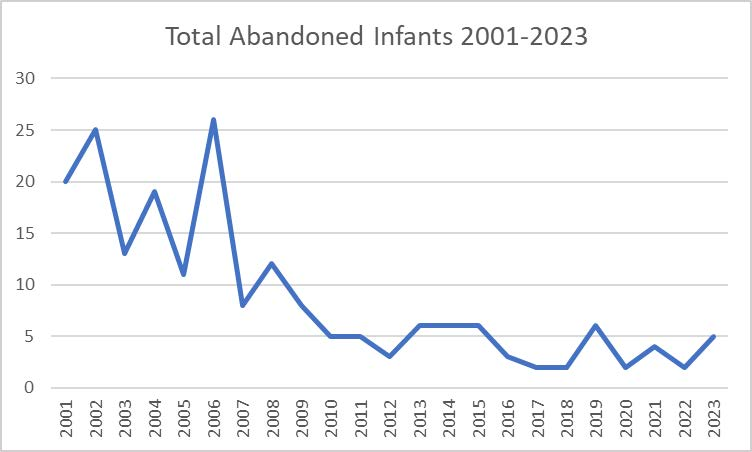
It is impossible to definitively say how many children’s lives have been saved through safe haven laws, since it is not known whether these children would have been abandoned if they had not been surrendered. However, looking only at the numbers of infants safely surrendered, 5,068 have been relinquished since 1999,[23] the year of the first safe haven law. Conversely, since 1999, 1,700 infants have been illegally abandoned.[24] While these numbers demonstrate that the problem of infant abandonment is ongoing, safe haven laws seem to have contributed to a significant reduction in the number of infants illegally abandoned each year.
Baby Boxes
Baby boxes are temperature-controlled hatches located on the wall of an emergency medical services location, like a fire station, and accessible from the outside. They provide a place for women to surrender their infants without the need for human interaction.[25] With a total of 350 baby boxes in 23 states,[26] baby boxes are rapidly spreading across the United States. Since they were first installed in the U.S. in 2016, there have been 53 baby box surrenders.[27] Twenty-five states expressly permit baby boxes in state law,[28] although baby boxes are not necessarily prohibited in states without these explicit protections. Some states with recent baby box laws do not yet have baby boxes in operation, while other states have baby boxes without having established baby box laws.
Advocates of baby boxes believe these boxes are instrumental in stopping infant abandonment.[29] The anonymous nature of the boxes means that a woman who might otherwise abandon her child for fear of recognition, may now surrender her infant unharmed. However, anonymity can also carry risks. Because the baby box is anonymous, it can be difficult to ensure that the infant was not kidnapped or abandoned against his or her mother’s will, although many states require safe haven staff to check missing child reports before placing the infant in a pre-adoptive home.[30] Furthermore, advocates for face-to-face surrender argue that baby boxes may serve to exacerbate infant abandonment because of how simple it is for mothers to surrender their children in them.[31] Additionally, the mother relinquishing her child often needs medical attention, and without in-person surrender, she loses the opportunity for resources or medical assistance.[32] Some opponents also cite the costs of installation and training and argue that funds could be spent on other purposes.[33],[34] Another common argument against baby boxes is that they deny the child the right to know his or her parents, a crucial part of any child’s identity.[35]
However, baby box proponents note that none of these criticisms account for the fact that baby boxes have the potential to save lives. If baby boxes can prevent the abandonment of even some infants, then they are worth having. Proponents assert that opponents of baby boxes should be wary of letting the child’s right to know and be cared for by his or her parents overshadow the child’s right to life.[36] In advocates’ view, if the alternative to baby boxes is the death of the child, then they should be implemented no matter the potential drawbacks.
Conclusion
While safe haven laws are just one aspect of protecting life, they are an important one. Ideally, mothers would be able to parent their babies or choose to place their children in open adoptions rather than relinquish them. Yet, the rising rates of infant abandonment called for a response, and state legislators had a duty to reply. With over 5,000 infants relinquished since their institution,[37] safe haven laws have worked to reduce the high rates of infant abandonment. While the states’ enactment of safe haven laws was a good start, there is room for greater clarity and cohesion between safe haven statutes. Mothers in crisis need to know their options and that safe haven laws offer a life-saving choice.
Mariana Timler served as an intern at Charlotte Lozier Institute in Summer 2025.
Elyse Gaitan is Research Associate at Charlotte Lozier Institute.
Tessa Cox is Senior Research Associate at Charlotte Lozier Institute.
[1] Dobbs v. Jackson Women’s Health Organization, 597 U.S. __, No. 19‑1392 (2022), pp. 33–34, https://www.supremecourt.gov/opinions/21pdf/19-1392_6j37.pdf; Tom Joyce, “Amy Coney Barrett Is Right about Safe Haven Laws,” Washington Examiner, December 5, 2021, https://www.washingtonexaminer.com/news/2879153/amy-coney-barrett-is-right-about-safe-haven-laws/. Accessed July 2025.
[2] Nevada Legislative Counsel Bureau, Bulletin No. BP01‑03 (Carson City: Nevada Legislative Counsel Bureau), 3–4, https://www.leg.state.nv.us/division/research/publications/bkground/bp01-03.pdf.
[3] Texas’s law originated from the biblical story of baby Moses, who, as an infant, was left in a basket on the banks of the Nile River. His mother did this to save her son from infanticide at the hands of the Egyptians, who had been commanded by their Pharoah to kill all the firstborn sons of the Jewish people. Thus, Texas drew biblical inspiration for the title of its law, in part, to highlight the great sacrifice that a mother makes in deciding to relinquish her child at a safe haven. Just as Moses’s mother had to make the difficult decision to leave her infant son, so these mothers in crisis choose to make a heavy but courageous choice when they surrender their children through a safe haven.
[4] AL Code § 26‑25‑1 (2024); AK Stat. §§ 11.81.500, 47.10.013 (2024); AZ Rev. Stat. § 13‑3623.01; AR Code §§ 9‑34‑201–9‑34‑204 (2024); CA Health & Safety Code § 1255.7 (2024); CO Rev. Stat. § 19‑3‑304.5 (2024); CT Gen. Stat. §§ 17a-57–17a-61 (2024); 16 DE Code § 907A (2024); DC Code §§ 4-1451.01–4-1451.08 (2024); FL Stat. §§ 383.50–383.51 (2024); Ga. Code §§ 19-10A-1–19-10A-7 (2024); HI Rev. Stat. §§ 587D-1–587D-7 (2024); ID Code §§ 39-8201–39-8207 (2024); 325 ILCS 2/ (2024); IN Code §§ 31-34-2.5-1–31-34-2.5-6 (2024); IA Code §§ 233.1–233.6 (2024); KS Stat. § 38-2282 (2024); KY Rev. Stat. § 405.075 (2024); LA Chil Code Arts. 1149–1161 (2024); 22 ME Rev. Stat. § 4018 (2024); MD Courts & Judicial Proceedings Code § 5-641 (2024); MA Gen. L. ch. 119 § 39½ (2023); MI Comp. L. §§ 712.1–712.20 (2024); MN Stat. § 145.902 (2024); MS Code §§ 43-15-201–43-15-211; MO Rev. Stat. § 210.950 (2024); MT Code §§ 40-6-401–-40-6-417 (2024); NE Rev. Stat. § 43-4903 (2024); NH Rev. Stat. §§ 132-A:1–A:5 (2023); NJ Rev. Stat. §§ 30:4C-15.5–30:4C-15.9 (2024); NM Stat. §§ 24-22-1–24-22-8 (2024); NV Rev. Stat. § 432B.630 (2024); NY Penal L. § 260.00 (2024); NC Gen. Stat. §§ 7B-520–7B-528 (2024); ND Cent. Code § 50-25.1-15 (2024); OH Rev. Code § 2151.3515–2151.3533 (2024); 10A OK Stat. § 1-2-109 (2024); OR Rev. Stat. § 418.017 (2023); 23 PA Cons. Stat. §§ 6501–6509 (2024); RI Gen. L. §§ 23-13.1-1–23-13.1-8 (2024); SC Code § 63-7-40 (2024); SD Codified L. § 25-5A-27–25-5A-35 (2023); TN Code § 68-11-255 (2024); TX Fam. Code §§ 262.301–262.308 (2024); UT Code § 80-4-502 (2024); 13 VT Stats. § 1303 (2024); VA Code §§ 18.2-371.1, 40.1-103 (2023); WA Rev Code § 13.34.360 (2024); WV Code § 49-4-201–49-4-206 (2024); WI Stat. § 48.195 (2024); WY Stat. §§ 14-11-101–14-11-109 (2024).
[5] Table 1 does not include baby boxes as they are discussed separately in a section below, which includes the list of states permitting baby boxes in their law.
[6] Arizona, Delaware, Florida, Idaho, Illinois, Indiana, Kentucky, Minnesota, Mississippi, Missouri, Montana, Ohio, Oklahoma, Tennessee, Texas, Utah, Washington, West Virginia, Wisconsin, Wyoming.
[7] Alabama, Arizona, California, Connecticut, Delaware, Florida, Georgia, Hawaii, Idaho, Illinois, Indiana, Iowa, Kansas, Kentucky, Maine, Massachusetts, Michigan, Minnesota, Mississippi, Missouri, Montana, Nevada, New Hampshire, New Jersey, New Mexico, North Carolina, North Dakota, Ohio, Oklahoma, Oregon, Rhode Island, South Carolina, South Dakota, Tennessee, Texas, Utah, Vermont, Washington, West Virginia, Wisconsin, Wyoming.
[8] Alabama, Alaska, Arkansas, California, Connecticut, Delaware, Idaho, Iowa, Kansas, Maine, Michigan, Mississippi, Missouri, Montana, North Carolina, North Dakota, Rhode Island, South Carolina, Tennessee, Texas, Wisconsin.
[9] Rachel M. Wagner, “Creating a Safer Haven: A Post‑Dobbs Proposal for a Model Infant Safe Haven Law,” Columbia Journal of Law & Social Problems 57, no. 4 (2024): 789-792, https://jlsp.law.columbia.edu/files/2024/08/Wagner.pdf.
[10] Wagner explains that 50% of infanticides occur within the first three months of life. Furthermore, infants are much more vulnerable to infanticide on their first day of life—from 2008 to 2017 they were 5.4 times more likely to be killed within their first 24 hours of life than at any other point (Wagner, “Creating a Safer Haven,” 758).
[11] Ibid., 760.
[12] Ibid., 761.
[13] In the case of an emergency, these non-emergency intermediaries are not trained to handle the medical needs of a parent or infant in crisis. Thus, it is better if the infant is first surrendered at a location equipped to deal with a medical emergency, rather than one that is not (Ibid., 781).
[14] Ibid., 784-785.
[15] Ibid., 781-782.
[16] National Safe Haven Alliance, accessed July 25, 2025, https://www.nationalsafehavenalliance.org/about-4.
[17] Wagner, “Creating a Safer Haven,” 782.
[18] Ibid., 751.
[19] Ibid.
[20] Sixty-two percent of infant homicide victims were the infants of non-Hispanic white mothers, 32.6% were infants of non-Hispanic Black mothers, and the remainder were infants of mothers of other ethnicities. Seventy-five percent of infant homicide victims had unmarried mothers, while the other 25% were born to married women or women whose marital status was unknown. Most of the infants’ mothers never attended college, receiving either a high school degree or less. Regarding the sex of the infant, 57.4% of infant homicide victims were male and 42.6% were female. (Centers for Disease Control and Prevention, “Infant Homicides Within the Context of Safe Haven Laws – United States, 2008-2017,” Morbidity and Mortality Weekly Report 69, no. 39 (October 2, 2020): 1387, https://www.cdc.gov/mmwr/volumes/69/wr/pdfs/mm6939a1-H.pdf.)
[21] CDC, “Infant Homicides Within the Context of Safe Haven Laws,” 1385.
[22] Wagner, “Creating a Safer Haven,” 756.
[23] National Safe Haven Alliance, accessed August 7, 2025.
[24] Leah Kipley (National Safe Haven Alliance), email message to author, July 15, 2025.
[25] The baby box is not a modern invention. In fact, its history reaches back to the foundling wheel of the Middle Ages. Often placed in the outside wall of a hospital or church, a foundling wheel was essentially an upright cylinder built into the wall. A mother would place her infant inside the cylinder and then turn the wheel so that her child was now inside the building. She would then ring a bell, alerting the authorities inside to the child’s presence. These wheels were ultimately discontinued in the late 19th century due to concerns for infant mortality and child welfare, and their anonymous and accessible nature meant that abandonment became the first resort rather than the last for many mothers at this time. Nevertheless, the concept behind the foundling wheel is having a revival in the form of modern baby boxes.
[26] Safe Haven Baby Box Locators, accessed July 25, 2025, https://project-safe-haven-babybox.vercel.app/.
[27] Kipley, National Safe Haven Alliance, email message.
[28] Alabama, Arkansas, Florida, Idaho, Indiana, Iowa, Kansas, Kentucky, Louisiana, Maine, Maryland, Mississippi, Missouri, Montana, New Hampshire, North Dakota, Ohio, Oklahoma, Pennsylvania, South Dakota, Tennessee, Texas, Virginia, West Virginia, Wisconsin.
[29] Wagner, “Creating a Safer Haven,” 763.
[30] Ibid., 765.
[31] Sophia Jones, “U.N. Committee Calls for an End to Centuries-Old Practice of ‘Baby Boxes,’” NPR: The Two-Way, November 26, 2012, https://www.npr.org/sections/thetwoway/2012/11/26/165942545/u-n-committee-calls-for-an-end-to-centuries-old-practice-ofbaby-boxes. Accessed July 25, 2025.
[32] “Wagner, “Creating a Safer Haven,” 764.
[33] Ibid., 765.
[34] Ibid., 765-766
[35] Jones, “U.N. Committee Calls for an End to Centuries-Old Practice.”
[36] Debra Worley, “More than just a box: Mothers grateful for Safe Haven Baby Boxes when they had nowhere to turn,” Western Mass News, August 22, 2024, https://www.westernmassnews.com/2024/08/22/more-than-just-box-mothers-grateful-safe-haven-baby-boxes-when-they-had-nowhere-else-turn/; Shannon McGinley, “Baby Boxes Save Lives, Why the Push Back?” Cornerstone, November 22, 2024, https://www.nhcornerstone.org/op-ed/baby-boxes-save-lives-why-the-push-back/.
[37] National Safe Haven Alliance.