











In 2024, 78 abortions at brick-and-mortar facilities in the state were reported to Texas Health and Human Services. This information was published in September 2025 and shows a drop in abortions from 2023 and earlier. The data published by the state does not include the total number of abortions obtained by Texas residents outside of the state (only those performed in certain states) or the number of self-managed abortions performed by women outside of the healthcare system. The report also does not contain the number of mail-order abortion drugs obtained by Texas residents prescribed by licensed providers in other states. In a separate section, Charlotte Lozier Institute (CLI) will describe data provided by the Guttmacher Institute’s Monthly Abortion Provision Study that details the number of Texas residents who traveled out of state in 2024 to obtain abortions at brick-and-mortar facilities or via telehealth in other states.
Texas’ regulatory code defines abortion as “the act of using or prescribing an instrument, a drug, a medicine, or any other substance, device, or means with the intent to cause the death of an unborn child of a woman known to be pregnant.” The statute code also notes that an abortion is not synonymous with acts intended to save the life or preserve the health of an unborn child or the removal of a dead, unborn child whose death was caused by a miscarriage or ectopic pregnancy (HSC §245.022).
Currently, abortions are prohibited in Texas except in cases where a continued pregnancy would threaten the mother’s life or physical health. This regulation (HSC §170A.002) has been in effect, along with the state’s civilly enforced life-at-conception law (Art. 1191), since August and June of 2022, respectively. All 78 brick-and-mortar abortions performed on residents in Texas in 2024 were performed to save the life of the mother and/or to preserve her physical health.
Abortion Totals and Trends
Seventy-eight brick-and-mortar abortions were reported to have been performed in Texas in 2024, the second full year after the state’s laws protecting life at conception went into effect. Seventy-six of the abortions were performed on Texas residents, while two were performed on nonresidents.
In addition to reporting abortions occurring in the state, Texas also shares data with other states and provides statistics on abortions performed on Texas residents out of state. However, Texas does not share which states do or do not share data with them. In 2024, there were 7,088 Texas resident abortions reported, of which 76 were performed in Texas on residents, two were performed on nonresidents in Texas, and 7,010 were performed on Texas residents in other states that shared this data with Texas. Total reported Texas resident abortions dropped by 10% from 2023. Drug-induced abortions decreased by 6%, from 5,178 in 2023 to 4,889 in 2024 (Fig. 1). Drug-induced abortions made up 69% of Texas abortions in 2024. CLI estimates that Texas’ abortion rate also fell by 10% to 1.1 abortions per 1,000 women ages 15 to 44 (Fig. 2).1
State Report Summary
Texas abortions include abortions performed in Texas on residents and nonresidents, as well as abortions performed on Texas residents in other states. In 2024, just 1% of Texas abortions (76) were performed on state residents in Texas (an increase from 62 in 2023, but a decrease of 99.6% from 2022). Two abortions were performed on nonresidents in Texas, and 98.9% were performed on Texas women in other states (a decrease of 11% from 2023 but an increase of 49% from 2022).
To see how Texas’ 2021 heartbeat law, as well as the state’s 2022 life-at-conception laws, impacted where Texas and non-Texas residents sought abortions, see the table below:
Table 1 – Changes in Abortion Provision for Texas Residents due to Recent Legislative Changes, 2019-2024
| # of Total Abortions on TX res., non-res. in TX, and TX res. out-of-state | # of Total ab. on TX res. in TX | # of Total ab. on non-res. in TX | # of Total ab. on Women of Unknown Residency done in Texas | # of Total ab. on TX res. and non-res in TX | # of Total Ab. on TX res. out-of-state | # of Total TX res. ab. in and out-of-state | |
| 2024 | 7,088 | 76 | 2 | 0 | 78 | 7,010 | 7,086 |
| 2023 | 7,906 | 62 | 0 | 0 | 62 | 7,844 | 7,906 |
| 2022 | 22,232 | 17,212 | 302 | 0 | 17,514 | 4,718 | 21,930 |
| 2021 | 53,572 | 50,783 | 1,077 | 0 | 51,860 | 1,712 | 52,495 |
| 2020 | 56,358 | 53,949 | 1,183 | 0 | 55,132 | 1,226 | 55,175 |
| 2019 | 57,929 | 55,966 | 1,303 | 6 | 57,275 | 654 | 56,620 |
While the total number of brick-and-mortar abortions performed in Texas on resident and nonresident women has decreased astronomically over the last six years, the number of reported abortions performed on Texas women out of state has increased 972% since 2019. While there has been a change in where Texas women are seeking abortions, the state’s heartbeat and life-at-conception laws have decreased the number of reported abortions by 89%. However, the number of reported abortions by the state is significantly lower than more detailed estimates collected by Guttmacher and another private-sector organization, Society for Family Planning (SFP).
Reported Abortions on Texas Residents
In 2024, 7% of reported Texas resident abortions were performed on girls under the age of 20. Twenty-nine percent of the abortions were obtained by women ages 20 to 24, and 28% by women ages 25 to 29. Twenty-one percent of the abortions were performed on women ages 30 to 34, and 12% on women ages 35 to 39. Four percent were performed on women ages 40 and older.
Hispanic women made up the largest group of women undergoing Texas abortions, comprising 34% of the total in 2024. Twenty-seven percent of the abortions were performed on black women, and 21% on white women. Seven percent of Texas abortions were performed on Asian women, 0.5% on Native American women, and 4% on women of other races. Race was not reported for 7% of the abortions. CLI estimates that Texas’ black abortion rate was 2.1 abortions per 1,000 women ages 15 to 44, three times the white rate of 0.7, while the Hispanic rate was 0.9.
Sixty-nine percent of Texas resident abortions were drug-induced. Twenty-seven percent were suction curettage procedures, and 2% were conducted via dilation and evacuation. There were 57 sharp curettage abortions (0.8%), a large increase from 2023 when 11 were performed. There were three hysterotomy/hysterectomy abortions, while the type of procedure was not reported for 1% of the abortions.
A majority of reported abortions on Texas residents, 86%, occurred before nine weeks’ post-fertilization (approximately 11 weeks of gestation). Five percent were performed between nine- and ten- weeks’ post-fertilization, and 3% were reported between 11 and 12 weeks. Two percent of Texas abortions occurred between 13 and 14 weeks’ post-fertilization, another 2% between 15 and 16 weeks, and another 2% between 17 and 20 weeks. There was one abortion reported between 21 and 24 weeks’ post-fertilization (approximately 23 to 26 weeks of gestation) and no abortions at 25 weeks’ post-fertilization or later. The post-fertilization age was not reported for eight abortions. Texas’ abortion report notes that of the 76 abortions performed in the state on residents in 2024, 58 were performed at 15 weeks’ post-fertilization or later, and indicates that 177 of the 244 total abortions performed at 15 weeks’ post-fertilization or later were performed on Texas women in other states.
In 2024, 78% of the abortions obtained by Texas residents (both in Texas and in other states that shared data with Texas) were performed on unmarried women, while 17% were performed on married women and 5% were performed on women of unknown marital status. Forty-five percent of Texas abortions were performed on women with no previous live births. Twenty percent were performed on women with one prior live birth, and 32% on women with two or more previous live births. Seventy-five percent of Texas resident abortions were obtained by women who reported no previous abortions, 17% by women with one prior abortion, and 8% by women with more than one previous abortion.
In 2024, zero abortions were performed in Texas abortion facilities or physicians’ offices. One abortion was performed at an ambulatory surgery center, while 77 were performed in Texas hospitals. Ninety-nine percent were performed in unknown facilities out of state.
In 2021, the Texas legislature passed S.B. 8 (the state’s heartbeat law), which also contains a requirement that if an abortion is performed due to a medical emergency or a threat to a woman’s physical health, those reasons must be included in the physician’s abortion report submitted to the state. This information is only collected for abortions on Texas residents in and outside of Texas. In 2023, all 76 abortions performed in the state on Texas residents were allowed under an exception to the state’s law. Four abortions were performed to preserve the mother’s physical health, and 72 abortions were performed for both medical emergency and physical health reasons.
Of the 7,010 abortions performed on Texas residents out of state, none were reported to have been performed for physical health or emergency reasons.
Abortion Complications
Texas’ 2024 abortion report includes the third full year of data for expanded complication reporting required under Texas HSC §171.006. These new requirements were added by SB 4, which was signed into law by Texas Governor Greg Abbott in 2021 and went into effect on December 2 of that year. The additional requirements expanded on the state’s complication reporting law, which was originally passed as HB 13 in 2017.
In 2024, Texas received 129 forms from abortion facilities, including seven duplicate forms. Multiple complications can be reported on each form, and multiple forms can be submitted for a single patient or complication. Although duplicates are included in the total number of forms received, Texas removes duplicates from the count before reporting the total number of complications. In 2024, 182 complications were reported by facilities, compared to 2023 when there were 155.
The most frequent complication was incomplete abortion, which occurred 54 times. There were 41 cases of hemorrhage, 19 cases of infection, 12 cases of failure to terminate the pregnancy, nine cases of sepsis, and seven cases of endometritis. There were three cases each of a missed ectopic pregnancy and an adverse reaction to anesthesia or other drugs, as well as two cases each of a damaged uterus, shock, and uterine perforation. There was one case each of renal failure, a metabolic disorder, an embolism, fluid accumulation in the abdomen, and a blood clot resulting in either a pulmonary embolism or deep vein thrombosis. There were 13 other, unspecified complications that met the Food and Drug Administration’s definition of “adverse event.” Ten babies were reported to have been born alive during an abortion in 2024, though there is no further information reported on the babies’ outcomes. There were zero abortion-related maternal deaths reported in 2024. Since 2018, when strengthened born-alive reporting requirements went into effect, 31 born-alive abortion survivors have been reported in the state.
Guttmacher Data3
Guttmacher estimated that 28,170 abortions were obtained by Texas residents who traveled to other states to obtain an abortion. To compare, Texas reported 7,010 abortions obtained by Texas women out of state, a total 302% lower than Guttmacher’s estimate. One potential partial explanation for this large discrepancy is that not every state that Texas women travel to reports abortion data back to Texas. To see the number of abortions obtained by Texas women according to Guttmacher in various states, see below:
| States Traveled to by Texas Women | # of Abortions Obtained by Texas Women Who Traveled to Other States to Get Abortions, 2024 |
| Arizona | 160 |
| California | 1,640 |
| Colorado | 4,190 |
| District of Columbia | 160 |
| Florida | 360 |
| Illinois | 1,230 |
| Kansas | 6,780 |
| Maryland | 140 |
| Michigan | 120 |
| North Carolina | 120 |
| New Mexico | 12,010 |
| Nevada | 390 |
| New York | 490 |
| Virginia | 230 |
| Washington | 150 |
| Total | 28,170 |
One can see from this data and Table 1 that abortions performed on Texas women are still occurring; they are just more often happening in different states. While the number of abortions obtained by Texas women in other states decreased from 2023 to 2024, data from the Society for Family Planning showed that 35,810 additional abortion drugs were sent to Texas women.4 These drugs were sent into the state by prescribers in other states who then mailed the drugs to Texas women under their respective states’ shield laws. If one looks at the total number of abortions obtained by Texas women in and out of the state, as reported by the state (7,086), the number is 804% lower than the combined total as reported by Guttmacher and #WeCount (64,060).
Related to the issue of shield laws, the Texas attorney general sued a New York doctor in December 2024 who was sending abortion drugs into Texas. This case arose when the aforementioned New York doctor sent abortion drugs to a Texas woman who then took the drugs, experienced a complete abortion, and suffered serious complications. The attorney general noted that Texas law prohibits abortion drugs from being transported via the mail system. Texas law also prohibits the prescription of drugs via telehealth to Texas women unless the doctor holds a valid Texas medical license, which the implicated doctor does not have. In response, the state of New York, under the state’s shield law, refused to extradite the doctor in question or enforce the Texas settlement, and is now under the direction of the New York attorney general barring the Ulster County court system from enforcing the out-of-state punishment.
On September 17, Governor Abbott signed HB 7 (2025) into law. This legislation allows citizens to sue anyone who “manufactures, distributes, mails, transports, delivers, prescribes, or provides” abortion drugs to Texas residents. The bill expressly exempts the woman taking the abortion drugs from legal punishment. In essence, the law theoretically aims to deter people from sending abortion drugs into the state. The law is slated to go into effect on December 4, 2025. However, some online abortion drug providers have declared they still plan on sending abortion drugs into the state, claiming their respective states’ shield laws protect them from legal punishment.
State Ranking
In 2024, CLI published a paper reevaluating abortion reporting across the country, and Texas’ abortion reporting was ranked 11th best. Texas has made significant strides since 2016, when CLI originally evaluated states’ abortion reporting requirements. However, Texas could improve by reporting the states from which it did or did not receive data on abortions performed on Texas women.
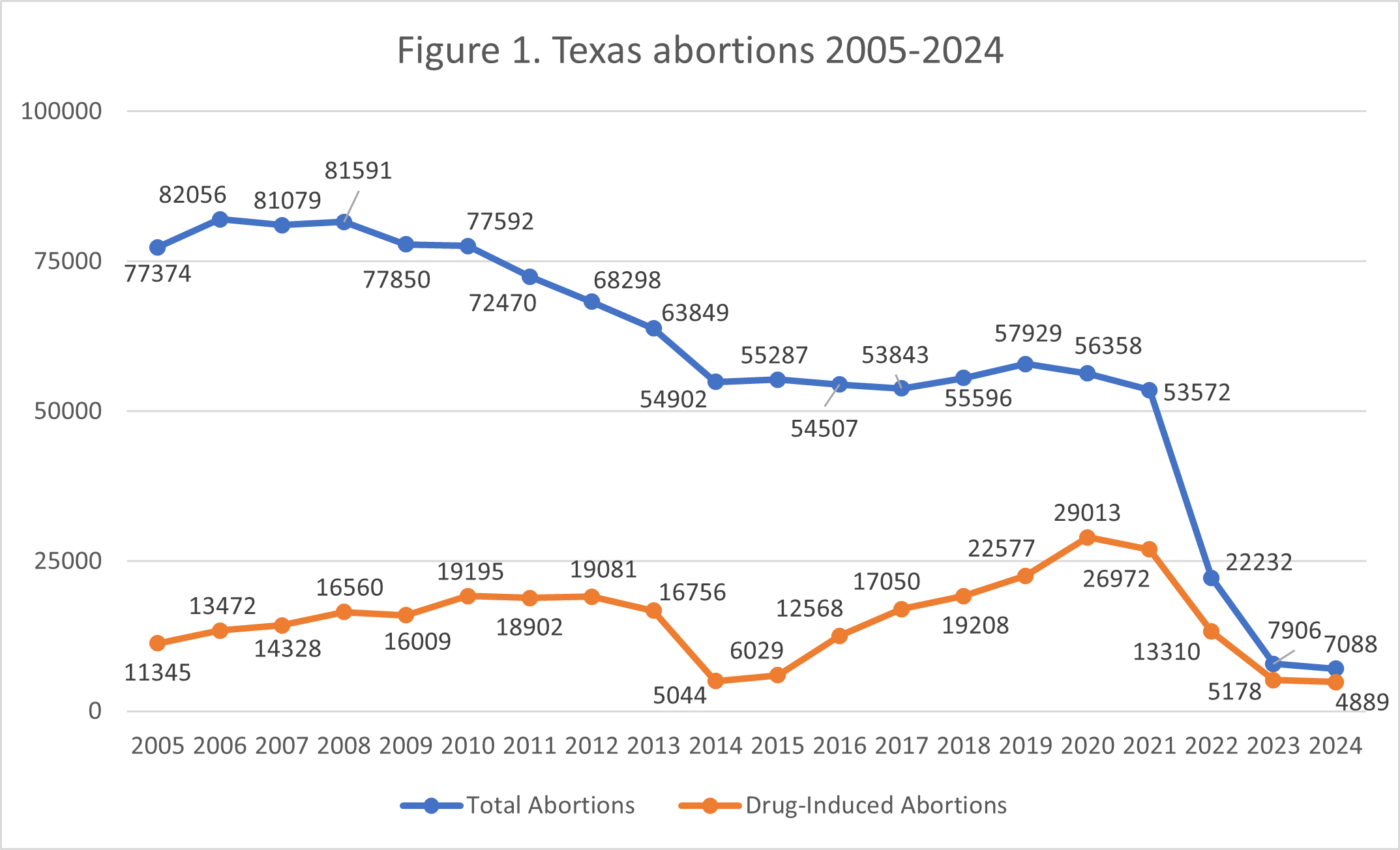
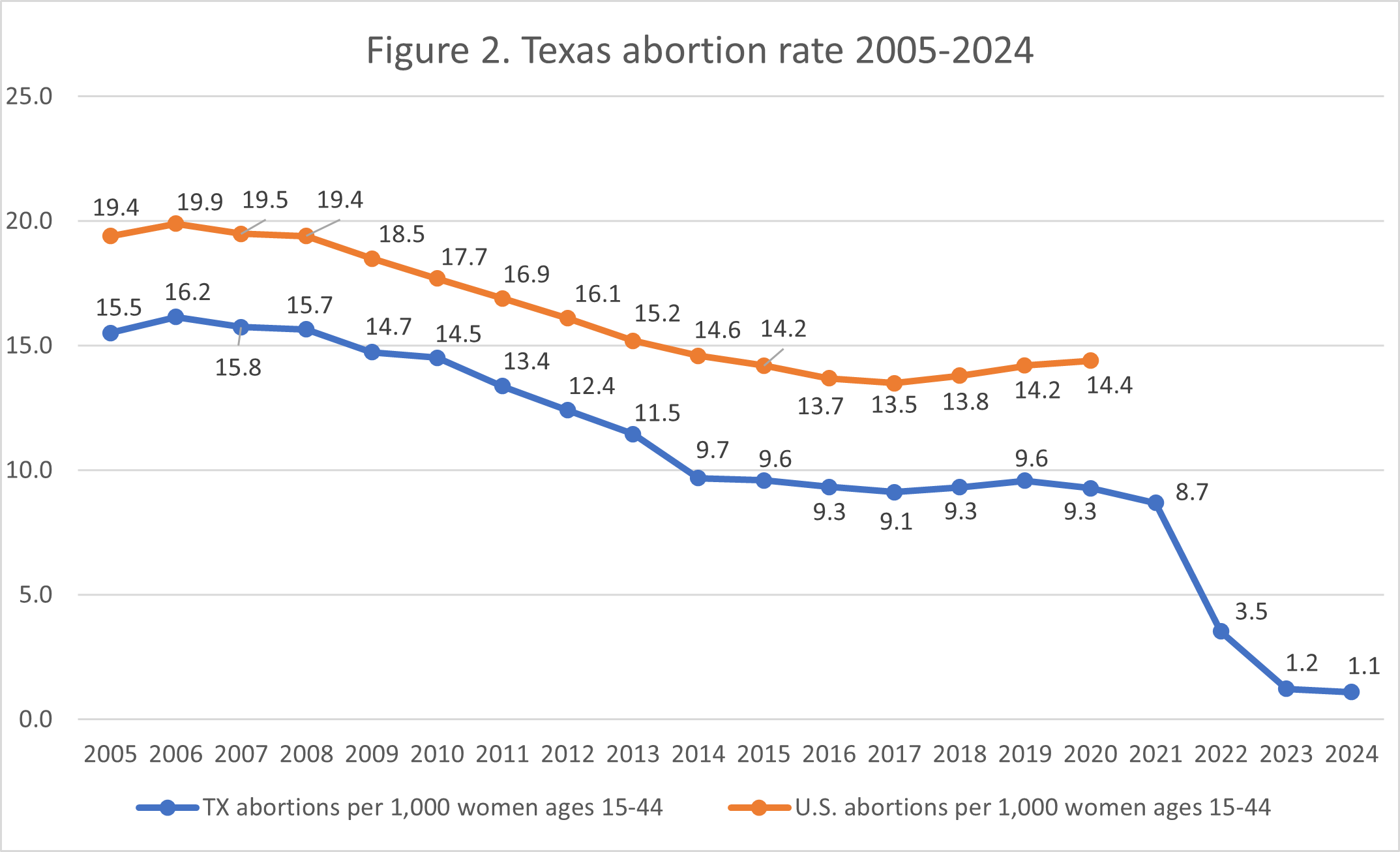
- National rates were calculated by the Guttmacher Institute. Texas rates were calculated by CLI using the following formula: (total number of abortions performed in Texas ÷ number of resident women ages 15-44 [based on most recent population estimates]) x 1,000. Rates may differ slightly from previous CLI articles due to revised population estimates. Population estimates were obtained from the CDC WONDER database. Estimates for 2005-2009 are intercensal estimates of the July 1 resident population. Estimates for 2010-2019 are Vintage 2020 postcensal estimates of the July 1 resident population. Estimates for 2020-2024 are Vintage 2023 postcensal estimates of the July 1 resident population. Estimates were produced by the U.S. Census Bureau and the National Center for Health Statistics. Rates for 2024 were calculated using the Vintage 2023 postcensal estimates because 2024 population estimates have not yet been released by the CDC.
- Statistics on abortion complications reported here represent a minimal number of deaths and complications, as this data is collected in a non-systematic and non-verifiable way. As such, this data cannot be used to calculate either an accurate abortion mortality rate or an accurate abortion complication rate for the state.
- The Guttmacher Institute notes that their monthly abortion totals by state are estimates and that each state’s estimate is within a range of uncertainty. Guttmacher also notes that their estimates do not reflect self-managed abortions or those obtained by women in states with total abortion bans under shield laws. This information is updated as of September 18, 2025. Guttmacher’s travel and residence data can be found here (State_Abortion_Travel_2024.csv).
- #WeCount’s data can be found here by downloading the “Report data tables [.xlsx]” document. The #WeCount report specifies that the numbers included in their tables for abortions performed under shield laws only represent the number of women whom abortion drugs were sent to, not the number of drug-induced abortions that were a result of the mailed drugs. However, because #WeCount’s data is the only source of data that delineates the number of abortions by mode of provision (in-person, telehealth/mail order, and/or abortion drugs obtained under shield laws), their data is the best available.
Click here to view reporting from:2023202220212020201920172016