









Abortions continue to increase in Georgia while the state claims otherwise.
Georgia released its 2025 abortion statistics through its online vital statistics database (OASIS) in October 2026. The data showed that reported resident abortions and abortions performed in Georgia decreased from the previous year. However, the data published by the state does not include the total number of abortions obtained by Georgia residents out of state or the number of self-managed abortions performed by women outside of the healthcare system. The report also does not contain the number of mail-order abortions obtained by Georgia residents prescribed by licensed abortion providers in the state or by providers in other states. Below, the data that the report does contain is summarized.
In a separate section, CLI describes data provided by both the Guttmacher Institute’s Monthly Abortion Provision Study (MAPS) and the Society of Family Planning’s (SFP) #WeCount project detailing the number of mail-order abortions obtained by Georgia residents from in- and out-of-state prescribers. Guttmacher’s and #WeCount’s abortion estimates include the number of abortions obtained at brick-and-mortar facilities and those provided via telehealth and virtual providers in the United States.
Georgia’s statute code defines abortion as “the act of using, prescribing, or administering any instrument, substance, device, or other means with the purpose to terminate a pregnancy with knowledge that termination will, with reasonable likelihood, cause the death of an unborn child…” (Ga. Stat. §16-12-141). The state does not consider the removal of a dead unborn child due to a miscarriage or an ectopic pregnancy to be an abortion.
Georgia’s heartbeat law, which prohibits abortion in most cases after an unborn child’s heartbeat has been detected, was in effect from July 20, 2022, until November 15, 2022, when it was blocked. The law went back into effect on November 23, 2022, and remained in effect until September 30, 2024, when it was blocked again. The law went back into effect on October 7, 2024, and remains in effect. When the law was temporarily enjoined on multiple occasions, abortion was prohibited, with some exceptions, from 20 weeks of gestation onward. Georgia’s heartbeat law contains exceptions in cases where a continued pregnancy would threaten a mother’s life or physical health; in cases of rape or incest when the pregnancy is less than 21 weeks of gestation; and/or in cases where the pregnancy is “medically futile.”
Statistics and Changes in Georgia Abortions, 2024-2025
The change in total abortions and abortion rate reflects the change in abortions performed on Georgia residents in and outside of Georgia, as reported by the state. The change in drug-induced abortions reflects the change in drug-induced abortions obtained in the state regardless of the individual’s state of residence. The report does not include information on Planned Parenthood’s Georgia abortion market share.
Abortion Totals and Trends
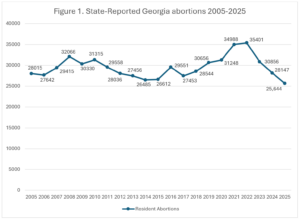
Georgia’s abortion data available on OASIS includes abortions performed on Georgia residents in Georgia and other states but does not include abortions performed in Georgia on nonresident women. In 2025, OASIS reported that there were 25,644 abortions performed on Georgia residents, both inside and outside of Georgia. This was a 9% decrease from 2024, when 28,147 resident abortions were reported (Fig. 1). Georgia did not report the number of drug-induced abortions performed on residents. CLI estimates that Georgia’s 2025 abortion rate was 11.1 abortions per 1,000 women ages 15 to 44, a decrease of 9% from the previous year (Fig. 2).1 As of November 2026, 16 states reported 2025 abortion data, with six reporting a decrease in abortions from 2024.
State Report Summary
A little over 6% of Georgia resident abortions were performed on girls in their teens or younger, with 1.5% performed on girls between the ages of 10 and 17, and 4.6% on girls between the ages of 18 and 19. Twenty-five percent were performed on women in their early twenties, and 28% on women in their later twenties. Thirty-seven percent were obtained by women in their thirties, and 4% by women ages 40 to 55.
In 2025, 64% of Georgia resident abortions were performed on black women. Seventeen percent of the abortions were performed on white women and 3% on Asian women. There were 54 abortions (0.2%) performed on American Indian or Alaska Native women and 21 abortions (0.1%) on Native Hawaiian or other Pacific Islander women. Two percent of the abortions were obtained by multiracial women. Race was not reported for 14% of abortions. The black resident abortion rate (19.3 abortions per 1,000 women ages 15 to 44) was over five times the white abortion rate (3.6) in 2025.
In 2025, 87% of Georgia resident abortions were performed on non-Hispanic women, 4% on Hispanic women, and 9% on women of unknown ethnicity.
Occurrence Data
Separate from the state’s abortion data in OASIS, CLI requested data on all abortions occurring in Georgia from the Georgia Department of Public Health (GDPH). In 2025, according to the data given to CLI by the Department, there were 22,805 abortions reported in Georgia, of which 83% were drug-induced. The number of abortions occurring in Georgia decreased by 12% from 2024 to 2025, and the number of drug-induced abortions decreased by 13%. Differences in the demographic trends associated with the occurrence data, such as age, ethnicity, and race data, were not statistically significant.
Unlike the residence data, the occurrence statistics sent by GDPH did provide data on the educational level and marital status of women who had abortions in Georgia. Eighty-five percent of abortions occurring in Georgia were performed on unmarried women, while 11% were obtained by married women. The marital status was unknown for 5% of abortions occurring in Georgia. Forty-seven percent of abortions that occurred in Georgia were performed on women with some college or a completed postsecondary degree of some kind. Forty-one percent were performed on women with a high school diploma/GED, while 5% were performed on women with less than a high school diploma/GED. Six percent of Georgia abortions were performed on women whose educational level was not reported.
The occurrence data provided by the GDPH also included information on abortions by gestational age. In 2025, 98% of Georgia abortions occurred at six weeks of gestation or earlier. Less than 2% of abortions were performed from seven weeks through 23 weeks of gestation and beyond. The number of abortions performed at 23 weeks and beyond went up from 10 in 2024 to 74 in 2025.
Also, unlike the data made available by the state’s OASIS dashboard, the occurrence data provided by the state to CLI detailed the number of abortions by procedure type. In 2025, 83% of Georgia abortions were performed using abortion drugs while 17% were surgical abortions. For the first time since the GDPH started sending CLI occurrence data in 2022, the breakdown of abortions by procedure didn’t specify what type of surgical abortions occurred. Thirty abortions were performed by other, unspecified methods.
Lastly, Georgia’s 2025 occurrence data provided information on abortions by state of residence. Georgia women obtained 83% of the abortions that occurred in the state and Alabama women obtained 9%. South Carolina women obtained 3% of the abortions, while Tennessee women obtained 2%. Mississippi women obtained 1% of the abortions. The remaining abortions were obtained by women from a variety of states. In total, 3,923 women from other states were reported to have obtained abortions in Georgia.
Informed Consent
Every year, as a requirement of Georgia’s Woman’s Right to Know Act, the state’s Department of Health releases a summary report of parental consent and informed consent data for abortions that occur in the state. Georgia’s 2025 annual report was published in May 2026. In 2025, 68 parents or guardians were notified regarding their daughters, who were minors, seeking an abortion. Of the 68 parents notified, 32 had minors who went on to obtain an abortion, while one minor obtained an abortion via a judicial waiver, not parental consent. The number of women (of all ages) who were provided information regarding the risks of abortion, the gestational age of the unborn child, and other medical information, as well as the assistance available to pregnant women (8,337 women), was far lower than the number of resident women who obtained abortions in Georgia (18,882 abortions). Of the women who received medical information and information on the assistance available to pregnant women, 3,612 chose to get an abortion. Many women (13,090) were offered the opportunity to view their fetal ultrasound and/or hear the baby’s heartbeat, and 3,743 chose to do so.
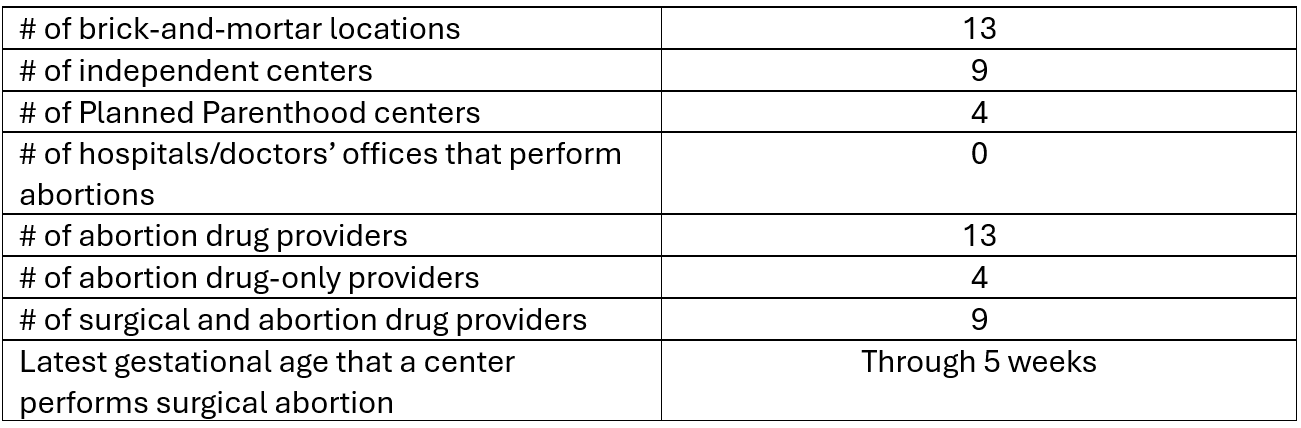
Breakdown of Abortion Providers in Georgia2
Guttmacher Data
In 2025, Guttmacher estimated that 38,110 abortions occurred in Georgia, while the state reported that 22,805 occurred—a total 66% lower than Guttmacher’s estimate. In addition, Guttmacher estimated that 5,050 abortions were obtained by women who traveled to Georgia for this purpose, while the state reported 3,923 of these abortions. For the number of abortions obtained in Georgia by women from various states according to Guttmacher, see below.3
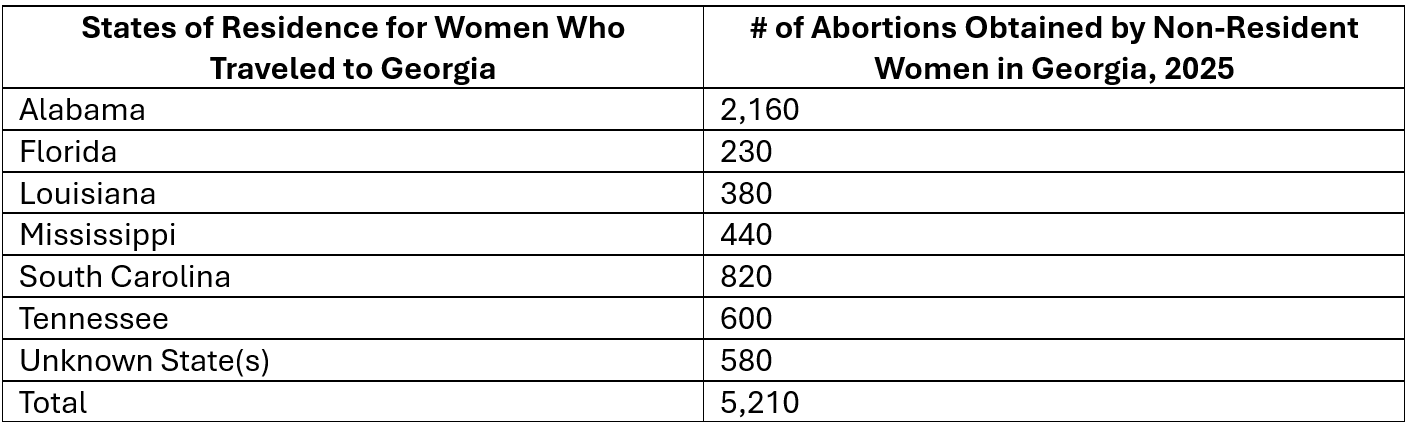
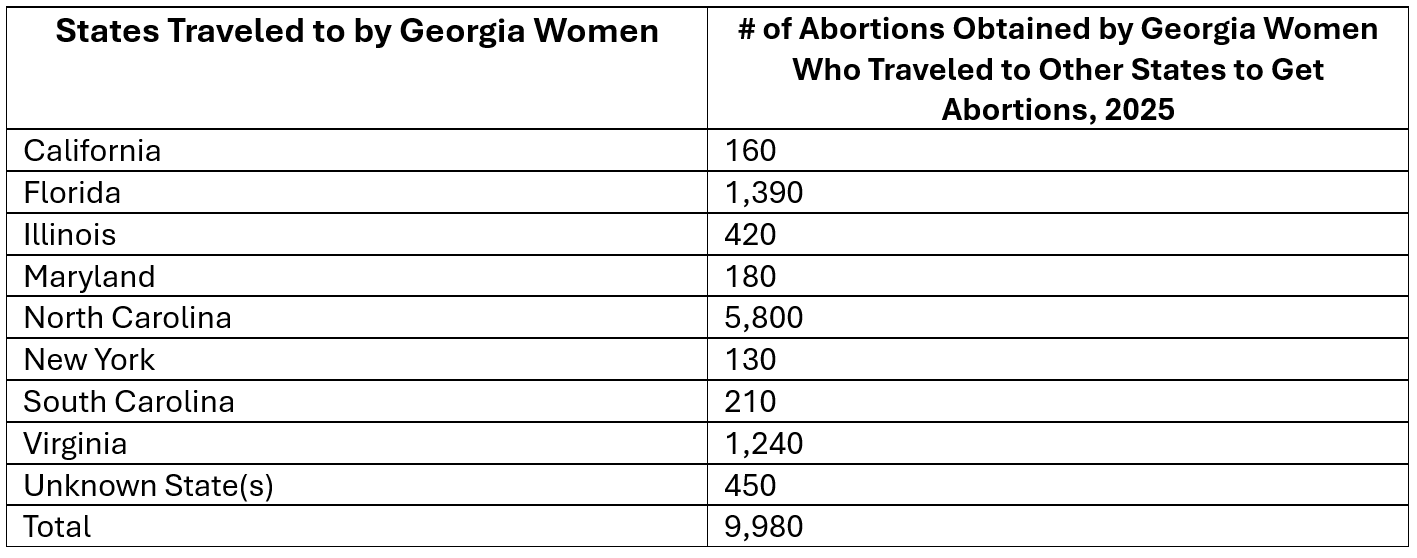
Guttmacher also estimated that 9,980 abortions were obtained by Georgia residents who traveled to other states to obtain an abortion, while the state reported a total of 6,762. For the number of abortions obtained by Georgia women in various states, see below.3
The following table displays the difference in totals for different categories reported by Guttmacher and the GDPH.
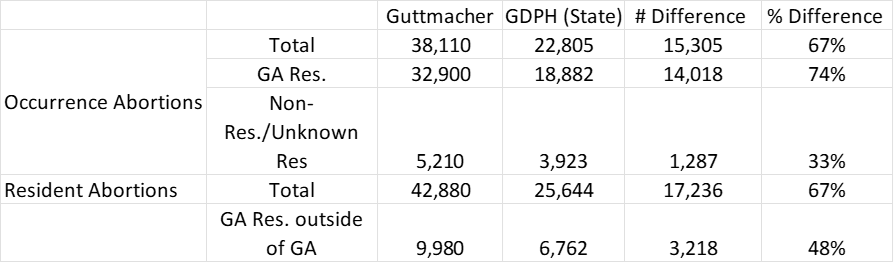
A possible explanation for these discrepancies is that Guttmacher’s estimates include telehealth mail-order abortions, while the state (in a 2024 email) told CLI they are not tracking mail-order abortions from in or out-of-state prescribers. Moreover, according to SFP #WeCount data, 37,800 abortions occurred in Georgia in 2025, a total very similar to Guttmacher’s. SFP further breaks down the data by noting that 22,220 of the 37,800 abortions were performed at brick-and-mortar facilities (a number very similar to the number of occurrence abortions reported by the state (22,805)), while 15,580 abortions were performed via telehealth—an amount that more than covers the discrepancy (15,145 abortions) in the state’s and Guttmacher’s/WeCount’s occurrence totals.4
State Ranking
In 2024, CLI published a paper reevaluating abortion reporting across the country, with Georgia ranking as tied for 20th place. As CLI has previously recommended, Georgia could include in its state report all the information it provides to the CDC, including the pregnancy history of women obtaining abortions. Georgia could also include data for all abortions performed in the state and identify the states that share abortion data with Georgia. Lastly, Georgia should include information on complications that arise from abortion procedures performed in the state and any complications data for Georgia resident women shared with Georgia by other states.
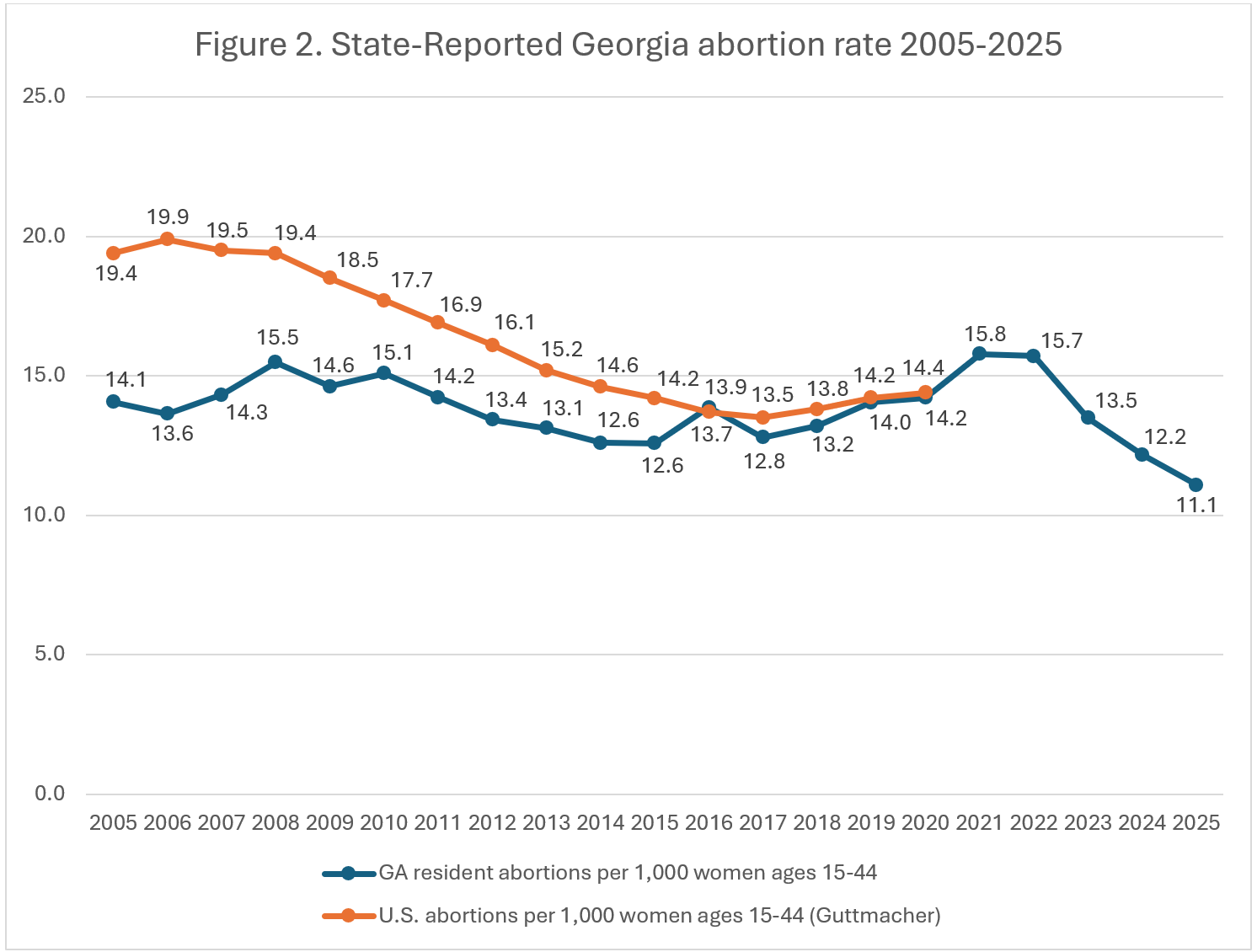
- National rates were calculated by the Guttmacher Institute. Georgia rates were calculated by CLI using the following formula: (total number of abortions performed in Georgia÷ number of resident women ages 15-44 [based on most recent population estimates]) x 1,000. Rates may differ slightly from previous CLI articles due to revised population estimates. Population estimates were obtained from the CDC WONDER database. Estimates for 2005-2009 are intercensal estimates of the July 1 resident population. Estimates for 2010-2019 are Vintage 2020 postcensal estimates of the July 1 resident population. Estimates for 2020-2025 are Vintage 2024 postcensal estimates of the July 1 resident population. Estimates were produced by the U.S. Census Bureau and the National Center for Health Statistics. Rates for 2025 were calculated using the Vintage 2024 postcensal estimates because 2025 population estimates have not yet been released by the CDC.
- Provider totals do not include hospitals or physician offices not listed in databases that compile abortion provider locations in different states, but do include Planned Parenthood locations, independent abortion centers, and hospitals/doctor’s offices included in databases like Abortion Finder and Ineedana. This information is updated as of November 23, 2026.
- Guttmacher’s travel and residence data can be found in the CSV folder here (State_Abortion_Travel_2023_2024_2025.csv). This information is updated as of November 23, 2026.
- #WeCount’s data can be found here by downloading the “Report data tables [.xlsx]” document. The #WeCount report specifies that the numbers included in their tables for abortions performed under shield laws only represent the number of women whom abortion drugs were sent to, not the number of drug-induced abortions that were a result of the mailed drugs. However, because #WeCount’s data is the only source of data that delineates the number of abortions by mode of provision (in-person, telehealth/mail-order, and/or abortion drugs obtained under shield laws), their data is the best available.
Click here to view reporting from:20242023202220212020201920182017