











A New Federal Right to Abortion? Assessing Seyb v. Members of the Idaho Board of Medicine


This is Issue 44 of the American Reports Series.
Introduction
On August 13, 2026, a federal trial court in Idaho held that the U.S. Constitution includes a “fundamental right to a life-saving abortion” and “abortion when necessary to preserve [a woman’s] health,” including “abortions that are necessary to prevent the death of the woman from self-harm.”[1] Seyb v. Members of the Idaho Board of Medicine is the first case in which a federal judge has found a constitutional right to abortion since the U.S. Supreme Court overturned Roe v. Wade in Dobbs v. Jackson Women’s Health Org. The Court in Dobbs held that “[t]he Constitution makes no reference to abortion, and no such right is implicitly protected by any constitutional provision, including … the Due Process Clause of the Fourteenth Amendment.”[2] Given that the decision in Seyb clearly conflicts with Dobbs, the Ninth Circuit should reverse it. Even the current temporary injunction on Idaho’s law encourages federal lawsuits to undermine Dobbs.
Background
Idaho has two gestation-based abortion bans,[3] the Defense of Life Act[4] and the Fetal Heartbeat Act.[5] The Defense of Life Act, which supersedes the Fetal Heartbeat Act,[6] prohibits abortion throughout pregnancy unless “[t]he physician determined, in his good faith medical judgment and based on the facts known to the physician at the time, that the abortion was necessary to prevent the death of the pregnant woman.” The law also provides that “[n]o abortion shall be deemed necessary to prevent the death of the pregnant woman because the physician believes that the woman may or will take action to harm herself.”[7]
In 2023 and 2025, Idaho state courts clarified the life exception in the Defense of Life Act. The Idaho Supreme Court held that the life exception applies even when the risk of death is not imminent:
The plain language … leaves wide room for the physician’s “good faith medical judgment” on whether the abortion was “necessary to prevent the death of the pregnant woman” based on those facts known to the physician at that time. This is clearly a subjective standard, focusing on the particular physician’s judgment. … the statute does not require objective certainty, or a particular level of immediacy, before the abortion can be “necessary” to save the woman’s life. Instead, the statute uses broad language to allow for the “clinical judgment that physicians are routinely called upon to make for proper treatment of their patients.”[8]
A lower court made additional clarifications:
… Idaho’s Abortion Laws don’t make it a crime to perform an “abortion” … if, in the performing physician’s good faith medical judgment (based on the facts known to the physician at the time of the abortion), the patient—because of an existing medical condition or pregnancy complication that would be alleviated by an abortion—faces a non-negligible risk of dying sooner without an abortion (even if her death is neither imminent nor assured), so long as (i) the risk of her death doesn’t arise from a risk of self-harm, and (ii) the manner of pregnancy termination is the one that, without risk [sic] increasing the risk of her death, best facilitates the unborn child’s survival outside the uterus, if feasible.[9]
The plaintiff in Seyb admits he is “unfamiliar with” the Idaho Supreme Court’s interpretation of the abortion ban,[10] a shortcoming that is incongruous with his professional obligations as a maternal-fetal medicine specialist who performs abortions.[11] Regardless, Dr. Seyb argues that the right to abortion should extend beyond what Idaho’s law permits. Specifically, he challenges the abortion bans as they apply to “(1) pregnancies that pose serious long-term risks to the woman’s health [but not necessarily death]; (2) pregnancies that threaten the woman’s life due to the possibility of self-harm; and (3) pregnancies with severe fetal complications which will result in the death of the fetus shortly after birth.”[12]
Ironically, some of Dr. Seyb’s hard cases listed in the opinion would likely be legal under Idaho law. For instance, the court writes that before Idaho’s ban took effect, Dr. Seyb “had a patient developing early preeclampsia. The only cure was to remove the placenta and terminate the pregnancy. If he had a similar patient today, Dr. Seyb would refer her out of state rather than treat her in Idaho.”[13] This tragic case illustrates a situation in which Dr. Seyb could exercise his “clinical judgment that physicians are routinely called upon to make for proper treatment of their patients,” and in which he would not be required to have “objective certainty, or a particular level of immediacy” before determining that the abortion is necessary to save his patient’s life.[14] The court concedes that “[a]bortion in some of [Dr. Seyb’s case examples] may have fallen within Idaho’s death-of-the-mother exception,” but finds that “medical providers in Idaho are understandably reluctant to provide abortion under any circumstance due to fear of prosecution.”[15] This position is difficult to reconcile with the clarifying state-court decisions quoted above.
The court’s constitutional analysis
In Seyb, the district court asserts that the Supreme Court’s holding in Dobbs that there is no right to abortion in the Constitution is limited to “elective abortion,” because it does not analyze “abortions performed out of medical necessity.”[16] However, Dobbs did not carve out any circumstances in which abortion is constitutionally protected. Rather, the Court explicitly held that “[t]he Constitution does not prohibit the citizens of each State from regulating or prohibiting abortion. Roe and Casey arrogated that authority. We now overrule those decisions and return that authority to the people and their elected representatives.”[17]
Nevertheless, based on an inaccurate interpretation of Dobbs and a flawed application of the history-and-tradition analysis,[18] the court in Seyb held that “the Due Process and Equal Protection Clauses of the Fourteenth Amendment establish a narrow but fundamental right to abortion when a pregnancy threatens the woman’s life or health.”[19] The court then subjected Idaho’s law to strict scrutiny in these circumstances and held that a “blanket ban on health-preserving abortions is not narrowly tailored”[20] to a compelling state interest. Likewise, Idaho does not have a compelling state interest under the Equal Protection Clause of the Fourteenth Amendment to criminalize “life-saving abortions necessitated by psychiatric conditions.”[21]
Based on these due process and equal protection “rights,” the court enjoined the enforcement of Idaho’s abortion bans “in cases where a physician has determined, in his or her good faith medical judgment, that continuation of the pregnancy poses a non-negligible risk of serious and lasting harm to the health of the pregnant woman.” The court also enjoined enforcement of the laws “in cases where a physician has determined, in his or her good faith medical judgment, that abortion is necessary to prevent a non-negligible risk that continuation of the pregnancy will result in the death of the pregnant woman from self-harm.”[22]
The court did not find a constitutional right to an abortion sought because a “fetus will die shortly after birth and for high-order pregnancies where the termination of one fetus increases the chance that the others will survive,” but where the pregnant woman does not have an elevated health risk. Applying rational basis review, the court acknowledged that the law prohibiting abortions in these circumstances “is rationally related to the state’s interests in, for example, preventing abortions based on mistaken fetal diagnoses and affirming the dignity of people with profound disabilities.”[23]
Seyb applied
Unlike Idaho’s now-settled life exception, the federal injunction announces a standard with no comparable case law foundation. In Seyb, the court attempted to distinguish pregnancies in which abortion must be permitted under the Constitution from most pregnancies, writing that “[t]reating the normal burdens of pregnancy as justification for a health-preserving abortion would obviously contradict Dobbs. The baseline principle that states are free to regulate abortion as they wish, subject only to rational basis review, applies unless the pregnancy poses an extraordinary threat to the health of the woman.”[24]
However, the opinion does not make “obvious” what constitutes an “extraordinary threat” to a patient’s health. Further, the order does not use that term but instead enjoins the law when a physician makes a “good faith medical judgment” that there is a “non-negligible risk of serious and lasting harm to the health of the pregnant woman” [emphasis added].[25] The court neither defines key terms nor provides an exhaustive list of health conditions that may cause “serious and lasting”[26] harm to women’s health.
This determination is left to doctors, even as the court acknowledges that the plaintiff seeks a much broader abortion right than the court deems to exist. The court writes, “Dr. Seyb is not entirely consistent in his detailing of this right, and he at times articulates it expansively as, essentially, the right to abortion whenever recommended by a doctor.”[27] The court then states that such a right “would effectively give the medical profession veto power over abortion policy in Idaho. That conclusion is plainly incompatible with Dobbs and too abstract to survive the demands of the Glucksberg history-and-tradition test.”[28]
Yet, the court’s opinion will not prevent an undefined standard from producing similar results in practice. In the absence of precise definitions or lists, the opinion invites doctors to exercise that “veto” over Idaho’s law. Although the court declines to provide a list of conditions that justify abortion, the examples in the opinion range widely, from rare complications to routine interventions like cesarean sections, offering little to constrain doctors’ discretion in practice.[29]
Many women in the United States suffer from chronic diseases that can affect maternal and infant outcomes. These diseases are often undiagnosed in nonpregnant women but can cause complications during pregnancy.[30] Granting abortion providers the authority to perform abortions on women with chronic illnesses because they may suffer serious and lasting harm will lead to abortions of many wanted pregnancies, when the focus should be on caring for both the mother and her unborn child.
On August 25, 2026, the court stayed the injunction pending appeal, “only to the extent that it prohibits enforcement of the challenged statutes against persons other than Dr. Seyb.” In a footnote, however, the court clarified: “To be sure, the Court would anticipate that the same reasoning and the same result would apply to any action brought by a physician facing the same situation as Dr. Seyb. But given [Supreme Court precedent on universal injunctions] it is neither necessary nor appropriate for the Court to anticipate a situation or claim that is not before it.”[31] Such claims will likely continue to arise, as they have in state courts.
Sidebar: State Supreme Courts on Abortion Bans
Since the U.S. Supreme Court’s decision in Dobbs, eight state supreme courts have considered whether their strong abortion bans are permissible under state constitutions. In seven of the eight states, including Idaho, the laws were upheld, with state supreme courts in Florida,[32] Idaho,[33] Iowa,[34] and South Carolina[35] finding no state constitutional right to abortion. In Indiana, North Dakota, and Oklahoma, the state supreme courts found partial rights to abortion but still upheld the states’ abortion bans. In Wyoming, the only state whose supreme court found a broad right, the court struck down the law under a healthcare amendment approved by a ballot initiative that was not related to abortion. The decisions in Indiana, North Dakota, Oklahoma, and Wyoming are briefly discussed below.
Indiana: “to protect her life or to protect her from a serious health risk;” statute upheld
In 2023, the Indiana Supreme Court held that the state constitution’s “inalienable rights” clause “protects a woman’s right to an abortion that is necessary to protect her life or to protect her from a serious health risk, but the General Assembly otherwise retains broad legislative discretion for determining whether and the extent to which to prohibit abortions.”[36] The court rejected a facial challenge to the state’s abortion ban, which permits abortions “when reasonable medical judgment dictates that performing the abortion is necessary to prevent any serious health risk to the pregnant woman or to save the pregnant woman’s life.”[37]
On remand, Planned Parenthood filed a motion for preliminary injunction, arguing that the ban’s health and life exceptions are too narrow and therefore violate the constitutional rights of women with serious health risks during pregnancy.[38] The trial court disagreed, holding that “[p]laintiffs have not shown that the Health or Life Exception prohibits any constitutionally protected abortion.”[39] It also found that the definition in Indiana’s law “does not require physicians to wait until a woman is clinically unstable to provide care.”[40] The Indiana Court of Appeals affirmed.[41]
North Dakota: “to prevent … death or a serious health risk;” statute narrowly upheld
North Dakota’s ban prohibits abortion unless it is “deemed necessary based on reasonable medical judgment which was intended to prevent the death or a serious health risk to the pregnant female.” “Serious health risk” is defined as:
[A] condition that, in reasonable medical judgment, complicates the medical condition of the pregnant woman so that it necessitates an abortion to prevent substantial physical impairment of a major bodily function, not including any psychological or emotional condition. The term may not be based on a claim or diagnosis that the woman will engage in conduct that will result in her death or in substantial physical impairment of a major bodily function.[42]
In 2023, the state supreme court held that “the right to pursue and obtain safety, which necessarily includes a pregnant woman, has a fundamental right to obtain an abortion to preserve her life or her health.”[43] The right to “pursue and obtain safety” is an inalienable right grounded in Article I, Section 1 of North Dakota’s constitution. On November 21, 2025, three of the five justices on North Dakota’s supreme court found the law unconstitutionally vague; however, the state requires four of five justices to strike down a law. Therefore, the two-justice opinion prevailed: “The district court erred in concluding [North Dakota’s law] is unconstitutionally vague and further erred in concluding [North Dakota’s constitution] protects a right to abortion broad enough to conflict with [the abortion limit].”[44]
That a simple majority of the court would have struck down the law is not surprising, given the court’s prior doubts about the law’s exceptions’ sufficiency when it refused to stay the lower court’s injunction: “The law’s exception for injury and death caused by psychological maladies appears arbitrary. If the State’s goal is to prevent unnecessary abortions and protect maternal health, this law does not appear narrowly tailored to achieve that aim within constitutional bounds. Therefore, the law is unlikely to survive strict scrutiny review.”[45]
Oklahoma: “to preserve life;” statute upheld
Oklahoma bans abortion unless it is “necessary to preserve [a woman’s] life.”[46] In a decision upholding the ban, the Supreme Court of Oklahoma held that “[T]he Oklahoma Constitution … protects the right of a woman to terminate her pregnancy in order to preserve her life.”[47] The court grounded this right in Article II, Section 2 (“the inherent right to life, liberty, the pursuit of happiness”) and Section 7 (the right not to be “deprived of life, liberty, or property, without due process of law”).[48]
The outlier: Wyoming: “right of health care access;” statute struck down
After Dobbs, Wyoming enacted an abortion ban that prohibited abortion throughout pregnancy unless it was necessary to prevent the mother’s death or there was “a substantial risk of death for the pregnant woman because of a physical condition or the serious and permanent impairment of a life-sustaining organ of a pregnant woman.”[49] In 2026, the Wyoming Supreme Court affirmed a lower-court decision enjoining the law, holding that it violated Article I, § 38, the “Right of health care access,” of the state constitution. Wyoming’s citizens approved this constitutional provision in response to the Affordable Care Act. Lawmakers and voters sought to ensure they could make their own healthcare decisions without federal encroachment.[50] The amendment does not mention abortion.
Conclusion
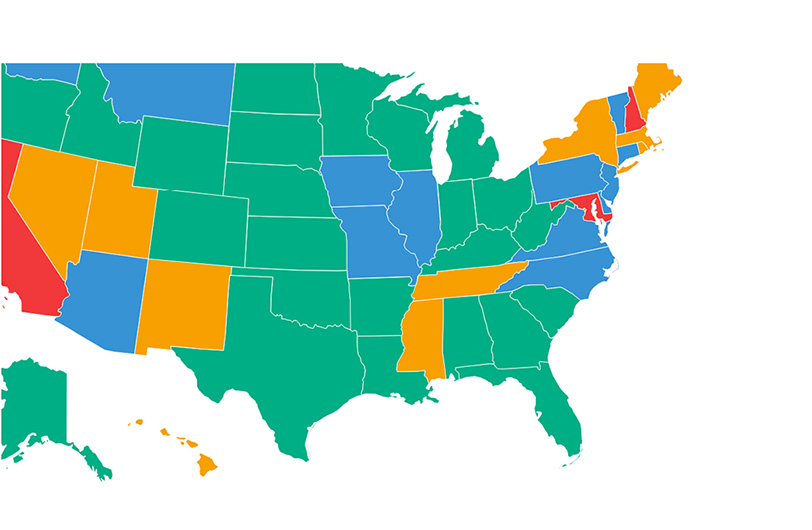
In the wake of Dobbs, 20 states have strong pro-life laws, while 26 protect abortion.[51] In some states with strong abortion bans, lawsuits have compelled state courts to decide whether statutes now permissible under federal constitutional law are also permissible under state constitutional law. Overwhelmingly, these courts have upheld the will of the elected legislators. Without question, states can and should clarify their life and serious health exceptions when the medical community requests it, and some have.[52] Such actions both protect pregnant women and their babies and help the laws withstand judicial scrutiny.
The state courts in Idaho upheld their abortion ban and clarified the law’s exception. In Seyb, the federal court acknowledged that, regarding the plaintiff’s third challenged application of the law, the “solution” for “Idahoans who oppose this law … lies at the ballot box rather than the courthouse.”[53] Under Dobbs, the Ninth Circuit should apply this logic to all applications of the law on appeal, allowing Idahoans to decide whether additional changes are needed.
Mary E. Harned, J.D., is an associate scholar at the Charlotte Lozier Institute
[1] Seyb v. Members of the Idaho Board of Medicine, No. 1:24-cv-00244, 2026 LX 413777, at *9 (D. Idaho Aug. 13, 2026).
[2] 597 U.S. 215, 231 (2022).
[3] “Abortion ban” is the term most frequently used to describe laws like the Defense of Life Act, Idaho Code § 18-622 and Fetal Heartbeat Act, Idaho Code § 18-8804. The author prefers the term “gestation-based abortion limitation,” but given that the court refers to the laws as bans, this paper adopts this term as well.
[4] Idaho Code § 18-622.
[5] Idaho Code § 18-8804.
[6] “Nothing in this section shall be construed to conflict with the effectiveness of section 18-622, Idaho Code, following the occurrence of the circumstances described therein. In the event both this section and section 18-622, Idaho Code, are enforceable, section 18-622, Idaho Code, shall supersede this section.” Idaho Code § 18-8806.
[7] Idaho Code § 18-622(2)(a)(i). The law also permits abortion in the first trimester if the pregnancy resulted from rape or incest. Idaho Code § 18-622(2)(b).
[8] Planned Parenthood Great Nw. v. Idaho, 522 P.3d 1132, 1203 (Idaho 2023).
[9] Adkins v. State of Idaho, No. CV01-23-14744, slip op. at 39 (Idaho Dist. Ct. Apr. 11, 2025).
[10] Seyb v. Members of the Idaho Board of Medicine, No. 1:24-cv-00244, 2026 LX 413777, at *37.
[11] Id. at *10. “Plaintiff Dr. Stacy Seyb is a board-certified maternal-fetal medicine specialist practicing at St. Luke’s Health System in Ada County, Idaho. Until Idaho’s abortion ban went into effect in 2022, he provided medically necessary abortions to women whose pregnancies endangered their lives and their health. Dr. Seyb also testified as an expert witness.”
[12] Seyb v. Members of the Idaho Board of Medicine, No. 1:24-cv-00244, 2026 LX 413777, at *6.
[13] Id. at *30-1, citing Seyb Test., Tr. 126.
[14] See Planned Parenthood Great Nw. v. Idaho, supra n. 7. See also, Mary E. Harned & Ingrid Skop, Pro-Life Laws Protect Mom and Baby: Pregnant Women’s Lives are Protected in All States. Charlotte Lozier Institute (Dec. 9, 2025), https://lozierinstitute.org/pro-life-laws-protect-mom-and-baby-pregnant-womens-lives-are-protected-in-all-states/; Ingrid Skop, Fact Sheet: Medical Indications for Separating a Mother and Her Unborn Child. Charlotte Lozier Institute (Jul. 20, 2026), https://lozierinstitute.org/fact-sheet-medical-indications-for-separating-a-mother-and-her-unborn-child/.
[15] Seyb v. Members of the Idaho Board of Medicine, No. 1:24-cv-00244, 2026 LX 413777, at *32.
[16] Id. at *50.
[17] 597 U.S. at 302.
[18] The state summarizes why the court’s history-and-tradition analysis is flawed in its motion for a stay: “Despite its incorrect application of the history-and-tradition analysis (and mostly ignoring the contrary historical evidence), the opinion still ended up finding the history ‘ambiguous.’ … Ambiguous history is not remotely good enough to meet the high standard for taking the authority to protect innocent unborn life out of the hands of the Legislature. History shows that legislatures and courts simply chose not to criminalize abortions to protect the life of the mother, and no such evidence exists for general health preserving abortions.” See Att’y Gen. Raúl Labrador’s Emergency Motion for stay of Injunction Pending Appeal at (I)(A)(3), 1:24-cv-00244 (D. of Idaho Aug. 18, 2026).
[19] Seyb v. Members of the Idaho Board of Medicine, No. 1:24-cv-00244, 2026 LX 413777, at *6.
[20] Id. at *8-9.
[21] Id. at *9.
[22] Id. at *88.
[23] Despite this acknowledgment, the court expressed hostility towards Idaho’s prohibiting abortion in these circumstances. The court wrote, “Some may find the law cruel. And the Court fully understands and appreciates that sentiment. Pregnant women faced with a devastating fetal diagnosis must either bear the challenges of pregnancy while waiting to watch their child die or flee the state to receive appropriate medical care [emphasis added]. Although some women may certainly wish to continue the pregnancy, Kraus Test., Tr. 1135-37, many others do not. Eller Test., Tr. 435-36. And one might conclude that Idaho regards women in this latter category more as incubators for a fetus who will not survive than as human beings with the capacity to make an extraordinarily difficult decision about their bodies and their families. But the Court’s role here is not to express its personal judgment of the wisdom of the legislature’s decision. Rather, it is to establish the constitutional boundaries which the Idaho legislature may not cross. The Court finds that the policy adopted by the legislature, while troubling, does not cross that line. For Idahoans who oppose this law, the solution lies at the ballot box rather than the courthouse.” Seyb v. Members of the Idaho Board of Medicine, No. 1:24-cv-00244, 2026 LX 413777, at *87.
[24] Seyb v. Members of the Idaho Board of Medicine, No. 1:24-cv-00244, 2026 LX 413777, at *87 n. 33.
[25] Id. at *88.
[26] Id.
[27] Seyb v. Members of the Idaho Board of Medicine, No. 1:24-cv-00244, 2026 LX 413777, at *49, citing Am. Compl. ¶¶ 125-26, Dkt. 56; P.’s Am. Proposed Findings ¶ 142, Dkt. 145 (discussing a “right to therapeutic abortion”).
[28] Seyb v. Members of the Idaho Board of Medicine, No. 1:24-cv-00244, 2026 LX 413777, at *49.
[29] See Id. at *16-30.
[30] See Olumayowa Azeez et al., Hypertension and Diabetes in Non-Pregnant Women of Reproductive Age in the United States, 16 Prev. Chron. Dis. E146 (2019), https://pmc.ncbi.nlm.nih.gov/articles/PMC6824149/.
[31] Seyb v. Members of the Idaho Board of Medicine, 1:24-cv-00244, slip op. at 5 (D. Idaho Aug. 25, 2026).
[32] “[W]e conclude there is no basis under the Privacy Clause to invalidate [a challenged gestational limit to abortion]. In doing so, we recede from our prior decisions in which—relying on reasoning the U.S. Supreme Court has rejected—we held that the Privacy Clause guaranteed the right to receive an abortion through the end of the second trimester.” Planned Parenthood v. State, 384 So.3d 67, 71 (Fla. 2024).
[33] “[W]e cannot read a fundamental right to abortion into the text of the Idaho Constitution.” Planned Parenthood Great Northwest v. State, 522 P.3d 1132, 1148 (Idaho 2023).
[34] “[W]e hold today … that the Iowa Constitution is not the source of a fundamental right to an abortion necessitating a strict scrutiny standard of review for regulations affecting that right.” Planned Parenthood of the Heartland, Inc. v. Reynolds, 975 N.W.2d 710, 716 (Iowa 2022).
[35] “The legislature has found that the State has a compelling interest in protecting the lives of unborn children. That finding is indisputable and one we must respect. The legislature has further determined … that its interest in protecting the unborn becomes actionable upon the detection of a fetal heartbeat…wehold the 2023 Act is constitutional.” Planned Parenthood S. Atl. v. State, 440 S.C. 465, 485 (S.C. 2023).
[36] Members of the Med. Licensing Bd. of Indiana v. Planned Parenthood Great Northwest, 211 N.E.3d 957, 962 (Ind. 2023).
[37] Ind. Code Ann. § 16-34-2-1. Abortion is also permitted when “the fetus is diagnosed with a lethal fetal anomaly” and during the first 10 weeks when the pregnancy resulted from rape or incest.
[38] Brief in Support of Plaintiffs’ Motion for Preliminary Injunction, Planned Parenthood v. Members of the Med. Licensing Bd., No. 53C06-2208-PL-1756 (Ind. Cir. Ct. Nov. 9, 2023).
[39] Planned Parenthood v. Members of the Med. Licensing Bd., No. 53C06-2208-PL-001756, slip op. at II, ¶ 14 (Ind. Cir. Ct. Sept. 11, 2024).
[40] Id. at II, ¶ 15.
[41] Planned Parenthood v. Members of the Med. Licensing Bd., No. 24A-PL-2467 (Ind. Ct. App. Aug. 11, 2025), https://public.courts.in.gov/Decisions/api/Document/Opinion?Id=4ADcrAkhtivlyKlmBu1BDuXvtxOAdVAgghWh5qAg5MbcxImawA4ZErw2HFdEOxs00.
[42] N.D.C.C. ch. 12.1-19.1. The ban also permits abortion for rape or incest when the pregnancy is six weeks or less. https://ndlegis.gov/cencode/t12-1c19-1.pdf.
[43] Wrigley v. Romanick, 2023 ND 50, P40 (N.D. 2023).
[44] Access Indep. Health Servs. v. Wrigley, 2025 ND 199, P147 (N.D. 2025).
[45] Access Indep. Health Servs. v. Wrigley, 2025 ND 26, P36 (N.D. 2025).
[46] 21 Okl. St. § 861.
[47] Okla. Call for Reprod. Just. v. Drummond, 2023 OK 24, P16 (Okla. 2023).
[48] Id.
[49] Wyo. Stat. § 35-6-120-128. The statute also permitted abortion when the pregnancy results from rape or incest or “there is substantial likelihood that the unborn baby has a lethal fetal anomaly or the pregnancy is determined to be a molar pregnancy.”
[50] See Nick Healey & Teddy Boyer, The Shield Becomes a Sword: Wyoming’s constitutional right to make healthcare decisions, Wyoming Medicine 10 (Spring 2023), https://www.wyomed.org/wp-content/uploads/2024/01/The-Shield-Becomes-a-Sword-Wyomings-constitutional-right-to-make-healthcare-decisions-BY-NICK-HEALEY-and-TEDDY-BOYER.pdf.
[51] See Mary E. Harned, Abortion Law in America Today: Introduction and the Pro-life States, Charlotte Lozier Institute (Dec. 17, 2025), https://lozierinstitute.org/abortion-law-in-america-today-introduction-and-the-pro-life-states/.
[52] See Mary E. Harned, Abortion Law in America Today: Pro-life Responses to Pro-abortion Challenges. Charlotte Lozier Institute (Feb. 4, 2026), https://lozierinstitute.org/abortion-law-in-america-today-pro-life-responses-to-pro-abortion-challenges/.
[53] Seyb v. Members of the Idaho Board of Medicine, No. 1:24-cv-00244, 2026 LX 413777, at *87.