

















This is Issue 46 of the American Reports Series.
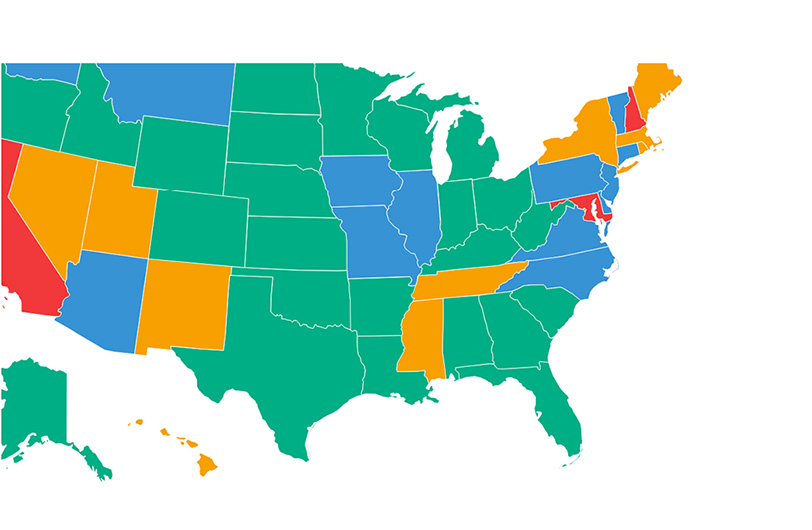
On November 3, 2026, voters in four states will consider ballot measures on abortion. This paper examines how these provisions, three of which are state constitutional amendments, will affect state laws. For an in-depth examination of the abortion-protection amendments adopted in recent years and the campaigns behind them, please see Abortion Law in America Today: Abortion Protection States.
Below are brief summaries of the content and potential impacts of each ballot initiative, followed by more detailed explanations.
Nevada Question 6
- Will establish a constitutional right to abortion.
- Provides that a state interest in protecting unborn children is not a compelling state interest.
- May lead to the performance of late-term abortions outside of hospitals, in settings lacking the equipment to care for infants born alive during abortions.
- Likely permits nonphysicians to perform abortions.
Virginia Question 1
- Will establish a constitutional right to abortion.
- Provides that a state interest in protecting unborn children is not a compelling state interest.
- Can be interpreted as prohibiting restrictions on public funding for abortion.
- May lead to the performance of late-term abortions outside of hospitals, in settings lacking the equipment to care for infants born alive during abortions.
- Could complicate the investigation of some newborn deaths as “pregnancy outcomes.”
Idaho Proposition 1
- Will establish a statutory right to abortion.
- Provides that laws that regulate most abortions must be “narrowly tailored” to benefit abortion patients, not their unborn children.
- Immunizes abortion facilitators and providers without requiring the consent of those whom they provide or help to acquire abortions.
- May lead to the performance of late-term abortions outside of hospitals, in settings lacking the equipment to care for infants born alive during abortions.
Missouri Amendment 3
- Will repeal the 2024 abortion protection amendment, permitting the enforcement of pro-life laws.
- Will permit abortion in cases of medical emergency, fetal anomaly, rape, or incest.
- Otherwise, it permits Missouri to ban abortions.
- Bans and regulates abortion in specific contexts.
- Permits additional regulation of abortion.
- Provides that the state may not infringe on access to care in cases of miscarriage, ectopic pregnancy, and other medical emergencies.
Nevada, Question 6[1]
Background
Nevada has an abortion protection statute (i.e., a law that permits most or all abortions), enacted in 1973 and affirmed by referendum in 1990.[2] The state maintains few protections for unborn babies and their mothers. However, the state constitution does not prevent lawmakers from enacting pro-life laws; rather, it is silent on abortion, and the Supreme Court of Nevada has not found an abortion right within it. This will change if voters approve Nevada Question 6, an amendment that will establish a “fundamental right to abortion” and thereby undermine existing and future laws written to protect unborn children and their mothers.
The Amendment
In 2024, voters approved Question 6 by 64.36% to 35.64%.[3] It is on the ballot again in 2026 because the state constitution requires approval in two even-numbered election years.[4] Question 6 will constitutionalize and strengthen the state’s already robust abortion protections in the following ways:
1. Question 6 will establish a constitutional right to abortion.
- Question 6: Provides that “[a]ll individuals shall have a fundamental right to abortion performed or administered by a qualified health care practitioner until fetal viability, or when needed to protect the life or health of the pregnant patient, without interference from the state or its political subdivisions.” Any law that denies, burdens, or infringes upon that right must be “justified by a compelling state interest that is achieved by the least restrictive means.”[5]
- Current law: Does not establish a constitutional right to abortion. State law prohibits abortion “after the 24th week of pregnancy” unless “the physician has reasonable cause to believe that an abortion currently is necessary to preserve the life or health of the pregnant woman.”[6]
- Impact: Every law in the state that regulates abortion may be challenged under the new constitutional right to abortion, even the 24-week gestation limit (see below). Courts will apply strict scrutiny (the law must be justified by a compelling state interest that is achieved by the least restrictive means) in these cases. This highest level of review will make it difficult for most pro-life laws to survive, particularly given the amendment’s definition of “compelling state interest,” discussed below.
2. Question 6 provides that a state interest in protecting unborn children is not a compelling state interest.
- Question 6: Defines a “compelling state interest” as “an interest which is limited exclusively to the state’s interest in protecting, maintaining, or improving the health of an individual who is seeking abortion care that is consistent with accepted clinical standards of practice” (emphasis added).[7] Therefore, protecting an unborn baby’s life is not a compelling interest.
- Current law: Does not contain this limitation.
- Impact: Existing laws, including informed consent requirements, parental involvement requirements, and even the hospital requirement for late-term abortions (see 3 below), are likely to be challenged under the new amendment. If a court finds that the state’s interest in a challenged law is to protect unborn babies rather than mothers, or that the law is not the least restrictive means of protecting mothers, the law will fail under Question 6’s definition of compelling interest.
3. Question 6 may lead to the performance of late-term abortions outside of hospitals, in settings lacking the equipment to care for infants born alive during abortions.
- Question 6: Provides that “fetal viability” is the moment at which the constitutional right to abortion ends unless the mother’s health or life is at risk. Fetal viability is defined as “the point in pregnancy when, in the professional judgment of the patient’s treating health care practitioner, there is a significant likelihood of the fetus’ sustained survival outside the uterus without the application of extraordinary medical measures” (emphasis added).[8] “Extraordinary medical measures” is not defined. The amendment does not require that abortions at fetal viability be performed in a hospital.
- Current law: Provides that “all abortions performed after the 24th week of pregnancy or performed when, in the judgment of the attending physician, there is a reasonable likelihood of the sustained survival of the fetus outside of the womb by natural or artificial supportive systems must be performed in a hospital…” (emphasis added).[9] The attending physician must document the reason for a late-term abortion in the patient’s records.[10] Further, healthcare practitioners who fail “to take all reasonable steps, in keeping with good medical practice, to preserve the life and health” of born-alive infants are subject to criminal and civil liability.[11]
These provisions, taken together, show that Nevada treats late-term abortions differently from other abortions. Under current law, abortions after 24 weeks are permitted only when medically necessary, must be performed in hospitals where both mothers and born-alive babies can receive appropriate care, and the physicians must document the reasons for the abortions.
- Impact: The hospital requirement may conflict with Question 6. Question 6’s definition of viability, the point at which Nevada may limit abortion, requires a significant likelihood of the unborn baby’s sustained survival without extraordinary measures. Under current law, when abortions are performed after 24 weeks, or when an unborn baby has a reasonable (e., not “significant”) likelihood of sustained survival with natural or artificial support systems (i.e., possibly earlier than 24 weeks), they must be performed in a hospital.
The hospital requirement serves, at least in part, to protect the unborn baby if the baby is born alive. Further, the documentation requirement reinforces that a physician must have a medical reason to perform a late-term abortion.
If the hospital requirement is deemed unnecessary or not the least restrictive means of protecting the health of a woman seeking an abortion, the requirement will likely fail strict scrutiny. This could lead to more late-term abortions performed outside hospitals in locations lacking the equipment needed to care for fragile born-alive infants.
4. Question 6 likely permits nonphysicians to perform abortions.
- Question 6: Provides that women have a right to abortion “performed or administered by a qualified health care practitioner,” which is undefined.[12]
- Current law: Provides that abortions must be performed by “a physician licensed to practice in this state or by a physician in the employ of the government of the United States.”[13]
- Impact: A constitutional right to an abortion performed by an undefined “qualified health care practitioner” may lead to the approval of nonphysician abortion providers, either by statute or through litigation.[14]
Virginia, Question 1[15]
Background
Over the last few years, Virginia has steadily become more protective of abortion. Abortion is currently prohibited in the third trimester, except when the pregnancy is likely to lead to death or “substantially and irremediably impair the mental or physical health of the woman.”[16] While the state once had numerous pro-life laws, in 2020 the legislature passed, and then-Governor Northam signed, a law repealing numerous provisions, including a requirement that only physicians may perform abortions during the first trimester; ultrasound, informed consent, and reflection requirements; and the application of hospital health and safety regulations to facilities that perform first-trimester abortions.[17] In 2026, the state enacted an abortionist legal shield, a statute that shields abortion providers and abortion facilitators from legal repercussions when they violate other states’ abortion laws.[18]
As in Nevada, Virginia’s constitution is silent on abortion, and the Virginia Supreme Court has never found a right to abortion. However, the state’s remaining protections for unborn babies and their mothers, including abortion funding restrictions, a parental involvement law, and any remaining abortion facility health and safety requirements, will be vulnerable in legal challenges if voters approve Question 1.
The Amendment
If approved, Virginia Question 1, which is self-executing (i.e., it does not require implementing legislation prior to enforcement), will change Virginia law in the following ways:
1. Question 1 will establish a constitutional right to abortion.
- Question 1: Provides “[t]hat every individual has the fundamental right to reproductive freedom, including the ability to make and carry out decisions relating to one’s own prenatal care, childbirth, postpartum care, contraception, abortion care, miscarriage management, and fertility care. An individual’s right to reproductive freedom shall not be, directly or indirectly, denied, burdened, or infringed upon unless justified by a compelling state interest achieved by the least restrictive means. Notwithstanding the above, the Commonwealth may regulate the provision of abortion care in the third trimester, provided that in no circumstance shall the Commonwealth prohibit an abortion (i) that in the professional judgment of a physician is medically indicated to protect the life or physical or mental health of the pregnant individual or (ii) when in the professional judgment of a physician the fetus is not viable.”[19]
- Current law: Does not establish a constitutional right to abortion. Abortion is prohibited in the third trimester except when the pregnancy is likely to lead to death or “substantially and irremediably impair the mental or physical health of the woman.”[20]
- Impact: Courts will apply strict scrutiny (the law must be justified by a compelling state interest that is achieved by the least restrictive means) in cases challenging pro-life laws. As in Nevada, this highest level of review will make it difficult for most pro-life laws to survive, particularly given the Amendment’s definition of “compelling state interest,” discussed below.
Further, the Amendment’s health exception to any laws regulating abortion in the third trimester is written more broadly than current law. In current law, for an abortion to be performed in the third trimester, “The physician and two consulting physicians [must] certify and so enter in the hospital record of the woman, that in their medical opinion, based upon their best clinical judgment, the continuation of the pregnancy is likely to result in the death of the woman or substantially and irremediably impair the mental or physical health of the woman” (emphasis added).[21] In contrast, under the Amendment’s exception, a single physician may decide in his “professional judgment” that an abortion “is medically indicated to protect the life or physical or mental health of the pregnant individual” (emphasis added). The word “protect” is not defined and is open to broad interpretation.
2. Question 1 provides that a state interest in protecting unborn children is not a compelling state interest.
- Question 1: Provides that “a state interest is compelling only if it is for the limited purpose of maintaining or improving the health of an individual seeking care, consistent with accepted clinical standards of care and evidence-based medicine, and does not infringe on that individual’s autonomous decision making (emphasis added).” Protecting the life of an unborn baby is not a compelling interest.
- Current law: Does not contain this limitation on pro-life legislation.
- Impact: If, in a challenge to one of the state’s remaining pro-life laws, a court determines that the state’s interest is to protect the unborn, the law is unlikely to survive. Even when a law is written to maintain or improve the health of an individual seeking care, such as a parental involvement requirement, it may still be found unconstitutional if it is not the least restrictive means of protecting that individual or if it infringes on “autonomous decision making.”
3. Question 1 can be interpreted as prohibiting restrictions on public funding for abortion.
- Question 1: Provides that “the Commonwealth shall not discriminate in the protection or enforcement of this fundamental right.”
- Current law: No other right receives such broad express protection under Virginia’s Constitution. The anti-discrimination clause in Article I, Section 11 protects a “right to be free from any governmental discrimination” for individuals in protected classes,[22] but it does not tell the state to refrain from discriminating in “protection or enforcement” of a specific right. No other enumerated right in Article I has its own “shall not discriminate in the protection or enforcement” clause.
- Impact: In Michigan, which has a nearly identical clause in its amendment, plaintiffs have filed a lawsuit challenging the state’s abortion funding restrictions.[23] The lawsuit claims that because Michigan funds most pregnancy and childbirth care for Medicaid-eligible patients, the state’s ban on funding abortion and related services “predictably and obviously burdens, infringes on, and discriminates against the reproductive rights of Medicaid-eligible patients.”[24] Currently, Virginia permits state Medicaid and state employee healthcare funds to pay for abortions in limited circumstances only. This limitation is likely to be challenged under Question 1’s nondiscrimination clause.
4. Question 1 may lead to the performance of late-term abortions outside of hospitals, in settings lacking the equipment to care for infants born alive during abortions.
- Question 1: Does not explicitly require any abortions to be performed in a hospital.
- Current law: Virginia law requires abortions in both the second and third trimesters to be performed in a hospital. Further, the law provides that “[m]easures for life support for the product of such abortion or miscarriage must be available and utilized if there is any clearly visible evidence of viability.”[25]
- Impact: The hospital requirement serves, at least in part, to protect an unborn baby if born alive. If the hospital requirement is deemed unnecessary or not the least restrictive means to protect the health of a woman seeking an abortion, the requirement would likely fail strict scrutiny (which would be applied in the cases of second trimester abortion or when a third trimester abortion is deemed necessary to protect the life or physical or mental health of a woman). This could lead to more late-term abortions performed outside hospitals in locations lacking the necessary equipment to care for fragile born-alive infants.
5. Question 1 could complicate the investigation of some newborn deaths as “pregnancy outcomes.”
- Question 1: Provides that “[t]he Commonwealth shall not penalize, prosecute, or otherwise take adverse action against an individual based on such individual’s own exercise of this fundamental right or such individual’s own actual, potential, perceived, or alleged pregnancy outcomes, including miscarriage, stillbirth, or abortion.”
- Current law: Does not contain this immunity.
- Impact: This language, also found in the recent abortion protection amendments approved in Michigan, Missouri, and Montana, is likely intended to ensure that “no one can be punished for having a miscarriage, stillbirth, or abortion.”[26] However, the language is overly broad. A prohibited “adverse action” could include any investigation of “perceived” or “alleged” “pregnancy outcomes,” even live birth. The Amendment lists pregnancy outcomes as including miscarriage, stillbirth, or abortion, but does not state that the list is exhaustive. If law enforcement alleges that a baby was born alive and then died, they could be prevented from investigating a potential murder under this Amendment.
Idaho Proposition 1, the “Reproductive Freedom and Privacy Act,” an initiated statute[27]
Background
Idaho is a pro-life state with numerous pro-life laws, including two gestation-based abortion bans,[28] the Defense of Life Act[29] and the Fetal Heartbeat Act.[30] The Defense of Life Act, which supersedes the Fetal Heartbeat Act,[31] prohibits abortion throughout pregnancy unless “[t]he physician determined, in his good faith medical judgment and based on the facts known to the physician at the time, that the abortion was necessary to prevent the death of the pregnant woman.” The law also provides that “[n]o abortion shall be deemed necessary to prevent the death of the pregnant woman because the physician believes that the woman may or will take action to harm herself.”[32] In 2023, the Idaho Supreme Court clarified that the life exception in the Defense of Life Act is written broadly enough to protect women in emergencies, holding that a “good faith medical judgment” is a “subjective standard, focusing on the particular physician’s judgment.” There need not be “objective certainty, or a particular level of immediacy, before the abortion is ‘necessary’ to save the woman’s life.”[33]
Idaho Proposition 1, which establishes a statutory right to abortion, is intended “to control over any other section of Idaho Code,” subject to a few constraints.[34] This means that when the Proposition conflicts with the Defense of Life Act and other pro-life laws in the state, the Proposition prevails. Importantly, while Proposition 1 reads like a state constitutional amendment, it is a citizen-initiated abortion-protection statute. Therefore, if it is approved, the state legislature can later amend or repeal it.
The Statute
If approved, Idaho Proposition 1 will change Idaho’s law in the following ways:
1. Proposition 1 will establish a statutory right to abortion.
- Proposition 1: Provides, “Notwithstanding any other provision of law to the contrary … A person’s voluntary exercise of the right to [abortion] shall not be burdened, interfered with, discriminated against, deprived, or prohibited by the state, directly or indirectly, in any manner, unless such state action is narrowly tailored to improve or maintain the health of the person seeking reproductive health care through the least restrictive means.”
However, “After the point of fetal viability, it shall not be a violation of the right to reproductive freedom and privacy for the state to regulate abortion, except in cases of medical emergency.”[35]
“‘Medical emergency’ means a physical medical condition that, on the basis of a physician’s good faith medical judgment, based on the facts known at the time, and determined on a case-by-case basis, complicates the physical medical condition of a pregnant patient as to warrant an abortion: (i) to protect a pregnant patient’s life; or (ii) For which a delay may: (a) Place the health of a pregnant patient in serious jeopardy; (b) Cause serious impairment to a bodily function of a pregnant patient; or (c) Cause serious dysfunction of any bodily organ or part of a pregnant patient’s body.”[36]
“Fetal Viability” is present when, in the physician’s good faith medical judgment, “the fetus has a significant likelihood of sustained survival outside of the uterus without extraordinary medical measures.”[37]
- Current law: There is not a statutory right to abortion. The Defense of Life Act prohibits abortion throughout pregnancy unless “[t]he physician determined, in his good faith medical judgment and based on the facts known to the physician at the time, that the abortion was necessary to prevent the death of the pregnant woman.” The Act also permits abortion in the first trimester when a pregnancy results from rape or incest that has been reported to law enforcement.[38] Idaho law defines a “viable fetus” as “a fetus potentially able to live outside the mother’s womb, albeit with artificial aid.”[39]
- Impact: Because the provisions of Proposition 1 “are to be liberally construed in favor of reproductive freedom and privacy and are intended to control over any other section of Idaho Code,” it will supersede the Defense of Life Act. Abortion will be functionally legal throughout pregnancy, given that abortion providers may broadly apply the “medical emergency” exception, which does not define “serious jeopardy,” to a wide range of physical conditions that can accompany or be complicated by pregnancy.
Furthermore, in granting a right to abortion until fetal viability, Proposition 1 significantly narrows the definition of viability from “potentially” able to survive with “artificial aid,” to a “significant likelihood of sustained survival outside of the uterus without extraordinary medical measures.”
2. Proposition 1 provides that laws that regulate most abortions must be “narrowly tailored” to benefit abortion patients, not their unborn children.
- Proposition 1: Provides that laws regulating abortion before viability or in cases of “medical emergency” must be “narrowly tailored to improve or maintain the health of the person seeking reproductive health care through the least restrictive means.” The Long Ballot Title for the measure states, “[T]he measure seeks to prevent the state from enforcing certain abortion laws protecting the life of the unborn child.”[40] In other words, the purpose of a law cannot be protecting the lives of unborn babies.
- Current law: Idaho’s law contains numerous statements affirming the value of unborn babies. For example, “The life of each human being begins at fertilization, and preborn children have interests in life, health, and well-being that should be protected.”[41] Also, “the state of Idaho has a compelling interest in protecting the life of a preborn child at all stages of development….”[42] And, “it is hereby declared to be the public policy of this state that all state statutes, rules and constitutional provisions shall be interpreted to prefer, by all legal means, live childbirth over abortion.”[43]
- Impact: Proposition 1 constitutes a radical departure from longstanding law and policy in Idaho. It abandons the current state position of valuing both unborn babies and their mothers and adopts the position that each person should be free to “make their own decisions [about abortion] based on their own values, health care needs, and circumstances,” with no “government interference” on behalf of their unborn children.[44] Numerous pro-life laws are subject to challenge under this standard, including gestational bans, informed consent and reflection period requirements, a parental consent law, and clinic health and safety regulations. Proposition 1 carves out government funding as one area of pro-life law that may remain in place. It says: “This act does not create a financial obligation on the state, its agencies, or their programs to pay for, fund, or subsidize the reproductive health care protected by this act.”[45]
3. Proposition 1 immunizes abortion facilitators and providers without an express consent requirement.
- Proposition 1: Provides that “[a]ny person or entity may voluntarily advise, assist, facilitate, inform, refer, or otherwise aid another person exercising the right to … [abortion] and the state shall not burden, interfere with, discriminate against, deprive, or prohibit such acts, directly or indirectly, in any manner, unless such state action is narrowly tailored to improve or maintain the health of the person seeking reproductive health care through the least restrictive means.”[46]
Further, healthcare providers cannot be subject to “professional discipline, civil liability, or criminal liability” when it is “solely on the basis that the health care provider knowingly advised, assisted, facilitated, informed, referred, or otherwise aided a person in exercising their right to …[abortion].”[47]
- Current law: Provides no such shield for abortion facilitators or abortion providers. In fact, Idaho criminalizes abortion trafficking: “An adult who, with the intent to conceal an abortion from the parents or guardian of a pregnant, unemancipated minor, either procures an abortion…or obtains an abortion-inducing drug for the pregnant minor to use for an abortion by recruiting, harboring, or transporting the pregnant minor within this state commits the crime of abortion trafficking.”[48] Further, anyone who assists in procuring an abortion that is illegal under current law would be subject to general aiding-and-abetting laws.
- Impact: These immunity provisions in Proposition 1 do not address consent by women allegedly seeking abortion. The language provides that the facilitators must act voluntarily but does not state that the woman or girl “exercising her right” actually consented to an abortion. The language that shields health care providers likewise fails to state that a patient’s consent is necessary for a provider to receive immunity.
As written, the provision could shield a person who “facilitates” an abortion for a woman he is coercing or abusing. Then, it could shield the abortion provider who performs the coerced abortion. Proposition 1 states that it does not immunize against claims of “medical malpractice against a health care provider for failing to comply with the applicable community standard of health care practice.”[49] However, this provision does not cure the missing consent requirement in the immunity provisions.
4. Proposition 1 may lead to the performance of late-term abortions outside of hospitals, in settings lacking the equipment to care for infants born alive during abortions.
- Proposition 1: Does not explicitly require any abortions to be performed in hospitals.
- Current law: Idaho law requires any abortions performed in both the second and third trimesters to be performed in a hospital. Further, any abortions performed in the third trimester must, “consistent with accepted medical practice and with the well-being and safety of such patient, be performed in a manner consistent with preservation of any reasonable potential for survival of a viable fetus.”[50]
- Impact: This hospital requirement serves, at least in part, to protect an unborn baby if born alive. If the hospital requirement is deemed unnecessary or not the least restrictive means to protect the health of a woman seeking an abortion, the requirement would likely be invalid under Proposition 1 (as applied to second trimester abortions and third trimester abortions in medical emergencies). This could lead to more late-term abortions performed outside hospitals in locations lacking the necessary equipment to care for fragile born-alive infants.
Missouri, Amendment 3[51]
Background
Like Idaho, Missouri has long been a pro-life state. After Roe v. Wade was overturned, a law took effect that prohibited abortion throughout pregnancy except in a “medical emergency,” defined as “a condition which, based on reasonable medical judgment, so complicates the medical condition of a pregnant woman as to necessitate the immediate abortion of her pregnancy to avert the death of the pregnant woman or for which a delay will create a serious risk of substantial and irreversible physical impairment of a major bodily function of the pregnant woman.”[52]
However, in November 2024, voters in Missouri approved an abortion protection constitutional amendment[53] that provides, “[t]he Government shall not deny or infringe upon a person’s fundamental right to reproductive freedom, which is the right to make and carry out decisions about all matters relating to reproductive health care, including…abortion….” The right to abortion “shall not be denied, interfered with, delayed, or otherwise restricted unless the Government demonstrates that such action is justified by a compelling governmental interest achieved by the least restrictive means.”
The government “may enact laws that regulate the provision of abortion after Fetal Viability provided that under no circumstance shall the Government deny, interfere with, delay, or otherwise restrict an abortion that in the good faith judgment of a treating health care professional is needed to protect the life or physical or mental health of the pregnant person.”[54] The 2024 amendment also provides that “any person assisting a person in exercising their right to reproductive freedom with that person’s consent” cannot be “penalized, prosecuted, or otherwise subjected to adverse action for doing so.”[55]
The 2024 amendment states that Missouri may restrict abortion after viability, but not when an abortion is “needed to protect” the mother’s “life or physical or mental health,” a term that is undefined and open to broad interpretation. After the amendment’s approval, abortion providers promptly challenged Missouri’s gestation-based abortion bans[56] and additional protections for unborn children and their mothers. A trial court struck down most of the challenged laws in June 2026.[57]
The Amendment
Unlike the other three states with abortion provisions on the ballot this November, the amendment in Missouri repeals the state’s 2024 abortion protection amendment, limits abortion, and permits additional limitations.
1. Amendment 3 will repeal the 2024 abortion protection amendment, permitting enforcement of pro-life laws.
- Amendment 3: Repeals the 2024 abortion protection amendment.[58]
- Current law: Many pro-life laws are presently unenforced under Comprehensive Health of Planned Parenthood Great Plains et al. v. Missouri, because the court determined they conflict with the 2024 amendment. These laws include gestational bans; reason-based bans; abortion reporting; abortion facility licensing requirements; admitting privileges requirements; complication plan requirements following drug-induced abortions; pathology requirements; a mandatory reflection period; a telemedicine ban; and criminal penalties.[59] The court upheld the state’s prohibition on post-viability abortions that includes exceptions when the mother’s life is at risk, or there are serious health risks with continuing the pregnancy.[60],[61],[62]
- Impact: The state appealed Comprehensive Health to the Missouri Supreme Court. If Amendment 3 passes, the state will likely seek relief from the Comprehensive Healthjudgment on the ground that it is no longer “equitable that the judgment remain in force” once its constitutional basis is repealed.[63] Because the case is currently on appeal to the Missouri Supreme Court, the state may need to seek a remand from that court before the trial court can act on such a motion.
2. Amendment 3 will permit abortion in cases of medical emergency, fetal anomaly, rape, or incest.
- Amendment 3: Provides that abortion may be performed in cases of “medical emergency, fetal anomaly, rape, or incest,” with abortions in cases of rape or incest limited to the first twelve weeks of pregnancy.[64]
“Medical emergency” is defined as “a condition that, based on reasonable medical judgment, so complicates the medical condition of a pregnant woman as to necessitate the immediate termination of her pregnancy to avert the death of the pregnant woman or for which a delay will create a serious risk of substantial and irreversible physical impairment of a major bodily function of the pregnant woman. A medical emergency shall include, but not be limited to, an ectopic pregnancy at any point following the diagnosis of such and treatment for a miscarriage.”[65]
“Fetal anomaly” is defined as “a structural or functional abnormality in the unborn child’s gestational development that would make life outside the womb impossible.”[66]
- Current law: All pre-viability abortions are legal under the 2024 amendment and Comprehensive Health. The gestational abortion bans enjoined in Comprehensive Health do not include exceptions in cases of fetal anomaly, rape, or incest.
- Impact: The abortion exceptions included in Amendment 3 will require revision to some pro-life laws in Missouri. Most critically, the state’s gestation bans do not permit abortion when a pregnancy results from rape or incest or when there is a fetal anomaly.
3. Amendment 3 otherwise permits Missouri to ban abortions.
- Amendment 3: Does not include a general gestational limit on abortion, but its approval would permit the state to enforce the state’s statutory gestation-based abortion bans, except when abortion is permitted under the constitution (“medical emergency, fetal anomaly, rape, or incest”).[67]
- Current law: The 2024 amendment permits a post-viability abortion ban, but not when an abortion is “needed to protect” the mother’s “life or physical or mental health,” a term that is undefined and open to broad interpretation.[68]
- Impact: Again, Missouri’s gestation-based abortion bans will be enforceable but will need modification to account for abortions in cases of “fetal anomaly, rape, or incest” (the bans already permit abortions in medical emergencies).
4. Amendment 3 bans and regulates abortion in specific contexts.
- Amendment 3:
-
- provides that “[n]o abortion shall be performed or induced upon a woman based on a prenatal diagnosis, test, or screening indicating a disability in an unborn child, except in cases of a fetal anomaly;”
- prohibits public funding of abortion, with exceptions for cases of “medical emergency, rape, or incest, or as otherwise authorized by law;”
- prohibits “fetal organ harvesting after an abortion;”
- requires “voluntary and informed consent, given freely and without coercion;”
- requires parental consent except in a medical emergency or under a legislatively established court order process.[69]
- Current law: While a parental consent law, public funding restrictions on abortion, and a prohibition on fetal organ harvesting after abortion remain in effect in Missouri, the court in Comprehensive Health enjoined Missouri’s laws prohibiting reason-based abortions and informed consent.
- Impact: Amendment 3 would protect these pro-life laws in the state constitution.
5. Amendment 3 permits additional regulation of abortion.
- Amendment 3: Lists numerous pro-life laws that are permitted, including health and safety regulations for abortion facilities and abortion providers, admitting privilege requirements, and physician examination requirements.
- Current law: The court in Comprehensive Health enjoined many of these provisions under the 2024 amendment, including abortion reporting, abortion facility licensing requirements, admitting privileges requirements, complication plan requirements following drug-induced abortions, and pathology requirements.
- Impact: With the repeal of the 2024 amendment and Amendment 3 stating that these types of laws are constitutionally permissible, these laws will likely be enforceable again.
6. Amendment 3 provides that the state may not infringe access to care in cases of miscarriage, ectopic pregnancy, and other medical emergencies.
- Amendment 3: Affirms that the state cannot infringe upon a woman’s access to treatment for “miscarriages, ectopic pregnancies, and other medical emergencies.”[70]
- Current law: Missouri law does not restrict access to this care, and it did not before the 2024 amendment was approved.
- Impact: The law will remain the same
Mary E. Harned, J.D., is an Associate Scholar at the Charlotte Lozier Institute
[1] Nev. Sec’y of State, Statewide Ballot Questions: Question 6, Sec. 1 (2026), https://www.nvsos.gov/home/showpublisheddocument/12633/638375592027970000.
[2] “NRS 442.250 was submitted to and approved by referendum at the 1990 general election and therefore is not subject to legislative amendment or repeal.” See Nevada Legislature, Nevada Revised Statutes, https://www.leg.state.nv.us/nrs/nrs-442.html#NRS442Sec250.
[3] See Ballotpedia, Nevada Question 6, Right to Abortion Initiative (2024), https://ballotpedia.org/Nevada_Question_6,_Right_to_Abortion_Initiative_(2024) (last visited Sept. 28, 2026).
[4] Nev. Const. art. 19, § 2.
[5] Nev. Sec’y of State, Statewide Ballot Questions: Question 6, Sec. 1 (2026), https://www.nvsos.gov/home/showpublisheddocument/12633/638375592027970000.
[6] Nev. Rev. Stat. § 442.250.
[7] Question 6, sec. 2, supra note 4.
[8] Id.
[9] Nev. Rev. Stat. § 442.250.
[10] Nev. Rev. Stat. § 442.250.
[11] Nev. Rev Stat § 442.270.
[12] Question 6, sec.1, supra note 4.
[13] Nev. Rev. Stat. § 442.250.
[14] See, Guttmacher Institute, Advanced Practice Clinicians Providing Abortion Care (as of Apr. 2026), https://www.guttmacher.org/state-policy/explore/advanced-practice-clinicians-providing-abortion-care.
[15] Proposed Constitutional Amendment, Question 1, Va. Dep’t of Elections (2026), https://www.elections.virginia.gov/election-law/proposed-constitutional-amendment-question-1/.
[16] Va. Code Ann. § 18.2-71, 72, 73, 74, 74.1.
[17] S.B. 733, 2020 Gen. Assem., Reg. Sess., ch. 899 (Va. 2020) (codified as amended at §§ 16.1-77, 18.2-72, 18.2-76, 32.1-127 of the Code of Virginia), available at https://legacylis.virginia.gov/cgi-bin/legp604.exe?201+ful+SB733ER.
[18] S.B. 794, 2026 Gen. Assem., Reg. Sess., ch. 905 (Va. 2026) (codified as amended at scattered sections of Va. Code Ann. titles 8.01, 19.2, and 32.1), available at https://legiscan.com/VA/bill/SB794/2026.
[19] Proposed Constitutional Amendment, Question 1, Va. Dep’t of Elections (2026), https://www.elections.virginia.gov/election-law/proposed-constitutional-amendment-question-1/.
[20] Va. Code Ann. § 18.2-71, 72, 73, 74, 74.1.
[21] Va. Code Ann. § 18.2-74.
[22] Constitution of Virginia, Article I. Bill of Rights, Section 11. Available at: https://law.lis.virginia.gov/constitution/article1/section11/.
[23] In July 2025, the Court of claims dismissed the suit for lack of standing, not on the merits. The plaintiffs have appealed. See Young Women’s Christian Ass’n of Kalamazoo v. Michigan, No. 24-000093-MM (Mich. Ct. Cl. July 3, 2025), https://milawyersweekly.com/files/2025/08/MichOF-CLAIMSTheYoungWomensChristianAssociationofKalamazoovStateofMichiganandDepartmentofHealthandHumanServices.pdf.
[24] Complaint at ¶¶ 1, 3, Young Women’s Christian Ass’n of Kalamazoo v. Michigan, No. 24-000093-MM (Mich. Ct. Cl. June 27, 2024), https://www.aclumich.org/press-releases/aclu-and-ywca-kalamazoo-file-lawsuit-challenging-constitutionality-michigans-ban/.
[25] Va. Code Ann. § 18.2-73, 74.
[26] See quote from Reproductive Freedom for All regarding the inclusion of this language in the Michigan Amendment, Michigan Proposal 3, Right to Reproductive Freedom Initiative (2022), BALLOTPEDIA, https://ballotpedia.org/Michigan_Proposal_3,_Right_to_Reproductive_Freedom_Initiative_(2022) (last visited Sept. 28, 2026).
[27] Letter from Idahoans United for Women & Families to Secretary of State Phil McGrane, dated November 20, 2024. “Re: Reproductive Freedom and Privacy Act Initiative – Resubmission.” https://archive.sos.idaho.gov/elections/initiatives/2026/RFPA.pdf.
[28] The author prefers the term “gestation-based abortion limitation,” but given that these laws are most frequently characterized as bans, this paper adopts this term as well.
[29] Idaho Code § 18-622.
[30] Idaho Code § 18-8804.
[31] “Nothing in this section shall be construed to conflict with the effectiveness of section 18-622, Idaho Code, following the occurrence of the circumstances described therein. In the event both this section and section 18-622, Idaho Code, are enforceable, section 18-622, Idaho Code, shall supersede this section.” Idaho Code § 18-8806.
[32] Idaho Code § 18-622(2)(a)(i). The law also permits abortion in the first trimester if the pregnancy resulted from rape or incest. Idaho Code § 18-622(2)(b).
[33] Planned Parenthood Great Nw. v. Idaho, 522 P.3d 1132, 1203 (Idaho 2023). The Defense of Life Act is again in litigation. A doctor filed a lawsuit in federal court, arguing that there should be additional exceptions to the state’s abortion limitation. The law is in effect while in litigation. See Mary E. Harned, A New Federal Right to Abortion? Assessing Seyb v. Members of the Idaho Board of Medicine, Charlotte Lozier Institute (Sept. 1, 2026), https://lozierinstitute.org/a-new-federal-right-to-abortion-assessing-seyb-v-members-of-the-idaho-board-of-medicine/.
[34] Reproductive Freedom and Privacy Act Initiative (Idaho 2024) (proposing Idaho Code § 39-803(4)), https://archive.sos.idaho.gov/elections/initiatives/2026/RFPA.pdf.
[35] Id. at (3)(a).
[36] Id. at (5)(g).
[37] Id. at (5)(d).
[38] Idaho Code § 18-622.
[39] Idaho Code § 18-604 (15).
[40] Idaho Sec’y of State, Change to Short Ballot Title and Fiscal Impact Statement: Reproductive Freedom & Privacy Act (2025), https://archive.sos.idaho.gov/elections/initiatives/2026/RFPA.pdf.
[41] Idaho Code § 18-8802 (1).
[42] Idaho Code § 18-8802 (8).
[43] Idaho Code § 18-601.
[44] Reproductive Freedom and Privacy Act Initiative, 39-802, supra note 30.
[45] Id. at 39-803 (4)(b).
[46] Id. at (2)(d).
[47] Id. at (2)(e).
[48] Idaho Code § 18-623. See Matsumoto v. Labrador, 122 F.4th 787 (9th Cir. 2024), reversing a lower court injunction of the law so long as the “recruiting” provision is severable from the statute, including the “harboring and transporting” provisions.
[49] Reproductive Freedom and Privacy Act Initiative, 39-803 (4)(c).
[50] Idaho Code § 18-608.
[51] “2026 Ballot Measures.” MO.gov, Elections & Voting. https://www.sos.mo.gov/petitions/2026ballotmeasures.
[52] § 188.017 R.S. Mo. (definitions in § 188.015 R.S. Mo.).
[53] For an in-depth analysis of the campaign behind the amendment, see Mary E. Harned, Abortion Law in America Today: Abortion Protection States, Charlotte Lozier Institute (Jan. 28, 2026), https://lozierinstitute.org/abortion-law-in-america-today-abortion-protection-states/.
[54] Mo. Const. art. I, § 36 (emphasis added).
[55] Mo. Const. art. I, § 36.
[56] Mo. Rev. Stat. §§ 188.017, 188.056, 188.057, 188.058, 188.375.
[57] Comprehensive Health of Planned Parenthood Great Plains v. Missouri, No. 2416-CV31931 (Mo. Cir. Ct. June 18, 2026).
[58] H.C.S. H.J.R. 73, 103d Gen. Assem., 1st Reg. Sess. (Mo. 2025) (proposed Mo. Const. art. I, § 36), https://documents.house.mo.gov/billtracking/bills251/hlrbillspdf/2454H.05T.pdf.
[59] Id.
[60] Id. The court also upheld physician only requirement and in-person requirements for abortion-inducing drugs.
[62] See § 188.030 R.S.Mo. “Except in the case of a medical emergency, no abortion of a viable unborn child shall be performed or induced unless the abortion is necessary to preserve the life of the pregnant woman whose life is endangered by a physical disorder, physical illness, or physical injury, including a life-endangering physical condition caused by or arising from the pregnancy itself, or when continuation of the pregnancy will create a serious risk of substantial and irreversible physical impairment of a major bodily function of the pregnant woman. For purposes of this section, “major bodily function” includes, but is not limited to, functions of the immune system, normal cell growth, digestive, bowel, bladder, neurological, brain, respiratory, circulatory, endocrine, and reproductive functions.”
[63] See Mo. R. Civ. P. 74.06(b)(5).
[64] Proposed Mo. Const. art. I, § 36(a)(2).
[65] Id. at § 36(a)(12)(5).
[66] Id. at § 36(a)(12)(2).
[67] Id. at § 36(a)(2).
[68] Mo. Const. art. I, § 36.
[69] Mo. Const. art. I, §§ 36(a)(4)-(7).
[70] Id. at § 36(a)(8).