










How Many Abortions Are Occurring in America Post-Dobbs? A September 2026 Update


This is Issue 45 of the American Reports Series
The Appendix containing the tables and figures referenced in this paper can be found here: https://lozierinstitute.org/wp-content/uploads/2026/09/ARS-45-Appendix.pdf
Executive Summary
- In 2024, 1,108,810 abortions occurred within the formal U.S. healthcare system, while 1,129,020 occurred in 2025, according to #WeCount.
- Abortions increased between 2020 and 2023, between 2023 and 2024, and between 2024 and 2025. These totals and increases are the result of a variety of factors occurring in a complex legal and cultural landscape, and as such cannot be reduced to either political talking points or simplistic causal explanations.
- A majority of abortions post-Dobbs occurred the same way they did pre-Dobbs: in person, in states where abortion is still legal and obtained by residents of those states.
- From 2025 to 2026, 48 states and D.C. saw increases in the number of online-only organizations willing to send abortion drugs into their states, while no states saw decreases, and there are currently 827 brick-and-mortar abortion centers across the country.
- Barring new federal protections for the unborn, abortions will continue to rise. The reasons for that increase, however, will continue to be nuanced.
Abortions have continued to rise after Roe v. Wade was overturned in June 2022. Following this momentous change, several states enacted laws prohibiting abortions from being performed at any point in a woman’s pregnancy (life-at-conception laws) or at a certain gestational age. In May 2025, Charlotte Lozier Institute (CLI) published the original version of this paper[1] describing the legal reasons why abortions continued to rise as of June 2024, the breakdown of abortion providers operating in and outside of the formal United States healthcare system,[2] and the most recent and in-depth explanations of abortion totals in America. That paper included estimates of the number of abortions occurring within the formal healthcare system using Guttmacher’s Monthly Provision Study (MAPS) and Society of Family Planning’s (SFP) #WeCount data. It also discussed the number of abortions occurring outside of the formal healthcare system, drawing on peer-reviewed papers and news articles. [3]
While this year’s version of the paper mentions some new estimates of the number of abortions occurring outside of the formal healthcare system, it primarily focuses on analyzing Guttmacher and #WeCount data for the 2024 and 2025 abortion totals occurring within the formal healthcare system. More specifically, this paper does the following[4]:
- Explains how Guttmacher’s MAPS methodology has changed since CLI’s 2025 paper was published.
- Identifies the changes that have occurred since May 2025 impacting how women obtain abortions, including legal developments and abortion facility closures and openings.
- Provides a synthesized description of Guttmacher and #WeCount data points released since May 2025, as well as analyses of the trends the data presents. These data points include:
- Yearly U.S. abortion totals for 2024 through 2025 and a comparison of states’ abortion totals in 2024 and 2025;
- The number of abortions obtained by women traveling outside of their states of residence from 2023 through 2025 (residency data);
- Abortion totals by mode of provision for 2024 through 2025, with a specific focus on abortions obtained in person at brick-and-mortar facilities and via online-only organizations that mail abortion drugs around the country.[5]
- Analyze the total number of abortions occurring in pro-life states from 2024 through 2025.
In 2024, 1,108,810 abortions occurred within the formal U.S. healthcare system, while 1,129,020 occurred in 2025, according to #WeCount.[6] Abortions increased between 2020 and 2023, between 2023 and 2024, and between 2024 and 2025. These totals and increases are the result of a variety of factors occurring in a complex legal and cultural landscape, and as such cannot be reduced to either political talking points or simplistic causal explanations. However, there are certain factors that are clearly more salient than others. From 2020 to 2023, the national increase in abortions was primarily driven by an increase in abortions obtained by women traveling out of state. The increase in abortions from 2020 to 2024-2025 and the increase from 2024 to 2025 were primarily driven by an increase in women ordering abortion drugs online in their homes and an increased number of residents in states where abortion is still legal obtaining more abortions in those states. The legal changes and changes to the abortion supply chain that primarily drove the increases in 2024 and 2025—traveling out of state and/or ordering abortion drugs online from online-only organizations—doesn’t erase the fact that a majority of abortions post-Dobbs occurred the same way they did pre-Dobbs: in person, in states where abortion is still legal and obtained by residents of those states. Lastly, as abortion totals of one million plus in 2023, 2024, and 2025 show, there is no lack of access to abortion in America.
Reporting Changes
Much has changed regarding abortion reporting since the first version of this paper was written in May 2025. Up until March 2026, SFP’s #WeCount project was the only reporting organization that estimated abortions occurring via shield laws (laws in pro-abortion states that protect abortionists who ship abortion drugs into pro-life states or perform abortions on non-resident women) in states with life-at-conception laws. Guttmacher’s MAPS previously captured abortions occurring in states, via shield laws, with six-or-12-week restrictions or restrictions on mail-order abortions. However, MAPS did not capture mail-order abortion drugs being mailed to states with life-at-conception laws like Alabama until March 2026. In March 2026, Guttmacher released its abortion totals for all of 2025, both for individual states and the country as a whole. The March 2026 data uploaded by Guttmacher included estimates for every state with a life-at-conception law beginning from July 2023, the point in time when #WeCount started tracking such data.[7]
As of August 2026, both Guttmacher and #WeCount’s estimates capture abortions[8]:
- Occurring in person (at brick-and-mortar facilities) in all states where abortions (both surgical and drug-induced) are legal throughout a woman’s pregnancy or up until a certain gestational age;
- Occurring via online-only organizations in all states where such abortions are legal and in all states where they are prohibited by state law (either by gestational limits and/or specific mail-order abortion prohibitions) but are performed anyway via pro-abortion states’ shield laws.[9]
Where Guttmacher and #WeCount’s data still differ is in how they break down the states’ abortion estimates. Guttmacher’s focus on residency data allows researchers to see how many abortions within a state were obtained by residents versus nonresidents, as well as how many women traveled out of state to obtain abortions. #WeCount, on the other hand, breaks down state totals by type of provision: in-person (at brick-and-mortar facilities) versus online-only organizations or hybrid brick-and-mortar centers.
The reason why the public and researchers must rely on private, pro-abortion organizations’ reporting of abortion totals is because official reporting by states is so limited. Of the 51 possible reporting areas (50 states and D.C.), only 36 report brick-and-mortar abortions occurring within their state. [10] Only seven state health departments claim to track the number of abortion drugs mailed into the state from abortionists in other states and include those abortions in their public facing abortion reports.[11] Finally, of the 32 states and D.C. where abortionists are allowed to ship abortion drugs within the state, seven claim they include such abortions in their published totals, yet two of those states (Colorado and New Mexico) don’t publicly report abortion data.[12]
While the Guttmacher and #WeCount reporting models are certainly not without flaws, they are the only two available and comprehensive sources that include abortion estimates for all 50 states and D.C. and capture the relative totality of abortions occurring within the formal U.S. healthcare system. The chief flaw in both Guttmacher’s and #WeCount’s data is that it is not reproducible, as gold-standard social science data should be, because the two organizations do not publish facility-level abortion totals.[13]
Changes to Where and How Women Access Abortion
As described in the original version of this paper, three regulatory and legal changes in the past several years have caused abortion totals to not only rise from pre-Dobbs levels but continue to rise year after year after the Dobbs decision.[14] Those three factors are:
- The initial 2020 removal of the Risk Evaluation and Mitigation Strategy (REMS) in-person dispensing requirement for the abortion drug mifepristone. This initial removal was made official in December 2021 and the requirement was removed from the regulatory rulebooks in January 2023. This change allowed for online access to abortion drugs within the formal healthcare system via the mail.[15]
- The 2022 Dobbs decision ushered in the enactment of laws that allowed pro-life states to prohibit abortion at differing points in a woman’s pregnancy (or altogether). These legal changes initiated subsequent responses by pro-abortion states that codified the “right” to an abortion in their state constitutions or changed their state laws to allow abortion later in pregnancy.[16]
- Shield laws in eight states, mainly passed in 2022-2024, that specifically shield abortionists who mail abortion drugs into pro-life states from any legal ramifications, and the shield laws in an additional 14 states that shield abortionists who perform abortions in their states of residence and/or licensure on both women from their own states and women who travel from pro-life states.[17]
While these factors continue to contribute to the rise in the number of abortions in the United States, it is also important to describe new developments that are contributing to this rise and changing how women obtain abortions in America. Below, developments surrounding the opening and closing of brick-and-mortar abortion centers, the opening of more online-only organizations, and legal changes since May 2025 will be discussed.[18]
The Opening and Closing of Brick-and-Mortar Abortion Centers in Several States
The passage of Public Law 119-21, otherwise known as the One Big Beautiful Bill Act (OBBBA), on July 4, 2025, thrust the topic of brick-and-mortar abortion centers into a national conversation increasingly dominated by discussions of the rise in telehealth abortions.[19] The OBBBA included a section (Sec. 71113) prohibiting organizations from receiving federal funds if they were tax-exempt, an essential community provider primarily focused on providing family planning services, received over $800,000 in Medicaid funding from the federal and state governments in fiscal year 2023, and performed abortions. This meant that Planned Parenthood affiliates and the health centers they governed stopped receiving federal funds until this provision expired on July 4, 2026.[20] Prior to the OBBBA going into effect on July 4, 2025, 17 abortion-performing Planned Parenthood locations closed from January 1, 2025, to July 4, 2025, as well as eight after the OBBBA went into effect (through the end of 2025). In 2025, 11 independent abortion centers closed as well for reasons independent of the OBBBA, as these centers were not implicated in the OBBBA’s restrictions. In 2026, as of July 31, seven abortion-performing Planned Parenthood centers have closed, while six independent abortion centers and/or abortion-performing hospitals/doctors’ offices closed, as well.
Despite widespread claims that access to abortion is shrinking, unfortunately, there are a plethora of brick-and-mortar abortion centers still in operation as of July 31, 2026—827 to be exact.[21] This is not to say that there wasn’t a higher number of brick-and-mortar abortion centers closing versus opening from 2024 to 2026. There were 39 more closures of brick-and-mortar abortion centers from 2024 to July 31, 2026, than there were openings of brick-and-mortar abortion centers. However, this doesn’t negate the fact that for a legal landscape that the abortion industry often decries as too restrictive, abortion centers are still opening in states where abortion is legal and largely unregulated.[22] To see the closures and openings of brick-and-mortar abortion centers by state, see Table 3 below.[23]
Table 3 – Number of Brick-and-Mortar Abortion Center Closures and Openings by State, 2024 – 2025
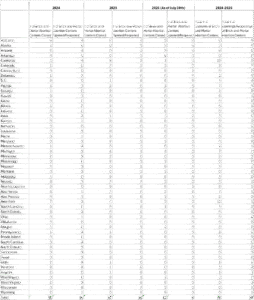
As data described later in the paper shows, there was a large increase in abortions obtained through online-only organizations from 2024 through 2025 in most states. One of the contributing factors to this could have been the closing of brick-and-mortar Planned Parenthood centers due to the OBBA or other, unrelated reasons, as well as the closure of independent abortion centers.
The Increase in the Number of Online-Only Organizations and The Expansion of Existing Online-Only Organizations’ Mail Order Abortion Services
One of the other factors responsible for the continued rise in abortion totals from 2024 to 2025 (and likely throughout 2026) is the increase and proliferation of online-only organizations that either ship abortion drugs only to states where abortion is still legal at some point or to all 50 states and D.C. From 2025 to 2026, the number of online-only organizations increased from 20 to 34, while the number of hybrid brick-and-mortar centers offering mail-order abortion drugs also increased from 101 to 103.[24] Furthermore, from 2025 to 2026, 48 states and D.C. saw increases in the number of online-only organizations willing to send abortion drugs into their states, while no states saw decreases.
To see the overall increase in access to abortion drugs via online-only organizations operating within the formal healthcare system from 2025 to 2026, see Table 5 below.[25]
Table 5 – Increase in Online-Only Organizations by State, 2025 – July 31, 2026
| # of Online-Only Organizations that Shipped Abortion Drugs to Individual States, as of May 22, 2025 | # of Online-Only Organizations that Shipped Abortion Drugs to Individual States, as of July 31, 2026 | Change in # of Online-Only Organizations that Shipped Abortion Drugs to Individual States from 2025 to July 31, 2026 | |
| Alabama | 4 | 8 | 4 |
| Alaska | 5 | 9 | 4 |
| Arizona | 5 | 10 | 5 |
| Arkansas | 5 | 8 | 3 |
| California | 21 | 21 | 0 |
| Colorado | 20 | 23 | 3 |
| Connecticut | 16 | 18 | 2 |
| Delaware | 14 | 14 | 0 |
| D.C. | 14 | 19 | 5 |
| Florida | 5 | 8 | 3 |
| Georgia | 4 | 8 | 4 |
| Hawaii | 13 | 13 | 0 |
| Idaho | 5 | 8 | 3 |
| Illinois | 17 | 19 | 2 |
| Indiana | 5 | 8 | 3 |
| Iowa | 5 | 8 | 3 |
| Kansas | 6 | 8 | 2 |
| Kentucky | 5 | 8 | 3 |
| Louisiana | 5 | 8 | 3 |
| Maine | 16 | 18 | 2 |
| Maryland | 18 | 19 | 1 |
| Massachusetts | 15 | 17 | 2 |
| Michigan | 12 | 16 | 4 |
| Minnesota | 17 | 19 | 2 |
| Mississippi | 4 | 8 | 4 |
| Missouri | 5 | 8 | 3 |
| Montana | 9 | 14 | 5 |
| Nebraska | 5 | 8 | 3 |
| Nevada | 10 | 13 | 3 |
| New Hampshire | 11 | 14 | 3 |
| New Jersey | 13 | 14 | 1 |
| New Mexico | 17 | 19 | 2 |
| New York | 18 | 24 | 6 |
| North Carolina | 5 | 8 | 3 |
| North Dakota | 5 | 8 | 3 |
| Ohio | 7 | 11 | 4 |
| Oklahoma | 5 | 8 | 3 |
| Oregon | 13 | 18 | 5 |
| Pennsylvania | 9 | 11 | 2 |
| Rhode Island | 13 | 15 | 2 |
| South Carolina | 5 | 8 | 3 |
| South Dakota | 5 | 8 | 3 |
| Tennessee | 5 | 8 | 3 |
| Texas | 4 | 8 | 4 |
| Utah | 5 | 8 | 3 |
| Vermont | 14 | 16 | 2 |
| Virginia | 16 | 19 | 3 |
| Washington | 17 | 19 | 2 |
| West Virginia | 5 | 8 | 3 |
| Wisconsin | 5 | 8 | 3 |
| Wyoming | 6 | 8 | 2 |
Table 3 above shows that there were 40 more closures of brick-and-mortar centers from 2024 through July 31, 2026 than there were openings of brick-and-mortar centers, while Table 5 shows that 48 states experienced an increase in the number of online-only organizations willing to ship abortion drugs within or into their states.
Legal Changes
In conjunction with the changes to the supply of abortions post-Dobbs, and specifically since publication of the 2025 edition of this paper, several legal changes have occurred. Since May 2025, North Dakota’s[26] and Massachusetts’ gestational laws have changed.[27] Several states’ laws regarding mail-order abortions have also changed. In September 2025, Texas passed HB 7.[28] This legislation acts as an explicit prohibition on mail-order abortions that works in conjunction with the state’s pre-existing implicit prohibition on mail-order abortions, passed in 2013.[29] HB 7 prohibits the manufacturing, distribution, mailing, or provision of abortion drugs to, by, or from anyone in Texas. The law went into effect on December 4, 2025. Similarly, South Dakota strengthened existing state law that implicitly prohibits mail-order abortions with the passage of HB 1274 in March 2026.[30] This legislation went into effect immediately, and although it is now enjoined, it prohibited the distribution or sale of abortion drugs within the state.
In addition to changes to state abortion drug and gestational laws since May 2025, several states have brought cases to state and federal courts seeking to reinstate mifepristone’s in-person requirement, remove mifepristone from the market completely, or enforce their laws outlawing mail-order abortion drugs. For the most up-to-date, in-depth summary of these cases, see the section titled Ongoing and Closed Federal and State Litigation Regarding Telehealth Abortion in CLI’s May 26, 2026, paper “An Overview of Online Abortion Drug Access in Post-Dobbs America.”[31] Despite numerous cases currently playing out in the courts, mifepristone remains widely available under the 2023 REMS requirements.[32] If mifepristone is removed from the market or the 2016 in-person requirement is reinstated, abortion-providing organizations and activists have already devised a strategy for continuing to provide abortion drugs by mail without delay.[33] These organizations will provide misoprostol-alone abortions both in-person and via the mail, depending on the specific legal status of mifepristone at the time.
How Many Abortions are Occurring in America by Year, 2024 – 2025
Analysis of abortion totals by year allows researchers to see how different legal decisions, legislative changes, and ensuing changes to the supply of abortion in America impact abortion totals. Below is a comparison of yearly abortion totals as contained in Guttmacher and #WeCount’s most recent data for all U.S. states and D.C., as well as the total number of abortions for the 35 states plus D.C. that did not have a life-at-conception law in effect at any point from 2023 through 2025 (in bold).
Table 6 – Yearly Total Number of Abortions for all 50 States and D.C. as well as for the 35 States and D.C. Without Life-at-Conception Laws from 2023 – 2025[34]
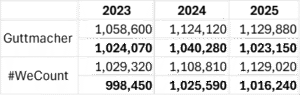
As one can see, both Guttmacher and #WeCount, for the most part, show year-over-year increases for both categories of states/D.C., albeit by slightly differing amounts. Both organizations show larger increases in the total number of abortions from 2023 to 2024 than from 2024 to 2025. Both also reported the same general pattern of abortion totals for the states/D.C. without life-at-conception laws: an increase from 2023 to 2024 and a decrease from 2024 to 2025. This suggests that while a majority of abortions are still occurring in states where abortion remains legal at some point in pregnancy, abortions occurring in states with life-at-conception laws are playing an increasingly larger role in the total number of abortions occurring in America and the yearly increases in abortions.
It is difficult to compare Guttmacher’s and #WeCount’s state abortion totals over time because they are just different enough in some states that the two organizations show slightly different pictures of where abortion increased and decreased from 2024 through 2025. Guttmacher’s data showed that of all 50 states and D.C., 33 states saw increases in their abortion totals from 2024 to 2025, while 17 states and D.C. saw decreases. Of the 33 states that saw increases in their total number of abortions, 17 had pro-life laws in effect, and 16 were pro-abortion. Of the 17 states and D.C. that saw a decrease, two had pro-life laws in effect, and 16 had pro-abortion laws in effect.[35] Guttmacher’s data shows that more pro-life states saw increases than decreases in abortions from 2024 through 2025, and of the 17 states/D.C. that saw decreases, all but two were pro-abortion. #WeCount’s data showed that 36 states and D.C. saw increases in abortion totals, while 14 saw decreases. Of the 36 states and D.C. that saw increases, 16 had pro-life laws in effect, and 21 had pro-abortion laws in effect. Of the 14 states that saw decreases, three had pro-life laws in effect, and 11 had pro-abortion laws in effect.[36] The differences in which states saw increases versus decreases in abortion totals from 2024 to 2025 according to Guttmacher versus #WeCount leads to different conclusions about the changes that primarily led to the overall increase in abortions from 2024 to 2025 when compared to #WeCount’s data.[37] If Guttmacher noted that pro-life states made up a majority (17 out of 33) of the states that saw increases in abortion totals from 2024 to 2025, but #WeCount noted that a majority of states that saw increases in abortion totals from 2024 to 2025 were pro-abortion (21 out of 36 states and D.C.), it is hard to discern whether the “restrictiveness” of pro-life states’ laws or permissiveness of pro-abortion states’ laws primarily caused the increase in the national abortion total from 2024 to 2025.
#WeCount’s data does show, like Guttmacher’s, that of the states where decreases occurred in abortion totals from 2024 to 2025, a majority were pro-abortion states. However, the numerical differences in some of the states don’t allow researchers to make a definitive conclusion about whether a majority of the states that saw increases in abortion totals from 2024 to 2025 were states with pro-life laws or pro-abortion laws. Despite this limitation, both organizations do report statistically significant aggregate yearly abortion totals for the U.S. in 2024 and 2025 (within 1.4% and 1.0% of each other’s estimates, respectively).[38]
Using #WeCount’s 2024 and 2025 data, the six states with the biggest increases in abortion totals from 2024 to 2025 included (in descending order):
- Texas: +11,240 abortions
- Ohio: +6,630
- California: +3,220
- Louisiana and Alabama (tied): +2,540
- Tennessee: +2,290
The five states with the biggest decreases in abortions from 2024 to 2025 according to #WeCount included (in descending order)[39]:
- Florida: -6,560 abortions
- New York: -5,700 abortions
- Illinois: -5,690 abortions
- New Mexico: -2,560 abortions
- Kansas: -2,320 abortions
Overall Trends in Abortion Data in Post-Dobbs America
In this section, Guttmacher’s 2023 through 2025 residency data, #WeCount’s 2024-2025 data on abortions by type of provision, and the major trends that have emerged from this data are discussed.
Abortions Obtained by Women Traveling Out of State
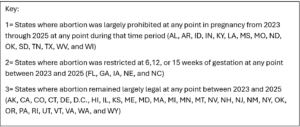
The explosion in the number of women who traveled out of state to obtain an abortion in 2023 in comparison to 2020 rightly thrust the discussion regarding residency data into the national spotlight. In all 50 states and D.C., resident abortions and total abortions increased from 2020 to 2023, 2023 to 2024, and 2024 to 2025, while nonresident abortions increased from 2020 to 2023 but then decreased from 2023 to 2024 and 2024 to 2025. Despite the number of abortions out of state declining after 2023, the number of abortions obtained by women outside their states of residence was astronomically higher in 2024 and 2025 than it was in 2020. Between 2023 and 2025, the number of abortions obtained by women traveling out of state from states with life-at-conception laws decreased, as well as for women from states where abortion remains widely unrestricted. However, travel increased for residents from 2023 to 2024 and 2024 to 2025 in states where abortion was restricted at six, 12, or 15 weeks in 2023 (at any point in the year) through 2025. To see how the travel totals changed by year and by type of state restriction, see Table 9 below.[40]
Table 9 – Number of Abortions Obtained by Women Traveling Out of State in 2020, 2023-2025 by State Abortion Law
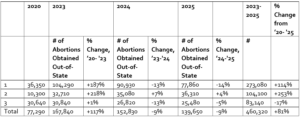
In 2023, amongst all 50 states and D.C., 167,840 women traveled out of their state of residence to obtain an abortion, while 152,830 did in 2024, and 139,650 in 2025. In aggregate across the country, compared to 2020 when abortion was legal in all 50 states and D.C., the number of women in America who traveled out of state to obtain an abortion exploded in 2023 (increasing by 117%) and then decreased from 2023 to 2024 and 2024 to 2025.
While there was an enormous increase in the number of abortions obtained by women living in states with abortion restrictions who traveled to states where abortion remained largely legal, a majority of abortions in post-Dobbs America still occur in states where abortion is still widely legal and are obtained by residents of those states. In 2023, 2024, and 2025, resident women living in states where abortion remained legal at some point in pregnancy for all of 2023 through 2025 obtained 84%, 85%, and 86% of the abortions occurring in those states, respectively. The number of women who obtained an abortion in their state of residence, regardless of their state’s abortion law, was higher in 2025 (985,212) than the country’s abortion total in 2020 (930,160), which included resident and nonresident abortions. These two seemingly conflicting trends—that there was a large increase in the number of women traveling out of state to obtain abortions after the Dobbs decision, yet a majority of abortions are still being obtained by women in their state of residence—do not actually conflict. Rather, these two trends illuminate the point that the post-Dobbs abortion landscape and the subsequent increase in abortions after the decision aren’t the result of a singular legal change or a singular change in how women obtain abortions. The current abortion landscape and the increase in abortions post-Dobbs are the result of a confluence of factors fueled by a lack of federal protections for the unborn. The lack of federal protections enables women in pro-life states to either travel to pro-abortion states and obtain an abortion or stay in their homes and order abortion drugs. Furthermore, the increased vigor with which pro-abortion politicians and state governments have acted to remove any barriers to abortion has also contributed to this country-wide increase in abortions and made it easier for residents in these states to obtain abortions in their state of residence.
This confluence of factors working together to effectuate an increased availability of abortion throughout the country is why, in 2023 to 2024, 15 of the 35 states and D.C. that did not have life-at-conception laws in effect saw resident and nonresident abortion totals increase in their states. Meanwhile, abortions obtained via women traveling from states with life-at-conception laws peaked in 2023. From 2024 to 2025, resident abortions increased while nonresident abortions decreased in 10 of those same 35 states and D.C. where abortion remained legal for any part of 2023 through 2025. This was likely because women from life-at-conception states had increased access to mail-order abortion drugs and residents in pro-abortion states had increased access to both in-person and mail-order abortion drugs.[41]
The role that resident and nonresident abortions played in the 2023-2025 abortion totals of the 35 states and D.C. without life-at-conception laws, and the increase in total abortions since 2020, can best be summarized as follows:
- A majority of the abortions that occurred in America from 2023 through 2025 occurred in these 35 states and D.C.
- The overall increase in abortions from 2020 to 2023 in America was primarily driven by an increase in resident and nonresident abortions in these 35 states and D.C. (30 out of 35 states and D.C.)
- The overall increase in abortions from 2023 to 2024 was primarily driven by an increase in resident and nonresident abortions in these 35 states and D.C. (15 out of 35 states and D.C.)
- The overall increase in abortions from 2024 to 2025 was primarily driven by an increase in resident abortions, as there was a decrease in nonresident abortions in these 35 states and D.C.
Abortion Total Estimates by Type of Provider
The most recent and complete reports on the total number of abortions occurring in America in 2024 (1,108,810) and 2025 (1,129,020) are from #WeCount and can be broken down by the type of abortion provider within the formal healthcare system that performed the abortions. These yearly totals for 2024 and 2025 are depicted graphically below.[42]
Figure 2 – Total Abortions by Type of Abortion Provider, 2024
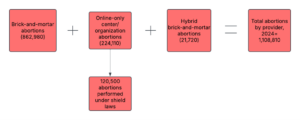
Figure 3 – Total Abortions by Type of Abortion Provider, 2025
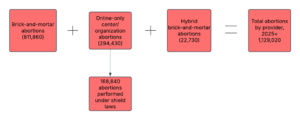
The 2024 abortion total was the highest since 2012 and the 2025 abortion total was the highest since 2011.[43] It is important to note that in 2024 and 2025, a statistically significant majority of abortions in America obtained within the formal healthcare system occurred at brick-and-mortar centers. In 2024, 78% of the estimated abortions were performed at brick-and-mortar centers, and 72% in 2025. These percentages do not suggest that the 22% and 28% of abortions performed via telehealth (online-only + hybrid brick-and-mortar) were insignificant. In fact, data trends show just the opposite. These totals are a simple reminder that despite the 51,000+ decrease in brick-and-mortar abortions from 2024 to 2025 and the subsequent 70,000+ increase in online-only abortions, brick-and-mortar abortions still represent a majority of the total number of abortions occurring within the formal U.S. healthcare system.
While brick-and-mortar centers still perform a majority of abortions occurring in the United States, there has been an undeniable increase in abortions via online-only organizations, especially since 2023. Pre-Dobbs, from April 2022 through June 2022, roughly 5% of all U.S. abortions were estimated to have occurred via telehealth, and from July 2023 through December 2023, telehealth abortions accounted for 18% of the abortions performed in the United States. That number increased to 22% in 2024 and 28% in 2025. The fact that within three-plus years such a significant increase in online-only abortions could occur shows how multifaceted and complex the supply of abortions is in a post-Dobbs America.
Calculations show that, holding all else relatively constant, approximately 73 months after July 2023 (around 6.1 years, August 2029), online-only abortions would equal the number of brick-and-mortar abortions and surpass them shortly thereafter.[44] Similar to the role that traveling to obtain an abortion has had on America’s post-Dobbs abortion totals, the role that telehealth abortions have had on abortion totals is also nuanced. While 2025 saw the country’s highest total number of abortions obtained via online-only organizations ever recorded (294,430), the number of in-person abortions (811,860) was still almost three times the online-only total. However, #WeCount’s 811,860 in-person total for 2025 was the lowest number ever recorded by the organization for in-person abortions.[45] This statistic, coupled with the calculations showing that if conditions remain relatively similar online-only abortions will surpass in-person abortions slightly after April 2030, might lead some to assume in-person abortions will ultimately become obsolete. But it is important to remember that women further along in pregnancy obtain surgical abortions and that surgical abortions are always in person. Right now, the latest point in a pregnancy when a telehealth organization will mail abortion drugs to a pregnant woman is through 13 weeks of gestation. That is, three weeks past the FDA’s 70-day limit for the use of mifepristone.[46] Therefore, the 7% of abortions occurring at 14 weeks of gestation or later, according to the most recent data available from the CDC, will theoretically continue to be in person.[47]
Furthermore, studies show that a woman’s decision to choose a drug-induced abortion over surgical abortion can be associated with a complex web of factors including race, income, insurance status, and previous pregnancy history.[48] Given these differing intrapersonal factors and legal changes that affect the supply of abortions, one should not assume that one mode of abortion will ever cease to exist. The abortion industry can only survive and thrive when abortion is widely accessible, and it responds to changes in regulations by state and federal governments in ways that make abortion accessible at any cost in any way it can. Whenever there has been an attempt to prohibit a specific type of abortion—drug-induced versus surgical or in-person drug-induced abortions versus mail-order drug-induced abortions—the abortion industry has responded by making the remaining modes of abortion available by any means possible.
Shield laws have played a monumental role in the increase of online-only abortions. From 2024 to 2025, shield law abortions increased by 48,340 across all three categories of shield law states. The biggest increase—23,000+—occurred in states with life-at-conception laws.[49]
Total Number of Abortions in Pro-Life States – 2020, 2024-2025
Immediately after Dobbs, it would have been a reasonable assumption that abortions would decrease from pre-Dobbs levels in the states that enacted life-at-conception laws as well as six- and even 12- and 15-week gestational limits. However, these assumptions could not have accounted for the impact that the enactment of shield laws and changes to the mifepristone REMS requirements would have, nor did most people expect the number of women from pro-life states who traveled to other states to obtain abortions to be so high, especially in 2023. Even today, state health departments mistakenly claim these pro-life states with life-at-conception laws are abortion-free because the number of in-person abortions has decreased to almost zero in most of these states. However, the latest data shows that these states are anything but abortion-free.[50]
In the 12 states with life-at-conception laws in effect for the entirety of 2024 and 2025, there was a 17% increase in total resident abortions in 2024 compared to 2020, a 28% increase from 2020 to 2025, and a 9% increase from 2024 to 2025.[51] Of the 12 states, 10 saw increases from both 2020 to 2024 and 2024 to 2025, all while the number of in-person abortions occurring in these 10 states decreased by 102,630 abortions from 2020 to 2025.[52] To see how the total number of resident abortions changed from 2020 to 2024-2025 in these 12 states graphically, see Table 12 below.
Table 12 – Total Number of Resident Abortions in the 12 States with Life-at-Conception Laws for the Entirety of 2024-2025 in 2020, 2024-2025

Table 12 shows that an increase in abortions obtained out of state was primarily responsible for the overall increase from 2020 to 2024, while the increase in abortion drugs obtained via the mail was primarily responsible for the increase from 2024 to 2025. From 2020 to 2025, Texas (+8,910 resident abortions), Tennessee (+5,540), and Indiana (+4,620) saw the biggest increases in abortions by residents in these 12 states.
Of the five states that had six-, 12-, or 15-week laws in place for all of 2024 and 2025, all five experienced an increase in resident abortions from 2020 to 2024, 2020 to 2025, and 2024 to 2025.[53] To graphically see how the total number of resident abortions changed from 2020, 2024-2025 in these five states, see Table 13 below.
Table 13 – Total Number of Resident Abortions in the Five States with 6, 12, and/or 15 Week Laws for the Entirety of 2024-2025 in 2020, 2024-2025

There was an increase of 38% in the total number of resident abortions in those five states from 2020 to 2024, a 49% increase from 2020 to 2025, and an 8% increase from 2024 to 2025. In aggregate, the increase in abortion drugs obtained via the mail was the factor most associated with the increase from 2020 to 2025 in the five states, while an increase in abortions being obtained out of state also played an important but lesser role. From 2024 to 2025, the increase in the total number of resident abortions was primarily due to a large increase in online-only abortions, which made up for the 3,000-plus decrease in in-person abortions. The slight increase in in-person abortions from 2020 to 2024 in these five states exhibits the demand of residents to obtain abortion in their states of residence even after the various gestational laws were enacted, as nonresident abortions were not included in this total.
The increase in total abortions in states with life-at-conception laws or six-, 12-, and 15-week laws from 2020 to 2024, 2020 to 2025, and 2024 to 2025, as well as Tables 11 and 12 above, show how nuanced the conversation is regarding why resident abortions increased after Dobbs. Ultimately, both the availability of mail-order abortion drugs and the ability to travel out of state to obtain an abortion played large roles in the increase in resident abortions in both categories of states, with the magnitude of the role they played in the increase depending on the category of states and the years being measured.
Abortions Occurring Outside of the Formal Healthcare System
In the 2025 edition of this paper, estimates from peer-reviewed and media sources were summarized regarding the number of abortion drugs being mailed outside of the formal healthcare system. Below, this paper summarizes one newly published peer-reviewed study on this topic and some new media articles.[54]
In October 2025, Willerford et al. published a study showing that between November 2021 (pre-Dobbs) and February 2023 (post-Dobbs, but when Aid Access was still operating outside of the formal U.S. healthcare system as an international online abortion-providing organization), Aid Access completed 16,154 online requests for abortion drugs across 18 U.S. states and 743 counties.[55] There were two-and-half times more requests for abortion drugs after the Dobbs decision than there were pre-Dobbs. In terms of other international online abortion-drug organizations, Women on the Web‘s executive director told Ms. Magazine in November 2025 that her organization was receiving “around 30 requests per day” for abortion drugs from U.S. women.[56] This article also noted that a majority of the requests came from women in states with life-at-conception laws. Lastly, an article in Ms. Magazine from December 2025 noted that the international online abortion drug organization Abortion Pills in Private had served around 3,500 U.S. women since March 2024 when they first started serving U.S. women.[57] Most of the requests to Abortion Pills in Private came from women in Texas, Florida, Georgia, Ohio and Pennsylvania.
In February 2026, another article in Ms. Magazine noted that the four community networks associated with the organization Red State Access sent abortion drugs to “approximately 3,500” American women “across 38 states each month.” Two of the networks associated with Red State Access, IdahoAccess and MidWest+Access, sent around 400-500 and 700 abortion drug-regimens a month, respectively, to U.S. women across 20 states.[58] E-commerce websites and other community networks aren’t touched upon in this section, but as the 2025 edition of this paper noted, these types of online provider ship thousands and thousands of abortion drugs into America each year.[59]
Conclusion
Looking forward, it seems as though abortions will continue to increase. As of July 2026, Guttmacher, the only organization that has reported abortion totals for any part of 2026, estimated that 393,700 abortions occurred from January 1, 2026, through April 30, 2026. If that trend continues for the rest of 2026, there will have been approximately 1,181,100 abortions in the United States this year.
Access to mifepristone on a national scale is also unlikely to change in 2026. There is ongoing litigation pending oral arguments before the Supreme Court which has the potential to change the way mifepristone can be accessed, but the Court’s decision will likely come out months later into 2027.[60] In that case, The State of Louisiana and Rosalie Markezich v. U.S. FDA, Louisiana and its resident, Rosalie Markezich, are suing the FDA over their decision to remove the in-person dispensing REMS requirement in 2021/2023.
While researchers will most likely have to wait until June or July of 2027 for the full annual abortion totals for 2026, it is safe to say now, barring new federal protections for the unborn, that abortions will continue to rise, and the reasons for that increase will continue to be nuanced. Despite the media and the abortion industry’s efforts to make the conversation about abortion totals in America simplistic and centered around euphemistic catchphrases, the post-Dobbs abortion landscape is very complex and influenced by regional variations in abortion policy, intrapersonal decisions, a lack of federal limits on abortion, and legal changes that occurred before and after the Dobbs decision. In the years (2024-2025) when the abortion industry said that court cases, federal defunding of Planned Parenthood, and state laws would cripple abortion access, abortions increased.
When it comes to abortion in America, the only way to bring the total down significantly is to enact federal protections that would stop not only the circumvention of state pro-life laws by pro-abortion states that enact shield laws but also stop pro-abortion states from becoming abortion tourist destinations for nonresidents traveling from out of state. Even then, the federal government would also have to enforce existing laws to combat abortions occurring outside of the formal healthcare system via domestic and international online abortion drug providers. Despite every effort made by pro-life states, the abortion industry has adapted and made abortion available by any means possible. This will only continue, and abortions will only continue to rise, until federal protections are enacted.
Mia Steupert, M.A., is Research Associate at the Charlotte Lozier Institute.
[1] Mia Steupert, “How Many Abortions Are Occurring in America Post-Dobbs?,” Charlotte Lozier Institute, May 22, 2025, https://lozierinstitute.org/how-many-abortions-are-occurring-in-america-post-dobbs/.
[2] For the most recent visual depiction of abortion providers operating in and outside of the formal healthcare system as of July 31, 2026, see Figure 1 in the Appendix of this paper. The data on the number of brick-and-mortar abortion clinics came from CLI’s internal spreadsheet on abortion centers that uses information from the Ineedana website. The data on the online organizations that mail abortion drugs came from CLI’s internal spreadsheet which uses information from the Plan C website.
[3] For some of the original estimates of abortions occurring outside of the formal healthcare system from peer-reviewed papers and news articles, see Tables 10 and 11 in the 2025 version of this paper cited above.
[4] Because 2025’s paper was written when Guttmacher was not tracking abortions occurring via shield laws in states with life-at-conception laws, this paper will not compare the claims and conclusions made in the 2025 paper to the claims made in this paper.
[5] 2023 abortion totals will not be discussed in depth in this paper outside of residency data and some general comparisons to 2024 and 2025 abortion totals because neither Guttmacher nor #WeCount have full-year estimates for states that had life-at-conception laws in effect for any part of 2023. Furthermore, the last version of this paper already analyzed the available 2023 data at length. This paper primarily focuses on 2024 and 2025 data because the full year of 2024 data wasn’t published by #WeCount when the previous version of this paper was published in May 2025, and only a few months of 2025 data were available via Guttmacher.
[6]“WeCount Report-11-Dec-2025-data tables,” Report Data Tables, Society of Family Planning, June 10, 2026, https://societyfp.org/wecount-report-11-dec-2025-data-tables/. It appears the abortion totals on #WeCount’s website and in their documents for 2025 abortion totals, released on June 10, 2026, slightly differ from the data included in the “WeCount Report-11-Dec-2025-data tables.xlsx” also released on June 10, 2026. As such, the #WeCount data that currently appears on the webpage for the project adds up to a different 2025 total (1,126,760) than the total within the spreadsheet (1,129,020). It appears the discrepancy (2,260 abortions) in the sources’ abortion totals occurs because of the spreadsheet having higher abortion totals for Minnesota (+1,840) and Nebraska (+420) than the webpage’s data explorer tool. This report uses data from the spreadsheet in all its analyses, figures, and tables that include #WeCount data. For Guttmacher data, this paper uses data released by Guttmacher on June 9, 2026, and July 21, 2026, as well as 2020 data released in 2025.
[7] While Guttmacher and #WeCount’s estimates now capture the same types of abortions occurring within the formal healthcare system, because of slightly different methodological techniques their estimates sometimes differ for certain states and for yearly national totals.
[8] “Methods_Appendix.pdf,” Guttmacher Institute Monthly Abortion Provision Study, July 21, 2026, https://osf.io/k4x7t/overview. “Methods,” #WeCount, Society of Family Planning, June 10, 2026, https://societyfp.org/research/wecount/wecount-december-2025-data/. The Centers for Disease Control (CDC) has not published its abortion surveillance report for 2023 because of a pause in the CDC’s reporting as of July 2025. Because the latest CDC data is for abortions performed in 2022, along with the fact that it doesn’t include abortions from states with some of the highest abortion totals in the country (California, Maryland, and New Jersey, amongst other states), it’s abortion totals are no longer at all relevant to any conversation related to countrywide abortion totals. Because of the CDC’s pause in publishing its abortion surveillance summaries, the District of Columbia’s, Hawaii’s, New Mexico’s, Rhode Island’s, Tennessee’s, Virginia’s, and Washington’s health departments’ data have not been released for 2023 abortion totals and beyond.
[9] “Guttmacher Releases New Data on Travel for Abortion Care in 2025,” News Release, Guttmacher Institute, July 22, 2026, https://www.guttmacher.org/news-release/2026/guttmacher-releases-new-data-travel-abortion-care-2025. Guttmacher’s MAPS data does not include the very limited number of abortions that occur under the exceptions to states’ life-at-conception laws, according to Guttmacher’s methodology document cited in footnote 8, but #WeCount’s data does include such data in their in-person totals. Neither Guttmacher’s or #WeCount’s data includes estimates of the number of abortions occurring outside the formal healthcare system via international online organizations, e-commerce websites, community networks, or via self-harm. It is also important to note that Guttmacher and #WeCount’s data on telehealth abortions represents the number of abortion drugs prescribed, dispensed, and mailed, not the number of women who did or did not take the abortion drugs sent to them. For this reason, each organization’s telehealth estimates for online-only organizations and hybrid brick-and-mortar may be overestimated.
[10] Table 1 in the Appendix contains the breakdown of what information each state reports and how an overall lack of mail-order abortion reporting leads to significant underreporting of abortions in most states.
[11] Table 1 shows that, of the seven states claiming to track mail-order abortion drugs mailed into their states (AL, AK, CO, MA, NV, OH, and OR), none have abortion totals that are statistically close to #WeCount’s estimates, because the states’ and #WeCount’s telehealth estimates are so incongruent.
[12] The 32 states/territories that allow abortion drugs to be shipped within or into the state include Alaska, Arizona, California, Colorado, Connecticut, Delaware, D.C., Georgia, Hawaii, Illinois, Kansas, Maine, Maryland, Massachusetts, Michigan, Minnesota, Missouri, Montana, Nevada, New Hampshire, New Jersey, New Mexico, New York, North Carolina, Ohio, Oregon, Pennsylvania, Rhode Island, Vermont, Virginia, Washington, and Wyoming. The seven states that allow abortion drugs to be shipped within their states and claim to track such mail-order abortion drugs include Alaska, Colorado, Massachusetts, Nevada, New Mexico, Ohio, and Oregon. The 19 states that do not allow abortion drugs to be shipped within their state (or from outside of the state but shield laws circumvent these laws) include Alabama, Arkansas, Florida, Idaho, Indiana, Iowa, Kentucky, Louisiana, Mississippi, Nebraska, North Dakota, Oklahoma, South Carolina, South Dakota, Tennessee, Texas, Utah, West Virginia, and Wisconsin.
[13] “What Security Precautions are in Place to Protect Providers and Patients,” Guttmacher Institute Monthly Abortion Provision Study, https://www.guttmacher.org/monthly-abortion-provision-study?state=US#methodology; “#WeCount Report,” Methods, Society of Family Planning, June 10, 2026, https://societyfp.org/research/wecount/wecount-december-2025-data/. While both Guttmacher and #WeCount claim that they do not release facility level abortion totals for patient confidentiality reasons, certain states (such as Massachusetts) release abortion totals by facility with no possible way for researchers or the public to identify women who obtained abortions at these facilities.
[14] Steupert, “How Many Abortions Are Occurring in America Post-Dobbs.”
[15] See “Questions and Answers on Mifepristone for Medical Termination of Pregnancy Through Ten Weeks Gestation,” U.S. Food and Drug Administration, last updated April 8, 2026, https://www.fda.gov/drugs/postmarket-drug-safety-information-patients-and-providers/questions-and-answers-mifepristone-medical-termination-pregnancy-through-ten-weeks-gestation; Patrizia A. Cavazzoni, “FDA REMS Review Announcement Letter,” Center for Drug Evaluation and Research, December 16, 2021, https://www.aclu.org/documents/fda-rems-review-announcement-letter. The December 2021 removal was announced via a Center for Drug Evaluation and Research letter to Graham Chelius who was associated with SFP and had inquired about the status of the CDC’s review of mifepristone’s REMS. For the 2023 removal of the in-person dispensing requirement from the regulatory rulebook the FDA did not issue a written statement announcing this regulatory change. Instead, the agency discreetly updated its website page on mifepristone to reflect the agency’s permanent changes (Questions and Answers).
[16] As of August 2026, 13 states have life-at-conception laws. These states include Alabama, Arkansas, Idaho, Indiana, Kentucky, Louisiana, Mississippi, North Dakota, Oklahoma, South Dakota, Tennessee, Texas, and West Virginia. Four states have heartbeat/6-week limits: Iowa, Florida, Georgia, and South Carolina. Nebraska and North Carolina have 12-week limits. Utah limits abortion at 18 weeks of gestation while Kansas, Ohio, and Wisconsin limit abortion at 22 weeks. Pennsylvania and New Hampshire limit abortion at 24 weeks. Thirteen states have ineffective viability limits that do not in practice substantially protect the unborn, including Arizona, California, Connecticut, Delaware, Hawaii, Illinois, Montana, Missouri, Nevada, New York, Rhode Island, Virginia, and Wyoming. Twelve states and D.C. have no limits on when an abortion can be performed. Those 12 states include Alaska, Colorado, Maine, Massachusetts, Maryland, Michigan, Minnesota, New Jersey, New Mexico, Oregon, Vermont, and Washington. In November 2025, a panel of North Dakota state Supreme Court judges upheld the state’s life-at-conception law, reversing a lower court’s ruling temporarily blocking the law (Access Independent Health Services, Inc., d/b/a Red River Women’s Clinic et al. v. Wrigley, et al., 2025, https://reproductiverights.org/wp-content/uploads/2025/09/ND-Supreme-Court-opinion-2025.pdf). Three of the court’s five judges agreed with the previous lower court’s ruling but fell short of having the supermajority needed under state law to declare laws unconstitutional. In March 2026, a Marion County, Indiana judge ruled that the state’s life-at-conception law violated the constitutional rights of those (Hoosier Jews for Choice) who believed that the right to an abortion is a religious belief and therefore violated the state’s Religious Freedom Restoration Act. As a result, this law has been enjoined from being enforced for those who argue their religious freedom requires access to abortion (Anonymous plaintiff 1, et al., v. The Individual Members of the Medical Licensing Board of Indiana, et al., https://www.courthousenews.com/wp-content/uploads/2026/03/indiana-abortion-marion-county-religous-lawsuit.pdf). However, it is unclear how this ruling is being enforced, as even pro-abortion sources such as the Center for Reproductive Right’s analysis of Indiana’s current abortion laws, agree that Indiana prohibits abortion except in limited cases. See “Indiana,” Center for Reproductive Rights, https://reproductiverights.org/maps/abortion-laws-by-state/indiana/.
[17] The eight states include California, Colorado, Maine, Massachusetts, New York, Rhode Island (and S2262 Substitute B, 2024), Vermont, and Washington. The 14 states include Arizona, Connecticut (and Public Act No. 22-19, 2022), Delaware, Hawaii, Illinois, Maryland, Michigan (and Executive Order No. 2022-5), Minnesota, Nevada, New Jersey (and N.J. Stat. §2A:84A-22.19), New Mexico, North Carolina (and Executive Order No. 8, 2025), Oregon, and Pennsylvania.
[18] Even though some of the changes in the next four subsections occurred in 2026 and most of the data described in future sections covers abortions occurring in 2024 and 2025, it is still important to discuss these changes and provide the most up to date summary possible of how women are obtaining abortions and laws surrounding the issue of abortion.
[19] Public Law 119-21- July 4, 2025. 119th Congress (H.R. 1), https://www.congress.gov/bill/119th-congress/house-bill/1/text.
[20] Other abortion-providing organizations were implicated by this reconciliation bill such as the Maine Family Planning organization, but Planned Parenthood was the main organization implicated by the OBBA.
[21] This figure is from an internal CLI abortion center spreadsheet. To see the number of brick-and-mortar centers by state see Table 2 in the Appendix. The CLI spreadsheet uses information from Ineedana’s website.
[22] The changes in brick-and-mortar totals came from CLI’s internal abortion center spreadsheet. The legal decisions in Missouri in both 2025 and 2026 have allowed for abortion centers to start operating again in the state. These openings represent most of the brick-and-mortar openings/reopenings in 2025 and 2026. Since the court decisions, five Planned Parenthoods started performing abortions in the state for the first time or again, three of which opened in 2025 and two in 2026 after a June 2026 court ruling. Three of the five locations perform both drug-induced and surgical abortions, while two perform only drug-induced abortions
[23] The data within the table regarding the number of brick-and-mortar centers opening and closing is from CLI’s internal abortion center spreadsheet. Opened/Reopened in this table means that the abortion center was one of the following: a brand-new center, a center that reopened after being closed, or a center that was open previously but just started performing abortions in x year.
[24] These figures came from CLI’s internal tracking of these organizations over the past year plus. While the increases reflect changes over a slightly different period of time than the majority of the data in future sections, it is still important to discuss these changes as they are reflective of a multi-year trend and show the accumulated efforts of the abortion industry playing out over a period of time. For the number of online-only and hybrid brick-and-mortar centers by state, see Table 4 in the Appendix. For more about how these organizations and centers operate, see “An Overview of Online Abortion Drug Access in Post-Dobbs America,” and Appendix C Tables 1-5 associated with that paper.
[25] The data on the number of virtual-only organizations by state for 2025 is from Appendix C, Table 8 of last year’s version of this paper. The number of virtual-only organizations by state for 2026 comes from CLI’s internal spreadsheet tracking different modes of online provision of abortion drugs. This spreadsheet contains data from Plan C and Ineedana. The increase in hybrid brick-and-mortar centers by state was not included in Table 5 because the change was so minimal.
[26] Discussed in footnote 15.
[27] On August 10, 2026, Massachusetts Governor Maura Healy signed house bill H.5595 titled “An Act prioritizing patient access to care,” and passed by the 194th Massachusetts Congress, into law (see https://malegislature.gov/Bills/194/H5595.pdf). This legislation replaced the prior ineffective, 24-week limit that contained broad exceptions to the post-24-week prohibition. H5595 removed any limits on when an abortion can be performed in Massachusetts.
[28] HB 7, “Relating to prohibitions on the manufacture and provision of abortion-inducing drugs, including the jurisdiction of and effect of certain judgments by courts within and outside this state with respect to the manufacture and provision of those drugs, and to protections from certain counteractions under the laws of other states and jurisdictions; authorizing qui tam actions.” 89th Legislature 2nd Special Session, Texas.
[29] The 2013 legislation was enacted into law as HB 2 titled “Relating to the regulation of abortion procedures, providers, and facilities; providing penalties,” passed by the 83rd Legislature during the 2nd Special Session (see https://legiscan.com/TX/text/HB2/id/872841). The 2013 Texas legislation requires in-person dispensing of abortion drugs, which implicitly creates a prohibition on mail-order abortions in the state.
[30] HB 1274, “An Act to restrict the delivery of an abortion-inducing medicine, drug, or substance into this state and provide a criminal and a civil penalty therefor, and provide a civil action for the wrongful death of an unborn child.” 101st Legislative Session. Passed into law on March 30, 2026. https://legiscan.com/SD/bill/HB1274/2026.
[31] Mia Steupert, “An Overview of Online Abortion Drug Access in Post-Dobbs America.” Charlotte Lozier Institute, May 26, 2026, accessed July 20, 2026. Since that paper was published in May 2026, one update has occurred. On July 17, 2026, a federal judge ruled that South Dakota could not enforce its advertising prohibition (legislated by HB 1274 discussed above) against Mayday Health or prosecute them for circumventing several of South Dakota’s laws on when, where, and how abortions can be performed/obtained in the state (Mayday Health and Nancy Turbak Berry, v. Governor Larry Rhoden and Attorney General Marty Jackley (2026), https://storage.courtlistener.com/recap/gov.uscourts.sdd.86282/gov.uscourts.sdd.86282.51.0.pdf). On August 3, 2026, South Dakota’s Attorney General and Governor filed an appeal of the July 17, 2026, ruling. However, the law remains blocked as the case plays out in court.
[32] “Risk Evaluation and Mitigation Strategy (REMS) Single Shared System for Mifepristone 200 MG,” Food and Drug Administration, most recent modification January 2023, https://www.accessdata.fda.gov/drugsatfda_docs/rems/Mifepristone_2023_01_03_REMS_Full.pdf.
[33] Nina Martin, “They Came for Mifepristone. The Abortion Rights Movement is Ready,” Mother Jones, May 7, 2026, https://www.motherjones.com/politics/2026/05/they-came-for-mifepristone-the-abortion-rights-movement-is-ready/.
[34] This data was taken from Guttmacher’s 6-92-26 document titled “MonthlyAbortionProvisionMonthly” in the previous estimates folder and #WeCount’s June 2026 data explorer tool.
[35] In the context of this analysis, states where the status of abortion’s legality changed at some point between 2024 and 2025 and/or the state had a governor in office whose views on abortion did not reflect their state’s abortion law, were categorized as follows: Missouri = pro-abortion, North Carolina = pro-life, and North Dakota = pro-life. To see which states experienced increases versus decreases in abortion totals from 2024 to 2025 according to Guttmacher, see Table 7 in the Appendix. The data came from Guttmacher’s June 9, 2026, spreadsheet titled “MonthlyAbortionProvisionMonthly,” in the folder titled Previously Published Estimates (see here: https://osf.io/k4x7t/overview).
[36] To see which states experienced increases versus decreases in abortion totals from 2024 to 2025 according to #WeCount, see Table 8 in the Appendix. The data came from #WeCount’s June 10, 2026 data, which can be found here: https://societyfp.org/research/wecount/wecount-december-2025-data/.
[37] The six states where Guttmacher and #WeCount disagreed on whether abortions increased from 2024 to 2025 included Connecticut, Hawaii, Maine, Michigan, Minnesota, and North Carolina (all but North Carolina allow abortion generally throughout pregnancy).
[38] The differences can be explained by the fact that the organizations have slightly differing data-capturing models and by the fact that #WeCount started tracking shield law abortions in states with life-at-conception laws in July 2023, while Guttmacher added estimates for these states for July 2023 onward in March 2026.
[39] The five states that saw the biggest percentage increases in abortion totals from 2024 to 2025 in descending order, according to #WeCount, include Missouri (+68%), North Dakota (+57%), Indiana (+48%), South Dakota (+47%), and Alabama (+45%). The five states that saw the biggest percentage decreases in abortion totals from 2024 to 2025 in descending order include Iowa (-20%), Wyoming (-16%), New Mexico (-14%), New Hampshire (-13%), and Kansas (-10%). Several of these states saw such big percentage changes because their state is a low abortion-volume state, statistically speaking, so any moderate numerical change in the number of abortions results in a significant percentage change. The states that saw large numerical changes in abortions as well as percentage changes including Missouri, Alabama, New Mexico, and Kansas. Most likely such changes occurred because of legal changes (Missouri), an increase in abortion drugs being sent into the state (Alabama), and a decrease in nonresident women from neighboring states traveling to their states to get abortions (Kansas and New Mexico).
[40] The residency data for 2023 through 2025 was taken from the July 21, 2026, Guttmacher spreadsheet titled “State_Abortion_Travel_2023_2024_2025,” which can be found here. The 2020 residency data was taken from the April 23, 2025, document titled “State_Abortion_Travel_2020.” One might wonder why certain states such as Missouri, North Dakota, and Wisconsin are categorized differently in different tables and figures in terms of the status of their state laws. The states are categorized in each table in a way that would portray the data in their states in the most honest and impactful way. For example, in Table 9 Wisconsin is included in the group of states with a life-at-conception law for any part of 2023 through 2025 because the state had a high number of women who traveled out-of-state in 2023 when the state’s life-at-conception law was in effect for part of the year. However, in a hypothetical table on the number of in-person abortions in each state in 2023, it wouldn’t be as critical to include Wisconsin in the group of states with a life-at-conception law because a relatively small number of in-person abortions occurred in the state in 2023.
[41] Tables 10A and 10B in the Appendix contain a breakdown of which of the 35 states and D.C. without life-at-conception laws for any part of 2023 through 2025 experienced resident abortion increases and/or nonresident abortion decreases from 2023 to 2024 and 2024 to 2025. Data for Tables 10A and 10B are from Guttmacher’s June 9, 2026, spreadsheet titled “MonthlyAbortionProvisionMonthly” in the Previously Published Estimates folder and Guttmacher’s July 21, 2026, spreadsheet titled “State_Abortion_Travel_2023_2024_2025.”
[42] These totals were calculated using data from #WeCount’s June 2026 data. The shield law totals included abortion drugs sent to women in states with life-at-conception laws, 6-week limits, and to women in states with telehealth restrictions or prohibitions.
[43] Pre-2024 abortion totals were taken from the only source with such totals: Guttmacher’s 2022 Abortion Provider Census, which detailed 1973-2017 and 2020 estimates.
[44] For the equations and calculations for this projection, see Table 11 and Figures 4 and 5 in the Appendix. Table 11 provides the data for Figure 4 which shows the graph associated with the calculations for Figure 5. These calculations depend on mifepristone remaining available under the current REMS requirements that allow for mail-order abortions and other legal conditions surrounding abortion and abortion drugs remaining constant.
[45] Rachel K. Jones et al., “Abortion Incidence and service availability in the United States, 2020,” Perspectives on Sexual and Reproductive Health, (2022), 128-141, https://doi.org/10.1363%2Fpsrh.12215. Before the FDA officially removed the in-person dispensing requirement for mifepristone in 2021/2023, women enrolled in FDA-exempted studies could obtain telehealth abortions starting in 2008. (see Megan K. Donovan, Improving Access to Abortion via Telehealth, Guttmacher Policy Review Vol. 22 (Guttmacher Institute, 2019), https://www.guttmacher.org/sites/default/files/article_files/gpr2202319.pdf). However, it is unclear if these abortions were included in Guttmacher’s 1975-2020 abortion totals described above.
[46] Steupert, “An Overview of Online Abortion Drug Access in Post-Dobbs America.” Appendices, 7.
[47] Stephanie Ramer et al., Abortion Surveillance- United States, 2022, Vol. 73 No. 7, Morbidity and Mortality Weekly Report (Centers for Disease Control and Prevention, 2024), 23. The 7% figure came from the CDC’s most recent data (2022) which, while flawed, is the only source that released (semi-)aggregate, country-wide gestational data. Guttmacher and #WeCount do not collect and/or release gestational age data, but Guttmacher does rely on the 7% figure in their own analyses. See “Abortion in the United States,” Fact Sheet, Guttmacher, March 2026, https://www.guttmacher.org/fact-sheet/induced-abortion-united-states.
[48] Rachel K. Jones et al., “Characteristics of People Obtaining Medication vs Procedural Abortions in Clinical Settings in the United States: Findings from the 2021-2022 Abortion Patient Survey,” Contraception 128, (2023): https://doi.org/10.1016/j.contraception.2023.110137; Laura Jacques et al., “Medication or Surgical Abortion? An Exploratory Study of Patient Decision Making on a Popular Social Media Platform,” AJOG 225, no. 3 (2021): 344-347, 10.1016/j.ajog.2021.05.011.
[49] This data came from #WeCount’s June 10, 2026, data.
[50] Steupert, “How Many Abortions are Occurring in America Post-Dobbs?”
[51] These 12 states include Alabama, Arkansas, Idaho, Indiana, Kentucky, Louisiana, Mississippi, Oklahoma, South Dakota, Tennessee, Texas, and West Virginia. Resident abortion totals in these states for 2024 and 2025 equals the limited number of resident abortions occurring in-person under exceptions to the states’ life-at-conception law (#WeCount’s June 10, 2026, data) + the number of mail-order abortion drugs shipped to residents of the state via shield laws (#WeCount’s June 10, 2026, data) + the number of abortions obtained by residents traveling out-of-state to states where abortion remains legal (Guttmacher’s 7-21-2026 travel data). The number of resident abortions in 2020 equals the number of resident in-person abortions and the number of abortions obtained by residents traveling out-of-state (both data points were taken from Guttmacher’s 4/23/2025 spreadsheet titled “State_Abortion_Travel_2020”). This equation applies to Table 12 below. The comparison between 2020 and 2024-2025 is not 100% symmetrical because the resident in-state total for 2024-2025 includes all in-person abortions which theoretically could include nonresidents as #WeCount doesn’t stratify the in-person data by residency. However, as state data from these states with life-at-conception laws shows, very few abortions performed in these states under the law’s exceptions are performed on nonresidents. Of the most recent data from states that report the residence of those who obtain abortions under the exceptions to their life-at-conception laws, only nine abortions out of 239 were performed on nonresidents. This calculation was done using internal CLI spreadsheets from publicly available state abortion data for Idaho (2024), Indiana (2025), Kentucky (2024), South Dakota (2025), Texas (2024), and West Virginia (2025).
[52] Those 10 states include Alabama, Arkansas, Idaho, Indiana, Kentucky, Louisiana, Mississippi, South Dakota, Texas, and West Virginia. Only Oklahoma and Tennessee were outliers, with Oklahoma experiencing a decrease from 2020 to 2024 and an increase from 2024 to 2025 and Tennessee experiencing an increase from 2020 to 2024 and a slight decrease from 2024 to 2025.
[53] These five states include Florida (6-week law as of 5/21/24, 15-week law from 7/5/22-4/30/24), Georgia (6-week law), Nebraska (12-week law), North Carolina (12-week law), and South Carolina (6-week law). “Resident abortions” mean the same as it did in footnote 36, except that abortions are occurring in-person in these states in large numbers as abortion is legal until various points in pregnancy and not just under a limited number of exceptions to a life-at-conception law. Furthermore, the data for these five states were taken from the sources listed in footnote 36 and apply to Table 13, as well.
[54] This does not imply that the estimates contained in these sources capture all of the only abortions occurring outside of the formal healthcare system. Instead, these sources are simply covered to add to CLI’s previous discussion on this topic. For the discussion of these estimates see: Steupert, “How Many Abortions are Occurring in America Post-Dobbs?”, 19-23.
[55] Amy K. Willerford et al., “Distance to Care and Telehealth Abortion Demand After Dobbs,” JAMA 8, no. 10 (2025): doi:10.1001/jamanetworkopen.2025.38212. It is important to note that the number of completed telehealth requests does not equal the number of abortion drugs actually taken by women, and that not all abortion drug regimens taken result in a complete abortion. As mentioned in the previous version of this paper, one peer-reviewed study shows that 88% of requests to international online abortion-drug organizations (which Aid Access was during the study period) resulted in women taking the abortion drugs. (Abigail R. A. Aiken et al., “Provision of Medications for Self-Managed Abortion Before and After the Dobbs v Jackson Women’s Health Organization Decision,” JAMA 331, no. 18 (2024): 1558-1564, doi:10.1001/jama.2024.4266). Given this statistic, approximately 14,200 abortion drug regimens from Aid Access were taken by women during the period covered by the Willerford et al. study.
[56] Carrie N. Baker, “International Telehealth Provider ‘Women on Web’ Vows to Keep Abortion Pills Flowing to the U.S., No Matter What,” Ms. Magazine, November 17, 2025, https://msmagazine.com/2025/11/17/abortion-pills-usa-women-on-web-fda-trump-rfk/.
[57] Carrier N. Baker, “International Telehealth Provider ‘Abortion Pills in Private’ Ready to Ramp Up if FDA Restricts Mifepristone,” Ms. Magazine, December 8, 2025, https://msmagazine.com/2025/12/08/abortion-pills-international-usa-fda-mifepristone-texas-ban/.
[58] Carrie N. Baker, “Community Groups Sharing Free Abortion Pills Expand to States Where Abortion is Legal But Out of Reach,” Ms. Magazine, February 19, 2026, https://msmagazine.com/2026/02/19/free-abortion-pills/. One peer-reviewed study found that 98.5% of abortion drug requests to community networks resulted in the women taking the abortion drugs (Aiken et al., “Before and After the Dobbs v. Jackson Women’s Health Organization Decision”). Given that usage rate, 41,370 abortion drug regimens provided by community networks associated with Red State Access are sent to and taken by U.S. women a year (98.5% of 3,500 requests x 12 months).
[59] Allison McCann, “Inside the Online Market for Overseas Abortion Pills,” The New York Times, April 13, 2023, https://www.nytimes.com/interactive/2023/04/13/us/abortion-pill-order-online-mifepristone.html.
[60] The State of Louisiana and Rosalie Markezich v. U.S. FDA (2025), https://litigationtracker.law.georgetown.edu/wp-content/uploads/2025/10/State-of-Louisiana_2025.10.06_COMPLAINT.pdf.