





Search Icon
close-panel

Charlotte Lozier Institute

Phone: 202-223-8073
Fax: 571-312-0544

2776 S. Arlington Mill Dr.
#803
Arlington, VA 22206

Get Notifications

Sign up to receive email updates from Charlotte Lozier Institute.

This field is for validation purposes and should be left unchanged.

close-panel

Become A Defender of Life

Your donation helps us continue to provide world-class research in defense of life.

DONATE

Charlotte Lozier Institute

Phone: 202-223-8073
Fax: 571-312-0544

2776 S. Arlington Mill Dr.
#803
Arlington, VA 22206

Month 9

Preparing for birth

Human Prenatal Age
  • Post-conception week 34-38
  • 9 Months Pregnant
  • Gestational Weeks 36-40
Highlights
  • Babies remember flavors from the womb, and may prefer them after birth.1

  • Newborns cry with the melody of their mother’s language, so babies from different cultures sound different from birth.2

  • By 9 months, babies have about 40% more brain cells than they will have as adults.3

In the last month, the baby prepares for birth. After 37 weeks, he is no longer considered premature, but rather “early term.” His lungs are internally coated with surfactant, which keeps his air sacs open when he breathes. In other words, he is usually ready to breathe on his own.

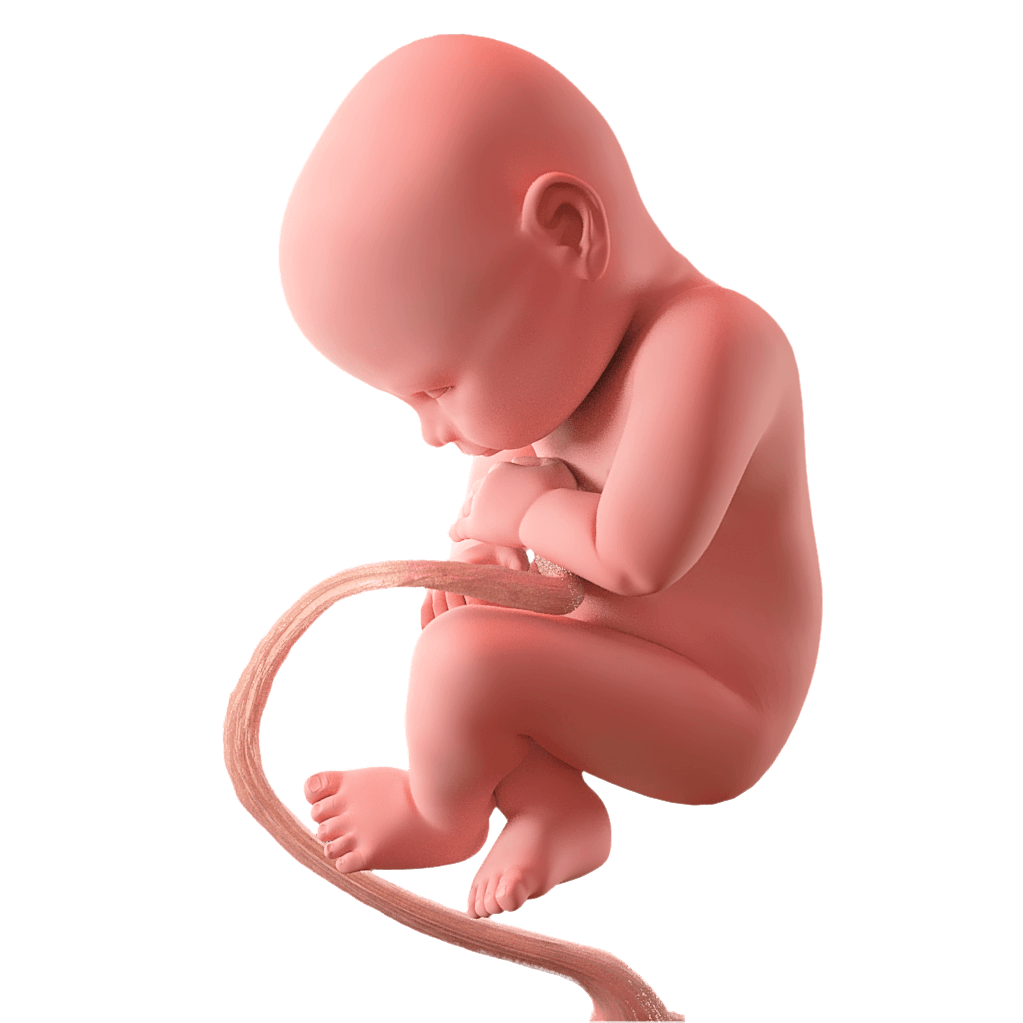
This composite image rendered from light-guided endoscopy recordings shows this fetus alive in the uterus at 9 months gestation. In the last month, the baby gains nearly half a pound each week.(Image Credit: <a href="https://erf.science/#high-resolution">Education Resource Fund</a>)
This composite image rendered from light-guided endoscopy recordings shows this fetus alive in the uterus at 9 months gestation. In the last month, the baby gains nearly half a pound each week.(Image Credit: Education Resource Fund)
Final weeks of growth

In the final month before birth, the unborn child is quite active in the womb. The baby swallows between one and two cups of amniotic fluid every day.4 Although this fluid provides a small amount of nutrition, about 40 calories daily,5 the baby’s growth is primarily fueled by nutrients and oxygen delivered through the placenta. On average, the baby gains nearly half a pound per week during this final month.6 In addition to swallowing, the baby also excretes over two cups of urine daily.7 To keep the amniotic fluid clean, the amniotic fluid circulates rapidly. In fact, the water content of the amniotic fluid is completely replaced every three hours!8

Experiences in the womb shape newborn reactions

Babies are surprisingly tuned into the world of smell and taste before and after they are born. Newborns can detect and respond to scents more acutely than adults, including recognizing their own amniotic fluid and their mother’s breastmilk within hours of birth.9 10 These smells don’t just guide babies toward food — they also bring comfort and even reduce pain. A familiar scent like vanilla or mom’s milk can soothe crying and lower stress during a blood draw.11 12

The unborn baby hears every word his mother says, and therefore gets lots of exposure to her voice and language. Babies prefer their mother’s voice and familiar stories she read before birth.13 Newborns even cry with the same melodic patterns from their mother’s native language.14 So, a German baby cries differently from a Chinese or English baby!

Tastes in the womb can be remembered after birth, too. For example:

  • Newborns less than 2 days old did not show an aversive reaction to the smell of garlic if their mothers had eaten lots of garlic in the last month of pregnancy.15
  • Newborns less than 4 days old preferred the smell of anise if their mother had eaten anise-flavored sweets in the last 2 weeks of pregnancy.16
  • Six month old babies react more positively to baby cereal made with carrot juice if the mother drank carrot juice regularly when she was 8 months pregnant.17

Newborns show clear preferences: they love sweet and savory flavors, react strongly to bitter ones, and don’t notice salt until they’re a few months old.18

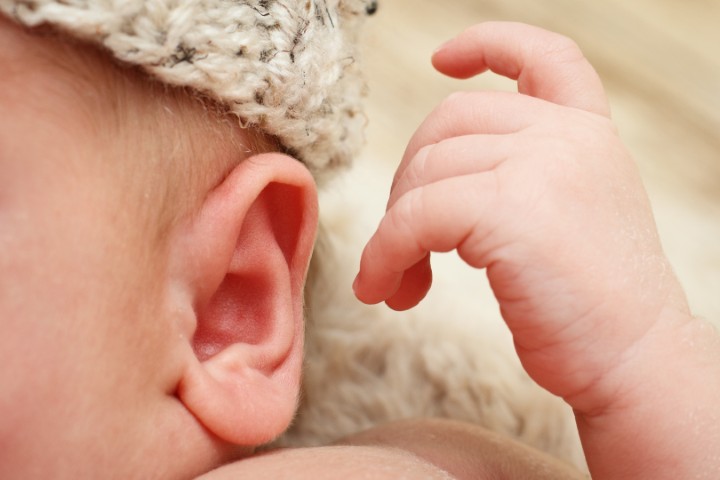
The tastes and smells that a baby encounters while in his mother’s womb, as well as while drinking breastmilk or formula shapes what he’ll enjoy eating years later. (Image credit: Adobe Stock Photos)

But the most fascinating discovery? Nutrition in the womb follows well after birth.  The tastes and smells that a baby encounters while in his mother’s womb, as well as while drinking breastmilk or formula shapes what he’ll enjoy eating years later. Flavors from a mother’s diet pass into amniotic fluid and breastmilk, giving babies early exposure to family foods.19 As a result, kids who are exposed to fruits, vegetables, and even bold flavors like broccoli or sour apple juice inside the womb will enjoy similar foods after birth.20 21

From familiar stories to sweet anise, early exposure helps shape preferences after birth, showing that learning begins long before the first snuggle.

This baby has about 40% more neurons than he will have as an adult. (Image Credit: <a href="https://commons.wikimedia.org/wiki/File:Baby_Toys_(Unsplash).jpg">Colin Maynard</a>)
This baby has about 40% more neurons than he will have as an adult. (Image Credit: Colin Maynard)
Why do babies have so many more brain cells than adults?

Just before birth, the human brain is built for possibility. Babies begin life with about 40% more neurons than they will keep as adults because the developing brain intentionally produces an excess of cells and connections.22 This early surplus gives the brain flexibility, allowing both nature and nurture to shape its wiring during the first years of life.

The size of the newborn brain hints at this remarkable early investment. While most internal organs weigh only about 1⁄20 of their adult weight, the brain of a full-term newborn already weighs about ⅓ as much as an adult brain.23 Because the brain adds very few new neurons after birth,24 25 26 most of its later growth comes from expanding dendrites, the branching extensions that allow neurons to communicate, and from myelin, the fatty insulation that speeds electrical signals along nerve fibers. 27

Neurons form connections, called synapses, linking each cell to thousands of others starting around 6 months gestation and rapidly increasing in pace for about a year after birth. By age three, the brain has over 150 trillion connections. 28 As a child grows, the brain strengthens frequently used connections and removes weaker ones. At the same time, fatty sheaths called myelin surround the nerve fibers to speed communication between cells. Myelin starts forming around 7 months gestation29 and keeps forming until young adulthood, meaning that even at birth the brain is not fully mature.30

This strategy allows genes and experience to work together in shaping the brain. Genes guide neurons to their proper locations, but sensory input and daily experience determine which neurons and connections survive. Repeated activity reinforces useful circuits, while unused ones are trimmed away.31 Active connections are made more efficient when they are wrapped in myelin. Over time, these processes transform the brain’s early abundance into an efficient network tailored to the individual.

Newborns have been listening to their mother speak, so they cry with the same melodic components from their mom's native language. So, a German baby cries differently from a Chinese or English baby! (Image credit: Adobe Stock Photos)
The heart and lungs right before birth

At birth, the heart pumps about 2,000 quarts of blood per day, which would likely fill a large hot tub!32 For comparison, an adult heart pumps three times that amount: about 6,000 quarts of blood each day. After birth, heart cells stop multiplying and instead grow bigger. Just one month after birth, the baby has nearly all the heart muscle cells he will ever have.33

By 38 weeks, mature alveoli start forming in the lungs. About 95% of alveoli develop after birth. Most of the gas exchange area is created by subdividing existing air space to create new alveoli. At birth, newborns have about 150 million alveoli, approximately half of the alveoli found in an adult. Many of these early alveoli are still immature. Children keep growing more alveoli until about age 8, reaching a total of about 300 million.34 New research shows that a few new alveoli continue to grow up to 21 years old!35

At birth, the baby's heart pumps about 2,000 quarts of blood per day, which could fill a large hot tub!36 For comparison, an adult heart pumps about 6,000 quarts of blood each day, which could fill 3 large hot tubs.
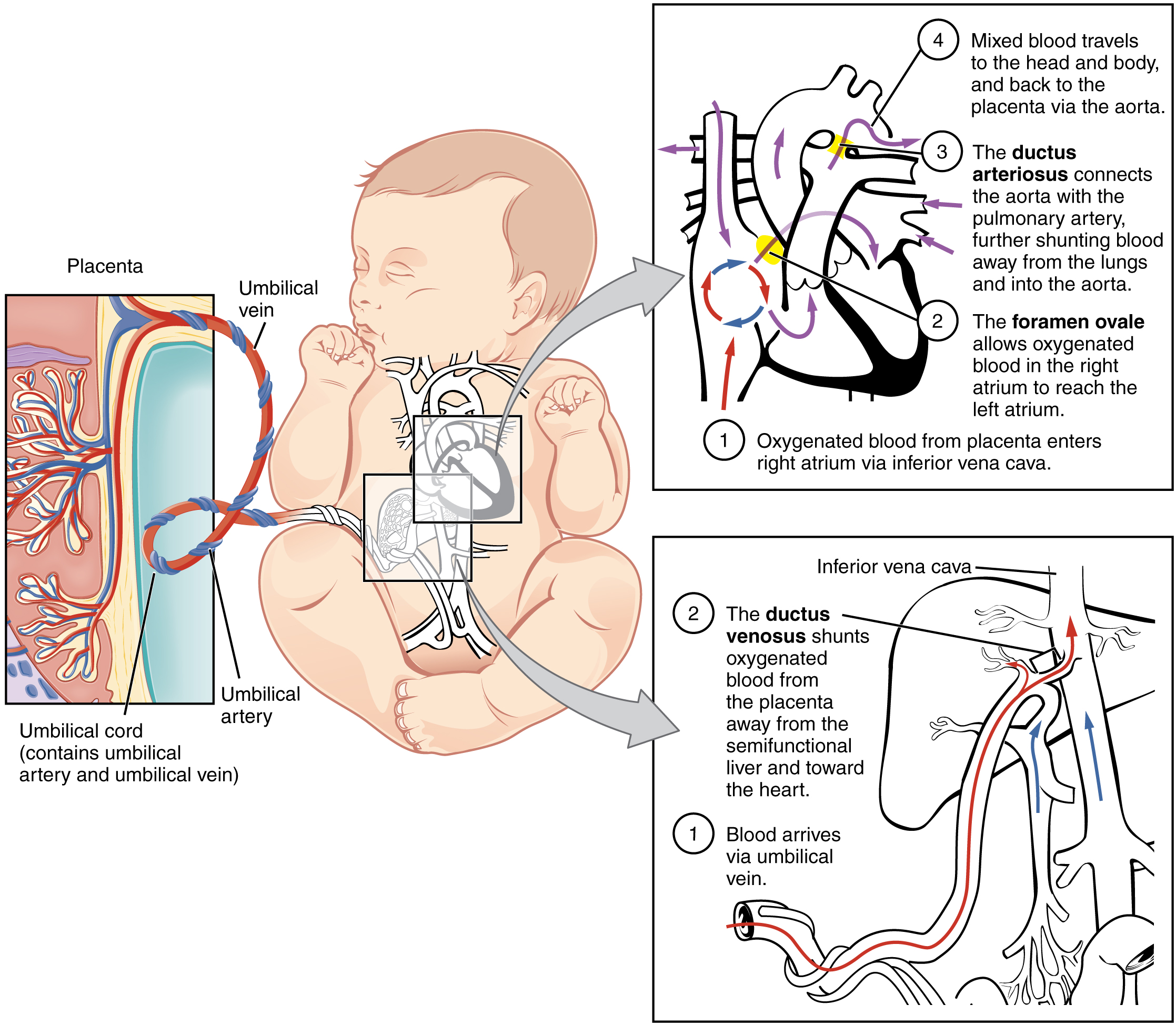
The fetal circulatory system includes three shunts to divert oxygenated blood from the placenta to the heart, reduce circulation in the lungs, and divert blood back to the placenta. (Image Credit: <a href="https://commons.wikimedia.org/wiki/File:2916_Fetal_Circulatory_System-02.jpg" target="_blank">OpenStax College</a>, Creative Commons)
The fetal circulatory system includes three shunts to divert oxygenated blood from the placenta to the heart, reduce circulation in the lungs, and divert blood back to the placenta. (Image Credit: OpenStax College, Creative Commons)
How is a fetus's blood flow different from a newborn's?

In the womb, a baby’s circulatory system relies on the placenta for oxygen and nutrients. Oxygen-rich blood travels from the placenta through the umbilical vein. About half of the blood bypasses the liver through a vessel called the ductus venosus and flows directly into the heart.37 Inside the heart, blood is directed away from the lungs through two special openings: the foramen ovale, which allows blood flow between the upper chambers, and the ductus arteriosus, which connects the pulmonary artery to the aorta. These shunts ensure that well-oxygenated blood reaches the brain and heart first, while blood with lower oxygen levels is sent back to the placenta. Only a small amount of blood passes through the lungs before birth, since their blood vessels are tightly constricted.38

To support rapid growth, fetal blood circulates at more than twice the rate seen in newborns.39 Furthermore, the fetal heart beats quickly, between 110 and 170 beats per minute, and sends over 40% of its output to the placenta. The left side of the heart delivers oxygenated blood to the brain and heart muscle, ensuring major organs receive what they need to develop properly. At birth, the newborn heart rate decreases to about 100-120 beats per minute. Breathing outside a mother’s womb transforms the baby’s circulation entirely.40 This elegant, transient system allows the unborn child to thrive in the womb until birth.

How long is a baby's intestines?

By 9 months gestation, the unborn baby’s small intestine measures about 9 feet—roughly the height of a basketball hoop—while the large intestine is about 2 feet long.41 Both are tightly coiled within the small abdomen. For comparison, an adult’s small intestine is about 22 feet long42 and the large intestine about 5 feet.43

Does the baby poop before birth?

In most cases, the baby never poops until after birth. Before birth, the placenta removes all the waste products from the developing child. The first poop, called meconium, is greenish-black in color and contains many bile acids, salts, proteins, and dead cells from the developing digestive system. Although meconium appears in the digestive tract early in development, it is rarely seen in the amniotic fluid before 34 weeks gestation.44

However, right before birth, the unborn baby sometimes poops in the amniotic fluid. This may be a sign of fetal distress. About 15-20% of babies born around their due date have some meconium in the amniotic fluid. This number increases to about 30-40% when babies are born after 42 weeks, more than two weeks past their due date.45

This baby's gut did not have any bacteria until after he was born. (Image credit: Adobe Stock Photos)
How does the gut get healthy bacteria?

In adults, lots of healthy bacteria inhabit the intestines. These bacteria help digest food, synthesize vitamins, provide immune system support and influence mood. Researchers have found that the same bacteria that aid in digestion and immunity only enter the intestines of healthy babies during and after birth.46

The journey in the womb from fertilization through birth
Watch the Video
Dive Deeper
Newborns outperform adults at a variety of smell tests...
Before a baby takes her first breath, her circulatory system works differently during pregnancy than it will after birth...
Newborns innately look at faces to gather emotional and communicative information...