
Use our account feature to register for a free CLI account. Your new account will allow you to bookmark and organize articles and research for easy reference later - making it simple to keep track of the research that's important to you!
Register / Sign in
Search Icon
Search Icon
Use our account feature to register for a free CLI account. Your new account will allow you to bookmark and organize articles and research for easy reference later - making it simple to keep track of the research that's important to you!
Register / Sign in
close-panel

Charlotte Lozier Institute

Phone: 202-223-8073
Fax: 571-312-0544

2776 S. Arlington Mill Dr.
#803
Arlington, VA 22206

Get Notifications

Sign up to receive email updates from Charlotte Lozier Institute.

This field is for validation purposes and should be left unchanged.

Become A Defender of Life

Your donation helps us continue to provide world-class research in defense of life.

DONATE

Charlotte Lozier Institute

Phone: 202-223-8073
Fax: 571-312-0544

2776 S. Arlington Mill Dr.
#803
Arlington, VA 22206

Research Type:

Sort 1 results by:

Filter Applied. Clear All

Latest Posts

April 29, 2026 Public Comment: Lozier Institute on NIH’s Request for Information on Reducing Reliance on Human Embryonic Stem Cells in NIH-Supported Research Public Comment: Lozier Institute on NIH’s Request for Information on Reducing Reliance on Human Embryonic Stem Cells in NIH-Supported Research April 14, 2026 Drug-induced Abortion After the First Trimester Drug-induced Abortion After the First Trimester April 10, 2026 Abortion Law in America Today: Confronting Infringements on Pro-life Laws Abortion Law in America Today: Confronting Infringements on Pro-life Laws
Reset All Filters
Health Risk: Wisconsin Department of Health Services Data Reveals Sharp Increase in  Risky Abortion Method
Maternal & Public Health

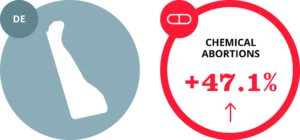
Health Risk: Wisconsin Department of Health Services Data Reveals Sharp Increase in Risky Abortion Method

The most recent Wisconsin abortion data shows a significant increase in the number of women using potentially dangerous abortion drugs, which according to multiple peer-reviewed studies pose higher rates of complications.

Maternal & Public Health

Abortion Reporting: Alabama (2019)

Alabama’s 2019 abortion report was published online in February 2021. According to the report, abortions in the state declined from 2018.

Maternal & Public Health

Study on Reproductive Loss Shows Need for Advanced Grief Screening in Mothers 

Reproductive loss impacts many women across the United States and around the world every day and can cause years of unresolved grief. The Mayo Clinic estimates that 10-20% of “known” pregnancies end in miscarriage.i In 2014, the latest year published, 24,000 stillbirths were reported in the United States by the Centers for Disease Control and Prevention (CDC).

Maternal & Public Health

Abortion Reporting: Idaho (2019)

Idaho’s 2019 abortion report was released in February 2021, revealing that abortions in the state showed a marked increase between 2018 and 2019.

Maternal & Public Health

Abortion Reporting: New Mexico (2018)

In January 2021, New Mexico released its health statistics annual report, which includes abortion statistics for 2018. Additional abortion data is available in the abortion surveillance reports published by the CDC.

Maternal & Public Health

Abortion Reporting: Wisconsin (2019)

Wisconsin’s 2019 abortion report was released in January 2021, showing that abortions in the Badger State increased for the third year in a row. As of August 2021, 38 states had released 2019 abortion statistics; 21 of these states reported that abortions had increased from the previous year.

Maternal & Public Health

New Peer-Reviewed Study Debunks Myth of Abortion as “Normative” for Mothers

A new peer-reviewed study of nearly eight million pregnancies debunks the abortion industry narrative that abortion is a normative experience for mothers, finding that mothers with both births and abortions are rare. 

Fetal Development

The ACOG Should Reconsider Fetal Pain

Can a fetus feel something like pain before viability, perhaps even by 15 weeks’ gestation? The American College of Obstetricians and Gynecologists (ACOG) says no, but increasing evidence suggests that the answer is yes.

Become A Defender of Life

Your donation helps us continue to provide
world-class research in defense of life.

BECOME A PARTNER
cta-image