













Utah’s 2024 abortion data was published on the state’s new Abortion Dashboard. The state also provided drug-induced abortion data upon request. The data reveals that reported abortions increased from 2023 to 2024. However, Utah’s new Abortion Dashboard excluded several categories of data previously provided to CLI upon request and/or included in the state’s published abortion reports. The categories of data excluded include the number of abortions by:
- The mother’s age
- The unborn baby’s gestational age
- The mother’s race
- The mother’s previous pregnancy history
- The mother’s contraceptive history
- The mother’s reason for getting an abortion
- Whether the mother experienced post-abortive complications
- Month
Furthermore, the data published by the state does not include the total number of abortions obtained by Utah residents out of state or the number of self-managed abortions on women outside of the healthcare system. The report also does not contain the number of mail-order abortions obtained by Utah residents prescribed by licensed abortion providers in other states. In a separate section, CLI will describe data provided by the Guttmacher Institute’s Monthly Abortion Provision Study that details the number of women who traveled to Utah to obtain abortions and their states of residence, as well as the number of abortions obtained by Utah women in other states. Guttmacher’s abortion estimates include the number of abortions obtained at brick-and-mortar facilities and those provided via telehealth and virtual providers in the United States.
Utah’s statute code defines abortion as “the act, by a physician, of using an instrument, or prescribing a drug, with the intent to cause the death of an unborn child of a woman known to be pregnant…” (Utah Code §76-7-301). In Utah, abortion is prohibited at 18 weeks of gestation or later (Utah Code §76-7-302) except in cases where:
- A continued pregnancy threatens the life or physical health of the pregnant woman
- Two fetal-medicine physicians agree, in writing, and note in the patient’s medical record that the unborn child has a fetal abnormality that in the physicians’ reasonable medical judgement renders the child incompatible with life
- The mother of the unborn child is a victim of rape and/or incest, and the unborn child hasn’t reached 18 weeks of gestation
Statistics and Changes in Utah Abortions, 2023-2024

The change in total abortions and drug-induced abortions reflects abortions performed on Utah residents, while the change in the abortion rate reflects all abortions occurring in the state. The report does not include information on Planned Parenthood’s Utah abortion market share.
Abortion Totals and Trends
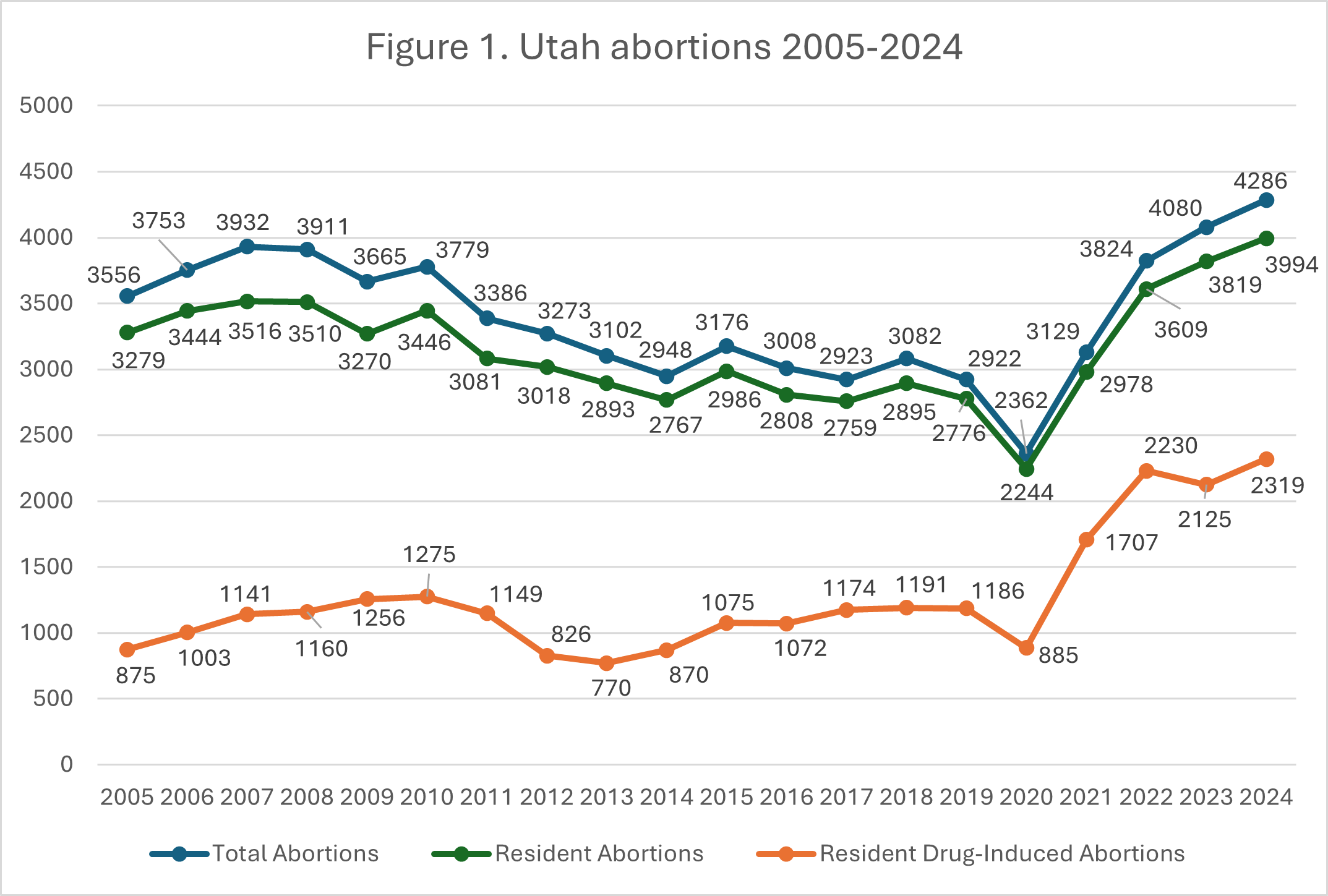
Utah reported 4,286 abortions in 2024, up 5% from the previous year when 4,080 abortions occurred in Utah. Of the 4,286 total abortions performed in 2024, 3,994 were performed on residents, an increase of 5% from 2023. The 4,286 abortions performed in the state is the highest total ever reported since the state started reporting and collecting this data in 1980. There were 2,319 drug-induced abortions performed on Utah residents in 2024, an increase of 9% from 2023 (Fig. 1). CLI estimates that Utah’s 2024 abortion rate was 5.5 abortions per 1,000 women ages 15-44 (Fig. 2).1 As of June 2026, 30 states have released 2024 abortion statistics with nine showing an increase in abortions.
State Report Summary
In 2024, 93% of the abortions reported in Utah were performed on state residents. Seven percent were performed on women from other states, including 216 on women from Idaho, 28 from Wyoming, 15 from Nevada, 12 from Texas, and 21 from other states including Arizona, California, Colorado, Connecticut, Florida, Kansas, Louisiana, Michigan, Minnesota, New Hampshire, Ohio, and Oregon. The number of abortions obtained by residents and nonresidents both increased from 2023 to 2024. Most of the information on Utah’s Abortion Dashboard is for abortions performed on Utah residents only.
Unlike in years past, the 2024 data in the state’s Abortion Dashboard didn’t include the number of abortions obtained by the Utah resident woman’s age. However, abortion rates (# of abortions per 1,000 females aged 15-44) for abortions by the mother’s age were included in the new dashboard. In 2024, the abortion rates by age category were as follows:
- Ages 15-19: 2.7
- Ages 20-24: 9.0
- Ages 25-29: 8.0
- Ages 30-34: 5.6
- Ages 35-39: 3.2
- Ages 40-44: 1.0
The 2024 abortion rates for girls under the age of 15 and women aged 45 and older are unknown.
Seventy-eight percent of the abortions were performed on unmarried women, and 22% were performed on married women, including women who were separated from their spouses. Marital status was not reported for 11 abortions. Thirty-eight percent of the abortions performed on Utah residents were on women who had graduated from high school or earned a GED, and another 38% were performed on women with more than a high school education. Eleven percent of Utah abortions were performed on women who had not finished high school, and 12% were performed on women whose level of education was not reported.
Forty-two percent of Utah resident abortions in 2024 were surgical, while 58% percent were drug-induced. The method for 10 resident abortions was unknown or suppressed.
Over half of Utah’s 2024 resident abortions obtained in the state(53%) were obtained by residents of the Salt Lake health district, while 9% were obtained by residents of the Davis Health District, 8% by residents in the Weber-Morgan health district, and 4% by residents in the Bear River health district. Residents of the Central Utah, San Juan, Southeastern, Southwest, Summit, Tooele, Tricounty, and Wasatch health districts also obtained abortions in Utah in 2024. The health district was unknown or suppressed for 18% of the abortions.
Breakdown of Abortion Providers in Utah2
| # of brick-and-mortar locations | 3 |
| # of independent centers | 1 |
| # of Planned Parenthood centers | 2 |
| # of hospitals/doctors’ offices that perform abortions | 0 |
| # of abortion drug providers | 3 |
| # of abortion drug-only providers | 1 |
| # of surgical and abortion drug providers | 2 |
| Latest gestational age that a center performs surgical abortion | Through 17 weeks |
These abortion provider totals are current as of June 1, 2026. This does not reflect the breakdown of providers available in Utah during the period that Utah’s Abortion Dashboard covers (2024).
Guttmacher Data 3
In 2024, Guttmacher estimated that 5,240 abortions occurred in Utah, while the state reported 4,286. Guttmacher also estimated that of the 5,240 abortions performed in the state, 4,730 were performed on residents while 510 were performed on nonresidents, while the state reported 3,994 and 292, respectively. According to Guttmacher, of the 510 nonresidents who obtained abortions in Utah in 2024, 320 were obtained by Idaho women and 190 by women of unknown states. Additionally, Guttmacher estimated that 240 Utah residents traveled to Nevada to obtain an abortion. To see the reporting discrepancies between Guttmacher and the state, see below:
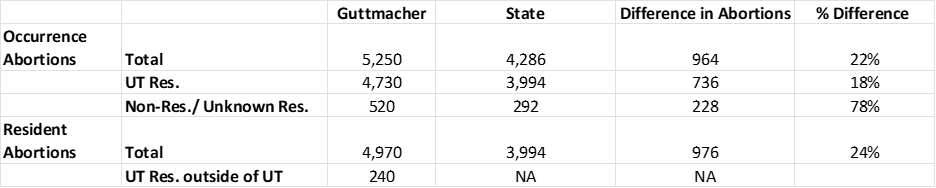
The discrepancy in abortions reported by the state and estimated by Guttmacher (a difference of 954 abortions) is a result of both a discrepancy in resident and nonresident abortion totals, but primarily a result of the discrepancy in reported resident totals. Additional context for the underreporting of resident abortions occurring in Utah by the state is provided by the Society of Family Planning (SFP). Utah abortion providers are not allowed to prescribe abortion drugs via telehealth, and the Utah Department of Health and Human Services said in an email to CLI that they do not track mail-order abortions prescribed by out-of-state providers. However, SFP estimated that of the 5,380 abortions estimated to have occurred in Utah in 2024, 4,240 were performed in brick-and-mortar facilities, and 1,140 were performed via virtual-only, telehealth organizations and obtained via mail-order. 4 Because telehealth abortions are prohibited within Utah, those 1,140 drug-induced abortions obtained from virtual-only organizations were prescribed by out-of-state abortion providers under shield laws. The difference in total abortions as reported by the state (4,286) and SFP (5,380) (a difference of 1,094) can almost be completely explained by the inclusion of telehealth abortion totals obtained via shield laws (1,140) by SFP and the exclusion of such data by the state.
State Ranking
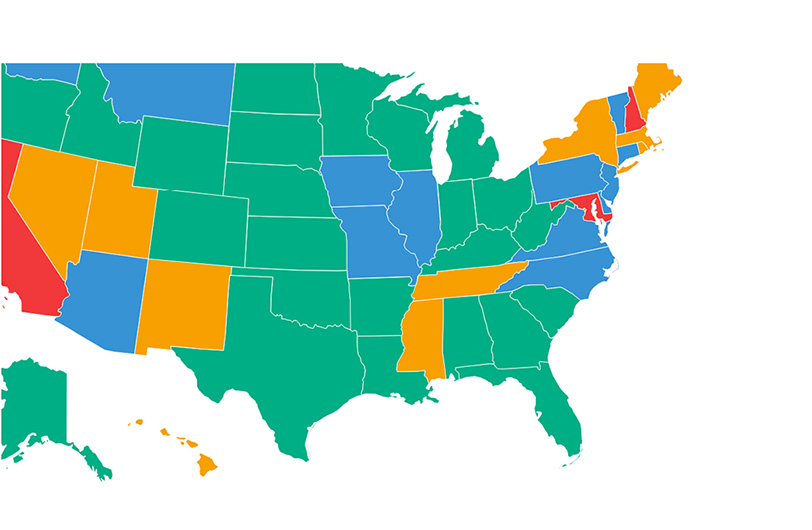
In 2024, CLI published a paper reevaluating states’ abortion reporting across the country, with Utah tied for 17th best. However, since the release of that paper, Utah has drastically changed and reduced the quality and completeness of its abortion data, as noted in the beginning of this article. To improve its reporting, Utah could reinclude the data categories it no longer includes in its Abortion Dashboard. Additionally, as previously recommended, Utah could improve its reports by incorporating information on all abortions occurring in the state, not just those performed on state residents. Utah could also require all healthcare providers, particularly emergency rooms and urgent care facilities, to report abortion-related complications they treat.
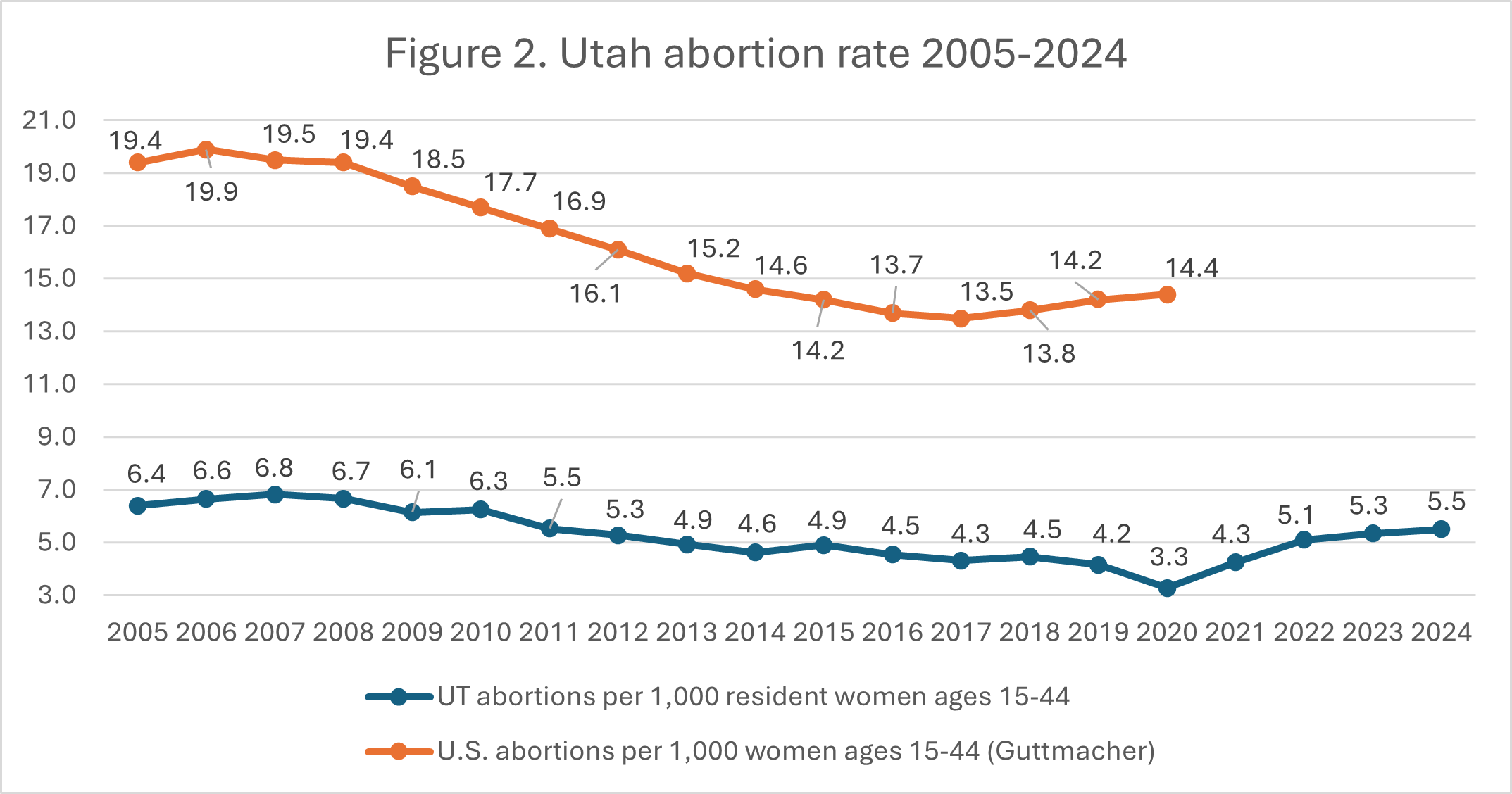
- National rates were calculated by Guttmacher Institute. Utah rates were calculated by CLI using the following formula: (total number of abortions performed in Utah÷ number of resident women ages 15-44 [based on most recent population estimates]) x 1,000. Rates may differ slightly from previous CLI articles due to revised population estimates. Population estimates were obtained using the CDC WONDER database. Estimates for 2005-2009 are intercensal estimates of the July 1 resident population. Estimates for 2010-2019 are Vintage 2020 postcensal estimates of the July 1 resident population. Estimates for 2020-2024 are Vintage 2024 postcensal estimates of the July 1 resident population. Estimates were produced by the U.S. Census Bureau and the National Center for Health Statistics.
- Provider totals do not include hospitals or physician offices not listed in databases that compile abortion provider locations in different states, but do include Planned Parenthood locations, independent abortion centers, and hospitals/doctors’ offices included in databases like Abortion Finder and Ineedana. This information is up to date as of June 1, 2026.
- The Guttmacher Institute notes that their monthly abortion totals by state are estimates and that each state’s estimate is within a range of uncertainty. Guttmacher’s travel and residence data can be found in the CSV folder here (State_Abortion_Travel_2024.csv). This information is updated as of June 1, 2026.
- #WeCount’s data can be found here by downloading the “Report data tables [.xlsx]” document. The #WeCount report specifies that the numbers included in their tables for abortions performed under shield laws only represent the number of women to whom abortion drugs were sent, not the number of drug-induced abortions that resulted from the mailed drugs. However, because #WeCount’s data is the only source of data that delineates the number of abortions by mode of provision (in-person, telehealth/mail order, and/or abortion drugs obtained under shield laws), their data is the best available. This information is updated as of June 1, 2026.
Click here to view reporting from:2023202120202019201820172016