













Fact of Life: American Cars (and Their Drivers) Exhibit Decidedly More Pro-life than Pro-choice Views


This is Issue 115 of the On Point Series. (Previous versions of this paper can be found as On Point Issue 99 and On Point Issue 32).
If you have spent any time on American roads in the past decade, you have likely noticed cars with pro-life license plates sharing the road with you. Pro-life license plates are currently available in the District of Columbia and 32 states. The Children’s First Foundation also makes a pro-life “half-plate” available for five additional states, which can be attached to the top or bottom of a standard DMV-issued plate. Pro-life license plates come in various styles, the most common of which is a yellow plate with a caricature of a boy and girl and the words “Choose Life.” After the State subtracts an administrative fee, the proceeds of pro-life license plate sales are distributed, sometimes through an intermediary, to pro-life pregnancy help centers or organizations offering adoption services.
Curiously, there is a notable absence of “pro-choice” license plates on the road. Only four states currently offer a pro-choice plate option: Alaska, Nebraska, Pennsylvania, and Virginia. In Alaska, the funds received from pro-choice plates go to the Alaska Children’s Trust, a state savings account that issues grants to programs aimed at preventing child abuse. In the three remaining states, monies from pro-choice plates fund or advertise a local or regional Planned Parenthood. Each of these states offer both a pro-life and pro-choice plate.
There is no adequate study as to why American drivers have so predominantly chosen pro-life plates over pro-choice plates. Sometimes the state legislature rejects a pro-choice plate bill. Other times, pro-choice activists in the state are unable to reach the required number of pre-sales for the state motor vehicle agency to create and offer the plate. Even states hostile to pregnancy centers appear to have difficulty producing a pro-choice plate option. In states that have both options, pro-life plates greatly out-sell their pro-abortion counterparts.
State-Sponsored License Plates and Organizational Plates
Specialty license plates, whether Choose Life or others, are offered through state departments of motor vehicles and are typically sold at a cost above and beyond standard license plate fees. The additional fees/costs are then either provided to an organization or state-sponsored program, depending on the category of the license plate.
Specialty license plates offered by states typically fall into one of two categories, state-sponsored or organizational license plates. While they look similar, the purpose and funding mechanisms can be very different. Regardless of the category, any specialty license plate is considered government-facilitated, subjecting these license plates to legal challenges.[1] How courts have handled these cases is discussed more in the “Lawsuits” section below.
State-sponsored License Plates
These license plates are created directly by state governments, often to promote their interests, agencies, or activities. Common examples include “Support our Troops,” “Parks and Wildlife,” and “Support Education” initiatives. Funding from sales of these plates typically goes to state administrative departments or state-run programs.[2] As discussed below, these license plates would constitute “government speech” and would therefore be constitutional when challenged in a court of law.
Organizational License Plates
Most states offer specialty license plate programs that include organizational or special group plates, through which a nonprofit or civic organization may apply to have a plate issued that promotes its mission, message, or activities.[3] However, not all states allow this in the same way, and some impose significant restrictions, such as requiring legislative approval or limiting eligibility to certain categories of organizations. For example, New York imposes significant restrictions on specialty license plates, often requiring legislative or formal state approval and limiting eligibility to certain categories such as educational institutions, military groups, or state-recognized causes.[4]
In many states, these plates are administered through the state’s department of motor vehicles (or equivalent agency), and they typically require the sponsoring organization to meet certain criteria, such as minimum pre-orders or application fees. A portion of the additional fees collected is often directed to the sponsoring organization or a related cause, although in a few states the funds are instead allocated to state-managed programs aligned with the plate’s theme.[5]
“Choose Life” license plates are a common example of this model. In many states, proceeds from these plates are directed—either directly or through a state-administered grant process—to pregnancy resource centers or similar organizations.[6]
As discussed in detail below in the section entitled “Lawsuits,” the U.S. Supreme Court has held that states have broad discretion to approve or reject proposed plate designs without being subject to traditional First Amendment viewpoint neutrality requirements.
State-sponsored license plates clearly fall in the realm of “government speech.” Organizational plate programs, on the other hand, are typically considered “private speech,” and at greater risk of being found unconstitutional because they are promoted by the government through their license plate programs. Many states nevertheless structure their programs to allow a wide range of nonprofit participation (eligible to both pro-life and pro-abortion organizations), which can reduce the risk of political or constitutional challenges, but they are not legally required to do so.
Case Studies
The following case studies demonstrate the preference for Choose-Life license plates over pro-abortion equivalents.
Alaska
In FY2012, Alaska passed legislation establishing both a pro-life license plate (“Choose Life”) and a pro-choice license plate (“Pro-Family, Pro-Choice”). In FY2013, Choose Life plates outsold the pro-choice plate by 38, with Choose Life plates having sold 46, and the pro-choice option only selling eight plates.[7]
California
In California, where the extreme pro-abortion legislature recently violated the constitutional rights of pro-life pregnancy centers by requiring them to notify clients of the availability of abortion-related services,[8] a 2017 Senate Bill authorizing a pro-abortion plate that would have been named “California Trusts Women”[9] plate died in an Assembly committee.[10]
Hawaii
Planned Parenthood of Hawaii has tried for years to obtain the required pre-sale of 150 plates. In 2003, the League of Women Voters in Hawaii reported that Planned Parenthood was only able to secure around 20 pre-sale orders.[11] As of May 2026, the Choose Life license plate which funds Aloha Pregnancy Care and Counseling Centers is still available from the Hawaii Department of Motor Vehicles.[12] After over 20 years, the Planned Parenthood plate remains unavailable,[13] suggesting that the League of Women Voters have still not obtained the necessary pre-sale of 150 plates.
Massachusetts
Drivers in Massachusetts have been able to order a Choose Life plate since the Summer of 2010. Nonetheless, pro-choice plates remain unavailable, despite extensive efforts by pro-abortion advocates to collect the required 3,000 signatures and 3,000 license plate presales.[14]
Virginia
The Virginia DMV reports that Virginia Choose Life plates are decidedly more popular than the “Trust Women, Respect Choice” license plates. In fact, for the years 2012-2023, the Virginia DMV reported total sales of “Choose Life” plates ($982,770) to be 2.3 times the total sales of “Trust Women, Respect Choice” plates ($423,121).[15]
Lawsuits
Throughout the years, pro-abortion groups have sought to enjoin (or ban) pro-life license plates by filing lawsuits. Until the United States Supreme Court weighed in, Circuit Courts of Appeals remained “split,” or divided on key issues essential to determining the constitutionality of state’s issuing pro-life license plates where similar pro-choice plates are not offered.
Critical to the decisions of the courts has been determining whether the license plates constituted government speech or private speech. Generally, the government may speak for itself. “[The government] is entitled to say what it wishes[,] … [and] may take legitimate and appropriate steps to ensure that its message is neither garbled nor distorted.”[16] Accordingly, where license plates are determined to be government speech, the plates will generally be upheld as constitutional. On the other hand, if a license plate constitutes private speech, “government regulation may not favor one speaker over another,”[17] and plates will be generally found unconstitutional viewpoint discrimination in violation of the First Amendment.
Fourth Circuit: South Carolina
In 2002, the United States District Court for the District of South Carolina found that license plates constituted private speech in Planned Parenthood of S.C. Inc. v. Rose,[18] ruling that a statute authorizing a specific offering for Choose Life plates was unconstitutional and that pro-life organizations can get an organizational license plate instead.[19]
The decision was appealed to the Fourth Circuit in 2004.[20] In determining whether license plates constituted private or government speech, the Fourth Circuit utilized a four part test it had developed in a previous license plate case involving a group displaying a Confederate flag in its proposed plate design, Sons of Confederate Veterans, Inc. v. Commissioner of Virginia Department of Motor Vehicles.[21] In Rose, the Fourth Circuit ruled that the pro-life specialty plates constituted a “mixture of private and government speech.”[22] Ultimately, the Fourth Circuit found that by only authorizing a Choose Life License plate, South Carolina violated the First Amendment.[23]
In 2004, the Fourth Circuit essentially affirmed this ruling by denying a petition for en banc review.[24] As discussed below, the United States Supreme Court ultimately weighed in, resulting in validation of specialty license plates in general.
Sixth Circuit: Tennessee
In 2006, the Sixth Circuit issued an opinion on the constitutionality of Choose Life plates in ACLU of Tennessee v. Bredesen,[25] finding that the Choose Life specialty plates constituted government speech.[26] The Sixth Circuit found that the plates did not violate the First Amendment.[27]
Eleventh Circuit: Florida
In 2003, the Eleventh Circuit upheld a decision by the United States District Court for the Southern District of Florida to deny the plaintiff’s challenge to Florida’s Choose Life plate for lack of standing.[28]
Circuit splits and U.S. Supreme Court resolution
The catalyst for Supreme Court resolution occurred in 2008, when both the Ninth Circuit and the Seventh Circuit issued opinions on challenges to pro-life license plates. In Arizona Life Coalition, Inc. v. Stanton,[29] the Ninth Circuit ruled that arbitrarily denying Life Coalition’s application for a Choose Life plate violated First Amendment free speech. Critical to the Court’s decision was its finding that “[m]essages conveyed through special organization plates … represent primarily private speech.”[30] Conversely, in Choose Life Ill., Inc. v. White,[31] the Seventh Circuit found that license plates are government speech, noting that the government can choose what to say and what not to say—it speaks for itself. In so ruling, the Seventh Circuit Court of Appeals upheld Illinois’ denial of the Choose Life license plate, contending it was not viewpoint discrimination because the state avoids the issue of abortion entirely by prohibiting all abortion-related specialty license plates.[32]
The debate continued in 2009 in Roach v. Stouffer. The Eighth Circuit ruled that the Choose Life license plates constituted private speech, and that Missouri’s denial of Choose Life License plates constituted unconstitutional viewpoint discrimination.[33]
In 2014, the Fourth Circuit again addressed the Choose Life license plate issue in ACLU of N.C. v. Tata.[34] In this case, the Court found North Carolina’s Choose Life license plate to be private speech, finding that issuing such plates constituted viewpoint discrimination.[35]
The following year, the United States Supreme Court (in a 5-4 decision) issued a critical ruling influencing decisions on specialty license plates in general. In Walker v. Texas Div., Sons of Confederate Veterans (SCV),[36] the Sons of Confederate Veterans asked the Texas DMV Board to approve a specialty license plate displaying a Confederate battle flag. The DMV Board rejected the application due to the “public comments [that] ha[d] shown that many members of the general public [found] the design offensive.” The Supreme Court held that Texas Specialty License plates constitute government speech, allowing Texas to reject the design proposed by the Sons of Confederate Veterans.
As a result of its decision in Sons of Confederate Veterans, the U.S. Supreme Court instructed the Fourth Circuit to reverse its prior opinion on the North Carolina license plate case (ACLU v. Tata, discussed above). The Fourth Circuit did so in ACLU of North Carolina v. Tennyson.[37]
The Second Circuit case contributing to the circuit split has a complex procedural history. The case, Children First Foundation, Inc. v. Fiala, was being adjudicated almost simultaneously with the Fifth Circuit case of Walker v. Sons of Confederate Veterans, Inc. (discussed above). Children First Foundation, Inc. v. Fiala involved a challenge to New York’s refusal to approve a specialty license plate reading “Choose Life.” The plaintiff, Children First Foundation, argued that the denial by the New York Department of Motor Vehicles violated the First Amendment by discriminating against its pro-life viewpoint. Initially, the United States District Court or the Northern District of New York ruled in favor of Children First Foundation and ordered Fiala, in her official capacity as Commissioner for the New York State Department of Motor Vehicles, to approve Children Family First Foundation’s application for its custom license plate.[38] The decision was then appealed and the Second Circuit ruled for the state, holding that specialty license plates constitute private speech. At that time the U.S. Supreme court had granted certiorari (agreed to hear) SCV. Accordingly, in its decision the Second Circuit noted:
The mandate in this case will be held pending the Supreme Court’s decision in Walker v. Texas Div., Sons of Confederate Veterans, Inc., 135 S.Ct. 752 (U.S. Dec 05, 2014). Should any party believe there is a need for the district court to exercise jurisdiction prior to the Supreme Court’s decision, it may file a motion seeking issuance of the mandate in whole or in part.[39]
Following the decision in SCV, the Second Circuit reopened the Children First Foundation case and remanded it for reconsideration under the Supreme Court’s newly articulated government-speech framework. The remand order vacated the district court’s judgment and contemplated further proceedings focused on the implications of Walker.[40] However, a published district court opinion addressing the merits after remand does not appear to be available in the reported decisions. As a result, the published record does not clearly reveal how the case was ultimately resolved after remand, and it is difficult to speculate why this is so. At this point, however, there is neither a pro-life nor pro-abortion plate available in New York State.[41]
The U.S. Supreme Court’s decision in SCV appears to have settled the matter of the constitutionality of Choose Life license plates. Of the eight states that encountered legal challenges to their issuance of Choose Life license plates, six currently offer a pro-life license plate option: Arizona, Florida, Missouri, North Carolina, South Carolina, and Tennessee. The remaining states, Illinois and New York, do not offer specialty plates on any abortion-related issue.
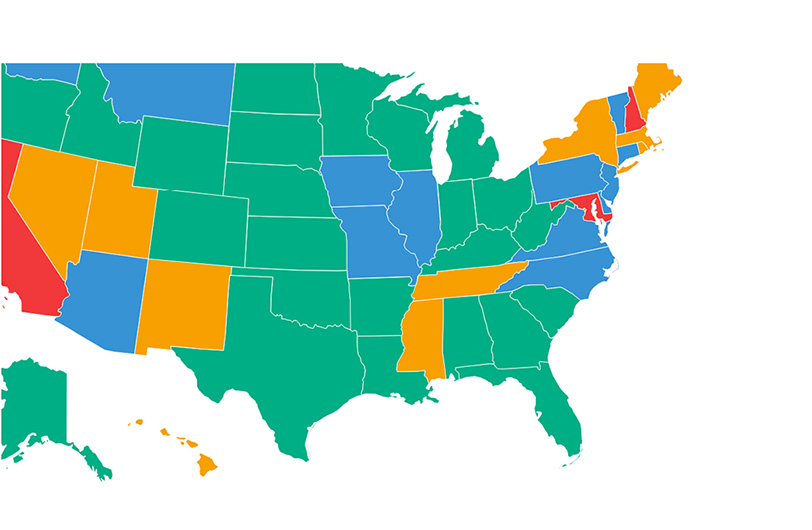
The table below shows which states offer pro-life and/or pro-choice license plates.
Choose Life License plate table – 2026
|
State |
“Choose Life” or “Pro-Life” Plate? | “Pro-Choice” Plate? |
| AL | Yes | No |
| AK[42] | Yes | Yes |
| AZ | Yes | No |
| AR | Yes | No |
| CA | half plate[43] | No |
| CO | No | No |
| CT | Yes | No |
| DE | Yes | No |
| DC | Yes | No |
| FL | Yes | No |
| GA | Yes | No |
| HI | Yes | No |
| ID | Yes | No |
| IL | No | No |
| IN | Yes | No |
| IA | Yes[44] | No |
| KS | Yes | No |
| KY | Yes | No |
| LA | Yes | No |
| ME | No | No |
| MD | Yes | No |
| MA | Yes | No |
| MI | No | No |
| MN | No | No |
| MS | Yes | No |
| MO | Yes | No |
| MT | No | No |
| NE | Yes | Yes |
| NV | No[45] | No |
| NH | half plate | No |
| NJ | Yes | No |
| NM | Yes[46] | No |
| NY | half plate | No |
| NC | Yes | No |
| ND | Yes | No |
| OH | Yes | No |
| OK | Yes | No |
| OR | No | No |
| PA | Yes | Yes |
| RI | half plate | No |
| SC | Yes | No |
| SD | Yes | No |
| TN | Yes | No |
| TX | Yes[47] | No |
| UT | No | No |
| VT | half plate | No |
| VA | Yes | Yes |
| WA | No | No |
| WI | Yes | No |
| WV | No | No |
| WY | No | No |
Jeanneane Maxon, J.D., is an associate scholar with the Charlotte Lozier Institute
[1] 135 S. Ct. 2239, 192 L. Ed. 2d 274, 2015 U.S. LEXIS 4063 (2014). Available at: Walker v. Texas Division, Sons of Confederate Veterans, Inc. (2015). Supreme Court of the United States. Justia. Retrieved 14 April 2026, from https://supreme.justia.com/cases/federal/us/576/200/.
[2] See, e.g., the Texas conservation license plates at: https://conservationplate.org/, where the money is allocated to various projects of the Texas Parks and Wildlife Department (https://conservationplate.org/projects.phtml). (Accessed 14 April, 2026). And New Hampshire Division of Motor Vehicles. (n.d.). Plate Types. Retrieved April 14, 2026, from https://www.dmv.nh.gov/vehicles-boats-and-titles/plate-types, where New Hampshire discusses the various state-sponsored plates available to its citizens.
[3] See, e.g., South Carolina Department of Motor Vehicles. (n.d.). Plate Gallery. Retrieved April 14, 2026, from https://dmv.sc.gov/vehicle-owners/registration/plate-gallery?filter=organizations, where South Carolina lists its organizational plates. And Florida Department of Highway Safety and Motor Vehicles. (n.d.). Specialty license plates. Retrieved April 14, 2026, from https://www.flhsmv.gov/motor-vehicles-tags-titles/personalized-specialty-license-plates/specialty-license-plates/, where Florida offers links to its various organizational plates by category.
[4] See New York Codes, Rules and Regulations, Title 15, § 16.5. (n.d.). Retrieved April 14, 2026, from https://www.law.cornell.edu/regulations/new-york/15-NYCRR-16.5.
[5] Stonehouse, A. (2023, March 15). How special license plates can be a revenue stream for nonprofits. Capital One. Retrieved April 27, 2026, from https://www.capitalone.com/cars/learn/finding-the-right-car/how-special-license-plates-can-be-a-revenue-stream-for-nonprofits/2174, and see, e.g., Texas Department of Motor Vehicles. (n.d.). Proposing a Specialty License Plate. Retrieved April 14, 2026, from https://www.txdmv.gov/sites/default/files/body-files/slp_brochure.pdf (describing the state’s administration of its specialty plate programs). Many states require sponsoring organizations to meet threshold criteria, such as paying application or startup fees and demonstrating sufficient demand through minimum pre-orders. Id. These plates typically involve additional fees beyond standard vehicle registration, a portion of which (as mentioned above) is often directed to the sponsoring organization or a related cause. See, e.g., Texas Department of Motor Vehicles. (n.d.). License Plates. Retrieved April 14, 2026, from https://www.txdmv.gov/motorists/license-plates. In some instances, however, proceeds are instead allocated to state-administered funds or programs aligned with the plate’s theme. Id.
[6] Choose Life America, Inc. (n.d.). About us. Choose Life America. Retrieved June 1, 2026, from Choose Life America – About Us; Texas Values. (2011, November 30). Texas Choose Life License Plates Now Available! Texas Values. Retrieved June 1, 2026, from https://txvalues.org/texas-choose-life-license-plates-now-available/.
[7] Alaska Department of Administration, Department of Motor Vehicles. (n.d.). Alaska specialty license plates [PDF]. Alaska State Legislature. https://www.akleg.gov/basis/get_documents.asp?session=28&docid=21123 (Retrieved April 13, 2026).
[8] Nat’l Inst. of Family & Life Advocates v. Becerra, 585 U.S. ___, ___ (2018) (Breyer, J., dissenting), https://www.supremecourt.gov/opinions/17pdf/16-1140_5368.pdf (slip op. at 1–2) (“[T]he first section requires licensed medical facilities… to tell those women where they might obtain help… with… abortion.”)
[9] Abcarian, R. (2017, March 5). A proposed California license plate is a subtle nod to abortion rights and to a slain hero. Los Angeles Times. Retrieved May 4, 2026, from https://www.latimes.com/local/abcarian/la-me-abcarian-trust-women-20170305-story.html.
[10] California Legislative Information. (n.d.). Bill status – SB-309 License plates: Reproductive Freedom Fund (2017-2018). California Legislature. Retrieved April 13, 2026, from https://leginfo.legislature.ca.gov/faces/billStatusClient.xhtml?bill_id=201720180SB309.
[11] League of Women Voters of Hawaii. (2003). Ka Leo Hana: Convention edition 2003. Retrieved April 13, 2026, from https://www.lwv-hawaii.com/kaleohana/klh0306-hawaii.htm.
[12] City and County of Honolulu, Department of Customer Services. (n.d.). Organizational License Plate Options. Retrieved May 4, 2026, from https://www.honolulu.gov/csd/organizational-plate-options/; Choose Life, America!, Inc. (n.d.). Hawaii. Retrieved May 4, 2026, from https://chooselifeplates.com/hawaii/.
[13] Hawaiʻi County Vehicle Registration and Licensing Division. (n.d.). Specialty License Plates. Retrieved May 4, 2026, from https://www.vrl.hawaiicounty.gov/motor-vehicle-registration/specialty-license-plates.
[14] Prochoiceplates.com. (2011, June 23). Introduction. Retrieved April 13, 2026, from https://prochoiceplates.com.
[15] Virginia DMV FOIA office, Response to FOIA request of Jeanneane Maxon. 12 Feb. 2024.
[16] Rosenberger v. Rector & Visitors of the Univ. of Va., 515 U.S. 819, 883 (1995).
[17] Id. at 828.
[18] 236 F. Supp. 2d 564 (2002).
[19] 236 F. Supp. 2d 564 (D.S.C. 2002).
[20] Planned Parenthood v. Rose, 361 F.3d 786 (4th Cir. 2004).
[21] Sons of Confederate Veterans, Inc. v. Comm’r of the Virginia Dep’t of Motor Vehicles, 288 F.3d 610 (4th Cir. 2002).
[22] Rose, 361 F.3d at 793.
[23] Id. at 798-799.
[24] Planned Parenthood of South Carolina, Inc. v. B. Boykin Rose, 373 F.3d 580 (4th Cir. 2004). Retrieved 14 April 2026, from https://www.courtlistener.com/opinion/786724/planned-parenthood-of-south-carolina-incorporated-renee-carter-v-b-boykin.
[25] Am. Civil Liberties Union of Tenn. v. Bredesen, 441 F.3d 370 (6th Cir. 2006), https://cases.justia.com/federal/appellate-courts/ca6/04-6393/06a0099p-06-2011-02-25.pdf?ts=1411010210.
[26] Id. at 375.
[27] Id. at 379.
[28] Women’s Emergency Network v. Bush, 323 F.3d 937 (11th Cir. 2003).
[29] 515 F.3d 956 (2008).
[30] Arizona Life Coalition, Inc. v. Stanton. (n.d.). CourtListener. Retrieved 14 April 2026, from https://www.courtlistener.com/opinion/1387260/arizona-life-coalition-inc-v-stanton.
[31] 547 F.3d 853 (7th Cir. 2008).
[32] Choose Life Illinois, Inc. v. White. (n.d.). CourtListener. Retrieved 14 April 2026, from https://www.courtlistener.com/opinion/1225539/choose-life-illinois-inc-v-white.
[33] Roach v. Stouffer, 560 F.3d 860 (2009) (n.d.). CourtListener. https://www.courtlistener.com/opinion/1226973/roach-v-stouffer (Accessed 9 Apr. 2026).
[34] 742 F.3d 563 (4th Cir. 2014). Available at: https://case-law.vlex.com/vid/am-civil-liberties-union-886378270 (Accessed 9 Apr. 2026).
[35] Id. at 576.
[36] Walker v. Texas Division, Sons of Confederate Veterans, Inc. (2015). United States Supreme Court. Retrieved April 21, 2026, from https://supreme.justia.com/cases/federal/us/576/200/.
[37] ACLU of North Carolina v. Tennyson, No. 13-1030, available at https://www.ca4.uscourts.gov/Opinions/Published/131030A.P.pdf (last visited Apr. 9, 2026).
[38] Children First Foundation, Inc. v. Martinez, 829 F. Supp. 2d 47 (N.D.N.Y. 2011). Retrieved June 1, 2026, from Alliance Defending Freedom PDF Archive.
[39] Children First Found., Inc. v. Fiala, 790 F.3d 328 (2d Cir. 2015). Available at: https://caselaw.findlaw.com/court/us-2nd-circuit/1701862.html.
[40] Children First Found., Inc. v. Fiala, 611 F. App’x 741 (2d Cir. 2015) (summary order). Available at: https://www.casemine.com/judgement/us/59145dc3add7b049341fdddb.
[41] See New York State Department of Motor Vehicles. (n.d.). Picture Plates. New York State Department of Motor Vehicles. Retrieved June 1, 2026, from Picture Plates | NY DMV. None of the 205 plate options are associated with pro-life or pro-abortion license plates or organizations.
[42] The Alaska state legislature passed bills establishing both a Choose Life License plate and Pro-Family, Pro-Choice plates. See https://www.akleg.gov/basis/get_documents.asp?session=28&docid=21123 (Accessed 14 April 2024).
[43] Half-plates are made available through the Children’s First Foundation, which can be attached to the top or bottom of a standard DMV-issued plate. Children’s First Foundation. (n.d.). Other states. Retrieved April 14, 2026, from https://thechildrenfirst.org/other-states.html.
[44] Proceeds in Iowa go to Iowa roadwork. Little Village Magazine. (2013, July 3). “Choose Life” license plates draw mixed reactions. Retrieved April 14, 2026, from https://littlevillagemag.com/choose-life-license-plates-draw-mixed-reactions.
[45] From July 16, 2018, through December 31, 2019, Nevada offered a “Nevada Values Life” specialty license plate. Under Nevada law, the plate was required to reach at least 3,000 active registrations to remain in production. The plate failed to meet this threshold and was discontinued at the end of 2019. Although no longer issued, existing plate holders may continue to use the plate so long as it remains continuously registered to a vehicle, consistent with Nevada DMV rules governing discontinued specialty plates. Corbin Girnus, A. (2020, January 2). Nevada’s anti-abortion license plate discontinued after lack of support. Nevada Current. Retrieved April 14, 2026, from https://nevadacurrent.com/briefs/nevadas-anti-abortion-license-plate-discontinued-after-lack-of-support/.
[46] While not a “Choose Life” plate, New Mexico offers a plate promoting adoption, called “Adopt a Child.” New Mexico Motor Vehicle Division. (n.d.). License plates: Organizations and causes. Retrieved April 14, 2026, from https://www.mvd.newmexico.gov/vehicles/license-plates/organizations-and-causes/.
[47] The Texas plate is not named “Choose Life.” Instead, it is called “Support Adoption” and was enacted by Senate Bill 2376. It may be purchased here: https://www.myplates.com/design/personalized/motorcycle/support-adoption/ (Accessed 14 April 2026).