







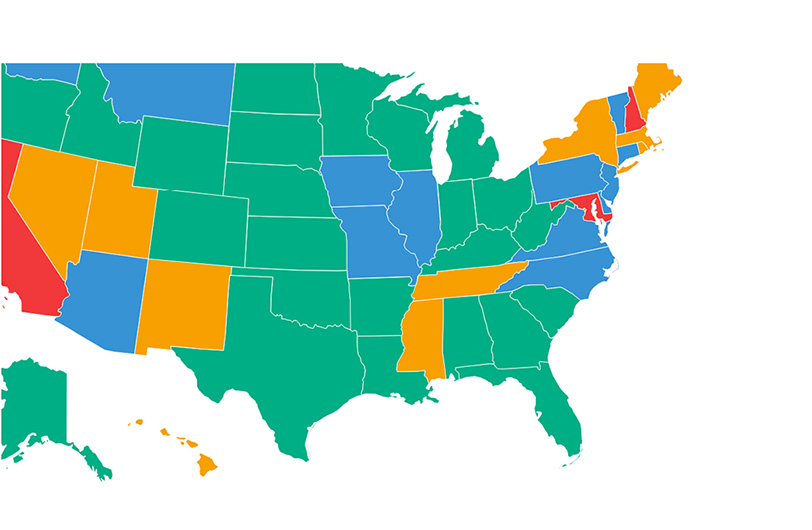





Originally published in February 2019, this fact sheet was updated on May 16, 2022, on January 9, 2025, and again on November 20, 2025.
What is a Late-Term Abortion?
“Late-term” abortion is an imprecise term used to refer to abortions performed in the third month of pregnancy or later.[1] For the purposes of this fact sheet, “late-term” will refer to abortions performed at 15 weeks of gestation or later. Evidence indicates that unborn babies can feel pain at 15 weeks, though some research suggests pain may be felt as early as 12 weeks of gestation.[2] While the precise number of late-term abortions in the United States is unknown, a substantial number (tens of thousands) of abortions are performed on unborn babies capable of experiencing pain.
What Does the Data Tell Us About Late-Term Abortion in the United States?
The exact number of late-term abortions is unknown due to gaps in reporting. The U.S. Centers for Disease Control and Prevention’s (CDC) abortion surveillance system reports on the number of abortions nationally, but there is no comprehensive abortion reporting requirement in the U.S., so several states where a large percentage of the country’s abortions take place (such as California, Maryland, and New Jersey) do not report data to the CDC. Furthermore, some that do, such as New York, do not specify abortions by gestational age in their data. Additionally, CDC reporting lags behind. Using 2022 data from the CDC, the Charlotte Lozier Institute previously estimated that over 60,000 abortions occurred after 15 weeks each year.[3] However, the most recent CDC abortion surveillance report is from 2022 and, therefore, does not reflect the full-year impact of pro-life laws enacted post-Dobbs (June 24, 2022) or the shift to abortions performed via abortion drugs.
There are abortion centers in various states throughout the country offering late-term abortions, including a few which offer abortions as late as 34 weeks of gestation and another offering abortions up to 35 weeks.[4]
What Are the Reasons for Abortions After 15 Weeks?
Abortion advocates often assert that late-term abortions are “almost always” obtained in cases of severe fetal abnormality or when the mother’s life is endangered. However, a study of nearly 400 women found that over half of the women who underwent abortions between 13 and 23 weeks of gestation had done so due to delays in recognizing their pregnancies earlier. Women who had abortions between 13 and 23 weeks also took more time to decide whether to have an abortion and therefore, took longer to book an appointment.[5] Another study of just over 1,200 women similarly found that frequent reasons for delay included recognizing a pregnancy, deciding on abortion, and arranging for the abortion.[6]
Similarly, another study compared the experiences of 272 women who obtained abortions at or after 20 weeks (excepting those who sought abortions for fetal anomaly or endangerment to the mother’s life) with those (169 women) who obtained abortions before 20 weeks. The study found that the reasons cited for obtaining an abortion between the groups were similar: stressful circumstances of unprepared pregnancy, single motherhood, financial pressure, and relationship discord.[7] Although the experiences of women who obtained abortions for fetal anomaly or life endangerment were not included, meaning that the percentages of abortions performed for those reasons are not available, the results show that some women do seek abortions after 20 weeks for non-medical reasons. Resources and support could empower these women to choose life similar to women earlier in pregnancy.
How Are Late-Term Abortions Performed?
In the past, many late-term abortions were performed via intraamniotic instillation of saline solution, urea, or prostaglandins to induce contractions causing vaginal delivery of the child. Abortionists also performed intact dilation and extraction or “partial-birth” abortions, which involved delivering the child into the birth canal up to his shoulders and killing him through suctioning the brain and crushing his skull.[8] This method was banned by Congress in 2003, and the ban was upheld by the Supreme Court in Gonzales v. Carhart in 2007.
In current practice, starting from about 13 to 14 weeks of gestation, a non-intact dilation and evacuation (D&E) or “dismemberment abortion” procedure is commonly used.[9] Several hours to a day or two before the abortion is performed, the abortionist prepares the cervix with osmotic and/or pharmacologic dilators (e.g., laminaria) to open the cervix. About the same time, he may administer an injection such as potassium chloride or digoxin into the amniotic sac, heart, or head of the unborn child to ensure that he or she is dead upon delivery, although this is practiced inconsistently among abortion centers.[10] On the day of the procedure, if further cervical dilation is needed, this is performed with mechanical dilators just prior to the procedure. Uterine evacuation is then performed. For younger babies this can be primarily accomplished using suction to remove as much of the tissue and soft body parts as possible, followed by using forceps for removal of larger and harder body parts. For older and larger babies, dismemberment using forceps is used (grasping and pulling off limbs for removal). The brain may be removed by suction and the skull crushed for removal. Misoprostol or Pitocin may also be given to the mother to induce uterine contractions, especially to help expel all the body parts and placenta. The abortionist then may reassemble the parts to ensure that no body parts have been left in the uterus. The brutality of dismemberment abortion has been acknowledged even by abortionists, with one early adopter of D&E noting that the procedure took a toll on his staff, resulting in stress, nightmares, and relationship problems.[11]
Late-term abortions may also be performed via labor induction, particularly in the last three months of pregnancy.[12] Although this abortion method has some similarities to induction of labor to produce a live birth, in the case of abortion, the goal is to prevent the unborn child from being born alive. Consequently, similar to the start of a D&E procedure, the abortionist may kill the unborn baby before beginning the abortion.[13] The abortionist may administer mifepristone to prepare the cervix and uterus. The woman will then be administered drugs to induce labor, frequently misoprostol. Repeat doses may be needed to complete the abortion.
Although late-term abortions are intended to be lethal to the unborn child, these methods may fail and the child may survive the attempted abortion. Because most states do not collect this data, the exact number of babies who survive abortions in the United States each year is unknown, but hundreds have been reported to be born alive.[14]
Fetal Development at 15 Weeks and Beyond[15]
By 15 weeks of gestation, an unborn child can feel pain. Pain receptors develop between 10 and 17 weeks of gestation, and nerves which connect these early pain receptors to the spinal cord and thalamus are observed by 15 weeks.[16] Additionally, the brain structures such as the brain stem, insula, and thalamus are mature enough to process pain despite the cortex not yet being fully developed. By this time, the child has displayed purposeful movements and can respond to light touch in most areas of the body. All sensory systems are developing, at least in part, by 15 weeks.[17]
At 18 weeks, the lungs have completed forming, although gas exchange sites continue to mature.[18] At 19 weeks, the heart, which first began beating at six weeks, has now beat over 20 million times and pumps 55 quarts of blood per day.[19] By 22 weeks, the unborn child responds to taste, sound, light, temperature, and movement and has the ability to survive outside the womb with medical support.[20]
[1] In some contexts, “late-term” is limited to abortions performed in the last three months of pregnancy or rooted in the concept of viability, which refers to the stage in pregnancy where an unborn child can survive on his or her own outside the womb with medical support.
[2] “Fact Sheet: A Timeline of the Development of Fetal Pain Sensation,” Charlotte Lozier Institute, February 24, 2025, accessed September 16, 2025, https://lozierinstitute.org/fact-sheet-science-of-fetal-pain/.
[3] To produce a national estimate of abortions at 15 weeks or later, CLI used data from the 2022 CDC report. Because CDC reports abortions occurring between 14–15 weeks as one lump sum, CLI reviewed data from states that report abortions by individual week of gestation to determine that, on average, 47% of abortions in the 14–15 week range occurred at 15 weeks in these states in 2022. CLI then multiplied the CDC’s 14–15 week abortion total by 47% to estimate the number occurring at 15 weeks. CLI determined that of all abortions for which gestational age was reported to the CDC, approximately 6% occurred at 15 weeks of gestation or later. CLI applied that 6% to the Guttmacher Institute’s estimate of total abortions in 2023.
[4] Melissa Block, “An all-trimester abortion clinic prepares to open in Maryland, one of few nationally,” NPR, September 1, 2022, accessed September 16, 2025, https://www.npr.org/2022/09/01/1120124723/an-all-trimester-abortion-clinic-prepares-to-open-in-maryland-one-of-few-nationa; VAG Clinic, accessed September 16, 2025, https://vagclinic.com/; RISE Collective, accessed October 20, 2025, https://riseboulder.org/. CARE Reproductive Health LLC, accessed October 22, 2025, https://abortionclinics.org/chevy-chase-maryland/.
[5] Drey EA et al. “Risk factors associated with presenting for abortion in the second trimester,” Obstet Gynecol. 2006;107(1):128–135, https://pubmed.ncbi.nlm.nih.gov/16394050/.
[6] Finer LB, Frohwirth LF, Dauphinee LA, Singh S, Moore AM. “Timing of steps and reasons for delays in obtaining abortions in the United States,” Contraception. 2006;74(4):334-344, https://pubmed.ncbi.nlm.nih.gov/16982236/.
[7] Foster DG, Kimport K. “Who seeks abortions at or after 20 weeks?” Perspect Sex Reprod Health. 2013;45(4):210-218. doi:10.1363/4521013.
[8] Wills S, Aultman K. “Does banning abortions after 15 weeks make any sense?” Charlotte Lozier Institute. Published September 27, 2021. Accessed December 20, 2024. https://lozierinstitute.org/does-banning-abortions-after-15-weeks-make-any-sense/.
[9] See Edelman A, Kapp N. “Dilation & evacuation (D&E) reference guide: induced abortion and postabortion care at or after 13 weeks gestation (‘second trimester’),” Ipas. 2018. https://www.ipas.org/wp-content/uploads/2020/06/DESTRE18-DilationEvacuationReferenceGuide.pdf; Hammond C. “Second-trimester pregnancy termination: dilation and evacuation,” UpToDate, 2025, https://www.uptodate.com/contents/second-trimester-pregnancy-termination-dilation-and-evacuation/.
[10] White KO, Jones HE, Shorter J, et al. “Second-trimester surgical abortion practices in the United States,” Contraception, 2018;98(2);95-99. doi:10.1016/j.contraception.2018.04.004.
[11] Hern W, Corrigan B. “What about us? Staff reactions to D&E,” Advances in Planned Parenthood, 1980;15(1):3–8. https://www.drhern.com/wp-content/uploads/2018/05/staff-reaction-de.pdf.
[12] See Hammond C. “Second-trimester pregnancy termination: Medication abortion,” UpToDate, 2025, https://www.uptodate.com/contents/second-trimester-pregnancy-termination-medication-abortion; Borgatta L, Kapp N. “Clinical guidelines. Labor induction abortion in the second trimester,” Contraception, 2011;84(1):4-18, doi:10.1016/j.contraception.2011.02.005; Cox T, Skop I. “Fact sheet: third trimester abortion and ‘abortion up to birth’,” Charlotte Lozier Institute. Published September 20, 2024. Accessed December 20, 2024. https://lozierinstitute.org/fact-sheet-third-trimester-abortion-and-abortion-up-to-birth/.
[13] Hammond C. “Second-trimester pregnancy termination: Medication abortion,” UpToDate, 2025.
[14] “Fact sheet: questions and answers on born-alive abortion survivors,” Charlotte Lozier Institute. Published December 19, 2024. Accessed December 20, 2024. https://lozierinstitute.org/fact-sheet-questions-and-answers-on-born-alive-abortion-survivors/.
[15] For more information on fetal development week by week, visit Voyage of Life https://lozierinstitute.org/voyage/.
[16] The Voyage of Life: Weeks 15 & 16, Charlotte Lozier Institute, https://lozierinstitute.org/fetal-development/weeks-15-and-16/.
[17] Ibid.
[18] The Voyage of Life: Weeks 17 & 18, Charlotte Lozier Institute, https://lozierinstitute.org/fetal-development/weeks-17-and-18/.
[19] The Voyage of Life: Weeks 19 & 20, Charlotte Lozier Institute, https://lozierinstitute.org/fetal-development/weeks-19-and-20/.
[20] The Voyage of Life: Weeks 21 & 22, Charlotte Lozier Institute, https://lozierinstitute.org/fetal-development/weeks-21-and-22/.