











Unintended Consequences of the FDA’s 2021-2023 Risk Evaluation and Mitigation Strategy (REMS) Changes to Mifepristone


image credit: JHVEPhoto – stock.adobe.com
This is Issue 47 of the American Reports Series.
Executive Summary
- The U.S. Food and Drug Administration (FDA)’s approval and regulation of Mifeprex (generic name “mifepristone”), combined with misoprostol in the approved regimen for drug-induced abortion, has been characterized by many deviations from accepted FDA protocols, indicating mifepristone may have received special treatment.
- In response to litigation requesting removal of key regulations related to mifepristone use, the FDA agreed to undertake a full review of these regulations in 2021, which led to mifepristone’s 2023 label changes. These changes allowed significant modifications in how the drug is prescribed and dispensed. There were many deficiencies in the FDA’s review.
- Few, if any, of the studies cited by the FDA adequately replicated the real-world conditions of use which the FDA has allowed. For example, in real-world conditions, it is often not possible to obtain and review ultrasounds or labs for high-risk women, as these drugs are often being remotely requested by telemedicine or online and sometimes dispensed to U.S. women from providers located out of state or even out of the country.
- The clinical implications of the FDA’s decisions may be numerous and harmful, including underestimation of gestational age, missed diagnosis and delayed treatment of ectopic pregnancy, inability to obtain follow-up or complication treatment from the abortion provider, drug procurement by others to cause unwanted or coercive abortions, and potentially increased risk of future pregnancy complications. Additionally, the FDA’s decisions have led to the ability of abortionists to circumvent state laws protecting unborn life by remotely providing illegal abortions in pro-life states.
Introduction
In the United States today, a pregnant woman in a pro-life state can visit a website that will sell her abortion drugs with minimal screening and limited informed consent[1] and will then deliver the drugs to her home by mail, allowing her to circumvent state laws and perform a self-managed abortion without medical supervision.[2] How did we get here? The FDA explained the reasoning behind their decision to permanently remove the in-person dispensing requirement in their 2021 mifepristone REMS Modification Rationale Review[3] and their 2023 Center for Drug Evaluation and Research (CDER) Summary Review.[4] This paper will address this controversial decision and the harms it may potentially cause for women.
Regulatory history of mifepristone abortion
The use of mifepristone combined with misoprostol in the regimen for drug-induced abortion has been controversial since its approval in the United States on September 28, 2000. Many deviations from accepted FDA protocols have been noted, indicating the FDA gave mifepristone special treatment.[5] Mifepristone (brand name Mifeprex, manufactured by Danco) was approved under a special category, “Subpart H: Accelerated Approval Regulations,” which is intended for drugs “treating serious or life-threatening illnesses and that provide meaningful therapeutic benefit to patients over existing treatments.”[6] Subpart H had previously only been used to approve drugs for serious illnesses such as AIDS, cancer, sepsis, and leprosy.[7] Notably, mifepristone abortion does not treat a life-threatening illness, because pregnancy is a normal physiological function, not a disease,[8] and most pregnancies remain uncomplicated.[9] Clearly, it has the opposite effect on the unborn child, whose death is intended by mifepristone consumption. Nor do abortion drugs have a clear therapeutic benefit over surgical abortions in all cases, with one study finding that drugs may cause up to four times as many adverse events as surgery.[10]
At the time of mifepristone’s initial approval, the FDA required a new drug to have at least two randomized, blind placebo-controlled trials documenting its safety and efficacy,[11] but the trials submitted in support of mifepristone had no placebo groups.[12] Additionally, concerns about falsification were raised regarding the submitted data from French trials.[13]
The FDA based their approval on the combined action of mifepristone with misoprostol, and they mandated the unapproved use of misoprostol (brand name Cytotec) over the objections of its manufacturer, Searle.[14]
Moreover, the FDA is required by the Pediatric Research and Equity Act (PREA) to test certain drugs in a pediatric population[15] but waived this requirement without explanation.[16] Only sixteen years later, in a clinical review to extend the abortion drug regimen’s use to 70 days of gestation, did the FDA give a reason for requesting a PREA waiver, stating there was enough evidence in published medical literature to show the drugs were safe and effective for women under 17 years of age.[17] Notably, none of the studies including minors which were cited in the 2016 clinical review had been published when the PREA requirement was originally waived for mifepristone’s approval in 2000.[18]
Finally, the Federal Food, Drug and Cosmetic (FD&C) Act requires an approved regimen to mimic clinical trial conditions.[19] The trials required an ultrasound to confirm gestational age and rule out ectopic pregnancy, as well as dispensing by an experienced surgeon who had nearby hospital admitting privileges in order to care for complications requiring surgery. However, these safeguards were not required of prescribers by the FDA. Whereas the FDA REMS requires the prescriber to “have made plans to provide such care through other qualified physicians” if he or she is unavailable to perform care for post-abortion complications, it does not appear that most mifepristone prescribers (particularly non-physicians without surgical skills) have made formal arrangements for this contingency. The de facto provision of this care has occurred through the vast U.S. emergency room system.[20]
Mifeprex’s initial approval did, however, require strict supervision. The abortion drug combination was to be used only until 49 days of gestational age (seven weeks). The physician provider had to receive specialized training, and women were to be counseled of the risk of serious side effects. Further, the drugs were to be distributed only in certain medical settings with three mandatory physician visits. Reporting of serious complications was also required.[21]
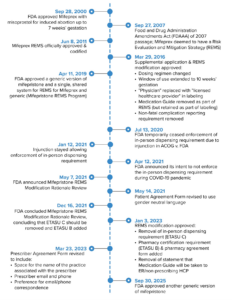
Following is a timeline showing the history of FDA approvals and regulatory changes related to mifepristone:
What did the FDA permit following its 2021 review?
The mifepristone label changes based on the 2021 Modification Rationale Review and finalized in 2023 (even though permitted as early as 2020) allowed significant deviations in how the drugs are prescribed and dispensed. The change with the most impact, suspension of the in-person mifepristone dispensing requirement, also known as Elements to Assure Safe Use (ETASU) C, was initially justified as promoting the safety of women seeking abortion during the COVID-19 pandemic. This was because it allowed them to avoid office visits and instead obtain telemedicine prescribing with mail-order distribution of the drugs. This reasoning was outlined in the American College of Obstetricians and Gynecologists (ACOG) v. FDA litigation, resulting in an injunction temporarily stopping enforcement of the in-person dispensing requirement on July 13, 2020.[22] Although the injunction was stayed on January 12, 2021,[23] the FDA resumed non-enforcement of the in-person dispensing requirement only four months later (on April 12, 2021),[24] once again allowing widespread ordering of abortion drugs outside the in-person medical system. Subsequent litigation in Chelius v. Becerra (now Purcell v. Kennedy) filed on May 7, 2021, requested the complete removal of the REMS from mifepristone.[25]
Although the FDA has thus far declined to remove the entire REMS, the REMS Modification Notification letters mailed on December 16, 2021, “specified that the ETASU must be modified to minimize the burden on the healthcare delivery system … by: Removing the requirement that mifepristone be dispensed only in certain healthcare settings, specifically clinics, medical offices and hospitals (i.e., the ‘in-person dispensing requirement’), and; Adding a requirement that pharmacies that dispense the drug be specially certified.”[26] Finally, on January 3, 2023, the FDA officially removed ETASU C when it modified the mifepristone REMS—although, as noted above, it had not been enforced since 2020.[27]
Mifepristone abortion provision today
Due to the foregoing, these drugs are now increasingly being accessed remotely, sometimes without pre-abortion testing or medical supervision. As of early 2025, most U.S. abortions were still being provided at over 700 brick and mortar abortion facilities, although several of these facilities provide a hybrid model allowing telemedicine consultation and mail-order drug provision. Other organizations have transitioned to fully remote abortion drug provision. Theoretically, the U.S.-based organizations are performing standard medical intakes to determine eligibility for the drugs as required by the FDA, but there is little evidence documenting how vigorously they screen for contraindications or whether they are always able to order and review pre-abortion testing if indicated. Those operating outside the formal U.S. healthcare system don’t adhere to the REMS. Instead, they obtain their drugs from international distributors and may provide no medical screening or assistance to women.[28] From January 2024 through December 2024, telehealth abortions occurring within the formal healthcare system were estimated to account for 22% of all U.S. abortions, with the number steadily increasing.[29]
Investigative journalists have documented the relative ease with which these drugs can be obtained.[30] Some abortion pill prescribers advertise the drugs’ use at gestational ages higher than the FDA recommends.[31] Some doctors have expressed concerns that this less regulated use, which may omit ultrasound and physical examination, may increase the risk of failures (incomplete abortions and ongoing pregnancies) due to use in more advanced gestational ages,[32] or cause harm to women when ectopic pregnancies are not diagnosed prior to mifepristone consumption, leading to treatment delays.[33] Failure to perform labs to determine the need for RhoGAM prophylaxis (to prevent a maternal immune response directed against future unborn children), rule out anemia, or detect sexually transmitted infections, may lead to current or future pregnancy complications or infertility.[34] Inability to verify that the person ordering the drugs is a woman seeking abortion has also led to cases reported in the media of unwanted abortions coerced by abusive partners.[35]
While it remains unknown how often remote prescribers fail to adhere to the current FDA REMS requirements, at least one large prescriber, Aid Access, advertises that it will distribute pills up to 14 weeks in all 50 states (which would include states that prohibit abortion), to women of all ages.[36] Dr. Christina Francis, the CEO of the American Association of Pro-Life Obstetricians & Gynecologists (AAPLOG), demonstrated in a video that she was able to obtain pills despite reporting many risk factors for complications, including being less than 16 years old, having three prior c-sections, and having an IUD in place (which is a significant risk factor for an ectopic pregnancy). AAPLOG’s video showed that Aid Access does not provide thorough informed consent counseling, perform a thorough screening process, or withhold abortion drugs from patients who are not candidates for drug-induced abortion.[37] Aid Access’s negligence in this regard violates even the current, less restrictive FDA REMS.
FDA’s literature review
In response to the Chelius v. Becerra/Purcell v. Kennedy litigation requesting removal of the REMS restrictions, the FDA agreed to undertake a full review of the mifepristone REMS program. They conducted a literature review in PubMed and Embase using the search terms “medical abortion,” “mifepristone,” and “pregnancy termination and mifepristone,” limited to the period from March 29, 2016 – July 26, 2021.[38] The search was refined to that time period in order to document safety data after the 2016 mifepristone clinical review leading to the 2016 REMS changes (extending gestational age limit, no longer requiring a doctor to prescribe the drugs, and modifying the dose and route of delivery of mifepristone and misoprostol, among other changes).[39] This interval also included times when the in-person dispensing requirement was unenforced.
A. What did the FDA not take into account from the available literature?
Although the FDA stated they would exclude publications which did not include objective safety data relevant to their query—such as policy, opinion, or advocacy statements, information available only by abstract, peer-reviewed articles about different abortion procedures or published before March 29, 2016 (the identified time frame for their literature review), and articles focused on the logistics of accessing abortion care or other non-clinical issues (such as demographics, incidence, and cost)—the FDA supplemented their search by examination of literature references provided by the Society of Family Planning, one of the plaintiffs associated with the Chelius litigation.[40] They subsequently also referenced clinical policy guidelines from abortion advocacy organizations such as the National Abortion Federation (NAF)[41] and the American College of Obstetricians & Gynecologists (ACOG).[42]
The FDA demonstrated potential bias because it excluded parallel input from pro-life stakeholders such as the American Association of Pro-life Obstetricians and Gynecologists (AAPLOG) and the American College of Pediatricians (ACPeds). These two groups jointly filed a citizen petition (CP) on March 29, 2019, requesting that the FDA maintain the REMS and restore and strengthen portions approved in 2000 that were previously removed.[43] This CP was not acknowledged in the review besides inclusion in their summary of significant regulatory history, nor were any of AAPLOG’s referenced studies directly addressed in the FDA’s 2021 review. However, the FDA did respond separately in a 2021 letter to AAPLOG/ACPeds in which they reviewed their previous decisions, attempted to address all of AAPLOG/ACPed’s main contentions and sources, and reaffirmed that they felt the reviewed data supported their REMS changes.[44] They declined to restore the pre-2016 regimen as AAPLOG/ACPeds had requested, although they did acknowledge that continuing the REMS was necessary (albeit in its current watered-down form).[45]
B. What complication data did the FDA include in their review?
The FDA performed a cursory investigation of complication reporting, stating that the number of adverse events (AE) reported to the FDA during the period of interest was “small … and the data provide no indication that any program deviation or noncompliance with the Mifepristone REMS Program contributed to these reported adverse events.”[46] While this statement is reassuring at first glance, it is important to understand that in the U.S., there are no federal mandatory abortion complication reporting requirements or accurate centralized systems collecting data related to abortion, leading to substantial uncertainty regarding the numbers of complications and deaths following abortion.[47] The abortion industry has frequently demonstrated its unwillingness to report data, contrary to its frequent assertion of safety,[48] even when complication reporting was required by the FDA prior to 2016.[49] Data has become markedly worse now that it is no longer required.[50]
U.S. studies on abortion complications are often of poor quality because most abortions are paid for privately, and insurance records-linkage cannot document these abortions. In addition, women are often hesitant for various reasons to report a preceding abortion if they have a complication requiring emergency care, resulting in significant deficiencies in hospital coding.[51] This also results in a large majority of abortion-drug complications being miscoded as due to miscarriages.[52] There is reason to believe some abortion providers help to incentivize this situation by encouraging women to misreport their abortions as miscarriages.[53] Many studies published by abortion providers reporting the numbers of abortions they have sold, moreover, are plagued by large numbers of women lost to follow-up, for whom abortion outcomes are unknown.[54]
The FDA investigated postmarketing adverse events (AE) by searching the FDA Adverse Events Reporting System (FAERS), documenting only eight cases. FAERS, now incorporated into the FDA’s Adverse Event Monitoring System (AEMS),[55] is a largely voluntary, passive collection system, inadequate for obtaining accurate abortion drug complication data, as it requires the motivation of physicians and the public who suspect drug injuries to navigate the complex and time-consuming system to create a report. As CLI has noted elsewhere, from 2020-2022, the six states that reported drug-induced abortion complications collectively reported nearly 60 times as many complications as the FAERS data, which contains complications reported to the FDA regardless of state.[56]
The FDA also reviewed AE summaries and analyses provided to them by mifepristone manufacturers Danco and GenBioPro, identifying only 55 cases in the defined time period. These 55 total cases seem infinitesimally small compared to the large number of drug-induced abortions performed over this five-year interval (nearly two million by some estimates[57]) and should have triggered red flags in their minds. They concluded based on this superficial investigation that “there does not appear to be a difference in adverse events between periods when the in-person dispensing requirement was being enforced and periods when the in-person dispensing requirement was not being enforced” and that “[t]his suggests that mifepristone may be safely used without an in-person dispensing requirement.”[58]
Older studies estimate that less than 1–10% of drug-induced serious adverse events ever get reported to FAERS,[59] and more recent analyses, while not estimating the percentage reported, nonetheless affirm that “neither the prevalence nor incidence of an AE can be calculated from FAERS data.”[60] The FDA defines serious adverse events (SAE) as those resulting in death, a life-threatening event, hospitalization, disability or permanent damage, congenital anomaly or birth defect, or other events requiring intervention to prevent permanent impairment or damage,[61] but often fail to consider the significance of clinically important events such as emergency room evaluation, continuing viable pregnancy, retained products of conception requiring surgical aspiration, hemorrhage without transfusion, infection without sepsis, adverse mental health effects, or complications in future pregnancies. Thus, the scattered reports referenced by the FDA are merely “safety signals” indicating the types of complications that may follow mifepristone use, but further investigation is required to determine the true incidence of complications.[62]
Although unable to detect all complications, the FDA could have performed a more accurate assessment on a smaller scale with a query of an insurance database that pays for elective abortions, documenting the medical billing codes that followed payment for a medication abortion to determine the complication incidence within a certain time frame in that population.[63] This type of study was not performed by the FDA, however, which seemed content to take the reassuring numbers of few complications at face value.
C. Sources cited by the FDA review
The FDA chose to highlight 15 peer-reviewed articles with original safety data related to mifepristone abortion in their review. These studies described different methods and locations for dispensing mifepristone. Notably, often there were large numbers of women lost to follow-up in these studies, with failure rates based on known outcomes.
Dispensing mifepristone at retail pharmacies
- Grossman (2021) studied 266 mifepristone abortion drug prescriptions at ≤ 70 days (10 weeks) of gestation dispensed through a retail pharmacy. The failure rate was 6.5%. All the women received standard pre-abortion testing including ultrasound and in-person counseling.[64]
- Wiebe (2020) studied 182 mifepristone abortion drug prescriptions at < 70 days (10 weeks) of gestation dispensed through a retail pharmacy or by mail, compared to a control group of 199 dispensed in-person. The failure rate was 9.9% vs. 10.1% (pharmacy/mail vs. in-person) and surgical completion was required in 3.3% vs. 4.5%. Other complications occurred in 5.4% vs. 5%. All the in-person patients had ultrasounds, but only 18.1% of the remote group also had ultrasounds. Additionally, Rh status was obtained in 90.6% of the remote patients.[65]
- Rocca (2018) studied 600 mifepristone abortion drug prescriptions at < 63 days (9 weeks) of gestation dispensed by nurse-midwives through pharmacies or government-certified public health facilities in Nepal. The failure rate was 1.3% and the complication rate was 1.7%. Documentation of gestational age was based on pelvic exams performed at the site on all women, and all received in-person counseling.”[66]
Dispensing mifepristone from pharmacies by mail
- Grossman (2022) studied 224 mifepristone abortion drug prescriptions at ≤ 63 days (9 weeks) of gestation dispensed through a mail-order pharmacy. The rate of incomplete abortion or ongoing pregnancy was 3.1% and adverse outcomes occurred in 4.9%. Most women received pre-abortion ultrasound or physical examination to confirm gestational age, and post-abortion ultrasounds or pregnancy tests were also performed for many women.[67]
- Upadhyay (2021) studied 141 mifepristone abortion drug prescriptions at < 70 days (10 weeks) of gestation, screened asynchronously through an online form with drugs dispensed through a mail-order pharmacy. Failure rate requiring intervention was 5%. Seventeen percent obtained ultrasounds and Rh type was determined for 57.4%.[68]
- Hyland (2018) studied 1,010 mifepristone abortion drug prescriptions at < 63 days (9 weeks) of gestation sent by mail. Surgical intervention was required in 3% and hospital admission occurred in 3%. All women were screened by phone and obtained local screening tests (ultrasound, hemoglobin, blood type, and quantitative HCG) as well as follow-up tests after the abortion.[69]
Dispensing mifepristone from prescribers by mail
- Raymond et al. (2019) studied 248 mifepristone abortion drug prescriptions at ≤ 70 days (10 weeks) of gestation sent by mail from prescribers. Failed abortion requiring a procedure occurred in 6%. Nearly all received pre-treatment laboratory tests and ultrasound.[70]
- Chong et al. (2021) studied 1,390 mifepristone abortion drug prescriptions sent by mail from prescribers. The failure rate requiring surgery was 1.2%, emergency room visits occurred in 6%, and other outpatient visits occurred in 7.8%. Ultrasounds were obtained in 52% of cases.[71]
- Anger et al. (2021) compared 125 mifepristone abortion drug prescriptions with pre-abortion ultrasound or pelvic exam to 287 mifepristone prescriptions distributed without pre-abortion testing (“no-test”). The “no-test” abortion patients had been prescreened by history and determined to be at low risk. Failures occurred more frequently in those without pre-abortion testing (5.6%) vs. those with testing (1.9%), and those in the no-test group were also more likely to have an unplanned clinical encounter (12.5% vs. 8%).[72]
- Kerestes et al. (2021) studied 334 mifepristone abortion drug prescriptions at < 77 days (11 weeks) of gestation provided with different distribution methods. The failure rate was 3.2% after telemedicine with in-person distribution, 2.9% after telemedicine with mailed distribution, and 6.4% after traditional in-person visits. Pre-abortion ultrasounds were obtained in 66.9% of cases.[73]
- Aiken et al. (2021) studied 52,142 mifepristone abortion drug prescriptions in the United Kingdom, by far the largest study group considered by the FDA.[74] This study, however, is likely to have contained significant underreporting of complications. It primarily relied upon data from the National Health Service’s (NHS) Abortion Notification System (ANS), which detects complications occurring in the clinic as the drugs are prescribed but usually before the drug regimen has been completed (as misoprostol is usually taken 24 hours after mifepristone). As a consequence, complications following the completed abortion drug regimen would be unlikely to occur in the abortion clinic. Complications treated elsewhere—such as in public clinics, hospitals, and emergency rooms—are reported in the Hospital Episode Statistics (HES) system, but no common identifying number for a particular woman links the two systems, so this research team may have been unaware of complications reported in HES but not ANS.[75] With these qualifications in mind, overall reported complication rates were low and comparable between the traditional and telemedicine-hybrid groups. Notably, according to NHS England, more than 54,000 women have been admitted to a hospital for the treatment of mifepristone abortion complications since “pills by post” became common in the UK during the COVID-19 pandemic.[76]
Dispensing mifepristone by courier from clinic
- Reynolds-Wright et al. (2021) studied 663 mifepristone abortion drug prescriptions at < 70 days (10 weeks) of gestation. The failure rate was 1.4%. Pre-abortion ultrasound was obtained in 21.3% and post-abortion ultrasound in 9.9% of cases.[77]
Dispensing by mail from partner organization (Women on Web)
- Aiken et al. (2017) studied 1,636 mifepristone abortion drug prescriptions at ≤63 days (9 weeks) of gestation mailed from the international abortion provider Women on Web (WoW). Failed abortion requiring surgery occurred in 4.5%. Gestational age had been confirmed by ultrasound in 58%.[78]
- Norten et al. (2021) surveyed more than 81,000 of WoW’s customers, with 37% responding. Of those who reported going through with the abortion, 10.2% required surgical intervention.[79]
- Endler et al. (2019) studied 615 mifepristone abortion drug prescriptions, comparing those obtained at ≤ 63 days (9 weeks) of gestation to > 63 days. Surgical intervention was required in 12.5% of women at ≤ 9 weeks and 22.6% at > 9 weeks. Treatment of any kind was provided in 18.3% of women at ≤ 9 weeks and 29% at > 9 weeks.[80]
- The WoW studies most closely approximate the use of these drugs in the real-world, and reported failures were not infrequent, occurring in about 1-2 in twenty women. This data is even more grim when one considers that WoW prides itself on sending drugs to 180+ countries around the world,[81] many of which have substandard health care and blood banking systems to care for women experiencing emergencies induced by WoW’s unsupervised abortion drugs. [82]
D. Clinical takeaways
Taken together, the above analyses of the aforementioned papers, as well as our previously published analyses in Skop et al. (2024) [83] and Sluzala et al. (2026),[84] demonstrate that the studies used by the FDA to justify their permanent removal of the in-person dispensing requirement for mifepristone did not provide a sufficient basis for this decision.[85] The FDA based this substantial decision upon 15 peer-reviewed articles containing original safety data, and a majority of the data came from a single study that has been demonstrated to undercount complications approximately ten-fold.[86]
Theoretically, the WoW studies came closest to replicating the conditions of use the FDA allowed, in which pre-abortion testing may not be performed in women for whom it is indicated. However, the FDA admitted the significant limitations of these three studies, stating that the 2017 Aiken study was “insufficient to determine the safety of dispensing mifepristone by mail through a partner organization,” that Endler and Norten “do not provide relevant information on mifepristone dispensing by mail, because neither provide meaningful outcomes data for consideration,” and that Norten has a response rate “that is too low for the study to be considered valid.”[87]
Additionally, the loss to follow-up rates in the 15 studies cited by the FDA varied dramatically, ranging from 2% to 63%.[88] And the failures requiring surgical completion were not inconsequential, ranging from 2% to 12.5%. Further, even though these studies were referenced by the FDA to allow a method of prescribing (telemedicine or online) that may not always involve proper screening or referral for ultrasound and other pre-abortion tests, ultrasounds were reported in between 17% and 66.8% of the studied women. In one study, 100% of the women had gestational age confirmed by pelvic exam.[89] And, finally, unanticipated follow-up (in clinics or emergency rooms) was found in 10.8% to 12.5% of cases,[90] with unscheduled communications in up to 46.2%.[91] When broken down by gestational ages, complications and need for emergency care increased as gestational age increased, with one study finding that 3.3% were evaluated in a hospital within a day of taking the pills at ≤ 9 weeks, compared with 11.7% at > 9 weeks and 22.5% from 11 to 14 weeks.[92]
These studies usually reported failed abortions and serious adverse events, but measurement of additional medically important events was inconsistent and scant, with minimal measurement of infections not requiring hospital admission, hemorrhage not requiring transfusion, missed diagnosis of ectopic pregnancies, and no attempts to measure Rh alloimmunization (if indicated RhoGAM is not administered to Rh negative women), or other complications in future pregnancies. The studies likewise did not appear to attempt to capture incidents such as abortion coercion or consider the implications of omitting other previously standard abortion-related actions, including the adequacy of informed consent in a telemedicine model, diagnosis and treatment of sexually transmitted infections (which, if unresolved, could lead to future infertility), and the provision of contraception to prevent rapid repeat pregnancies, possibly leading to additional abortions.
The critical question that the FDA failed to give sufficient weight is whether these referenced studies actually replicated the real-world conditions for which they would be used. Although the studies involved new methods of distribution, none of them adequately answered the salient question of whether it was safe to omit pre-abortion testing, especially ultrasound, in all women. The FDA appeared to acknowledge this in reference to Anger et al. (2021), which stratified results by the presence of pre-abortion ultrasound, when they wrote that “[Anger et al.’s] comparative analysis suggests a pre-abortion examination may decrease the occurrence of procedural intervention and decrease the number of unplanned visits for postabortion care.”[93]
In some studies all women received pre-abortion testing, and in others telehealth screening (usually via video) occurred to determine which women were at high-risk for complications. These so-called “no-test abortions” did not require testing for low-risk women but did require testing for women determined through screening to be at high-risk for complications. Pre-abortion testing was then performed on high-risk women and if contraindications were identified, the women did not receive the abortion drugs.
In today’s real-world use, women often receive screening through asynchronous online forms, and it has not been verified whether women whose screening indicates they are high-risk are consistently obtaining indicated pre-abortion screening that is subsequently reviewed by the abortion prescriber, with drugs being withheld from those with contraindications. Theoretically, an in-state telemedicine abortion provider could order an ultrasound for a woman who screens positive for uncertain gestational age or ectopic risk factors, but internet prescribers mailing their products over state lines do not have the ability to order ultrasounds if their screening questions should elicit concern.[94] While it is plausible that some women ordering abortion drugs online are receiving pre-abortion testing, including ultrasound, it is far from certain that all high-risk women in the real-world are receiving such testing.
As mentioned previously, Dr. Christina Francis of AAPLOG documented in a YouTube discussion her experience ordering these drugs from the Aid Access website. She found that if a screening question was answered in a way that resulted in a “hard stop” the website allows women to backtrack to change their answer and then proceed to complete and mail the prescription without ultrasound confirmation, even if they are high-risk.[95] With these concerns in mind, it is highly likely that the studies relied upon by the FDA did not sufficiently replicate real-world use.
2023 REMS changes and their clinical implications
Based largely on the demonstrably limited data documented above, the FDA made the following decisions in 2023:
REMS requirement that remained unchanged
The FDA continues to require abortion providers to sign a Prescriber Agreement Form, whereby the provider affirms that he/she has the “(1) ability to assess the duration of pregnancy accurately; (2) ability to diagnose ectopic pregnancies; and (3) ability to provide surgical intervention in cases of incomplete abortion or severe bleeding, or have made plans to provide such care through others, and be able to assure patient access to medical facilities equipped to provide blood transfusions and resuscitation, if necessary.”[96]
Continued maintenance of this requirement demonstrates that the FDA feels it is important that these actions be taken prior to a woman ingesting mifepristone and misoprostol. Yet, the FDA has made little effort to ensure that abortionists actually perform the actions they have stated they have the ability to perform.
REMS requirements that changed
The FDA removed the requirement under ETASU C that mifepristone be dispensed only in certain healthcare settings, specifically clinics, medical offices, and hospitals. They also added a requirement under ETASU B that pharmacies that dispense the drug be specially certified.
These decisions have allowed mifepristone and misoprostol to be prescribed by telemedicine or online, delivered through mail-order or brick-and-mortar pharmacies, often without pre-abortion testing or in medically unsupervised ways, as previously discussed.
The patient agreement form was updated with the following changes:[97]
- Clarified that the signatures may be written or electronic (facilitating remote prescribing).
- Reorganized the risk information about ectopic pregnancy “since it is not a risk of the drug.” Although it is true that mifepristone will not cause an ectopic implantation, if the pregnancy already exists in an ectopic location, mifepristone will not resolve the ectopic pregnancy. The FDA’s statement ignores the risks to a woman from failure to diagnose an ectopic pregnancy in a timely manner through the use of pre-abortion ultrasound. The potential harms of this omission will be discussed later.
- Removed the statement that the Medication Guide should be taken to an emergency room or provided to a healthcare provider who did not prescribe the mifepristone so that it is known that the patient had a drug-induced abortion. The FDA displayed minimal concern for the safety of women when it advised, “The review team agrees with removing the patient’s agreement to take the Medication Guide with them if they visit an emergency room or HCP [health care provider] who did not give them mifepristone so the emergency room or HCP will understand that the patient is having a medical abortion … the Agency has concluded that patients seeking emergency medical care are not likely to carry a Medication Guide with them, the Medication Guide is readily available online, and information about medical conditions and previous treatments can be obtained at the point of care.”
A heartbreaking story will demonstrate why it is necessary to provide the Medication Guide to a treating physician in an emergency. A young Nevada mother, Alyona Dixon, died of sepsis following a mifepristone and misoprostol abortion in 2022. Her autopsy report said that the emergency room where she presented for care recorded that she had taken methotrexate, not mifepristone.[98] The FDA continues to require a “black box” warning on mifepristone because there is evidence that mifepristone and misoprostol can, in rare cases, impair a woman’s immune system, leading to a rapidly progressive, sometimes fatal infection.[99] The mifepristone label alerts doctors that “[p]atients with serious bacterial infections and sepsis can present without fever, bacteremia or significant findings on pelvic examination. A high index of suspicion is needed to rule out serious infection and sepsis.”[100] Alyona suffered from the same atypical infection the FDA warns about, and yet the ER was apparently under the impression she had taken a different drug, and this may have affected her care. She died awaiting transfer to another hospital. For the FDA to remove the recommendation for the Medication Guide to be provided to emergency room providers just because a woman might not have it with her, rather than reinforcing with providers and patients the critical reason this requirement was implemented, is problematic. As previously noted, it is increasingly common for emergency providers to be unaware a woman has taken abortion drugs, being led to believe she is suffering a natural miscarriage.[101] The FDA’s de-emphasis on the Medication Guide will only worsen this confusion.
Many have expressed concerns about the various ways in which the FDA’s actions may harm women.[102] Following is a discussion of some of those concerns.
A. Inaccurate gestational age determination
The FDA limits mifepristone abortion to ≤ 70 days (10 weeks) of gestational age because it is well documented that failures occur far more frequently at higher gestational ages.[103] The first step in determination of gestational age is recording a woman’s last menstrual period (LMP). Yet many women have irregular menses, conceive on contraception, or simply do not accurately recall the date of their last menstrual period. Implantation bleeding may lead a woman to assume she had a period when in fact she is already pregnant.[104] The reality is that many women are incorrect in their estimation of gestational age based on LMP,[105] and gestational age should be accurately confirmed before mifepristone is prescribed.
An experienced physician may be able to confirm gestational age by physical exam, although obesity, anatomic variation, or multiple gestation may hinder this evaluation.[106] Ultrasound is the gold standard for correct estimation of gestational age. Yet, in many cases, neither of these confirmatory tests are available when abortion drugs are prescribed through telemedicine or online. Although it is possible for an ultrasound to be ordered by a remote provider, the FDA does not specifically require this, so it is likely that many women are not receiving ultrasounds or physical exams before obtaining mifepristone.[107]
How, then, is the REMS requirement that a provider have the “ability to address the duration of pregnancy” being addressed? Providing abortion drugs at more advanced gestational ages if gestational age is underestimated will lead to more failed abortion complications, including an ongoing living fetus and/or failure to evacuate all the pregnancy tissue.[108] It may also cause a woman to experience the medical and emotional risks of a second and third-trimester delivery, possibly alone at home. This may be accompanied by harm to infants who may survive these later deliveries and also poses legal risks to women if these premature children should subsequently die.[109]
B. Missed diagnosis and delayed treatment of ectopic pregnancy
Similarly, ultrasound is the gold standard for diagnosing or ruling out an ectopic pregnancy. The consequences of a missed diagnosis of ectopic pregnancy may be serious, possibly even fatal. Mifepristone and misoprostol will not resolve an ectopic pregnancy because these medications act on the uterus, allowing the ectopic pregnancy to continue to grow, possibly to the point of tubal rupture, which can lead to catastrophic bleeding and death. Only half of women diagnosed with ectopic pregnancies have risk factors for this life-threatening condition.[110] Studies have found that a woman is more likely to die from a ruptured ectopic while seeking drug-induced abortion if it remains undiagnosed, as the symptoms she experiences may be misinterpreted as being an expected symptom of a drug-induced abortion, rather than a warning sign of a serious problem.[111],[112]
Even experienced obstetricians may be unable to make this diagnosis by physical exam without ultrasound. Thus, providing abortion drugs without first ruling out an ectopic pregnancy by ultrasound is likely to lead to delayed diagnosis, which may cause women to require more aggressive surgical management like salpingectomy (removal of the tube) rather than conservative treatment like methotrexate, possible need for blood transfusion, or potentially death.[113],[114] How is the REMS requirement that a provider have the “ability to diagnose ectopic pregnancies” occurring through remote provision without ultrasound or physical exam?
Additionally, omission of ultrasound and physical examination may fail to give physicians the opportunity to diagnose other factors that may complicate an abortion such as uterine abnormalities of fibroids or septum, molar or multiple pregnancies, fetal demise, or pre-existing infection.[115]
C. Failure to perform laboratory testing may increase risk of complications
It has been the standard of medical care for decades to perform a blood type and screen in order to screen for Rh-D negativity and provide RhoGAM prophylaxis, if indicated, when a woman suffers pregnancy loss or induced abortion. This is to prevent alloimmunization, a potentially serious maternal immune response directed against the blood of her future unborn children.[116] These longstanding recommendations have recently been modified, and “shared decision-making” encouraged in determining whether this screening should be performed for women seeking telemedicine abortion.[117] These new recommendations, led by pro-abortion medical organizations, are based on limited clinical data,[118] and should be regarded with skepticism.
If RhoGAM is needed but not provided, and alloimmunization occurs, this can lead to life-threatening complications of severe fetal and neonatal anemia, brain damage, and stillbirth or neonatal death.[119] Although abortion advocates have recently stated that RhoGAM is not necessary in the first trimester,[120] fetal red blood cells have been found in the maternal circulation after surgical abortions beyond six weeks of gestation.[121] The failure to accurately determine gestational age by ultrasound may also lead to underestimation in some cases, causing some women to fail to receive indicated RhoGAM in the second or possibly third trimester in rare cases when it is highly likely to cause harm.[122]
Additionally, failure to perform labs for sexually transmitted infections will miss the diagnosis of chlamydia and other infections that may place a woman’s future fertility at risk.[123] Finally, failure to identify and exclude women with severe anemia may cause some women to be at increased risk for blood transfusion if they experience significant blood loss.[124]
D. Unavailability of abortion provider to manage complications
Finally, although the REMS requires a provider to assert that he/she has the “ability to provide surgical intervention … or have made plans to provide such care through others,” when women suffer an incomplete abortion or severe bleeding, the increasing incidence of remote medical abortions being provided from long distances—out of the city, out of the state, or even out of country—virtually guarantees that if they suffer a complication they will not be cared for by the abortionist or his designated alternate, but instead will be forced to rely upon our overstressed emergency room system for care. This “patient dumping” has been documented,[125] and recent callous recommendations by abortion advocates not to report the preceding abortion if they seek care[126] may be contributing to the many known mifepristone abortion-related complications treated in the ER that are miscoded as miscarriages, further obscuring complication data and compromising these women’s care.[127]
Other considerations unaddressed by the FDA
A. Informed consent deficiencies
Informed consent requires discussion of the risks, benefits, and alternatives of a procedure being considered. It is plausible that the conclusion is sometimes drawn by abortion providers that a woman is firm in her decision to obtain an abortion, and they merely discuss the different methods for ending the unborn child’s life.[128] It seems unlikely that remote providers are informing women about the many available pregnancy centers that exist to provide emotional, relationship, and material support,[129] or that many states have allocated alternatives to abortion funding to provide financial support to allow them to give birth to their child if that is what they prefer.[130]
B. Coerced and unwanted abortions
It is doubtful that a remote prescriber, prescribing through telemedicine or merely via a website form, will always be able to discern whether a woman is seeking abortion freely, without coercion. There may be no verification that the person requesting pills is even a woman who desires an abortion.[131] This has the potential to benefit sex traffickers, incestuous abusers, and coercive men who do not desire to become fathers and may result in unwanted abortions.
C. Post-abortion follow-up care
Additionally, women who live in a remote “healthcare desert” (an area without nearby emergency services) and experience a complication following remotely prescribed, medically unsupervised drug-induced abortion, may have trouble finding a provider to care for an emergency.[132]
D. Future pregnancy complications
In addition to concerns about Rh alloimmunization in future pregnancies, there is also considerable evidence that a drug-induced abortion completed surgically may increase the risk of preterm birth in subsequent pregnancies.[133]
E. Failure to consider safety concerns for unborn children who may survive mifepristone and misoprostol exposure
Approximately 1-3% of medication abortions performed before 10 weeks of gestation will fail to end the unborn child’s life.[134] Sometimes in this situation, women will knowingly continue the pregnancy to birth,[135] demonstrating that, for some women, there was uncertainty regarding whether the abortion was truly desired in the first place. Additionally, thousands of children have been born after women have changed their minds and chosen to reverse mifepristone’s effect with high-dose progesterone, a protocol known as “Abortion Pill Reversal” (APR).[136]
Because pregnancies sometimes continue after a drug-induced abortion attempt, the potential for subsequent birth defects if the child is born alive must also be considered as part of the mifepristone/misoprostol abortion regimen’s risk profile. Current data does not support an association of mifepristone alone with an elevated risk of birth defects, but this cannot be claimed of misoprostol.[137] Despite misoprostol’s known association with teratogenic effects, which sometimes results in serious craniofacial abnormalities (Mobius Sequence), limb defects, or neural tube defects,[138] it does not appear the FDA is actively searching for such injuries. It should be noted this lack of investigation into the potential harms to unborn children contrasts dramatically with the typical review process for drugs used in the pediatric population.[139]
F. Illegal abortions
In addition to the harms experienced by women, another substantial impact of the FDA’s loosening of abortion drug regulations is the ability of prescribers to circumvent state laws protecting unborn life by providing abortions in pro-life states. The Society of Family Planning estimates that abortions have increased since the Dobbs decision, with an outsized proportion of abortions in pro-life states being provided through mail distribution,[140] despite the federal Comstock law prohibiting mailing abortion drugs.[141]
While the FDA is not obligated to follow the preferences of the American public, it is noteworthy that most believe these drugs should be supervised. A 2025 poll found that 71% of Americans believe a doctor’s visit should be required for a drug-induced abortion.[142]
Call to Action
In response to widespread concern that the above noted deregulatory changes could increase the risk to women,[143] Marty Makary, the former director of the FDA, pledged to perform another review of mifepristone safety data, and his successor has likewise made this promise.[144] However, little information has been forthcoming regarding how this review will be performed, although the agency has stated its results will be released to the public in the fall of 2026.[145] Because mifepristone has repeatedly received special considerations by the FDA not applied to other drugs, and the safety of the current conditions of mifepristone use is not adequately documented, it would be beneficial if the FDA:
-
- Performed a timely and accurate review of complications following the use of mifepristone abortion drugs, noting the differences in complication rates correlated with time periods in which REMS requirements were modified.
- Immediately reinstated federal mandatory reporting of all complications, with enforcement mechanisms and penalties for noncompliance.
- Requested and analyzed complication data from the states that mandate abortion complication reporting.
- Analyzed FAERS (AEMS) data for safety signals but should not rely upon this data for determination of complication incidence.
- Performed records-linkage of insurance databases to determine the incidence of associated adverse events within a set time period after an abortion (30 days or six weeks) in that population.
- Thoroughly audited REMS-registered providers and removed certification from those blatantly violating REMS requirements.
- Reinstated in-person dispensing requirements (ETASU C) while a safety study is being performed, and continued these requirements if harm is demonstrated.
Ingrid Skop, M.D., is Vice President and Director of Medical Affairs for Charlotte Lozier Institute
[1] Mia Steupert, “How Many Abortions Are Occurring in America Post-Dobbs?” Charlotte Lozier Institute, May 22, 2025. https://lozierinstitute.org/how-many-abortions-are-occurring-in-america-post-dobbs/; Mia Steupert, “An Overview of Online Abortion Drug Access in Post-Dobbs America,” Charlotte Lozier Institute, May 26, 2026. https://lozierinstitute.org/an-overview-of-online-abortion-drug-access-in-post-dobbs-america/.
[2] Richardson K. “EXCLUSIVE: We Found Out How Easy It Is To Order An Abortion Pill. The Results Are Shocking.” Daily Caller. June 19, 2025. Available from: https://dailycaller.com/2025/06/19/chemical-abortion-pill-order-online/.
[3] The full 2021 REMS Review can be found in the appendix of the 2023 CDER Summary Review, beginning on p. 41 of the PDF. https://www.accessdata.fda.gov/drugsatfda_docs/summary_review/2023/020687Orig1s025SumR.pdf.
[4] Ibid.
[5] Calhoun, B.C.; Harrison, D.J. Challenges to the FDA Approval of Mifepristone. Annals of Pharmacotherapy 2004, 38, 163–168.
[6] Food and Drug Administration. New drug, antibiotic, and biological drug product regulations; accelerated approval. Final Rule Subpart H. Fed Register 1992;57(Dec 11):58942-58960. https://www.ecfr.gov/current/title-21/chapter-I/subchapter-D/part-314/subpart-H.
[7] Food and Drug Administration (FDA); Center for Drug Evaluation and Research (CDER) Mifeprex Approval Letter. 2000. https://www.accessdata.fda.gov/drugsatfda_docs/appletter/2000/20687appltr.htm. “Accelerated and Restricted Approvals Under Supbpart H (drugs) and Subpart E (biologics),” Food and Drug Administration, updated August 36, 2014, accessed February 3, 2026, https://www.fda.gov/drugs/drug-and-biologic-approval-and-ind-activity-reports/accelerated-and-restricted-approvals-under-subpart-h-drugs-and-subpart-e-biologics.
[8] X Wang, “Why pregnancy is not a disease: a critique from the perspective of biological trade-offs,” BMJ Journal of Medical Ethics, https://doi.org/10.1136/jme-2025-111409.
[9] Olsen O, Clausen JA, “Planned hospital birth compared with planned home birth for pregnant women at low risk of complications,” Cochrane Database Syst Rev 2023 Mar 8;2023(3):CD000352. doi: 10.1002/14651858.CD000352.pub3.
[10] Niinimaki M, et al., Immediate Complications after Medical Compared with Surgical Termination of Pregnancy, Obstetrics & Gynecology, vol. 114, no. 4 (October 2009); Upadhyay UD, Desai S, Zlidar V, Weitz TA, Grossman D, Anderson P, et al. Incidence of Emergency Department Visits and Complications After Abortion. Obstetrics & Gynecology. 2015 Jan 1;125(1):175–83. doi:10.1097/AOG.0000000000000603. Note, however, that the four-fold difference in Niinimaki et al. includes cases of hemorrhage not requiring surgical intervention. Accounting for this, the complication rate following drug-induced abortion is around 2.5 times higher than the rate following surgical abortion.
[11] 21 CFR 314.126 https://www.ecfr.gov/current/title-21/chapter-I/subchapter-D/part-314/subpart-D/section-314.126.
[12] Calhoun, B.C.; Harrison, D.J. “Challenges to the FDA Approval of Mifepristone.” Annals of Pharmacotherapy 2004, 38, 163–168. For an example, see Spitz IM, Bardin CW, Benton L, Robbins A. “Early pregnancy termination with mifepristone and misoprostol in the United States.” N Engl J Med 1998;338:1241-1247; and E Aubeny et al., “Termination of early pregnancy (up to 63 days of amenorrhea) with mifepristone and increasing doses of misoprostol [corrected],” Int J Fertil Menopausal Stud. 1995:40 Suppl 2:85-91.
[13] “Summary of findings,” memorandum accompanying FDA form 483 issued to Dr. Elizabeth Aubeny (June 28, 1996) FDA FOIA release (MIF 004135-45). Rockville, MD: Food and Drug Administration,1996.
[14] Cullen M. “Open letter to health care providers.” Skokie, IL: August 23,
- FDA FOIA Release: MIF 008022.
[15] Food and Drug Administration. Regulations requiring manufacturers to assess the safety and effectiveness of new drugs and biological products in pediatric patients. Final rule. Fed Register 1998;63(Dec 2):66632. https://www.govinfo.gov/content/pkg/FR-1998-12-02/pdf/98-31902.pdf.
[16] Mifeprex approval letter to Sandra P. Arnold, Population Council. Feb 18, 2000. https://www.accessdata.fda.gov/drugsatfda_docs/appletter/2000/20687appltr.htm.
[17] In 2016, the FDA granted a partial waiver for girls under age 12 and a full waiver for girls ages 12 to 17. The full waiver was based on one Planned Parenthood study published in 2015 which included 322 patients under 17 years old. While three additional studies were cited, they were not considered the basis of the waiver due to a small number of minors included in the studies (one, five, and 18 adolescents, respectively). CDER 2016 https://www.accessdata.fda.gov/drugsatfda_docs/nda/2016/020687Orig1s020MedR.pdf; Mary Gatter, Kelly Cleland, Deborah L. Nucatola, “Efficacy and Safety of Medical Abortion using Mifepristone and Buccal Misoprostol through 63 days,” Contraception 91, no. 4 (2015): 269-273, doi: 10.1016/j.contraception.2015.01.005.
[18] CDER 2016, https://www.accessdata.fda.gov/drugsatfda_docs/nda/2016/020687Orig1s020MedR.pdf.
[19] FD&C Act § 505(d) (21 U.S.C. § 355(d)).
[20] FDA medical review. Inclusion and exclusion criteria. https://www.accessdata.fda.gov/drugsatfda_docs/nda/2000/20687_Mifepristone_medr_P1.pdf.
[21] Food and Drug Administration (FDA); Center for Drug Evaluation and Research (CDER) Mifeprex Approval Letter. 2000. https://www.accessdata.fda.gov/drugsatfda_docs/appletter/2000/20687appltr.htm.
[22] ACOG vs FDA Preliminary Injunction Granted. https://assets.aclu.org/live/uploads/legal-documents/2020-07-13_Memorandum_dckt_90_0__1_.pdf.
[23] Supreme Court of the United States. FDA v. ACOG, 592 U. S. ____ (2021). https://www.supremecourt.gov/opinions/20pdf/20a34_3f14.pdf.
[24] “FDA Response to ACOG,” ACLU, April 12, 2021, accessed March 4, 2026, https://www.aclu.org/documents/fda-response-acog-april-2021.
[25] Declaration of Graham T. Chelius, M.D. in Chelius v. Becerra. https://www.aclu.org/cases/chelius-v-becerra?document=Declaration-of-Graham-T-Chelius-MD.
[26] Center for Drug Evaluation and Research Summary Review. https://www.accessdata.fda.gov/drugsatfda_docs/summary_review/2023/020687Orig1s025SumR.pdf.
[27] Food and Drug Administration, Center for Drug Evaluation and Research. Mifepristone Tablets, 200 mg Progestin Antagonist: Risk Evaluation and Mitigation Strategy (REMS) Single Shared System for Mifepristone 200 Mg. 2023. Available from: https://www.accessdata.fda.gov/drugsatfda_docs/rems/Mifepristone_2023_01_03_REMS_Full.pdf.
[28] Mia Steupert, “How Many Abortions Are Occurring in America Post-Dobbs?” Charlotte Lozier Institute, May 22, 2025. https://lozierinstitute.org/how-many-abortions-are-occurring-in-america-post-dobbs/.
[29] “#WeCount report, April 2022 to June 2025.” Society of Family Planning. https://societyfp.org/research/wecount/wecount-june-2025-data/.
[30] Richardson, K. “EXCLUSIVE: We Found Out How Easy It Is To Order An Abortion Pill. The Results Are Shocking.”
[31] “The Abortion Pill.” Planned Parenthood. https://www.plannedparenthood.org/learn/abortion/the-abortion-pill; “How to use abortion pills.” Aid Access. https://aidaccess.org/en/how-to-use-abortion-pills.
[32] Miller, C. “The Safety of Self-Managed Abortion: A Dearth of Good-Quality Evidence and a Wealth of Misrepresentation.” Issues Law Med 2023, 38, 3–26; Skop, I. “Medical Abortion: What Physicians Need to Know.” Journal of American Physicians and Surgeons 2019, 24; Miller, C. “Telemedicine Abortion: Why It Is Not Safe for Women.” In Agency, Pregnancy and Persons: Essays in Defense of Human Life (Eds. Nicholas Colgrove, Bruce P. Blackshaw, Daniel Rodger). Routledge, 2022; pp. 288–300 ISBN 9781000622638.
[33] Janjua NB, Aslam A, Cosine V, et al. “Medical Termination of Pregnancy – An Emerging Risk for Maternal Mortality.” Irish Medical Journal. 2024;117(3):937.
[34] Miller, C. “The Safety of Self-Managed Abortion: A Dearth of Good-Quality Evidence and a Wealth of Misrepresentation.” Issues Law Med 2023, 38, 3–26; Skop, I. “Medical Abortion: What Physicians Need to Know.” Journal of American Physicians and Surgeons 2019, 24; Miller, C. “Telemedicine Abortion: Why It Is Not Safe for Women.” In Agency, Pregnancy and Persons: Essays in Defense of Human Life (Eds. Nicholas Colgrove, Bruce P. Blackshaw, Daniel Rodger). Routledge, 2022; pp. 288–300 ISBN 9781000622638.
[35] Callahan, A. “Abortion Drugs Fuel Abuse: The Women Poisoned Against Their Will.” SBA Pro-Life America: Latest News. https://sbaprolife.org/latest-news/abortion-drugs-fuel-abuse-the-women-poisoned-against-their-will; “Abortion Pill Scumbags.” 40 Days for Life, https://www.40daysforlife.com/en/scumbags.
[36] Aid Access, https://aidaccess.org/en/.
[37] “Doctor Goes Undercover to Buy Abortion Pills. The Reality is Worse Than You Think.” AAPLOG Pro-Life Medical Experts [YouTube]. https://www.youtube.com/watch?v=4qAG4V-zHD4.
[38] 2023 Mifepristone CDER Summary Review. (Appendix CDER Dec 16, 2021, Mifepristone REMS Assessment Plan, p. 1), https://www.accessdata.fda.gov/drugsatfda_docs/summary_review/2023/020687Orig1s025SumR.pdf.
[39] 2016 CDER medical review. https://www.accessdata.fda.gov/drugsatfda_docs/nda/2016/020687Orig1s020MedR.pdf.
[40] Chelius et al. v. Wright et al., No. 1:17-cv-00493. 2017. Available from: https://www.aclu.org/cases/chelius-v-becerra?document=Complaint.
[41] National Abortion Federation 2020 Clinical Policy Guidelines for Abortion Care, https://nationalabortionfederation.org/wp-content/uploads/2020_cpgs_final.pdf.
[42] American College of Obstetricians and Gynecologists Committee on Practice Bulletins— Gynecology and the Society of Family Planning. Simultaneously published as ACOG Bulletin Number 225: Medication abortion up to 70 days of gestation. Obstet Gynecol 2020;136(4): e31- e47 and in Contraception 2020; 102:225-236.
[43] AAPLOG Citizen Petition. https://aaplog.org/wp-content/uploads/2021/01/Citizen-Petition-Final-FDA-Mif-REMS.pdf.
[44] Notably, for at least one of these studies (Carlsson et al., 2018), the FDA failed to properly address the findings of concern in their response letter. See Sluzala Z., Skop I., “A Critical Analysis of the FDA’s 2021 Mifepristone REMS Modification Rationale Review.” Issues in Law and Medicine (October 2026): 41(1), Sec. 2.4. https://issuesinlawandmedicine.com/articles/a-critical-analysis-of-the-fdas-2021-mifepristone-rems-modification-rationale-review/.
[45] Patrizia Cavazzoni, “Response Letter from FDA CDER to American Association of Pro-Life Obstetricians and Gynecologists and American College of Pediatricians.” Regulations.gov. https://www.regulations.gov/document/FDA-2019-P-1534-0016.
[46] Center for Drug Evaluation and Research Summary Review. 2023, p. 21. https://www.accessdata.fda.gov/drugsatfda_docs/summary_review/2023/020687Orig1s025SumR.pdf.
[47] Comparing the total number of abortions reported by the abortion research organization Guttmacher Institute, the U.S. Centers for Disease Control and Prevention (CDC) reporting accounts for 309,833 fewer abortions, meaning the federal agency’s abortion total is 30% lower than that of the private organization. See Tessa Cox and Mia Steupert, “Five Things We Don’t Know about Abortion in the U.S. (but Could with Better Reporting),” Charlotte Lozier Institute, March 30, 2023. https://lozierinstitute.org/five-things-we-dont-know-about-abortion-in-the-u-s-but-could-with-better-reporting/. Regarding the many issues contributing to the poor quality of data related to maternal mortality due to abortion, see especially Ingrid Skop, “Handbook of Maternal Mortality: Addressing the U.S. Maternal Mortality Crisis, Looking Beyond Ideology.” January 6, 2023. Charlotte Lozier Institute. On Women’s Health 1. https://lozierinstitute.org/handbook-of-maternal-mortality-addressing-the-u-s-maternal-mortality-crisis-looking-beyond-ideology/.
[48] Cirucci CA, Aultman KA, Harrison DJ. “Mifepristone Adverse Events Identified by Planned Parenthood in 2009 and 2010 Compared to Those in the FDA Adverse Event Reporting System and Those Obtained Through the Freedom of Information Act.” Health Serv. Res. Manag. Epidemiol. 2021, 8.
[49] Aultman K, Cirucci CA, Harrison DJ, Beran BD, Lockwood MD, Seiler S. “Deaths and Severe Adverse Events after the Use of Mifepristone as an Abortifacient from September 2000 to February 2019.” Issues Law Med 2021, 36, 3–26.
[50] Sluzala Z., Skop I., “A Critical Analysis of the FDA’s 2021 Mifepristone REMS Modification Rationale Review.” Issues in Law and Medicine (October 2026): 41(1), https://issuesinlawandmedicine.com/articles/a-critical-analysis-of-the-fdas-2021-mifepristone-rems-modification-rationale-review/.
[51] “Fact Sheet: Abortion Complications and Related ICD-10 Codes.,” Charlotte Lozier Institute, December 18, 2025. https://lozierinstitute.org/fact-sheet-abortion-complications-and-related-icd-10-codes/.
[52] Studnicki J, et al. “Determining the Period Prevalence and Acuity of Emergency Department Visits Following Induced Abortion Mistakenly Identified as Spontaneous Abortion: An Analytic Observational Prospective Cohort Study.” Fam. Med. Prim. Care Open Access 2025, 9, doi:10.29011/2688-7460.100282.
[53] Sluzala Z., Skop I., “A Critical Analysis of the FDA’s 2021 Mifepristone REMS Modification Rationale Review,” Appendix, Suppl. 1.
[54] Ingrid Skop, “Fact Sheet: Deficiencies Affecting U.S. Abortion Data Collection and Application,” Charlotte Lozier Institute. July 24, 2025. https://lozierinstitute.org/fact-sheet-deficiencies-affecting-u-s-abortion-data-collection-and-application/.
[55] “FDA News Release: FDA Launches New Adverse Event Look-Up Tool.” U.S. Food & Drug Administration. March 11, 2026. https://www.fda.gov/news-events/press-announcements/fda-launches-new-adverse-event-look-tool
[56] Ingrid Skop, Mia Steupert, “Fact Sheet: Three Problems with the FDA’s Abortion Drugs Complications Data,” Charlotte Lozier Institute. March 22, 2024. https://lozierinstitute.org/fact-sheet-three-problems-with-the-fdas-abortion-drugs-complications-data/.
[57] Isaac Maddow-Zimet et al., “Fact Sheet: Abortion in the United States.” Guttmacher Institute. March 2026. https://www.guttmacher.org/fact-sheet/induced-abortion-united-states.
[58] Center for Drug Evaluation and Research Summary Review. 2023. (Appendix CDER Dec 16, 2021, Mifepristone REMS Assessment Plan, p. 23). https://www.accessdata.fda.gov/drugsatfda_docs/summary_review/2023/020687Orig1s025SumR.pdf.
[59] Hazell L, Shakir SA. “Under-reporting of adverse drug reactions: a systematic review.” Drug Saf. 2006;29(5):385-96. doi: 10.2165/00002018-200629050-00003.
[60] Potter E, Reyes M, Naples J, Dal Pan G, “FDA Adverse Event Reporting System (FAERS) Essentials: A Guide to Understanding, Applying, and Interpreting Adverse Event Data Reported to FAERS.” Clin Pharmacol Ther. 2025 May 19;118(3):567–582. doi: 10.1002/cpt.3701. https://pmc.ncbi.nlm.nih.gov/articles/PMC12393772/.
[61] “What is a Serious Adverse Event?”, FDA.gov. https://www.fda.gov/safety/reporting-serious-problems-fda/what-serious-adverse-event.
[62] On this issue, see: Ramessur R, Gelfand JM. “Facing Our FAERS: Disproportionality Analyses, Signal Detection, and Interpretation.” Journal of Investigative Dermatology 145, no. 9 (2025): 2115–17. https://doi.org/10.1016/j.jid.2025.06.1579. The authors write that “spontaneous reports are primarily used for signal detection, which is simply a hypothesis that requires further evaluation by properly designed epidemiological studies or, in some cases, randomized trials.”
[63] While this type of study would not document all complications since most U.S. abortions are paid for privately, it would have fewer patients lost to follow-up and might provide a more accurate incidence rate. Notably, studies performed from insurance databases have found far higher complication rates than abortion industry studies. See for example: Studnicki et al. “Determining the Period Prevalence and Acuity of Emergency Department Visits Following Induced Abortion Mistakenly Identified as Spontaneous Abortion: An Analytic Observational Prospective Cohort Study.” J Family Med Prim Care Open Acc 2025;282(9):1-7; Studnicki et al. “Comparative Acuity of Emergency Department Visits Following Pregnancy Outcomes Among Medicaid Eligible Women, 2004-2015.”: International Journal of Epidemiology and Public Health Research. 2024;5(2):1-4; Liu and Ray. “Short-Term Adverse Outcomes After Mifepristone-Misoprostol Versus Procedural Induced Abortion: A Population-Based Propensity-Weighted Study.” Ann Intern Med. 2023;176(2):145-153.
[64] Grossman D, et al. “Medication Abortion With Pharmacist Dispensing of Mifepristone.” Obstet Gynecol 2021;137:613–22.
[65] Wiebe ER, Campbell M, Ramasamy H, Kelly M. “Comparing telemedicine to in-clinic medication abortions induced with mifepristone and misoprostol.” Contracept X. 2020 Jan 1;2:100023. doi:10.1016/j.conx.2020.100023.
[66] Rocca CH, Puri M, et al. « Effectiveness and safety of early medication abortion provided in pharmacies by auxiliary nurse-midwives: A non-inferiority study in Nepal”. PLoS ONE 2018 13(1): e0191174. https://doi.org/10.1371/journal.pone.019117.
[67] Grossman D, Raifman S, Morris N, et.al. “Mail-order pharmacy dispensing of mifepristone for medication abortion after in-person clinical assessment.” Contraception 2022; In press. doi:https://doi.org/10.1016/j.contraception.2021.09.008.
[68] Upadhyay UD, Koenig LR, Meckstroth KR. “Safety and Efficacy of Telehealth Medication Abortion in the US During the COVID-19 Pandemic.” JAMA Network Open. 2021;4(8):e2122320. doi:10.1001/jamanetworkopen.2021.22320.
[69] Hyland P, Raymond EG, Chong E. “A direct-to-patient telemedicine abortion service in Australia: Retrospective analysis of the first 18 months.” Aust N Z J Obstet Gynaecol 2018;58: 335-340.
[70] Raymond E, Chong E, et al. “TelAbortion: evaluation of a direct to patient telemedicine abortion service in the United States.” Contraception 2019;100:173-177.
[71] Chong E, Shochet T, et al. “Expansion of a direct-to-patient telemedicine abortion service in the United States and experience during the COVID-19 pandemic.” Contraception 2021;104:43-48.
[72] Anger HA, Raymond EG, et al. “Clinical and service delivery implications of omitting ultrasound before medication abortion provided via direct-to-patient telemedicine and mail.” Contraception 2021 Jul 28;S0010-7824(21)00342-5. doi: 10.1016/j.contraception.2021.07.108.
[73] Kerestes C, Murayama S, et al. “Provision of medication abortion in Hawai‘i during COVID-19: Practical experience with multiple care delivery models.” Contraception 2021 Jul;104(1):49-53. doi:10.1016/j.contraception.2021.03.025. Epub 2021 Mar 28.
[74] Aiken A et al. (2021). “Effectiveness, safety and acceptability of no-test medical abortion provided via telemedicine: a national cohort study.” British Journal of Obstetrics and Gynaecology, 128(9): 1464-1474.
[75] Skop I, Miller C, Duffy K. “United Kingdom Data Deficiencies Influencing U.S. FDA Decisions.” Issues in Law & Medicine 2024;39(1):3. https://issuesinlawandmedicine.com/articles/united-kingdom-data-deficiencies-influencing-u-s-fda-decisions/.
[76] “Hospital admitted patient care activity.” NHS England Digital. https://digital.nhs.uk/data-and-information/publications/statistical/hospital-admitted-patient-care-activity. As documented by Kevin Duffy of Percuity. https://percuity.blog/2025/10/02/54000-admissions-to-nhse-hospitals-for-abortion-complications/.
[77] Reynolds-Wright JJ, Johnstone A, McCabe K, et al. “Telemedicine medical abortion at home under 12 weeks’ gestation: a prospective observational cohort study during the COVID-19 pandemic.” BMJ Sex Reprod Health 2021;0:1–6. doi:10.1136/bmjsrh-2020-200976.
[78] Aiken AR, Digon I, Trussell J, et al. “Self reported outcomes and adverse events after medical abortion through online telemedicine: population based study in the Republic of Ireland and Northern Ireland.” BMJ 2017;357:j2011.
[79] Norten H, Ilozumba O, Wilkinson J, et.al. “10-year evaluation of the use of medical abortion through telemedicine: a retrospective cohort study.” BJOG 2021, https://doi.org/10.1111/1471- 0528.16765.
[80] Endler M, Beets L, Gemzell Danielsson K, Gomperts R. ”Safety and acceptability of medical abortion through telemedicine after 9 weeks of gestation: a population-based cohort study.” BJOG 2019;126:609–618.
[81] “Supporting pregnant people in 180 + countries.” Women on Web. https://www.womenonweb.org/en/supportiong-pregnant-people/.
[82] Isita Tripathi, Vanitha Raguveer, Nakul Raykar, “‘Blood Deserts’ Face the Burden of Global Blood Deficits.” American College of Surgeons: Viewpoint. https://www.facs.org/for-medical-professionals/news-publications/news-and-articles/bulletin/2024/february-2024-volume-109-issue-2/viewpoint-blood-deserts-face-the-burden-of-global-blood-deficits/.
[83] Skop I, Miller C, Duffy K. “United Kingdom Data Deficiencies Influencing U.S. FDA Decisions.” Issues in Law & Medicine 2024;39(1):3. https://issuesinlawandmedicine.com/articles/united-kingdom-data-deficiencies-influencing-u-s-fda-decisions/.
[84] Sluzala Z., Skop I., “A Critical Analysis of the FDA’s 2021 Mifepristone REMS Modification Rationale Review.” Issues in Law and Medicine (October 2026): 41(1), https://issuesinlawandmedicine.com/articles/a-critical-analysis-of-the-fdas-2021-mifepristone-rems-modification-rationale-review/.
[85] Center for Drug Evaluation and Research Summary Review, p. 21. https://www.accessdata.fda.gov/drugsatfda_docs/summary_review/2023/020687Orig1s025SumR.pdf.
[86] Skop I, Miller C, Duffy K. “United Kingdom Data Deficiencies Influencing U.S. FDA Decisions.” Issues in Law & Medicine 2024;39(1):3. https://issuesinlawandmedicine.com/articles/united-kingdom-data-deficiencies-influencing-u-s-fda-decisions/.
[87] Center for Drug Evaluation and Research Summary Review, p. 36, https://www.accessdata.fda.gov/drugsatfda_docs/summary_review/2023/020687Orig1s025SumR.pdf.
[88] Not all studies referenced earlier in this paper documented all outcomes discussed here, but the subset that did provide this data are included here.
[89] Rocca CH, Puri M, Shrestha P, Blum M, Maharjan D, Grossman D, et al. “Effectiveness and safety of early medication abortion provided in pharmacies by auxiliary nurse-midwives: A non-inferiority study in Nepal.” Vermund SH, editor. PLoS One. 2018 Jan 19;13(1):e0191174. doi:10.1371/journal.pone.0191174.
[90] Unanticipated follow-up in 10.8% (2.4+8.4%) in Reynolds-Wright et al., and 12.5% in Anger et al.
[91] Wiebe ER, Campbell M, Ramasamy H, Kelly M. “Comparing telemedicine to in-clinic medication abortions induced with mifepristone and misoprostol.” Contracept X. 2020 Jan 1;2:100023. doi:10.1016/j.conx.2020.100023.
[92] Endler M, Beets L, Gemzell Danielsson K, Gomperts R. “Safety and acceptability of medical abortion through telemedicine after 9 weeks of gestation: a population-based cohort study.” BJOG 2019;126:609–618.
[93] Center for Drug Evaluation and Research Summary Review, p. 34, https://www.accessdata.fda.gov/drugsatfda_docs/summary_review/2023/020687Orig1s025SumR.pdf.
[94] See, for example, “Professional Requirements: Cross-State Licensing.” Center for Connected Health Policy. https://www.cchpca.org/topic/cross-state-licensing-professional-requirements/.
[95] “Doctor Goes Undercover to Buy Abortion Pills. The Reality is Worse Than You Think.” AAPLOG Pro-Life Medical Experts [YouTube]. https://www.youtube.com/watch?v=4qAG4V-zHD4.
[96] “Prescriber Agreement Form,” Danco Laboratories, September 2025, accessed March 9, 2026, https://www.accessdata.fda.gov/drugsatfda_docs/rems/Mifepristone_2025_09_30_Prescriber_Agreement_Form_for_GenBioPro_Inc.pdf.
[97] Center for Drug Evaluation and Research Summary Review, p. 12. https://www.accessdata.fda.gov/drugsatfda_docs/summary_review/2023/020687Orig1s025SumR.pdf.
[98] Alyona Dixon autopsy report. Clark County Office of the Coroner/Medical Examiner: Investigator Report, October 11, 2022. https://abortiondocs.org/wp-content/uploads/AlyonaDixonAutopsy-searchable.pdf.
[99] Fischer M, Bhatnagar J, Guarner J, et al. “Fatal Toxic Shock Syndrome Associated with Clostridium sordellii after Medical Abortion.” N Engl J Med. 2005;353:2352-2360.
[100] MIFEPREX (mifepristone) tablets label. FDA.gov. https://www.accessdata.fda.gov/drugsatfda_docs/label/2016/020687s020lbl.pdf.
[101] Studnicki et al. “Determining the Period Prevalence and Acuity of Emergency Department Visits Following Induced Abortion Mistakenly Identified as Spontaneous Abortion: An Analytic Observational Prospective Cohort Study.” Fam. Med. Prim. Care Open Access 2025, 9, doi:10.29011/2688-7460.100282.
[102] See for ex.: Miller, C. “The safety of self-managed abortion: a dearth of good-quality evidence and a wealth of misrepresentation.” Issues in Law and Medicine 2023a; 38(1): 3-25; Miller, C. “Telemedicine abortion is not safe for women.” in N. Colgrove, B. Blackshaw and D. Rodger, eds. Agency, Pregnancy, and Persons: Essays in Defense of Human Life. Routledge, 2023b; David C. Reardon et al., “Overlooked Dangers of Mifepristone, the FDA’s Reduced REMS, and Self-Managed Abortion Policies: Unwanted Abortions, Unnecessary Abortions, Unsafe Abortions.” Charlotte Lozier Institute, December 16, 2021. https://lozierinstitute.org/overlooked-dangers-of-mifepristone-the-fdas-reduced-rems-and-self-managed-abortion-policies-unwanted-abortions-unnecessary-abortions-unsafe-abortions/.
[103] Mentula MJ, Niinimaki M, Suhonen S, Hemminki E, Gissler M, Heikinheimo O. “Immediate adverse events after second trimester medical termination of pregnancy: results of a nationwide registry study.” Human Reproduction. 2011 Apr 1;26(4):927–32. doi:10.1093/humrep/der016; Melissa J. Chen and Mitchell D. Creinin, “Mifepristone With Buccal Misoprostol for Medical Abortion: A Systematic Review,” Obstet Gynecol 126, no. 1 (2015): 12-21, doi: 10.1097/AOG.0000000000000897; Beverly Winikoff, Ilana G. Dzuba, Erica Chong, et al., “Extending Outpatient Medical Abortion Services Through 70 Days of Gestational Age,” Obstet Gynecol 120, no. 5 (2012): 1070-1076, doi: 10.1097/aog.0b013e31826c315f.
[104] “What is Implantation Bleeding?” American Pregnancy Association. Accessed March 11, 2026, https://americanpregnancy.org/pregnancy-symptoms/what-is-implantation-bleeding/.
[105] ACOG estimates that about half of women estimate their gestational age incorrectly using last menstrual period alone and cites one study that found 40% of the women randomized to receive an ultrasound in the first trimester had a discrepancy of more than five days between ultrasound dating and LMP dating. See “ACOG Committee Opinion No. 700: Methods for Estimating the Due Date.” American College of Obstetricians and Gynecologists, 2017. https://www.acog.org/clinical/clinical-guidance/committee-opinion/articles/2017/05/methods-for-estimating-the-due-date; Bennett, Kelly A., Joan MG Crane, Patrick O’shea, Joanne Lacelle, Donna Hutchens, and Joshua A. Copel. “First trimester ultrasound screening is effective in reducing postterm labor induction rates: a randomized controlled trial.” AJOG 190, no. 4 (2004): 1077-1081; Taipale P, Hiilesmaa V. “Predicting delivery date by ultrasound and last menstrual period in early gestation.” Obstet Gynecol 2001;97(2):189-194; Savitz DA, Terry JW, Dole N, et al. “Comparison of pregnancy dating by last menstrual period, ultrasound scanning, and their combination.” Amer J Obstet Gynecol 2002;187(6):1660-1666; Dana Schonberg et al., “The accuracy of using last menstrual period to determine gestational age for first trimester medication abortion: a systematic review.” Contraception. 2014;90(5):480-487; Ellertson C, Elul B, Ambardekar S, et al. “Accuracy of assessment of pregnancy duration by women seeking early abortions.” Lancet 2000;355:877-881.
[106] ““ACOG Committee Opinion No. 700: Methods for Estimating the Due Date.” American College of Obstetricians and Gynecologists, 2017. https://www.acog.org/clinical/clinical-guidance/committee-opinion/articles/2017/05/methods-for-estimating-the-due-date. ACOG explains why they recommend ultrasound for gestational age dating. My 30 years of clinical practice supports the reasons that a clinical exam may be in error.
[107] As an ob/gyn practicing in Texas, a state with strict abortion limitations, I have cared for many women suffering mifepristone complications who obtained abortion drugs by remote provision without being offered an ultrasound or physical exam despite reporting an uncertain LMP. Cf. Taneia Surles, “Do you need ultrasounds and bloodwork to get an abortion?,” Hey Jane, July 7, 2025, accessed March 11, 2026, https://www.heyjane.com/articles/lab-work-required-for-abortion.
[108] Mentula MJ, Niinimaki M, Suhonen S, Hemminki E, Gissler M, Heikinheimo O. “Immediate adverse events after second trimester medical termination of pregnancy: results of a nationwide registry study.” Human Reproduction. 2011 Apr 1;26(4):927–32. doi:10.1093/humrep/der016; Melissa J. Chen and Mitchell D. Creinin, “Mifepristone With Buccal Misoprostol for Medical Abortion: A Systematic Review,” Obstet Gynecol 126, no. 1 (2015): 12-21, doi: 10.1097/AOG.0000000000000897; Beverly Winikoff, Ilana G. Dzuba, Erica Chong, et al., “Extending Outpatient Medical Abortion Services Through 70 Days of Gestational Age,” Obstet Gynecol 120, no. 5 (2012): 1070-1076, doi: 10.1097/aog.0b013e31826c315f.
[109] National Network of Designated Healthcare Professionals for Children (NNDHP) (2021). “Position Statement: Early Medical Abortions: Safeguarding Young People”; Georgia Aspinall, “The terrifying rise in British women being prosecuted for abortion.” Grazia Daily. January 10, 2024. available online at https://graziadaily.co.uk/life/in-the-news/abortion-prosecutions-uk/.
[110] “Tubal Ectopic Pregnancy.” ACOG Practice Bulletin No. 193, March 2018. https://www.acog.org/clinical/clinical-guidance/practice-bulletin/articles/2018/03/tubal-ectopic-pregnancy; Axelsson PB, Løkkegaard ECL, Helm PA. “Ruptured ectopic pregnancy during early termination of pregnancy before ultrasound confirmation”. Ugeskr Laeger 2020 Apr 20;182(17):V11190651.
[111] Atrash HK, MacKay HT, Hogue CJ, et al. “Ectopic pregnancy concurrent with induced abortion: Incidence and mortality.” Am J Obstet Gynecol 1990;162(3):726-730.
[112] Marion LL, Meeks GR. “Ectopic pregnancy: history, incidence, epidemiology, and risk factors.” Clin Obstet Gynecol 2012;55(2):376-386.
[113] Bouyer B, et al. “Risk factors for ectopic pregnancy: a comprehensive analysis based on a large case-control, population-based study in France.” Am J Epidemiol 2003;157(3):185-194; American College of Obstetricians and Gynecologists. Practice Bulletin Number 175. Ultrasound in Pregnancy. Obstet Gynecol 2016;128(6):1459–1460.
[114] American College of Obstetricians and Gynecologists Practice Bulletin 193: Tubal Ectopic Pregnancy. Obstet Gynecol. 2018;131(3):91-103.
[115] Committee on Practice Bulletins—Obstetrics, American Institute of Ultrasound in Medicine Practice Bulletin No. 175: Ultrasound in Pregnancy. Obstetrics and Gynecology 2016, 128, e241–e256, doi:10.1097/AOG.0000000000001815.
[116] Bowman, J. “Thirty-five years of Rh prophylaxis.” Transfusion 2003; 43(12): 1661-1666; American College of Obstetricians and Gynecologists (2017). “Practice Bulletin 181: Prevention of Rh D Alloimmunization,” Obstetrics & Gynecology, 130(2): 481-483.
[117] ACOG Clinical Practice Update: Rh D Immune Globulin Administration After Abortion or Pregnancy Loss at Less Than 12 Weeks of Gestation. Obstet Gynecol 2024;144(6):e140-143.
[118] Horvath S, Tsao P, Huang Z, et al. “The concentration of fetal red blood cells in first-trimester pregnant women undergoing uterine aspiration is below the calculated threshold for Rh sensitization.” Contraception 2020; 102 (1): 1–6; Society for Maternal-Fetal Medicine Statement: RhD immune globulin after spontaneous or induced abortion at less than 12 weeks of gestation. Am J Obstet Gynecol 2024 Feb 28:S0002-9378(24)00368-5.
[119] Society for Maternal-Fetal Medicine Statement: RhD immune globulin after spontaneous or induced abortion at less than 12 weeks of gestation. Am J Obstet Gynecol 2024 Feb 28:S0002-9378(24)00368-5.
[120] Horvath S, Goyal V, Traxler S, Prager S. “Society of Family Planning committee consensus on Rh testing in early pregnancy.” Contraception 2022;114:1-5.,
[121] Fiala C, Fux M, Gemzell Danielsson K, “Rh-prophylaxis in early abortion.” Acta Obstet Gynecol Scand 2003: 82: 892—903.
[122] Prabhu M, Louis JM, Kuller JA; SMFM Publications Committee. Society for Maternal-Fetal Medicine Statement: RhD immune globulin after spontaneous or induced abortion at less than 12 weeks of gestation. Am J Obstet Gynecol. 2024 May;230(5):B2-B5. doi: 10.1016/j.ajog.2024.02.288.
[123] Qvigstad E, Skaug K, Jerve F, et al. “Therapeutic abortion and Chlamydia trachomatis infection.” Br J Vener Dis. 1982 Jun;58(3):182-3. doi: 10.1136/sti.58.3.182.
[124] Medication abortion up to 70 days of gestation. ACOG Practice Bulletin No. 225. American College of Obstetricians and Gynecologists. Obstet Gynecol 2020;136:e32.
[125] Aultman K, Cirucci CA, Harrison DJ, et al. “Deaths and Severe Adverse Events after the Use of Mifepristone as an Abortifacient from September 2000 to February 2019.” Issues Law Med 2021, 36(1): 3–26.
[126] Zawn Villines, “A Guide to Surviving in a Post-Roe World: Advice from Doctors, Midwives, & Experts on Abortion,” Daily Kos, 19 May 2022, https://www.dailykos.com/stories/2022/5/19/2098906/-A-Guide-to-Surviving-in-a-Post-Roe-World-Advice-from-Doctors-Midwives-Experts-on-Abortion; “Abortion with Pills – FAQ: Will Medical Staff be Able to Notice That I am Having an Abortion?,” Safe2Choose, accessed 6 June 2023, https://safe2choose.org/faq/medical-abortion-faq/during-abortion-with-pills/will-medical-staff-be-able-to-notice-that-i-am-having-an-abortion; Sluzala Z., Skop I., “A Critical Analysis of the FDA’s 2021 Mifepristone REMS Modification Rationale Review,” Appendix, Suppl. 1.
[127] Studnicki J, Fisher JW, Longbons Cox T, et al. “Determining the Period Prevalence and Acuity of Emergency Department Visits Following Induced Abortion Mistakenly Identified as Spontaneous Abortion: An Analytic Observational Prospective Cohort Study.” Fam. Med. Prim. Care Open Access 2025, 9, doi:10.29011/2688-7460.100282.
[128] Consistently, 96-97% of Planned Parenthood’s pregnancy resolution services are abortions. See for ex. “Fact Sheet: Planned Parenthood’s 2022-23 Annual Report.” Charlotte Lozier Institute, April 17, 2024. https://lozierinstitute.org/fact-sheet-planned-parenthoods-2022-23-annual-report/.
[129] “Pregnancy Centers Rising to the Occasion with Unwavering Care: A Legacy of Life & Love Report Series 2025.” Charlotte Lozier Institute. https://lozierinstitute.org/wp-content/uploads/2026/02/A-Legacy-of-Life-Love-2025-Rising-to-the-Occasion-with-Unwavering-Care.pdf.
[130] Jeanneane Maxon, “Fact Sheet: State Alternatives to Abortion Funding.” Charlotte Lozier Institute. December 18, 2025. https://lozierinstitute.org/fact-sheet-state-alternatives-to-abortion-funding/.
[131] David C. Reardon et al. “Overlooked Dangers of Mifepristone, the FDA’s Reduced REMS, and Self-Managed Abortion Policies: Unwanted Abortions, Unnecessary Abortions, Unsafe Abortions.” Charlotte Lozier Institute. December 16, 2021. https://lozierinstitute.org/overlooked-dangers-of-mifepristone-the-fdas-reduced-rems-and-self-managed-abortion-policies-unwanted-abortions-unnecessary-abortions-unsafe-abortions/.
[132] Skop I. “Medical abortion: What physicians need to know.” Journal of American Physicians and Surgeons. 2019;24(4):109-113; Skop I. “Chemical abortion: Risks posed by changes in supervision.” Journal of the American Association of Physicians and Surgeons. 2022;27(2):56-61.
[133] Liao H, Qiang W, Duan L, et al. “Repeated medical abortions and the risk of preterm birth in the subsequent pregnancy.” Arch Gynecol Obstet 2011; 284:579–586; AAPLOG Practice Bulletin 11: A Detailed Examination of the Data on Surgical Abortion and Preterm Birth. November 11, 2021. https://aaplog.org/wp-content/uploads/2021/11/PG-11-A-Detailed-Examination-of-the-Data-on-Surgical-Abortion-and-Preterm-Birth.pdf.
[134] Raymond E, Shannon C, Weaver M, Winikoff B. “First-trimester medical abortion with mifepristone 200 mg and misoprostol: A systematic review.” Contraception 2013; 87(1): 26-37; Winikoff B, Dzuba I, Chong E, et al. “Extending outpatient medical abortion services through 70 days of gestational age.” Obstetrics & Gynecology 2012; 120(5):1070-1076.
[135] Aultman K, Cirucci C, Harrison D, et al. “Deaths and Severe Adverse Events after the use of Mifepristone as an Abortifacient from September 2000 to February 2019.” Issues in Law & Medicine 2021; 36(1): 3-27.
[136] Delgado G, Condly S, Davenport M, et al. “A case series detailing the successful reversal of the effects of mifepristone using progesterone.” Issues in Law and Medicine 2018; 33(1):21-31; “Abortion Pill Reversal has Saved 7,000 Lives Despite Big Abortion’s Attempts to Discredit Science Behind it.” Heartbeat International. https://www.heartbeatinternational.org/legates/item/2853-abortion-pill-reversal-has-saved-6-000-lives-despite-big-abortion-s-attempts-to-discredit-science-behind-it.
[137] Delgado G, Condly S, Davenport M, et al. “A case series detailing the successful reversal of the effects of mifepristone using progesterone.” Issues in Law and Medicine 2018; 33(1):21-31.
[138] Jingran G, Yan D, Xiaoying Y. “Risk of teratogenicity in continued pregnancy after gestational exposure to mifepristone and/or misoprostol: a systematic review and meta-analysis.” Arch Gynecol Obstet 2024; 310(3):1331-1342.
[139] “Evaluating the Risks of Drug Exposure in Human Pregnancies: April 2005.” Center for Drug Evaluation and Research. FDA.gov. https://www.fda.gov/regulatory-information/search-fda-guidance-documents/evaluating-risks-drug-exposure-human-pregnancies.
[140] “#WeCount report, April 2022 to December 2024.” Society of Family Planning. June 23, 2025. https://societyfp.org/research/wecount/wecount-december-2024-data/.
[141] S. 1572. 42nd Congress, 3rd Session. February 11, 1873. https://www.congress.gov/42/llsb/S.1572v3.pdf.
[142] McLaughlin & Associates National Survey. August 2025. https://sbaprolife.org/wp-content/uploads/2025/10/National-Voter-Survey-Executive-Summary-.pdf.
[143] John Mize, “Coalition Letter Urges FDA to Reinstate Mifepristone Safety Protections.” Americans United for Life. May 14, 2025. https://aul.org/2025/05/14/coalition-letter-reinstate-safety/.
[144] “US FDA has delayed abortion pill safety study, Bloomberg News reports.” Reuters. December 8, 2025. https://www.reuters.com/business/healthcare-pharmaceuticals/us-fda-has-delayed-abortion-pill-safety-study-bloomberg-news-reports-2025-12-08/.
[145] Liz Essley Whyte, “FDA Launches Study of Abortion Pill Safety as Opponents Push for Limits.” Wall Street Journal, June 4, 2026. https://www.wsj.com/politics/policy/fda-launches-study-of-abortion-pill-safety-as-opponents-push-for-limits-a3cee37b.